


Latest Update: February 13, 2026
Email marketing trends in 2026 are defined by the fight for the inbox. Agentic AI is replacing basic automation by adding real context to personalization. Privacy laws are weeding out spammy senders, which is good news if you're providing value.
Mobile optimization is non-negotiable now that over half of emails are opened on phones. Newsletters are becoming sales channels, not just nurture streams. BIMI is gaining traction. Spintax is the quiet hero of deliverability. And segmentation + personalization is still the foundation.
Email marketing trends in 2026 are less about new, shiny tactics and more about what you can get away with. ESPs have gotten even stricter to protect inboxes from spam (made easier by the sheer explosion of AI and automation software).
So when people talk about email marketing trends today, they usually mean: "How do you land in the inbox, sound human, and get a reply without burning your domain?"
This article explores top email marketing trends and stats of 2026 to help you run informed campaigns that resonate with your audience and drive results.
Email Marketing Statistics
Before we get into what’s changing and how to adapt, it helps to ground this in data. These email marketing statistics show what’s happening across inbox placement, engagement, and performance, so you can get a baseline and a benchmark to work toward in 2026.
Stats on Email Marketing Effectiveness
Email marketing still delivers the highest ROI among lead-generation channels because it scales so well. But scale only works if your emails actually land, which is why deliverability at higher volumes matters.
When you’ve built a system that converts, deliverability becomes the difference between steady growth and wasted sends. Here are the statistics that show why email deserves the investment:
- High ROI: 65% of marketers get 10-50× ROI ($10–$50 back per $1 spent) with email.
- Open & Click Rates: Average email open rate of 43.5% (up from 42.35% in 2024).
- Bounce & Spam: Top senders keep hard bounces below 2%.
- Inbox Placement: Performance varies by provider; Gmail: 87% vs. Outlook: 75%.
- Click-to-open: CTOR is around 6.8%, indicating solid reader engagement with links.
Stats on B2B Email Marketing
The fastest, most cost-effective way to find leads for your business is by leveraging B2B email marketing.
Here are a few stats that show you what’s working and what’s not in B2B email:
- Recipient Preferences: 77% of B2B buyers say they prefer to be contacted by email.
- Newsletters Vs Cold Email: Newsletters (15% open rate); Cold email (36% open rate).
- Deliverability Issues: 67% of B2B buyers send marketing emails to their “junk” folder.
- Cadence & Timing: Engagement peaks mid-week (Tuesday–Wednesday).
- Best hours for sending B2B emails: B2B emails sent between about 9 and 11 AM on Tues/Wed yield the highest open and click rates.
With more B2B clients preferring email, it has become a no-brainer for all B2B companies to start prioritizing their email marketing operations.
Stats on Mobile Email Marketing
More than half of all emails are now opened on mobile devices, making mobile optimization non-negotiable. These stats reveal how mobile behavior is shaping email engagement, and what you need to do to keep up:
- Mobile Dominance: 50-65% of email opens occur on smartphones/tablets.
- Responsive Design: 73% of email marketers prioritize making emails mobile-friendly.
- Mobile-friendly template: Responsive emails get 5% higher unique click rates.
- User Behavior: 58% of consumers check email on their phones immediately upon waking, making early-morning sends highly effective.
- Mobile users also reply much faster: 54% quicker (28 min) than on desktop (62 min).
7 Email Marketing Trends to Pay Attention To In 2026
Email marketing only works if you have leads who get value from your offer, copy that entices them to take action, and a system that maintains deliverability and gets you inside your leads' inboxes.
Here are 7 email marketing trends that help you do just that:
Agentic Email Marketing Beats Automation
Think about all the time-consuming tasks involved in the email marketing process. As a rule of thumb, if you need to repeat a task, it can be automated. But automation and AI aren’t the same. What’s lacking is context, data turned to information. Agentic email marketing solves that.
Enterprise agencies and power users already leverage email marketing agents to:
- Create a tight ICP for any of your clients or businesses.
- Find, validate, and enrich lead data using your own prospecting tools.
- Segment lead lists based on pre-defined or automated lead scoring criteria.
- Pull data online about specific pieces of information you can use to angle your value.
- Personalize emails for every lead based on the information gathered during research.
G2 Rating: 4.8/5 ⭐ from 4,002 reviews
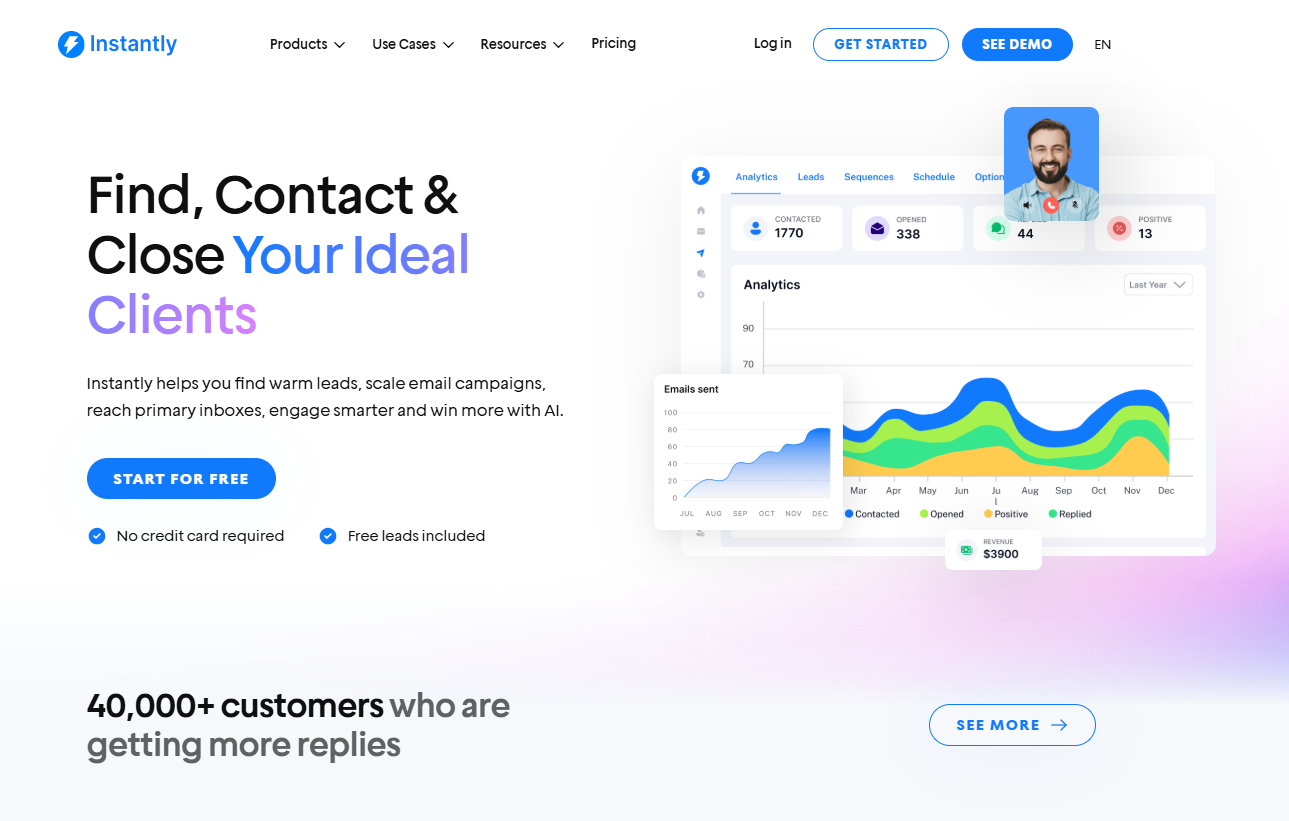
The good news is that this technology isn’t limited to companies with deep pockets. You get all these and more with Instantly.
Privacy and Data Protection Laws Help Email Marketing
Nobody likes spam. Unfortunately, most cold emails fall into that category. Data privacy and protection laws help weed out bad actors and reward agencies and businesses that provide value to their leads.
So, the best thing you can do in this time of stricter inbox laws is to stay compliant, keep lists clean, and maintain a focused prospecting process. Remember to segment and personalize to ensure you’re offering value with every email, or else, you’ll start seeing sender reputation drop.
Segmentation and Personalization are Here to Stay
Segmentation and personalization are fundamentals in email marketing. A MailChimp study found that, on average, segmented campaigns generate 14% higher open rates and 100% higher click-through rates than non-segmented ones.
At the same time, a McKinsey report suggests that 71% of consumers expect personalized communication, and 76% get frustrated when they don’t receive it. With that said, here are quick tips to help you get started with both:
- Start with two segment dimensions: who they are (role/industry) and why they care right now (intent triggers like hiring, funding, or tech changes).
- Segment by behavior (opens, clicks, replies, site visits, purchases) instead of relying only on firmographics.
- Personalize the reason for reaching out (pain point, proof, and CTA) rather than just the greeting.
- Use strict guardrails and fallbacks so personalization never depends on missing or uncertain data.
- Treat each segment as its own mini-campaign by testing one variable at a time and tracking results for each segment.
Optimizing for Mobile is a Necessity
As mentioned, over half of all emails are now opened on mobile devices. In other words, mobile optimization is non-negotiable for forward-looking marketers.
In practice, you need to adopt a responsive design to ensure your emails display well on any screen size. How?
- Use tap-friendly calls-to-action buttons
- Keep your email copy as concise as possible
- Shorten your subject lines and preheaders for full mobile display
- Make your content scannable with short, well-spaced paragraphs
- Use lightweight images and ensure they scale properly on mobile screens
- Regularly test your emails on different devices and ESPs to ensure compatibility
Newsletters Are Becoming a Sales Channel
Newsletters are shifting from “nice-to-have nurture” into a real extension of sales because they build familiarity and trust before a rep ever asks for a meeting.
The goal is to deliver consistent value to specific segments. In practice, that looks like using newsletters to:
- Educate by segment (different insights for different roles or industries)
- Pre-handle objections (answer the questions buyers always ask before they reply)
- Show proof without pitching (mini case studies, lessons learned, teardown-style wins)
- Create “reasons to reach out” (timely insights that sales can reference naturally)
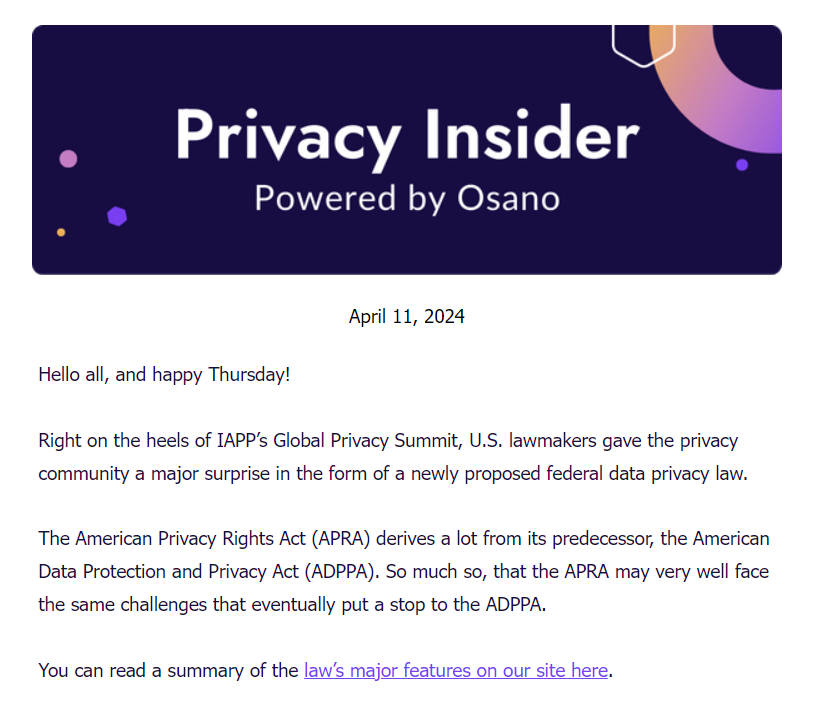
When newsletters are segmented and intentional, you become the brand that’s been useful for the last few weeks. Here’s an example from Osano providing insights into the data privacy space:
BIMI is Steadily Gaining Traction
BIMI (Brand Indicators for Message Identification) is a new standard that allows verified brands to display their logo next to their email in subscribers' inboxes. This visual cue helps recipients recognize and trust the sender, potentially increasing open rates.
As more ESPs support BIMI, marketers are starting to take note and implement it for two reasons:
- Higher Brand Recognition & Trust: Seeing a familiar logo builds trust and helps subscribers identify your brand's legitimate emails. It also reduces the risk of phishing attempts.
- Better Inbox Placement: It’s unconfirmed, but some ESPs may start prioritizing emails with verified BIMI logos, potentially improving deliverability.
There are a couple of steps involved in implementing BIMI. But it's best to start by setting up your SPIF, DKIM, and DMARC protocols (if you haven’t already). For brands serious about their email presence, implementing BIMI is becoming a must.
Spintax is the Industry Secret to Deliverability
One of the most overlooked factors of poor deliverability is the lack of Spin Syntax (spintax). Many marketers rely on templates and custom variables to personalize emails.
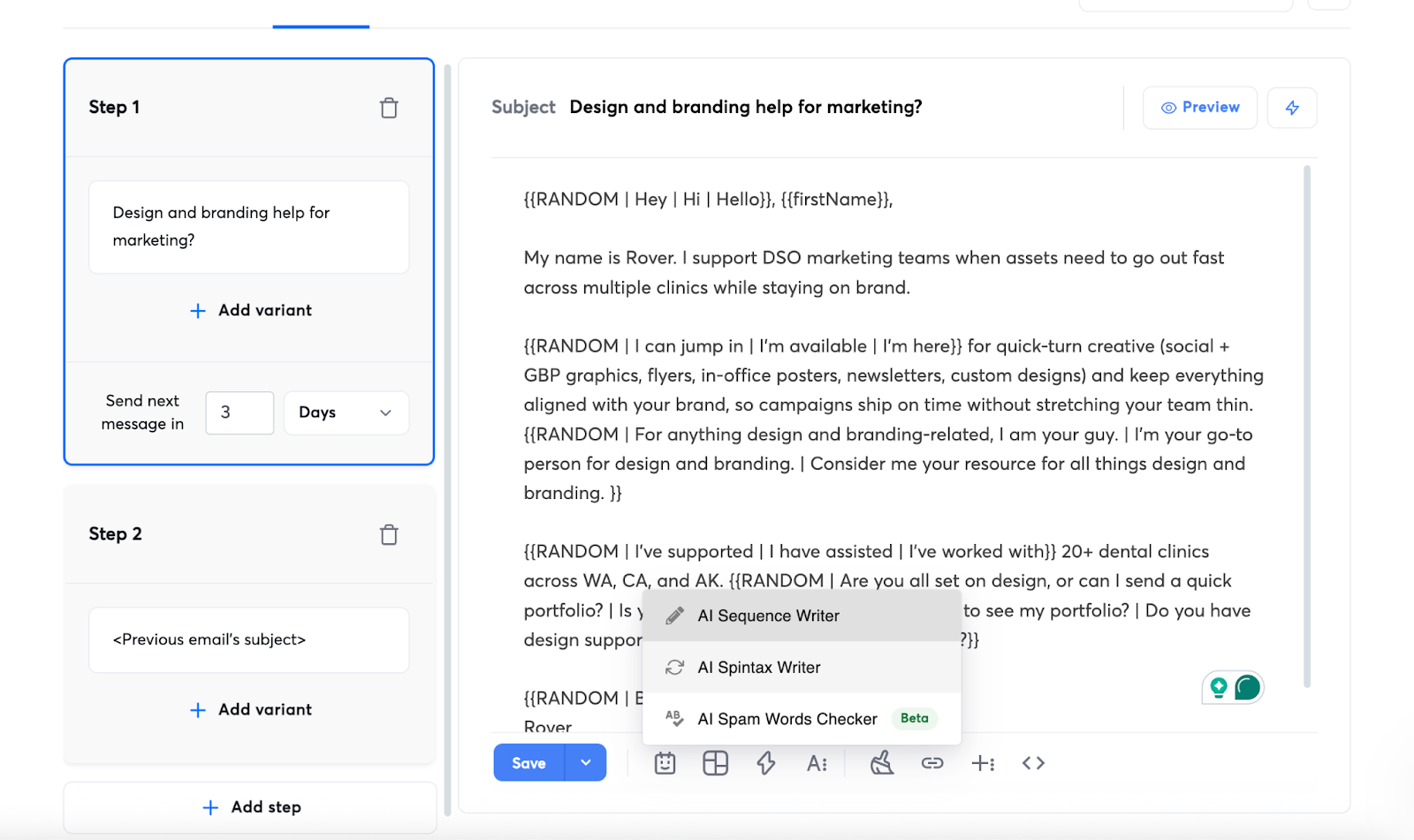
The issue is that even with custom variables, much of the copy still remains the same. ESPs can see this as a red flag. Spintax generates variations of your email copy while preserving the core message, ensuring every email is as unique as possible.
Instantly lets you add Spintax with a single click. After creating your email copy, just click on the AI Spintax Writer button on the bottom right.
Email Marketing Predictions for 2026
With how accessible email marketing is for businesses, it won’t be a surprise that you’ll get even more competition in the inboxes. That’s why you have to focus on improving deliverability, lead selection, and the value of every email you send. Based on 2026 email marketing trends, focusing on the following will help you achieve all three.
- Agentic AI is still in its infancy. But early adopters are already rewarded with scalability.
- Segmentation helps you create multiple campaigns, each one with its own value props.
- Privacy and data laws are a positive for email marketing, as long as you provide value.
- Newsletters aren’t just for nurturing. They should be an extension of your sales efforts.
- Optimizing for mobile is a non-negotiable.
Instantly is designed to help you seamlessly adapt to the latest trends. Don't just keep up with the future of email marketing—lead it with Instantly. Sign up for a free Instantly trial today.


