


Updated December 19, 2025
TL;DR: You sent 10,000 emails and got 50 replies. How many turned into revenue? If you can't answer that in 5 seconds, your reporting is broken. The 4-step system: 1. Centralize the input with a unified inbox. 2. Define clear pipeline stages with entry criteria. 3. Track money metrics like reply rate and meeting hold rate. 4. Run the weekly optimization loop to fix bottlenecks. Instantly's integrated CRM gives you a single source of truth for the entire lead-to-close lifecycle without per-seat fees or tool sprawl.
You sent 10,000 cold emails last month. You got 50 replies. How many turned into booked meetings? How many meetings actually happened? How many became opportunities? How much pipeline did that campaign generate?
If you're toggling between three different tools and spending Sunday night merging spreadsheets to answer those questions, your reporting system is costing you deals.
Context-switching kills productivity and creates data gaps that hide which campaigns work, which reps need coaching, and which leads are slipping away. Sales representatives can spend 5 to 10 hours per week switching between disconnected apps.
Effective CRM reporting isn't about pretty charts. It's about decision velocity. A streamlined 4-step system connects your outreach directly to revenue, identifies bottlenecks instantly, and scales your inside sales pipeline without hiring a data analyst.
What is a CRM and how does it help B2B sales & marketing?
A Customer Relationship Management (CRM) system is a technology for managing all of a company's relationships and interactions with potential and existing customers. In practice, it's a centralized database that logs every email, call, meeting, and deal stage so your team operates from the same facts.
B2B CRM systems are tailored for longer sales cycles and the management of multiple stakeholders within a single account. Sales CRM specifically focuses on pipeline tracking, activity logging, forecasting, and reporting.
Most revenue leaks happen in the handoff between marketing and sales. Marketing generates leads through campaigns and content. Sales works those leads into deals. Without a CRM, that handoff happens in email threads, Slack messages, or not at all. Poor tracking and delayed follow-up cause deals to slip through the cracks.
A CRM automates the Marketing Qualified Lead (MQL) to Sales Qualified Lead (SQL) workflow by assigning leads to reps based on score thresholds and tracking response times with Service Level Agreement (SLA) monitoring.
For outbound teams, your cold email platform should feed directly into your CRM so every reply and stage movement is tracked in one place. When your sending tool and CRM are separate, you're manually exporting data and missing conversion points.
The 4-step CRM reporting system
Most CRM advice assumes you have a RevOps team and a six-figure Salesforce contract. This system is for operators who need to see what's working today so they can fix it tomorrow.
Step 1: Centralize the input
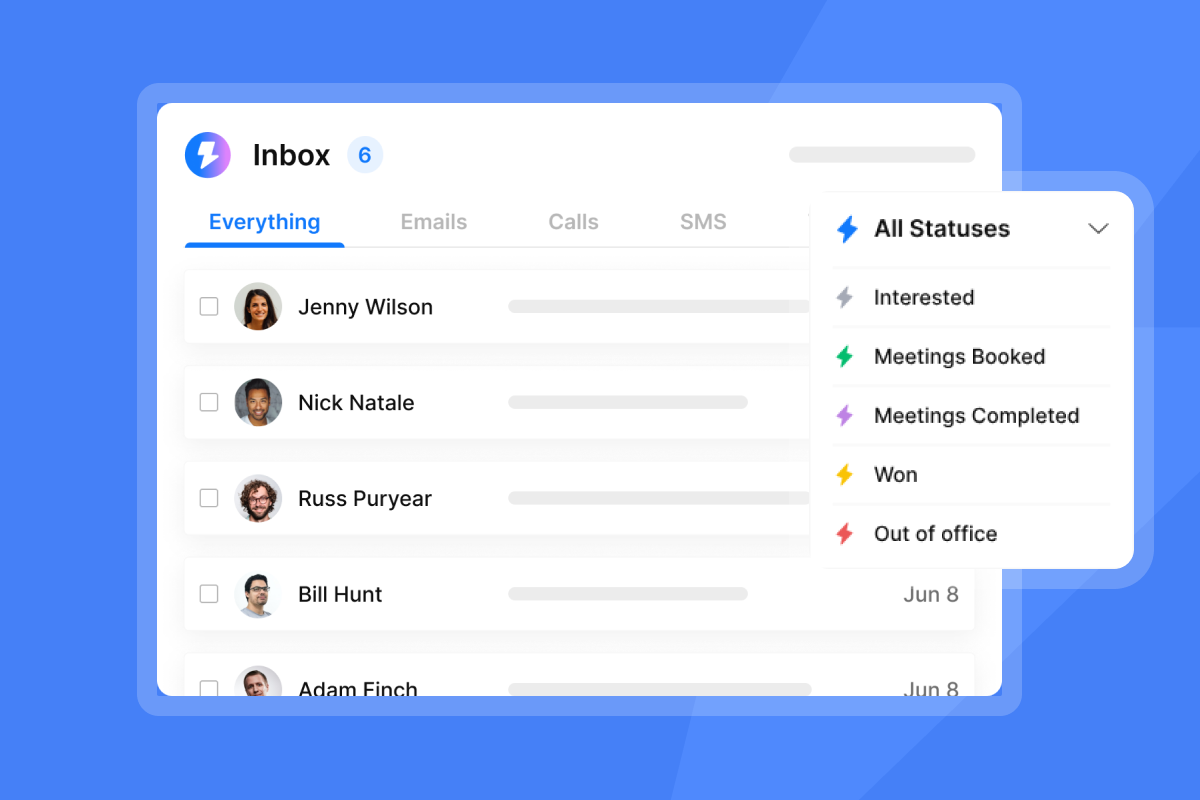
Stop switching tabs. Every customer interaction, every reply from an outreach campaign, and every inbound inquiry should land in a single unified inbox.
If your email sending tool lives in one platform and your deal tracking lives in another, you're creating sync errors and data gaps. The typical agency operator is managing 10 to 150 sending inboxes across multiple client domains. Manually copying replies into a CRM or a spreadsheet is a recipe for lost leads and burned domains.
"The platform is super intuitive, easy to set up, and makes it simple to manage multiple domains and inboxes at scale. Deliverability is great and the analytics give us exactly what we need to optimize campaigns quickly." - Verified user review of Instantly
What to do now:
- Connect your email sending accounts to your CRM or use a platform with a native unified inbox
- Tag every reply with an initial status: Interested, Not Interested, Meeting Booked, Out of Office, or Question
- Set up filters so high-intent replies surface first
By consolidating the input, you eliminate the first source of friction. No more toggling. No more missed replies. No more wondering if someone followed up.
Step 2: Define clear pipeline stages
A bloated pipeline with 12 stages and vague names like "Nurturing" or "Considering" is a reporting nightmare. A streamlined B2B sales pipeline has 4 to 6 stages with clear entry and exit criteria.
Here's a typical inside sales pipeline:
- Interested: Lead replied positively to outreach.
- Meeting Booked: Calendar invite accepted.
- Meeting Held: Discovery call happened.
- Proposal Sent: Pricing or proposal delivered.
- Closed-Won / Closed-Lost: Deal outcome recorded.
Each stage must have a definition. A lead moves to Meeting Booked only after a calendar invite is accepted, not after you send a Calendly link. A lead moves to Proposal Sent only after the document is in their inbox.
Without these definitions, your pipeline becomes a dumping ground. Reps push deals forward to look busy. Deals sit in "Proposal Sent" for 90 days with no activity. Your forecast is fiction.
"I have been using Instantly for the past 6 months now. I have explored the warm-up feature first, and started email campaigns, created the sequence, and I felt that Instantly tool is easy to navigate and understandable. Instantly also provides dashboard to see the analytics." - Verified user review of Instantly
What to do now:
- Write a one-sentence definition for each stage in your pipeline
- Audit your current deals and move anything stale to Closed-Lost
- Train your team on the entry criteria so reporting stays consistent
Clean stages are the foundation of accurate forecasting and effective coaching. Instantly's CRM opportunities dashboard provides a kanban view so you can see where deals are stuck at a glance.
Step 3: Track the money metrics
Open rates and click rates won't pay your bills. The money metrics form a chain of conversion points from initial outreach to closed revenue.
Here are the benchmarks and what to track:
| Metric | Target Benchmark | What it Tells You |
|---|---|---|
| Reply Rate | 5-15% | Targeting and copy quality |
| Meeting Booked Rate | 20-40% of positive replies | CTA strength |
| Meeting Held Rate | 70-85% of booked meetings | Qualification accuracy |
| Opportunity-to-Close Rate | 20-30% | Sales skill and product fit |
Industry benchmarks and outbound lead generation analysis confirm these ranges as healthy targets for cold outreach. If your reply rate is below 5%, your targeting or your copy is broken. If meeting held rate is below 70%, your qualification process needs work.
Additional money metrics to monitor weekly:
- Average Deal Size: Essential for revenue forecasting.
- Sales Cycle Length: The median time from Interested to Closed-Won.
- Cost Per Meeting: Total outreach spend divided by meetings booked. Flat-fee pricing models can reduce this by up to 50% compared to per-seat competitors.
The goal is to turn these metrics into a diagnostic tool. A high open rate with a low reply rate means your subject line works but your message doesn't. A high meeting booked rate with a low meeting held rate means your qualification process needs work.
"Instantly.ai has assisted us in creating outbound email systems that reach your ideal buyer's inbox and foster meaningful connections. Also, their customer support is next level, 10/10." - Verified user review of Instantly
Instantly's analytics dashboard tracks sent, opened, replied, and bounced emails in real time. You can drill down by campaign, by sending account, or by individual lead to spot patterns before they become problems. For a step-by-step walkthrough, watch this CRM tutorial for sales and marketing.
Step 4: The optimization loop
Data without action is noise. The optimization loop turns insights into improvements. This is a weekly discipline, not a quarterly project.
The loop works like this:
- Identify the weakest link: Review your money metrics and find the lowest conversion rate in the chain.
- Hypothesize the cause: Is it the copy, the targeting, the offer, or the timing?
- Make one change: A/B test a new subject line, tighten your ICP, or adjust send windows.
- Measure the impact: Run the test for 500 to 1,000 sends and compare the results.
- Scale what works: If the test wins, roll it out. If it loses, kill it and test something else.
For example, if your reply rate is strong at 8% but your meeting booked rate is only 10% of positive replies, the problem is your call-to-action or your response speed. Test a clearer CTA in your first reply or respond within 5 minutes instead of 2 hours.
AI Reply Agents can handle initial responses in under 5 minutes and free up reps to focus on high-intent conversations.
"Simple and well-designed UX, effective support from both humans and AI for small questions. Additionally, the AI is capable of entering campaign configurations and applying fixes, which is a huge time saver!" - Verified user review of Instantly
If your meeting held rate is low, your qualification is weak. You're booking meetings with people who aren't a fit. Tighten your discovery questions in the first email and ask about budget, timeline, and authority before sending the calendar link.
The optimization loop is where good campaigns become great campaigns. Our AI sales forecasting playbook shows that AI implementation can improve sales efficiency by 10-15%, often by automating data analysis and surfacing optimization opportunities faster than manual review.
3 ways a CRM scales your B2B sales without adding headcount
Beyond reporting, a CRM delivers three core benefits that directly impact revenue.
Pipeline management and automated follow-up
A visual pipeline shows every deal, every stage, and every stalled opportunity. For inside sales teams managing 50 to 200 active leads, a Kanban board or a list view filtered by stage is the only way to maintain visibility. Without it, deals die quietly in a forgotten email thread.
Consistent follow-up separates top performers from those who give up too early. A CRM automates the follow-up sequence so no lead is forgotten. If a prospect replies "not now, check back in Q2," the CRM sets a task for January 15. If a meeting doesn't happen, the system triggers a re-engagement sequence.
"Wish I found this platform sooner! It has all the tools needed for cold outbound in one place. Previously, I was running 3 different systems to get a fraction of the results." - Verified user review of Instantly
This persistence is what separates consistent performers from feast-or-famine operators. Automation removes the mental load and ensures every lead gets the touches they need.
Activity tracking for coaching
Sales leaders can't coach what they can't see. A CRM logs every activity so managers can identify patterns. Is one rep booking twice as many meetings with the same lead list? Compare their templates and response speed. Is one campaign outperforming another by 3x? Clone the winning structure.
A CRM with automation and AI can reclaim hours per week, allowing reps to handle more leads without burning out. Sales reps often spend the majority of their time on admin work and data entry instead of actual selling conversations.
Lead scoring and prioritization
Not all replies are equal. A CRM can automatically score leads based on engagement signals like reply sentiment, company size, job title, and previous interactions. High-scoring leads get routed to senior reps immediately. Low-scoring leads enter a nurture sequence.
This scoring improves conversion rates by matching lead quality with rep skill level and ensures your best closers spend time on your best opportunities.
CRM for inside sales teams
Inside sales is a remote sales model where reps connect with prospects through phone, email, and video conferencing instead of in-person meetings. The cost-per-rep is lower because there's no travel budget, but the reliance on technology is total.
For inside sales teams, a CRM is not optional. It's the shared memory of the team. Every call, every email, every objection, and every next step must be logged because there's no hallway conversation to fill in the gaps.
Inside reps often manage 2x to 3x the number of leads as field reps, with shorter sales cycles of 30 to 60 days. Digital-first touchpoints mean every interaction can be automatically logged.
AI tools reduce the manual work. Instantly Copilot can draft campaigns, analyze performance, and summarize lead research in seconds. The AI Reply Agent can handle common objections and questions automatically, freeing reps to focus on high-intent conversations.
"I really appreciate how Instantly simplifies both lead generation and cold email outreach. The platform offers an email outreach tool and mobile email capabilities that are extremely efficient, significantly reducing the time required to reach out to potential clients." - Verified user review of Instantly
The result is a higher volume of managed leads per rep and a faster time to first meeting. This AI Copilot demonstration shows how AI can handle research, campaign creation, and reply management at scale.
Top CRM platforms for B2B sales & marketing
The CRM market offers options for every budget and use case. For agencies and inside sales teams focused on outbound, the pricing model and email integration are the two critical factors.
| Platform | Starting Price | Best For | Key Strength |
|---|---|---|---|
| Instantly | $197/month | Agencies, outbound teams scaling across many accounts | Native email sending + CRM + 450M+ lead database, flat-fee pricing |
| HubSpot | Free tier, paid from ~$450/month | Inbound + outbound teams with marketing automation needs | Marketing automation + CRM suite, but expensive at scale |
| Salesforce | ~$25/user/month | Large enterprises needing deep customization | Deep customization and ecosystem, but complex setup and high total cost |
| Pipedrive | ~$14/user/month | Small sales teams wanting simple pipeline views | Simple pipeline management, but limited marketing automation |
Prices are approximate as of December 2025. Verify on vendor sites.
For a 5-person agency managing 20 client accounts, the cost difference is stark. Instantly's flat-fee model costs $2,364 per year. HubSpot Professional for 5 users costs $5,400 per year. Salesforce Professional costs $4,800 per year. That's more than double Instantly's cost, and per-seat pricing scales linearly with every additional user.
Economic analysis of flat-fee versus per-seat pricing models shows how unlimited-user structures eliminate the per-seat tax that punishes growth. When you add a sixth team member or a tenth client, your software cost stays the same.
"Instantly.ai is honestly one of the best outreach tools I've used. Setup is quick, the interface is super clean, and it just works. Emails send smoothly, deliverability stays high, and the analytics make it easy to tweak campaigns." - Verified user review of Instantly
Enterprise CRMs offer advanced territory management and commission tracking. But for most inside sales teams, those features are unused complexity. For a full platform walkthrough, watch this complete Instantly tutorial.
Build your reporting system and prove ROI fast
You don't need a RevOps team or a six-figure Salesforce contract to prove ROI. You need clean data, consistent stage definitions, and a platform that eliminates tool sprawl. When your outreach tool and your CRM are one system, attribution is accurate and you can see what's working in real time.
Instantly combines unlimited email accounts, a 450M+ lead database, built-in warmup, and a native CRM on flat-fee pricing, so you scale clients and campaigns without compounding software costs. Try Instantly free and use the 4-step framework to connect your outreach directly to pipeline and prove ROI in the first 30 days.
Frequently asked questions
What is the best CRM for B2B sales?
For agencies and outbound teams, Instantly's flat-fee pricing and integrated email outreach eliminate tool sprawl. For inbound-focused teams, HubSpot offers a comprehensive marketing suite.
How does a CRM help inside sales?
A CRM centralizes all remote interactions, automates follow-up sequences, and gives managers visibility into pipeline health and rep performance. Inside sales teams tracking B2B cold calling metrics rely on digital records because there's no face-to-face context.
Which CRM is best for marketing and sales alignment?
A CRM that automates the MQL-to-SQL handoff, provides shared lead visibility, and tracks SLA compliance. Instantly's unified inbox and opportunities dashboard create a single source of truth.
How much does CRM software cost for a small sales team?
Traditional per-seat CRMs charge $15 to $80 per user per month. A 5-person team pays $900 to $4,800 per year. Flat-fee platforms like Instantly start at $197 per month with unlimited users, which is $2,364 per year total.
Can AI replace manual CRM data entry?
AI can automate most data entry by logging emails and updating lead status in real time. AI Reply Agents can handle initial responses and save reps 1 to 2 hours per day.
Key terms glossary
CRM: A technology for managing all relationships and interactions with prospects and customers, providing a centralized database for sales activities and customer data.
B2B CRM: A CRM tailored for business-to-business sales, designed to handle longer sales cycles and multiple stakeholders.
Sales CRM: A CRM focused on pipeline tracking, activity logging, forecasting, and reporting to help sales reps close deals.
Inside Sales: A remote sales model where reps engage prospects through phone, email, and video instead of in-person meetings.
Pipeline Management: The process of tracking deals through defined stages from first contact to closed-won with clear visibility into bottlenecks.
Lead Nurturing: Automated or manual follow-up sequences that keep prospects engaged over time until they're ready to buy.
MQL (Marketing Qualified Lead): A lead that has reached a score threshold based on engagement and demographics.
SQL (Sales Qualified Lead): A lead that a sales rep has reviewed and accepted as a good fit for a sales conversation.
Reply Rate: The percentage of sent emails that receive a response, a key indicator of targeting and message quality.
Meeting Held Rate: The percentage of booked meetings that actually happen, a measure of qualification accuracy.
Sender Reputation: The trust score assigned to your email domain by mailbox providers, directly impacting inbox placement.
Unified Inbox: A centralized location where all replies from multiple email accounts and campaigns are aggregated.
Flat-Fee Pricing: A pricing model with a fixed monthly cost regardless of users or accounts, eliminating per-seat penalties.
Cost Per Meeting: Total outreach spend divided by meetings booked, a critical metric for ROI and efficiency.
Deliverability: The ability of emails to reach the primary inbox instead of spam, influenced by warmup and list hygiene.


