


Updated March 30, 2026
TL;DR: High reply rates come from specific structural patterns combined with rigorous technical deliverability, not luck or copy alone. Sequences with4-7 emailsachieve reply rates 3x higher than single-email campaigns. Top performers use value-first approaches, breakup emails that see 33% response rates, and objection handling to move prospects from cold to booked meetings. Instantly lets you automate these patterns across unlimited inboxes while protecting deliverability through built-in warmup, Spintax variations, and inbox rotation.
Most sales teams obsess over the subject line of the first email but ignore the architecture of the follow-up. You lose meetings there, not in the subject line.
B2B inboxes are flooded with AI-generated noise and templated messages in 2026. Decision-makers receive 10+ cold emails weekly, and only 5% feel personal or crafted. Prospects delete the other 95%.
I have worked with hundreds of sales teams to diagnose why their sequences fail and how to fix them. The answer is never just better copy. You need strategic structure, psychological triggers, and technical execution that lands your message in the primary inbox at the right time.
This guide breaks down 7 sequence strategies we use to book meetings consistently. Each strategy includes the concept, the psychology behind it, a template framework, and metrics that prove it works.
Why most email sequences fail to convert
An email sequence is a series of automated emails you send to leads, prospects, or customers on a set schedule. You trigger these messages by specific actions or schedule them at predetermined intervals, creating personalized and timely interactions with your audience.
Despite the promise of automation, most B2B cold email sequences fail for two reasons: content problems and technical problems.
Content failures
The biggest content mistake is self-centered copy. Your first email might be solid, but follow-ups that say "just checking in" or "bumping this to the top of your inbox" provide zero value.
Prospects ignore these messages because they show zero effort. Buyers can tell when you mail-merge a template to thousands. Prospects mentally filter out generic messages that could apply to any company before they even read them.
Technical failures
Even the best copy fails if it lands in spam. Poor domain reputation and wrong email authentication (missing or incorrect SPF, DKIM, and DMARC settings) make your emails look suspicious to inbox providers.
Over-automation compounds the problem. Sending 10,000 emails at once from a new address screams "spam" to inbox algorithms.
Five common deliverability mistakes:
- Relying on open rates as a health metric
- Skipping domain aging before campaigns
- Missing unsubscribe links
- Spiking send volume suddenly
- Mishandling catch-all email addresses
Watch our cold email strategy video for a full breakdown of what kills campaigns before they start.
7 email sequence strategies that book meetings
Each strategy below addresses a specific psychological trigger and solves a different problem in the buyer journey. Use these as modular building blocks. You can run Strategy 1 for one segment and Strategy 3 for another.
1. The value-first sequence
The concept: Provide valuable resources, insights, or help before asking for anything in return.
Why it works: When you give prospects something valuable first, they feel an innate desire to reciprocate. Recipients engage with your content and eventually reciprocate with their time or business because you led with value.
Template framework:
- Day 0: Share a relevant case study or industry insight. "I noticed {{companyName}} recently expanded into {{region}}. We published a guide on the 3 compliance traps companies hit when scaling into that market."
- Day 3: Offer a free resource (guide, calculator, tool). No ask, just delivery.
- Day 7: Provide additional tactical advice tied to a trend in their industry.
- Day 14: Soft CTA. "If any of this resonates, happy to walk through how we helped {{similarCompany}} avoid a 6-month delay."
Metrics that matter: Value-first sequences typically see 5-10% reply rates, with higher positive sentiment in replies compared to direct-ask sequences.
"I have worked with many tools, Instantly AI is truly beyond all others. The quality of the product and its efficiency are good, it helped me schedule more meetings from interested leads." - Levent Y. on g2
2. The objection handling sequence
The concept: Anticipate and address common objections prospects have before they voice them.
Why it works: Addressing concerns proactively builds credibility and removes friction from the decision process. You show that you understand their world and have already thought through their hesitations.
Template framework:
- Day 0: Standard intro with clear value prop.
- Day 3: Address objection 1. "Most teams worry about onboarding time. Our clients are live in 48 hours, not 4 weeks."
- Day 6: Address objection 2. "Budget is tight in Q1 for everyone. This is why we structure pricing around outcomes, not seats."
- Day 10: Social proof from a similar company.
Metrics that matter: By handling objections early, you filter for genuinely interested prospects. Optimizing for positive replies has 33% higher correlation with booked meetings than total response rate.
Learn more about campaign options and sequencing in our help center.
3. The breakup sequence
The concept: A final email acknowledging non-response and creating urgency by signaling the end of outreach.
Why it works: Loss aversion. HubSpot sees a 33% response rate to their breakup emails because they trigger loss aversion. Prospects realize they are about to lose access, so they respond.
Whilethe first follow-up may outperformother emails in absolute reply volume, breakup emails generate strong responses from previously unengaged prospects.
Template framework:
- Days 0-7: Standard sequence with value and case studies (3 emails).
- Day 14 (the breakup):
- Subject: "{{companyName}} - Closing your file"
- Body: "I haven't heard back from you regarding {{solution}}, so I am assuming you are trying a different approach or have changed priorities. If we can be of assistance now or in the future, feel free to reach out."
Keep it short, gracious, and final. No pressure.
Metrics that matter: Breakup emails often generate 10-33% response rates. Ryan Mckenzie reports a 10-15% response rate from cold prospects using this technique, and some become customers.
"I tried cold outreach emailing for my marketing business with no luck. The first week of sending out my campaigns, I got replies... I book calls every week, which Instantly gets me in the inboxes of my potential clients." - Ronika Kashyap on Trustpilot
Watch this tutorial on setting up your first campaign to implement these strategies.
4. The referral sequence
The concept: Ask for introductions to the right decision-maker when you have reached the wrong person.
Why it works: Social proof influences behavior. When you ask for a referral, you are implicitly asking the recipient to vouch for you, which lowers the barrier for the next person. You are not asking for a meeting, just a name.
Template framework:
- Day 0: Standard intro. "Hi {{firstName}}, I am reaching out because {{reason}}."
- Day 3 (if no response): "Hi {{firstName}}, I realize you might not be the right person for this. Could you point me to whoever handles {{responsibility}} at {{companyName}}?"
This approach is humble, respectful, and often gets a reply even if the person cannot help you directly.
Metrics that matter: Referral requests are low-friction because you ask for information, not commitment. This reduces psychological barriers to response.
5. The multi-channel touchpoint sequence
The concept: Combine email with other touchpoints (LinkedIn, phone) to increase visibility and engagement.
Why it works: Multiple exposures increase familiarity. When someone sees your name on LinkedIn, then in their email, then again in a follow-up, you move from "random stranger" to "someone I have heard of."
Template framework:
- Day 0: Send connection request on LinkedIn with a short note.
- Day 1: Email 1 referencing the LinkedIn request. "Hi {{firstName}}, I just sent you a connection request on LinkedIn. I wanted to reach out directly because {{reason}}."
- Day 4: Email 2 with value or insight.
- Day 8: LinkedIn message with a different angle.
- Day 12: Email 3 (breakup or final ask).
Metrics that matter: Multi-touch campaigns increase engagement because prospects see your name across channels. However, Instantly is primarily email-focused. For true multi-channel, you will need to coordinate LinkedIn actions manually or use supplementary tools.
Check out this cold email strategy breakdown for more ways to coordinate touchpoints.
6. The low-friction "quick question" sequence
The concept: Ask easy-to-answer questions or make simple requests to lower barriers to response.
Why it works: People align their actions with their commitments to maintain internal consistency. Each small "yes" makes the next "yes" more likely through cognitive consistency.
Template framework:
- Day 0: "Hi {{firstName}}, quick question. Is {{painPoint}} a priority for your team right now?" (Easier to answer than "Can we schedule a 30-minute demo?")
- Day 3: Share insight regardless of response. "Even if it is not a priority now, here is how {{similarCompany}} approached it."
- Day 7: "Would it make sense to explore this in Q2 instead?"
You are not asking for a meeting. You are asking for a signal. Low friction.
Metrics that matter: Interest-based CTAs achieve up to 30%, because you get responses even from prospects who say "not right now."
"Love how Instantly can warm up email domains, taking away all that manual work. Its also super easy to set up campaigns and integrates with Clay so I can just push my contacts from directly from Clay to instantly." - Holly B. on G2
7. The re-engagement sequence
The concept: Reach back out to prospects who went cold after initial interest.
Why it works: Prospects who showed interest but did not convert are easier to re-engage than brand-new leads because they already know you. You are closing an open loop rather than starting from scratch.
Template framework:
- 30-60 days after last contact: "Hi {{firstName}}, I know we talked about {{topic}} a few months ago. Any change in priorities since then?"
- Day 4: Share a new development. "We just launched {{feature}} that might be relevant based on our last conversation."
- Day 8: Final check. "Should I circle back in Q3, or is this off the table for now?"
Metrics that matter: Re-engagement sequences convert prospects at higher rates because they already expressed interest once. The recipient recognizes your name, reducing friction compared to cold outreach.
For a detailed walkthrough, see our video on the best follow-up strategy.
How to automate these sequences in Instantly
Instantly makes it easy to build, test, and scale these strategies across unlimited sending accounts without manual work or deliverability risk.
Step 1: Set up your campaign and import leads
Navigate to Campaigns and click Add Campaign. Upload your lead list via CSV or pull contacts from SuperSearch, our lead database with 450M+ verified contacts.
Map CSV columns to Instantly fields like {{firstName}}, {{email}}, and {{companyName}} for personalization. Watch this campaign setup tutorial for step-by-step guidance.
Step 2: Use the AI Sequence Writer to draft variations (Spintax)
Spintax creates unique email variations to improve deliverability by avoiding spam filters that detect templated content. Our AI Spintax Writer generates multiple versions of sentences or words, so each lead receives a slightly different version of your email.
Example syntax:
{{RANDOM |Hi | Hello | Hey}} {{firstName}},

I'd love to {{RANDOM |learn | hear | find out}} more about how you {{RANDOM|handle | manage | deal with}} sales at {{companyName}}.
Why it works: If you send 10,000 emails monthly with the same subject line and copy, email providers flag your email as spammy. By generating different versions, Spintax helps prevent your messages from being flagged as spam.
Learn more in our help doc on how to use Spintax.
Step 3: Schedule send windows and gaps
Set delays between steps in business days. Research shows the first follow-up should land 2-3 days after the initial email, when your message is still fresh but not forgotten.
Recommended timing:
Step | Days After Previous Email | Cumulative Days |
|---|---|---|
Email 1 | Day 0 | 0 |
Email 2 | 2-3 days | 2-3 |
Email 3 | 4-6 days | 6-9 |
Email 4 (Breakup) | 5-7 days | 11-16 |
Configure send windows in Campaign Options to control when emails go out (for example, 8:30-10:30 a.m. local time).
Step 4: Add inbox rotation to scale the sequence safely
Instantly offers unlimited email sending accounts on all plans. This feature lets you distribute sending volume across multiple inboxes, keeping per-inbox daily volume low to protect reputation.
Safe scaling math: Instead of sending 500 emails from 1 inbox (high spam risk), send 50 emails each from 10 inboxes. Total volume stays the same, but each inbox behaves like a normal human sender.
Cap daily sends per inbox at 30 emails and ramp gradually to protect reputation. Enable warmup for all accounts before launching campaigns.
Warmup sends and receives emails between your accounts and Instantly's network of 4.2M+ accounts to build sender reputation gradually over 30 days.
"Instantly has been a game-changer for our cold email campaigns... the platform makes it incredibly easy to manage multiple email accounts, warm them up properly, and track performance across campaigns." - Natalie on Trustpilot
For a full walkthrough, watch our email warmup setup video.
Measuring sequence success: Metrics that matter
Track these metrics to know when to iterate and when to kill a sequence:
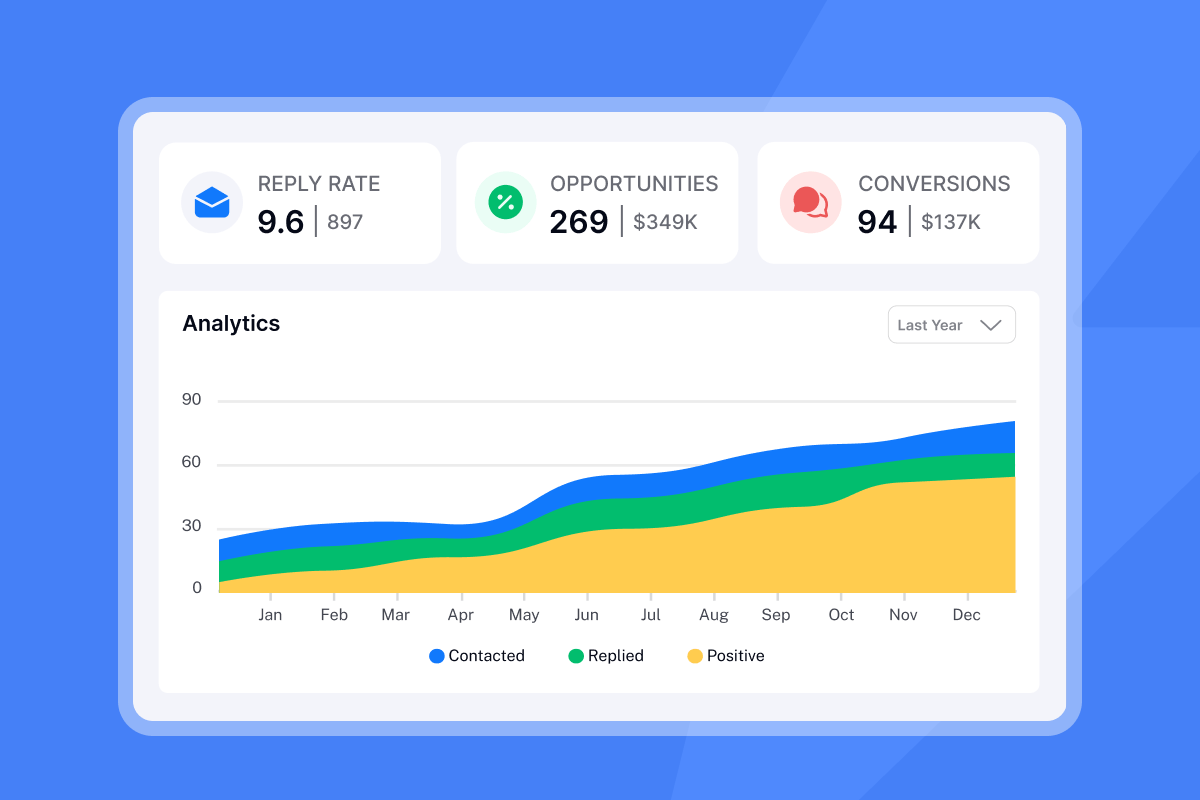
Reply rate: 5-10% is solid across B2B. 10-15% is excellent. 15%+ is top tier. If you are below 5%, fix your targeting, list quality, or copy. If you are above 10%, you are in the top tier.
Bounce rate: Keep bounces under 2% to protect sender reputation. Anything above 5% signals list quality problems that will damage your reputation fast.
Open rate: A 15-25% open rate is acceptable for cold B2B campaigns in 2026. If opens are high but replies are low, the problem is your message or offer, not deliverability.
Positive reply rate: Track the percentage of replies that show genuine interest vs. objections or unsubscribes. If you get 10% replies but only 2% are positive, your targeting or copy is off.
Meeting booked rate: The metric that matters most.If you achieve a 20% open rate, 5% response rate, 30% positive reply ratio, 50% meeting book rate, and 25% meeting-to-close rate, you need approximately 500 delivered emails per client.
Metric | Poor Performance | Good Performance | Excellent Performance |
|---|---|---|---|
Reply rate | Below 5% | 5-10% | 10-15%+ |
Bounce rate | Above 5% | 2-5% | Under 2% |
Open rate | Below 15% | 15-25% | 25%+ |
Positive replies | Below 30% | 30-50% | 50%+ |
When to iterate:
- Open rates above 20% but reply rates low - test copy or offer
- Some positive replies but low volume - refine targeting or list quality
When to kill:
- 5-6 follow-ups over 8-10 weeks with zero response
- High bounce rates (above 5%) plus low opens signal list quality or technical issues
- Spam complaints increasing means immediate stop
Instantly's Campaign Analytics tab shows reply rate per step, open rate per step, click rate, bounce rate, and unsubscribe rate. Use the Unibox for centralized reply management with labels for Interested, Meeting booked, and Not interested.
Check out this Instantly AI review for a deep dive into features, pricing, and deliverability.
Structure is the foundation. Psychology is the engine. Deliverability is the fuel. Without all three, your sequences will fail.
The 7 strategies above have proven results moving prospects from cold to booked.Sequences with 4-7 emails receive 3x more responsesthan campaigns with only 1-3 emails.The first follow-up can boost replies by 49%, while the second adds another 3%.
But even the best strategy fails if it lands in spam.17% of cold emails fail silentlydue to weak authentication, poor list hygiene, and low engagement.
We build warmup, inbox rotation, Spintax, and health monitoring into the platform as the foundation, not add-ons. Try Instantly free and use the ramp template inside the app. Set up your first campaign, connect your accounts, enable warmup, and launch your sequence in under 30 minutes.
For more advanced strategies, watch our breakdown of Alex Hormozi's cold email playbook and learn how to fully automate campaigns with integrations.
FAQs
How many emails should be in a sequence?
For B2B cold outreach, 4-7 emails is the sweet spot. Campaigns with 4-7 emails receive 3x more responses than campaigns with only 1-3 emails.
How many days should I wait between emails?
First follow-up: 2-3 days. Subsequent follow-ups: 4-6 days between each. Run your total sequence for 10-20 days depending on your industry and prospect seniority.
What is a good reply rate for cold email?
5-10% is solid. 10-15% is excellent. 15%+ is top tier. If you are below 5%, focus on targeting and list quality before changing copy.
Should I use Spintax in every email?
Yes. Spintax prevents your emails from being flagged as spam by creating unique variations for each recipient. Use it in subject lines and body copy.
How do I know when to kill a sequence?
If you have sent 5-6 follow-ups over 8-10 weeks with zero response, stop. High bounce rates (above 5%) or spam complaints mean immediate stop needed.
Key terms glossary
Spintax: A format used to create random sentence variations in automated emails to avoid spam filters and improve deliverability.
Deliverability: The ability of an email to land in the inbox vs. spam folder, influenced by sender reputation, authentication, and engagement.
Throughput: The total number of emails sent across all accounts in a given time period.
Primary inbox: The main inbox folder (not Promotions or Spam) where most emails are read and replied to.
Warmup: The process of gradually building sender reputation by sending and receiving emails between your accounts and a network of trusted accounts.
Bounce rate: The percentage of emails that fail to deliver due to invalid addresses or technical issues.
Reply rate: The percentage of sent emails that receive any response, positive or negative.


