.svg)
%20(1).svg)


Updated March 12, 2026
TL;DR: Most subject line advice borrows from B2C marketing playbooks and fails in B2B cold outreach. Teams chasing high open rates are optimizing for a metric that Apple's Mail Privacy Protection inflated by up to 18 percentage points. Relevance beats cleverness. Deliverability beats creativity. The only honest way to find what works for your specific market is structured A/Z testing that measures replies and booked meetings, not opens. We break down five common subject line myths and replace each with what the data actually supports.
If your reps spend hours on subject lines and still produce inconsistent pipeline, the playbook probably came from a B2C newsletter guru, not a B2B outbound operator. Subject lines control two things: whether you clear the spam filter and land in the primary inbox, and whether a busy executive trusts you enough to read the first sentence. We work through the five myths that quietly destroy both.
Myth 1: Shorter subject lines always perform better
The myth: Keep it under three words or no one reads it.
The reality: Length works when it earns its space. The first 33 characters are what matter most, not an arbitrary word count.
When we dig into the data, the "short is better" claim falls apart quickly. According to email client display research, the safe display window across all major devices is just 33 characters. Gmail on iPhone cuts off at 37 characters, Apple Mail at 48, and Outlook mobile at around 50 characters. Design around that constraint, not a three-word rule.
In B2B specifically, longer subject lines outperform shorter ones when the content justifies the length. Research analyzing nearly a billion email messages found that 2 to 4 word subject lines achieve the highest open rates, and performance begins to decline at 7 words, dropping further as lines get truncated and look cluttered on mobile.
The takeaway: Aim for 3 to 7 words. Front-load the key message in the first 33 characters. A clear seven-word line that qualifies the reader beats a vague one-word teaser every time, because it attracts opens from people who will actually reply. The cold email copywriting framework in Instantly's help center walks through the full anatomy of what produces replies.
Myth 2: Including the prospect's first name guarantees more opens
The myth: "Hey {{firstName}}" is the personalization gold standard.
The reality: Name insertion signals automation, not relevance.
Dropping {{firstName}} into a subject line is the oldest merge-field trick in the book, and both spam filters and prospects recognize it. Spam filters pattern-match predictable personalization syntax at scale. Executive buyers who receive hundreds of cold emails weekly treat a first-name subject line as a signal that a mass sequence follows.
The more effective approach is relevance personalization: referencing something specific to the prospect's company context, not their name. Compare these two:
- Name-based: "Hey Sarah, quick question"
- Relevance-based: "Question about Acme Corp's Q3 hiring plan"
The second line demonstrates you read something before sending. It also qualifies the reader. Someone not responsible for hiring will self-select out, which improves your reply-to-open ratio.
"I like how easy Instantly makes scaling outbound reach without sacrificing deliverability or personalization... Instantly makes it easy to tailor messaging at scale using dynamic fields and flexible sequences, allowing me to adjust copy based on persona, account type, or campaign goal while keeping things automated." - Steven M on G2
The Cold Email Copywriting Masterclass: personalization video covers what real personalization looks like in outreach copy versus token substitution.
The takeaway: Personalize on company signal, pain point, or trigger event instead of first name.
Myth 3: Emojis help your email stand out in the inbox
The myth: Visual elements grab attention and increase open rates.
The reality: In B2B cold outreach, emojis reduce credibility and hurt deliverability.
The emoji argument borrows from B2C marketing and fails in B2B. Here is what we found when we looked at the data.
Credibility damage: A professional email smiley face study found that senders who used smiley faces were rated as less competent, and recipients replied with less information than they did to emoji-free emails. When you are selling a $50,000 enterprise contract, a "🔥" in your subject line signals newsletter spam, not peer-to-peer business communication.
Deliverability risk: Emojis are Unicode characters, not standard ASCII. Emoji subject lines trigger spam filters because the behavior is associated with phishing and low-reputation senders trying to bypass text-based filters. Even moderate emoji use can be flagged by conservative spam filters that treat excessive non-ASCII characters as obfuscation.
Professional consensus: B2B emojis should be used sparingly, and for enterprise client outreach, defaulting to emoji-free communication is the lower-risk position.
The takeaway: Write subject lines that look like a colleague wrote them for one person. Plain text, no special characters, no formatting tricks.
Myth 4: Urgency and curiosity gaps drive higher conversion
The myth: "Quick question" or "Urgent matter" gets replies.
The reality: They generate opens and destroy trust simultaneously.
Urgency-based subject lines create a bait-and-switch dynamic. The open rate looks good. The reply rate tells the real story. When a subject line implies urgency or teases information the email body does not immediately deliver, the prospect feels misled. They close the email without replying, and some mark it as spam.
The spam trigger word problem compounds this. Words like "urgent," "act now," and "limited time" are high-severity spam filter triggers because they are the calling cards of mass promotional emails and scams. Per ActiveCampaign's spam word research, your email may never reach the inbox.
Audit these high-risk subject line patterns out of your sequences immediately:
- Urgency pressure: "Act now," "Urgent," "ASAP," "Last chance"
- Generic curiosity: "Quick question," "Important," "Following up"
- Overreach: "Double your revenue," "Guaranteed results," "Free trial"
"The best thing about Instantly is how easy it makes bulk and personalized email communication... after using Instantly, open and reply rates improved noticeably." - Raghav S. on G2
The takeaway: A subject line that honestly previews your email attracts the right people and keeps your domain clean.

Myth 5: High open rates are the ultimate success metric
The myth: If they open it, the subject line worked.
The reality: Open rates are partially fabricated and measure the wrong thing.
Apple's Mail Privacy Protection (MPP) broke open rate as a reliable signal, and we need to stop treating it as a success metric. When MPP is enabled, Apple's proxy servers pre-fetch the tracking pixel when the inbox refreshes, regardless of whether the recipient ever reads the email. The result: open rates jumped 18 points after MPP launched, from 22.6% to 40.5%, with no corresponding change in actual engagement.
Apple runs the largest email client, which means a significant portion of your "opens" are Apple bots, not human eyes. Chasing open rate improvements in this environment means chasing a ghost metric.
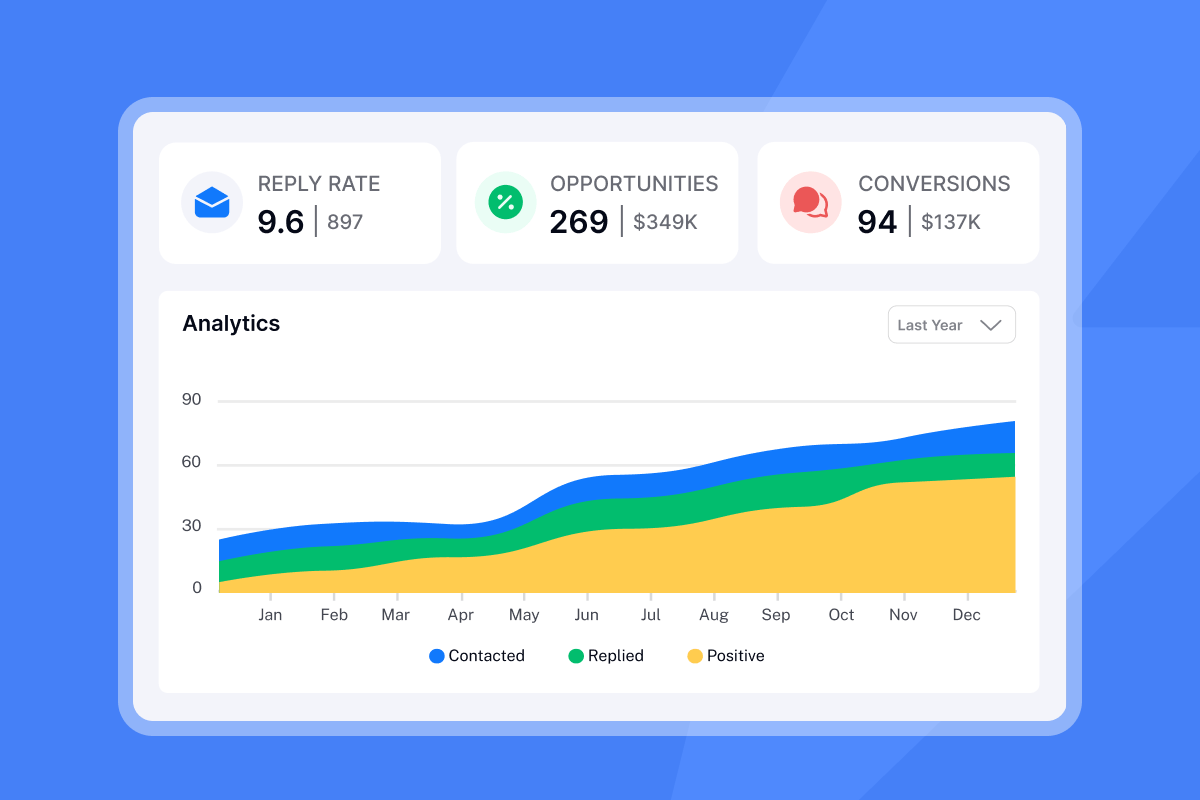
Focus on the metrics that actually matter for pipeline accountability: replies, positive sentiment replies, and meetings set. Instantly's analytics tracks opportunities, pipeline, and conversions alongside open rates, so you can benchmark what moves to SQL instead of what triggered a bot pixel. Instantly's low open rate guide makes this distinction clear: treat open rate as a deliverability health check, not a success KPI.
"Instantly has many good features. I personally like their warm-up system, which has improved the deliverability of my email accounts. The open rate of my campaigns has improved after switching to Instantly." - Verified user on G2
The takeaway: Track reply rate and opportunities created as primary KPIs. Open rate is a deliverability signal, not a conversion signal.
How to test subject lines systematically: the Instantly workflow
You cannot guess your way to a subject line that consistently converts. The only defensible approach is structured testing tied to reply outcomes.
Step 1: Run A/Z tests across angles, not just word tweaks
A/B testing two nearly identical subject lines ("Quick question" vs. "Brief question") gives you no useful signal. Testing genuinely different angles does, such as curiosity vs. specificity vs. social proof vs. pain point framing.
Instantly supports 26 variants per campaign step. Our auto-optimize feature monitors performance across all variants and automatically deactivates underperforming versions based on your defined winning metric. Set that metric to reply rate, not open rate, and the platform optimizes toward actual conversations instead of bot-triggered pixels.
A practical set of angles to test simultaneously:
- Pain-point: "Still manually handling [specific process]?"
- Outcome-focused: "How [Company] cut [metric] by 30%"
- Direct question: "Right person to discuss [topic] at {{CompanyName}}?"
- Trigger event: "Saw {{CompanyName}} just opened a [City] office"
The Instantly A/Z testing guide covers how to structure variants and what to look for before declaring a winner.
Step 2: Run a spam trigger audit before launching
Before any sequence goes live, run every subject line through a spam word check. Instantly's built-in AI Spam Checker (accessible from the campaign preview window) flags problematic language before your domain takes the hit.
The deliverability checklist in Instantly's help center outlines the full pre-launch review, including subject line hygiene alongside SPF, DKIM, and list verification checks. These steps work together: a clean subject line on a warmed domain with a verified list performs categorically better than a "creative" subject line on a cold setup.
"It is so easy to setup cold email campaign, the people at Instantly do a full done-for-you email box setup so you dont have to worry about SPF, DKIM, DMARC all that jazz. And they ensure subdomain tracking and deliverability." - Haris on Trustpilot
Step 3: Analyze by replies and opportunities, not opens
Once you have enough reply data to see a pattern across variants, pull results from the opportunities column in your Instantly analytics dashboard, not the open rate column. Look for the variant that generated the most replies with positive sentiment. That is the signal worth scaling.
"The fact that it is so simple to use and that their support team actually helps you out. Whenever I've had a problem its always solved within 1-2 hours." - Yasen K on G2
For a full walkthrough of how analytics and A/Z testing connect in practice, the Instantly.ai co-founder demo walkthrough is worth 20 minutes of your team's time. The I studied 1,000,000 cold emails video from Instantly pulls patterns from large-scale data on what subject line structures produce replies in 2025.
The difference between B2C marketing tactics and B2B cold outreach becomes obvious when you compare them side by side. Here is what works in each context and why:
B2C approach (bad for cold outreach) | B2B approach (good for cold outreach) | Why |
|---|---|---|
"🔥 50% OFF - Act now!" | "Question about {{CompanyName}}'s Q3 plan" | No emojis, no urgency triggers, relevance over noise |
"Hey John, don't miss this" | "Saw you're hiring 3 AEs at Acme Corp" | Trigger-based relevance beats name-drop |
"URGENT: Limited spots left" | "How [Company] reduced CAC by 28% in 90 days" | Outcome proof over manufactured scarcity |
"Free trial inside" | "Right person for a 10-min call on [topic]?" | "Free" triggers filters; a direct ask respects their time |
For a structured starting point, Instantly's 600 cold email templates library gives your team a base to test from rather than writing from scratch.
"I use Instantly for managing and automating my cold email outreach, which saves me a significant amount of time. I really like how simple, reliable, and powerful the platform is. It allows me to scale my outreach without losing personalization." - Mattia G on G2
The best subject line for your market is not on a guru's list. It comes from testing relevance against your specific buyer, tracking replies instead of opens, and keeping your domain clean in the process. Stop chasing open rate hacks borrowed from B2C newsletters. Start running A/Z tests that measure what actually moves pipeline. The sales leaders who consistently hit plan treat cold email as a system with inputs, constraints, and measurable outcomes, not a creative writing exercise.
Ready to apply a systematic testing process? Try Instantly free and use the A/Z testing and AI Spam Checker inside the campaign builder to audit and replace the subject lines hurting your domain today.
Frequently asked questions about cold email subject lines
What is the ideal length for a cold email subject line?
Aim for 3 to 7 words and keep the key message within the first 33 characters, since that is the display limit across the widest range of mobile devices and email clients. Gmail on iPhone cuts off at 37 characters, while Apple Mail extends to 48.
Do question-based subject lines outperform statements?
Yes. Research shows that question-based subject lines deliver roughly 10 to 21% higher open rates than statements in B2B cold outreach because they create engagement without being deceptive.
How many subject line variants should I test at once?
A common approach is to test 3 to 5 genuinely different angles simultaneously per campaign to collect reply data across each variant quickly. Instantly supports up to 26 variants per campaign step if you want to run broader tests.
Does adding a first name to the subject line increase replies?
Some practitioners report that adding a first name increases open rate slightly but does not meaningfully increase replies in B2B cold outreach, and it can signal automated mass email to both filters and prospects. Company-specific or pain-point-specific personalization produces better reply outcomes.
What open rate should I expect from a healthy B2B cold email campaign?
A 2024 B2B cold email benchmark found an average open rate of 27.7%. Treat anything in that range as a deliverability health signal, not a success metric, since Apple MPP inflates the number for a large share of your list.
Glossary of key terms
Preview text: The snippet visible next to or below the subject line in most inbox views. It functions as a second subject line and should extend the message rather than repeat it or display broken merge-field text.
Spam trigger words: Specific words and phrases that increase the probability of routing to the junk folder by algorithmic filters. Examples include "free," "urgent," "act now," and "guaranteed," all associated with high-volume promotional and scam email patterns.
A/Z testing: Testing more than two variants of an email element simultaneously to find the highest-performing version. In Instantly, A/Z testing supports up to 26 subject line or body copy variants per campaign step, with auto-optimization that deactivates lower-performing variants based on reply rate, open rate, or click rate.
Mail Privacy Protection (MPP): Apple's feature that pre-downloads email tracking pixels via proxy servers when a user's inbox syncs, regardless of whether the email is ever opened by a human. This artificially inflates open rates for any sender targeting Apple Mail users.
Sender reputation: A score assigned to your sending domain and IP by mailbox providers based on engagement signals, spam complaints, bounce rates, and sending behavior. Subject lines that generate spam complaints or trigger bait-and-switch high bounce patterns damage sender reputation over time.



