


Updated March 12, 2026
TL;DR: Modern spam filters use AI to score emails across three dimensions: vocabulary, formatting, and sender reputation. No single word automatically kills deliverability, but cumulative scoring means one bad subject line stacked with ALL CAPS, three exclamation marks, and an unwarmed domain will land straight in spam. The fix isn't memorizing a word list. It's a system: neutral language, clean formatting, technical warmup, and A/Z testing before you scale. The highest-risk categories are financial urgency ("Free," "Cash," "Act Now"), exaggerated claims ("Guaranteed," "#1"), and deceptive prefixes ("Re:," "Fwd:").
According to emailtooltester's 2024 deliverability benchmark, 16.9% of all emails never reach the intended inbox, with 10.5% going directly to spam and 6.4% disappearing entirely. That's roughly one in six emails your team sends, gone before a single prospect reads it.
You don't need to guess which words are safe. You need to understand how filters actually score your copy, then use the right tools to validate before you send at scale.
How modern spam filters analyze subject lines
Spam filters stopped working from static blacklists years ago. Today, Gmail and Outlook run transformer-based AI models that analyze sentence intent, not individual words. The same technology behind large language models reads your subject line the way a human would, detecting pressure tactics, deceptive patterns, and promotional intent even when you swap out the obvious trigger terms.
The filter assigns a cumulative spam score. Think of it as a point system where every signal adds to a total. One trigger word might add one point, an ALL CAPS word adds another, and a $$$ symbol in the subject adds ten more. Cross the threshold and the provider blocks or quarantines the email. Research on probabilistic spam classification confirms this weighted scoring approach: each feature carries a statistical likelihood of being spam, and the system multiplies those probabilities together.
This is why context matters. AI spam filters can differentiate between "Log in to view your monthly statement" and "Log in NOW or lose your account forever" even though both contain similar words. The urgency, tone, and semantic structure expose the intent, and the model acts on that signal.
There are three layers to understand:
- Vocabulary score: Specific words, phrases, and combinations that correlate with phishing or low-quality bulk email.
- Formatting score: ALL CAPS, excessive punctuation, multiple emojis, and special characters that mimic scam patterns.
- Sender reputation score: Your domain age, warmup history, bounce rate, and authentication (SPF, DKIM, DMARC), all of which Google's Postmaster Tools use to weight how your vocabulary and formatting signals get interpreted.
A clean domain with a strong sender reputation gives you more tolerance on the vocabulary layer. A burned domain with no warmup history gets flagged even on neutral subject lines. This is exactly why our email warmup infrastructure covering 4.2M+ accounts matters as much as the words you choose.
The complete list of spam trigger words by category
Use these tables when auditing existing campaigns and building new sequences. The goal isn't to ban every word here, but to avoid combinations that push your cumulative score past the filter threshold. You can also check your subject lines against our AI Blocklist Triggers before sending.
Financial and urgency triggers
Filters have trained on billions of scam emails that promise financial gain and demand immediate action, so combinations of these terms raise scores fast. When the AI sees "Free" paired with urgency language on a new domain, it reads the pattern as fraud, not outreach.
Column A | Column B | Column C |
|---|---|---|
Free | Cash | Bonus |
Credit | Earn | Income |
$$$ | Investment | Profit |
Revenue | Salary | Savings |
Cheap | Affordable | Bargain |
Discount | Lowest price | Best price |
Act Now | Apply Now | Don't Delete |
Exclusive Deal | Final Deadline | Instant |
Urgent | Limited Supply | Once in a Lifetime |
Quick | Order Now | Buy Now |
Limited Time | Offer Expires | Last Chance |
Final Notice | Expires Today | Time Sensitive |
Claim Your | Winner | You've Been Selected |
Double Your | Extra Income | Make Money |
No Cost | Zero Cost | No Fee |
Billion | Million Dollar | Serious Cash |
Big Bucks | Cool Cash | Money Back |
No Credit Check | Refinance | Debt Relief |
Financial Freedom | Passive Income | Get Paid |
Prize | Congratulations | Jackpot |
Rich | Wealth | Fortune |
Pay Off | Eliminate Debt | Consolidate |
Wire Transfer | Bank Transfer | Western Union |
Pre-Approved | You Qualify | Selected For |
Increase Sales | Boost Revenue | Grow Income |
Percent Off | Save Big | Huge Savings |
Special Promotion | Lowest Rate | Compare Rates |
Marketing and exaggerated claims
These words are native to B2C marketing copy, where broadcast-style language is expected. In cold B2B email, they read as promotional blasts rather than genuine outreach, which is exactly the signal spam filters look for. ActiveCampaign's spam word research identifies this as one of the most common sources of filter triggers for sales teams.
Column A | Column B | Column C |
|---|---|---|
Guaranteed | Risk-Free | 100% Satisfied |
Money Back | Promise | Refund Guaranteed |
#1 | Best | Amazing |
Incredible | Miracle | Breakthrough |
Revolutionary | Ultimate | Outstanding |
Exceptional | Phenomenal | Extraordinary |
Unbelievable | Unmatched | Unbeatable |
Exclusive | VIP | Elite |
Certified | Approved | Official |
Award-Winning | Top Rated | Industry-Leading |
World-Class | State-of-the-Art | Best-in-Class |
Number One | Market Leader | Proven Results |
Life-Changing | Mind-Blowing | Eye-Opening |
Jaw-Dropping | Game-Changer | Once in a Lifetime |
Don't Miss | Can't Afford to Miss | Too Good to Pass Up |
Solution | Cure | Fix Everything |
No Obligation | No Questions Asked | No Strings |
Only X Left | Spots Available | Limited Seats |
Click Here | Click Below | Click Now |
Visit Our Website | See Our Site | Check This Out |
As Seen On | Featured In | Endorsed By |
Satisfaction | Performance | Results |
Testimonials | Case Study | Proof |
ROI Guaranteed | Triple Your | 10X Your |
Explode | Skyrocket | Massively |
Overnight | 24 Hours | This Week Only |
48 Hours | Immediately | Time-Limited |
The key distinction: A newsletter from a brand you subscribed to can safely use some of these terms because domain reputation, engagement history, and opt-in consent offset the vocabulary score. In cold outreach, you have none of those buffers.
Manipulative and misleading patterns
This category carries the highest risk because several patterns cross from deliverability problems into legal liability. Using "Re:" when there's no prior thread, or "Fwd:" to imply someone passed your message along, violates CAN-SPAM's prohibition on deceptive subject headings, where each violation carries penalties of up to $53,088.
Column A | Column B | Column C |
|---|---|---|
Re: | Fwd: | FW: |
As Requested | Per Our Conversation | Following Up On |
Did I Leave My | Forgot Something? | You Left This |
Order Confirmation | Shipping Update | Account Alert |
Invoice Attached | Payment Required | Your Receipt |
Urgent Response Needed | Action Required | Immediate Attention |
Important Update | Security Alert | Account Suspended |
Verify Your Account | Confirm Your Email | Reset Required |
Your Application | Your Request | Your Quote |
Personal Message | For Your Eyes Only | Confidential |
Friend Request | Connection Request | Message From |
You Have Voicemail | You Have a Message | New Notification |
Last Warning | Final Notice | This Is Your Last Chance |
Trouble | Problem | Issue With Your Account |
Survey | Feedback Request | We Need Your Input |
Hello Friend | Dear Friend | Hey There |
You're Approved | Pre-Qualification | You May Already |
One Time Only | Never Again | Can't Be Repeated |
Best Kept Secret | They Don't Want You | Insider Information |
Shocking | You Won't Believe | What They're Hiding |
Free Gift | Gift For You | Something For You |
Not Spam | This Is Legitimate | I Promise |
Opt In | No Catch | No Gimmick |
All New | Brand New | Just Launched |
Passwords | Username | Login |
Click to Unsubscribe | Remove Me | Opt Out Here |
Satisfaction Guaranteed | You Won't Be Disappointed | Trust Me |
Critical warning on Re: and Fwd:: These patterns might generate a short-term open rate lift, but deceptive subject lines consistently produce higher manual spam complaint rates. Every manual spam report trains the mail provider's AI model in real time. When enough recipients flag your domain, the provider can block you globally across all accounts sending from that domain, often within hours. Jumpstart Technologies was fined $900,000 specifically for disguising promotional emails as personal messages. The short open rate gain isn't worth the domain burn.
Formatting and punctuation mistakes that look like spam
The words matter, but the formatting layer is equally dangerous. A perfectly neutral subject line loses deliverability points immediately if it's formatted like a scam.
ALL CAPS: Research shows that ALL CAPS formatting increases spam scores because it closely matches phishing patterns. It reads as shouting to both filters and recipients. Never capitalize an entire subject line or even an entire word unless it's an acronym (CEO, ROI, SaaS).
Excessive punctuation: Multiple exclamation marks ("!!!") or repeated question marks ("???") are among the clearest formatting spam signals, especially when combined with trigger vocabulary. One exclamation mark adds scoring points. Three adds several more. Combine them with words like "Free" or "Urgent" and you've crossed the threshold on formatting alone before the vocabulary score even registers.
Emojis in cold B2B outreach: A single emoji used sparingly at the end of a subject line generally won't hurt deliverability, but multiple emojis pattern-match scam and promotional emails. Avoid emojis entirely in cold outreach until your domain has a strong warmup history and you can test their impact through A/Z variants.
Subject line length: The optimal visible length across devices is 33-50 characters, according to emailtooltester's cross-client analysis. Gmail mobile shows ~37 characters, Android shows 33-43, and iPhone Mail shows around 40. Length itself isn't a hard spam trigger, but subject lines over 60 characters get truncated on mobile, which drops engagement rates. Lower engagement over time feeds back into your sender reputation score, creating an indirect deliverability problem.
How to rewrite risky subject lines for cold outreach
The principle here is straightforward: neutral subject lines outperform promotional ones in B2B cold email. Specific and conversational copy doesn't trigger filters, and it reads more like a genuine message from a peer than a mass blast. The cold email copywriting framework that consistently drives replies focuses on curiosity and specificity over hype.
Here are direct rewrites across seven common patterns:
Risky (trigger-heavy) | Safe rewrite |
|---|---|
URGENT: Save 50% on your software costs TODAY!!! | Software costs question |
100% Guaranteed ROI for [Company] 🚀💰 | Idea for [Company] |
ARE YOU AVAILABLE??? Final chance!!! | Quick question |
Re: our meeting (when no prior contact) | Intro: [Your Name] and [Prospect Name] |
The #1 Solution to Transform Your Workflow FREE | Thoughts on [Company]'s workflow |
ACT NOW: Limited Time Offer Expires at Midnight! | Following up on [specific topic] |
You're a Winner! Claim Your Free Trial Today | [Company] and [Your Company] |
The pattern is consistent across all seven: remove the superlatives, the urgency, and the financial promises, then replace them with a plain statement of intent or a specific reference. The subject line's only job is to earn the open, not to sell the product.
Our AI Spam Word Checker runs this audit inside the campaign editor, flagging high-risk terms before you send. It cross-references your subject line against current filter logic, not a static list from years prior. For a sales leader managing multiple reps writing sequences simultaneously, this removes the guesswork and gives you a defensible QA step before any send reaches a live prospect.
"I appreciate Instantly for its intelligent handling of domain and mailbox rotation... which is critical for ensuring that my emails land directly in the primary inbox instead of getting caught in spam filters." - Richard E. on G2
Beyond the subject line: Technical factors that trigger filters
Even a perfectly neutral subject line will route to spam if the technical infrastructure underneath it is broken. Most sales teams get burned here because they audit their copy but skip their setup.
Sender reputation and domain warmup: New domains have no history with email providers, so filters apply maximum scrutiny to every send. Our email warmup process builds that history by gradually increasing send volume, simulating genuine human engagement, and establishing a positive behavioral pattern before any real prospect receives an email. We recommend a minimum of two weeks of warmup, with four weeks preferred for brand-new domains, and keeping warmup running continuously during live campaigns.
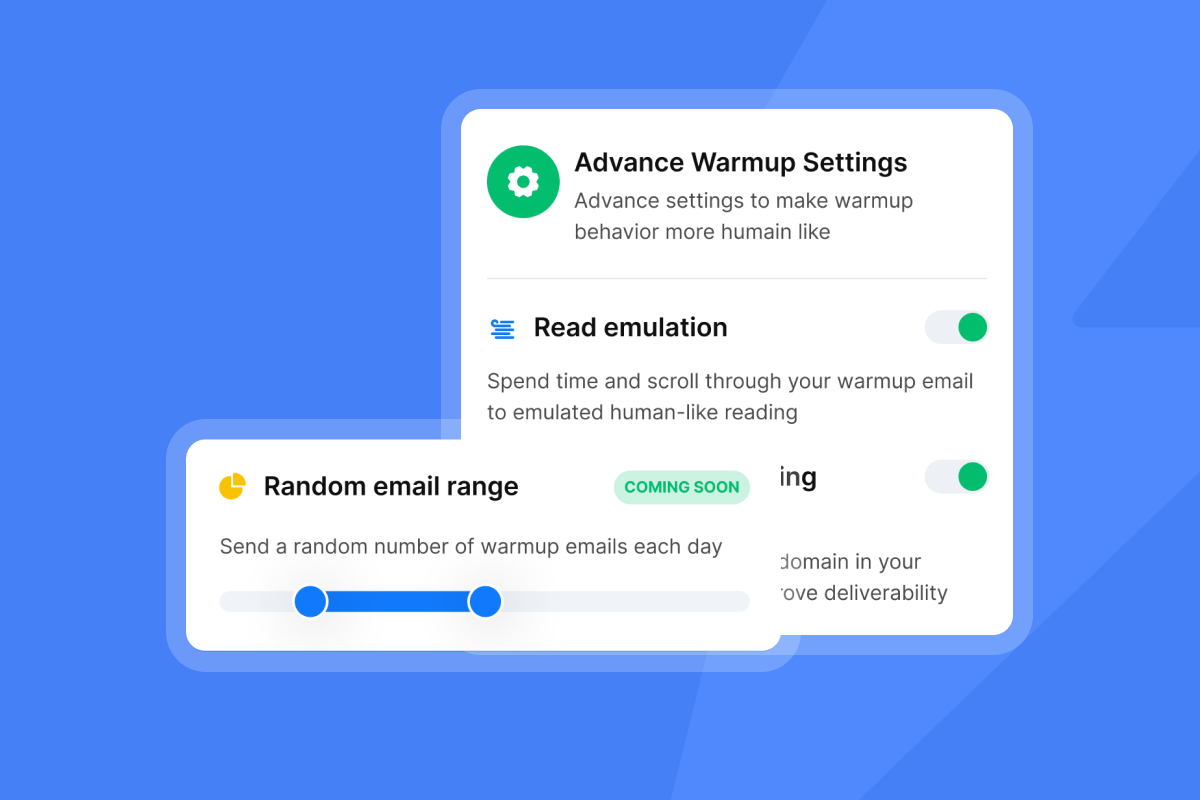
"I especially like the email warm-up tool. This tool automatically mimics human behavior and runs in the background to build a sender reputation for multiple new email accounts, ensuring emails land in the primary inbox rather than spam." - lucky b. on G2
Volume per inbox: Sending high volumes from a single inbox is one of the fastest ways to trigger provider-level filtering because spam filters flag sudden volume spikes. The safe limit is 100 emails daily, and you scale by adding more inboxes and rotating sends across them, not by pushing a single inbox past its threshold.
SPF, DKIM, and DMARC authentication: Cloudflare's email security documentation explains these protocols clearly: SPF tells receiving servers which IP addresses are authorized to send from your domain, DKIM provides a cryptographic signature confirming the message wasn't modified in transit, and DMARC tells the receiving server what to do when either check fails. Domains missing any of these records get quarantined even when the subject line and content are completely clean.
List hygiene and bounce rates: High bounce rates signal to providers that you're using scraped or unverified contacts, which is a primary fraud indicator. Keep hard bounces below 2%, and protect your primary sending domain from bounce damage by routing prospecting volume through secondary sending domains with verified contact lists.
For a practical walkthrough of the full deliverability system, the Ultimate Guide to Cold Email Deliverability from our channel covers warmup, authentication, and send pacing in detail.
How to test subject lines for deliverability
Auditing trigger words and fixing formatting is the starting point, but you still don't know which subject line actually drives opens and replies until you test. A/Z testing (running multiple subject line variants simultaneously across the same campaign) is the standard method, and it's built into Instantly at every plan tier. The complete A/Z testing methodology covers how to structure tests so each variant gets meaningful data.
Here's the process to run before scaling any new campaign:
- Write three subject line variants. One neutral (safest), one moderately direct, and one short curiosity-based (minimal words). Keep one variable per test, whether that's the subject, the preview text, or the opening sentence.
- Load variants into our A/Z testing configuration. We distribute sends evenly across variants and track each independently.
- Send to a small batch first. Use 100-200+ contacts per variant to get directional data without burning your full list.
- Measure open rate and reply rate. Open rate tells you about subject line and deliverability. Reply rate tells you about copy quality. A subject line that inflates opens but doesn't generate replies has a persuasion problem, not a deliverability problem.
- Use Auto-optimize to pause underperformers. Once a clear winner emerges on replies, our AI Copilot surfaces the insight and can pause losing variants automatically.
"I use Instantly for campaign automation and personalization... I like the pipeline analytics and AI-powered CRM because it helps me manage leads and track everything." - Said K. on G2
The Anatomy of a Cold Email masterclass and the 25 strategies deep dive from our channel are both worth reviewing before you design your test variants, particularly for structuring the subject-to-preview text relationship.
Build the system, not just the list
The right approach to cold email subject lines isn't finding the right word swap. It's building a system where vocabulary, formatting, technical reputation, and continuous testing all reinforce each other.
Start with the trigger word audit from this article and clean up high-risk vocabulary or formatting in your active sequences. Then verify your SPF, DKIM, and DMARC records, confirm your sending domains have completed a proper warmup cycle, and cap each inbox at 30 sends per day. Run A/Z tests before any campaign goes to full list volume.
We build the safety layer directly into the workflow with our AI Spam Word Checker, warmup infrastructure, and A/Z testing, which removes the guesswork and gives your team a repeatable QA standard before every send. Our cold email copywriting framework is also worth standardizing across your reps to keep subject lines consistent and filter-safe at team scale.
Don't let a single word ruin a campaign you spent weeks building. Try Instantly free and use the AI Spam Word Checker to audit your subject lines inside the editor before your next send.
FAQs
What words trigger spam filters in email?
Words indicating urgency ("Act Now," "Urgent," "Limited Time"), financial gain ("Free," "Cash," "$$$," "Guaranteed"), and exaggerated claims ("100%," "#1," "Miracle") consistently raise spam scores across Gmail and Outlook filters. The cumulative combination of these words with poor formatting and weak sender reputation is what actually sends email to spam, not any single word in isolation.
Does subject line length affect deliverability?
Indirectly, yes. Subject lines over 50 characters get truncated on most mobile clients, with Gmail mobile showing ~37 characters and Android showing 33-43, which lowers engagement rates over time. Lower engagement feeds back into your sender reputation score, creating a long-term deliverability problem even when individual emails don't trigger filters directly.
Is it illegal to use "Re:" in a cold email subject line?
It isn't strictly illegal under CAN-SPAM if the content is genuinely relevant to a prior topic, but using "Re:" when there's no actual prior thread is deceptive under CAN-SPAM's prohibition on misleading subject headings and carries penalties of up to $53,088 per email. More practically, it generates manual spam complaints that burn your sending domain within days.
How many spam trigger words does it take to get filtered?
There's no fixed number. Filters use cumulative scoring, so one moderate-risk word on a well-warmed domain with clean authentication may score safely, while that same word combined with ALL CAPS, three exclamation marks, and a new domain with no warmup will cross the filter threshold immediately.
What's the safest cold email subject line format for B2B?
Short (under 50 characters), sentence case, specific to the prospect, and free of financial or urgency language. Patterns like "Question about [specific topic]," "Idea for [Company]," and "[Your Name] and [Prospect Name]" consistently outperform promotional formats in cold B2B outreach.
Key terms glossary
Spam trap: An email address operated by ISPs to identify senders who scrape lists or send to unverified contacts. Hitting a spam trap damages sender reputation immediately and can trigger a domain-level block.
SPF (Sender Policy Framework): A DNS record that lists which IP addresses are authorized to send email from your domain. Receiving servers check incoming email against this record before delivering to the inbox.
DKIM (DomainKeys Identified Mail): A cryptographic signature attached to outgoing emails that verifies the message came from an authorized sender and wasn't altered in transit. Missing or misconfigured DKIM increases spam score even on clean content.
DMARC (Domain-based Message Authentication, Reporting, and Conformance): A policy record that tells receiving servers what to do when SPF or DKIM checks fail (quarantine, reject, or deliver). Properly configured DMARC protects your domain from spoofing and prevents spammers from impersonating your sending address.
Bounce rate: The percentage of emails that fail to deliver because the address is invalid or the domain is blocked. Keep hard bounces below 2% to maintain sender reputation and avoid provider-level filtering.
Sender reputation: A score assigned by email providers based on engagement rates, bounce rates, spam complaint rates, and authentication completeness. High sender reputation increases tolerance for borderline vocabulary and formatting signals in the cumulative spam score system.
Cumulative spam score: The total score assigned to an email by a filter, calculated by combining weighted scores from vocabulary, formatting, sending behavior, and domain reputation. No single factor determines filtering outcome, as the total score determines inbox or spam routing.


