


A strong ecommerce email marketing strategy centers on clean, opt-in lists, behavior-based segmentation, personalized messaging, mobile-friendly design, and non-stop testing. Using AI to optimize customer journeys automatically enhances things further.
When you combine relevance, automation, and smart deliverability hygiene, email becomes your highest-ROI channel for converting new leads and turning customers into repeat buyers.
Platforms shift and trends burn out fast in ecommerce, but email still beats every other channel for revenue. Even with social commerce and influencer marketing booming, email remains the highest-ROI engine in your stack.
Email gives you a level of control few channels can match. No pay-to-reach model. No algorithm throttling your visibility. Once you get execution right, email drives sales, deepens loyalty, and grows your store without inflating your spend.
But the playbook never remains static. Blasting the same newsletter to your entire list won’t move the needle anymore. What works now is precision: clean lists, behavior-driven segmentation, mobile-first design, and automation that scales without losing the human touch.
This guide breaks down exactly how to build an ecommerce email marketing strategy that converts in 2025 and beyond.
Why Does Email Marketing Work Better Than Other Channels for Ecommerce?
Despite all the attention on newer marketing channels, email keeps outperforming the competition in both affordability and results.
To illustrate, research tracking 119 referral campaigns found that 50.8% of new customers were reached by email, compared to 26.8% for Twitter and 22% for Facebook. Social platforms might grab attention and build awareness, but when it comes to actually converting those browsers into buyers, email nearly doubles their effectiveness.

Email marketing for ecommerce serves three critical functions:
- Loyalty builder: Email connects you directly with previous customers, making it easy to bring them back with special offers, product recommendations, and personalized re-engagement campaigns. Marketing emails triggered by customer behavior generate 10 times greater revenue than standard marketing emails.
- Revenue driver: Consumers spend 128% more when shopping from emails compared to other methods. For brands using email well, it accounts for a major share of total revenue.
- Data asset: Email helps you collect and use zero- and first-party data, so you can build your own audience and create better segments. Unlike paid ads, where costs keep rising, email gives you direct access without intermediaries.
That last point about ownership resonates strongly with ecommerce marketers. Many emphasize email's superior ROI compared to paid advertising, plus the fact that you control your audience rather than renting access from platforms.
As mentioned, the difference in 2025 comes from ditching generic blasts. Successful brands have stopped sending the same message to everyone.
Instead, they build automated email sequences that react to actual customer behavior, from browsing patterns to purchase history. So, what does this look like in practice? Let's find out.
6 Ecommerce Email Tactics That Work in 2025
Here are six proven email marketing tactics ecommerce brands use to convert visitors into paying customers in 2025 and beyond.
Building and Maintaining Your Email List: The Quality vs. Quantity Battle
Your email campaigns are only as strong as the list you're sending to. Yes, a smaller list of engaged subscribers will always outperform a bloated list full of inactive addresses. But that doesn't make volume any less important. Balance is key, and having a top-tier tool can prove invaluable.
With that said, most people won't hand over their email address for nothing. You need to offer something valuable enough to make the tradeoff worth it. Discounts are the obvious choice, but they're not the only option. For brands that do limited drops or sell out frequently, early access to restocks can be an incentive enough.
You can also run promos like contests or giveaways where the prize is your bestselling product. And if your products need a bit of education to use well (think skincare routines, workout plans, or recipe guides), a downloadable resource that helps customers get better results makes for a solid email signup offer.
Whatever you offer, pair it with a double opt-in. Yes, it adds an extra step, but it filters out fake addresses and ensures you're only emailing people who genuinely want to receive your messages. This protects your sender reputation and keeps you compliant with privacy laws like the GDPR.
Just as important: make unsubscribing easy. Gmail requires a one-click unsubscribe option for senders with over 5,000 subscribers, and even if you're not there yet, offering a simple exit improves deliverability. People who don't want your emails will find a way out regardless, so it’s better they click unsubscribe than mark you as spam.
You can also use email verification tools to catch invalid or risky addresses before sending. Instantly's email verification t0ol, for example, filters out problematic contacts that could damage your sender reputation and makes sure you're only reaching real, active inboxes.

And that's just one piece of what Instantly offers. Our platform provides a complete email toolkit with a built-in CRM and 450M+ lead database, so you can manage your entire outreach process in one place instead of switching between multiple tools.
Give Instantly a try for free, and see how it streamlines everything from list building to campaign tracking.
Getting Personalization Right (Without Being Creepy)
Email lets you speak directly to individual customers in ways that billboards and print ads never could. Effective email personalization shows your customers you see them as people, not just as contacts on a list.
The thing is, adding someone's name to an email stopped being impressive years ago. Some experts even go so far as to suggest skipping names altogether because faking familiarity can feel manipulative to subscribers who see right through it.
What does work? Personalization that reflects what customers actually do. When you suggest products that align with someone's buying patterns, you're showing them you pay attention to their preferences, not just treating them as another address on your list.
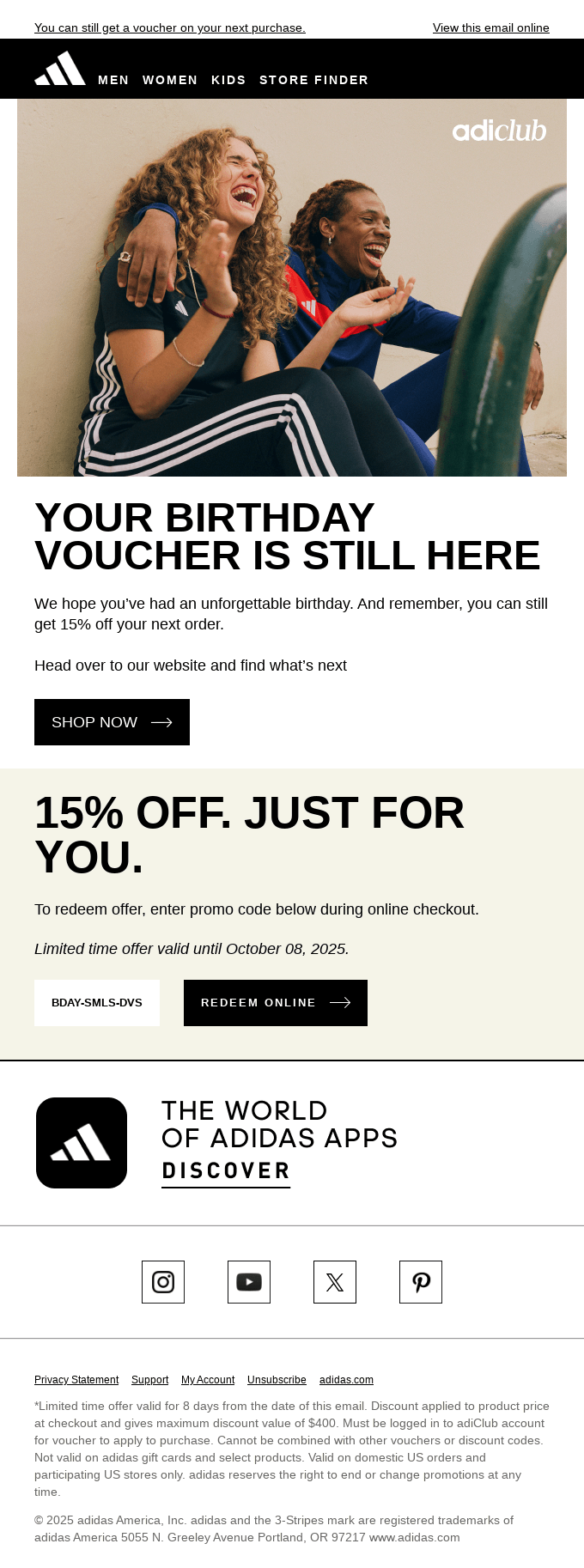
This shows up in birthday offers with discounts, post-purchase emails suggesting complementary products, or reminders when it's time to reorder consumables. Take a look at how Adidas approaches birthday emails with their "Your birthday voucher is here" message, offering 15% off.
Making Every Word Count with Consistent, Conversational Copy
Great email copywriting gets subscribers reading and engaging with your content. The difference between an email that converts and one that gets deleted comes down to how you write it.
The first rule? Skip the corporate speak. Emails that sound like they were written by a person instead of a marketing department get better results. Use contractions, write like you talk, and read your drafts out loud to make sure they sound natural.
Keep industry jargon and acronyms out of your emails unless you're absolutely certain your audience knows them. When in doubt, spell it out or use simpler terms.
Brevity matters too. Stick to one topic per email and cut anything that doesn't support your main point. There's no magic word count, but shorter emails tend to keep people engaged from start to finish.
Your subject line deserves special attention since it determines whether anyone opens your email at all. Keep it under 60 characters to avoid mobile cutoff, and stay away from the 60-70 character "dead zone" where both open rates and click-throughs drop.
An Upland Study tracking over 900 million emails found that subject lines under 49 characters perform well for opens, while lines over 70 characters drive better click-through rates.
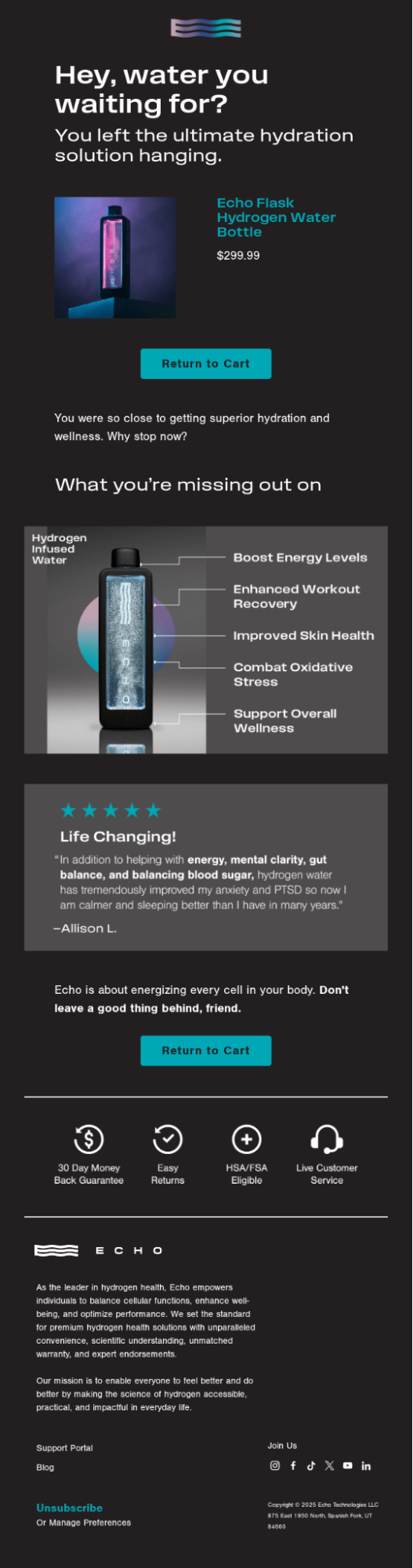
Below, Echo shows how playful, conversational copy can turn a routine cart reminder into something people actually want to read:
Skimmable, Mobile-First Design for Better Clicks
Email design is so much more than picking the right colors and fonts. Your message needs to work whether someone's sitting at their desk with a 27-inch monitor or scrolling through their inbox at 7 AM on the train.
A HubSpot study found that mobile devices account for 41% of all email opens, with tablets adding another 19%, meaning 60% of total email opens come from mobile and tablet devices combined. If your emails don't look good on a small screen, you're losing the majority of your audience before they even finish reading.
Here's how to design with mobile users in mind from the start:
- Use a single-column layout that adapts easily to smaller screens. Break up text with clear headers and short paragraphs. Add bullet points when listing features or benefits, and leave plenty of white space so the email doesn't feel cluttered.
- Make CTAs mobile-friendly. Your email call-to-action buttons should be at least 44 pixels wide by 44 pixels tall so they're easy to tap. Place them above the fold when possible, and keep important tappable elements in the middle of the screen where thumbs naturally rest.
- Design for accessibility. Use high-contrast colors for readability, add alt text to images for screen readers, and ensure your email can be navigated with a keyboard.
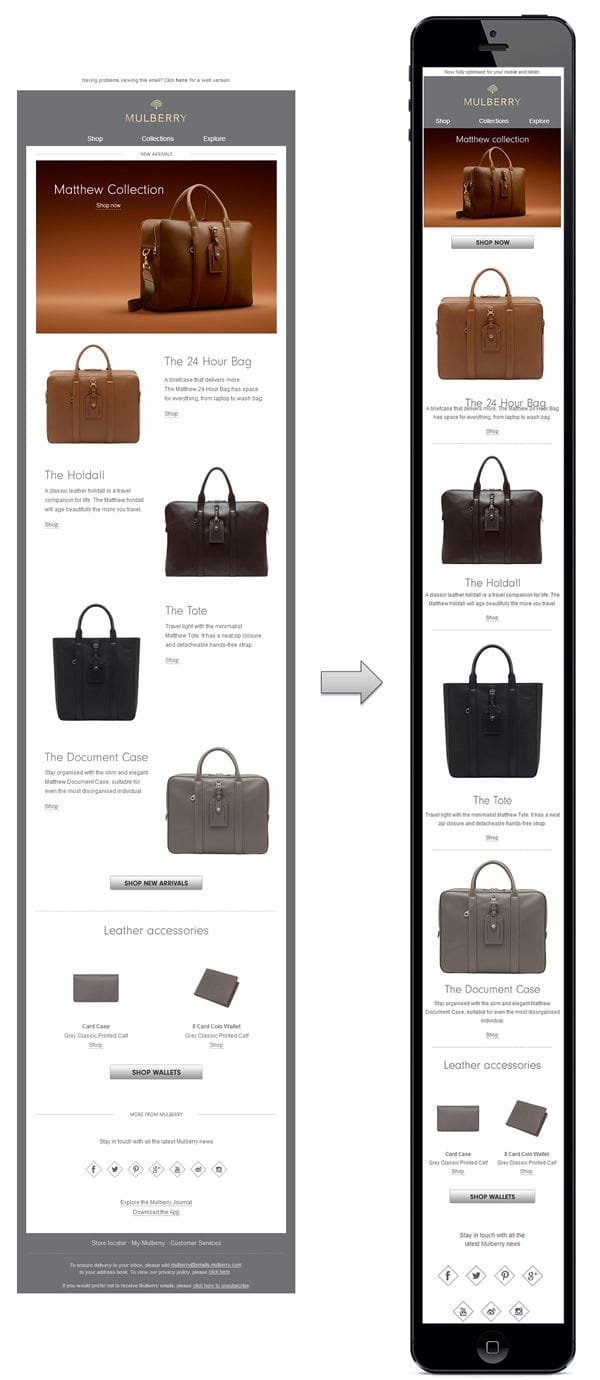
Mulberry demonstrates mobile-first design well, with their emails looking clean and functional whether viewed on desktop or mobile. The layout adapts smoothly without losing clarity or making users pinch and zoom to read.
The Automation Layer: What to Automate and Why
Of course, the biggest shift in ecommerce email marketing over the past few years has been the arrival of AI and automation. Thanks to these advances, what used to take hours of grunt work now happens in the background while you focus on strategy.
What exactly can AI and automation do for your email campaigns? Plenty:
- Figure out when each subscriber actually opens emails so you're not sending at random times and hoping for the best
- Keep your brand voice consistent across automated content without writing every email from scratch
- Spot customers who might unsubscribe before they do, giving you a chance to re-engage them first
- Personalize product recommendations by analyzing browsing patterns, past purchases, and customer preferences
- Test and optimize subject lines and CTAs automatically to find what drives the highest engagement
- Track email deliverability and spam scores so your emails actually land in inboxes instead of getting filtered out
- Automate entire campaign sequences like abandoned cart recovery, welcome series for new subscribers, post-purchase follow-ups, and repurchase triggers for products customers buy regularly
The trick with automation is keeping it from feeling robotic. Write like you're talking to a person, use purchase history to make relevant suggestions, and let AI handle the timing and optimization. Automation should feel like a friendly reminder from someone who knows what customers like, not a generic blast that could've gone to anyone.
Perhaps most importantly, opt for an email marketing software with a proven track record of delivering stellar results for ecommerce use cases.
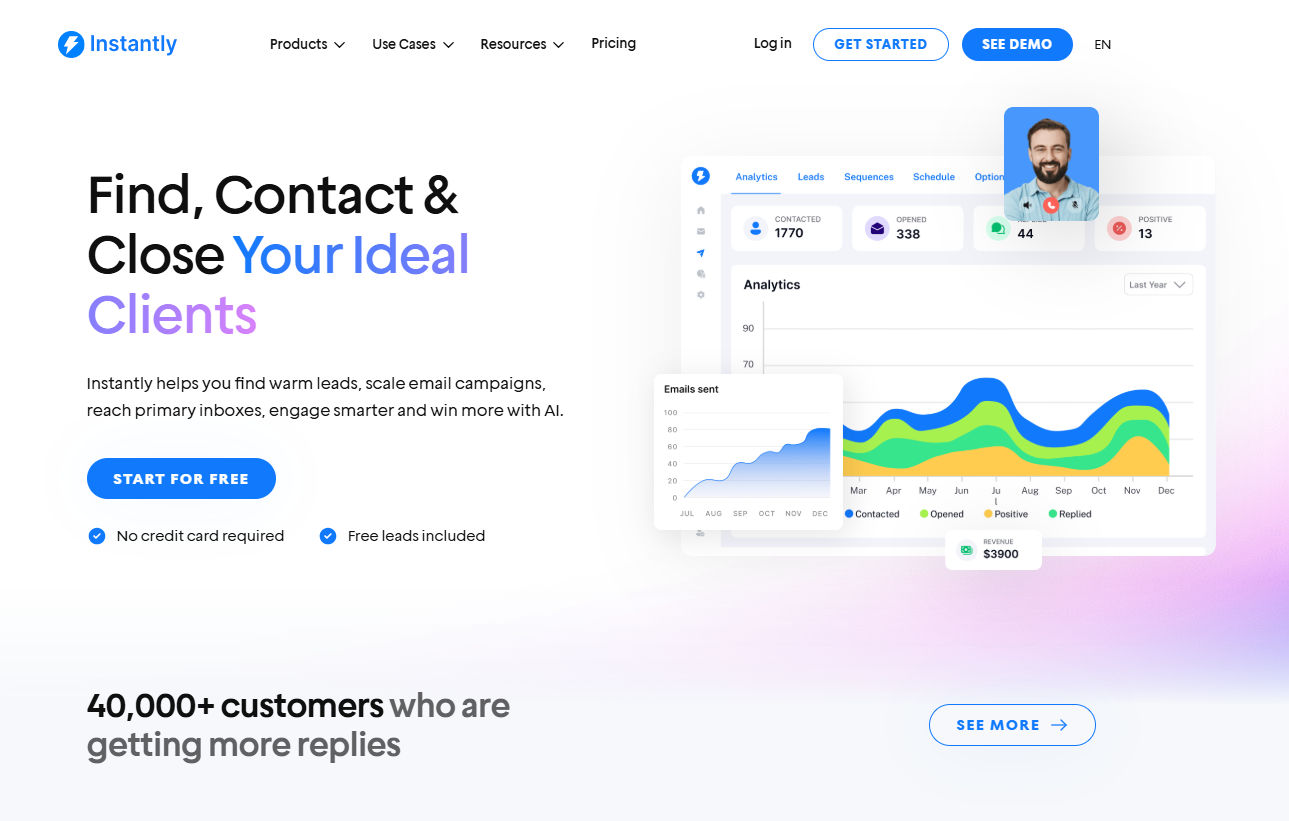
G2 Rating: 4.8/5 ⭐ from 3,861 reviews
Instantly has every vital ecommerce email marketing feature that helps you handle the technical side of your campaigns so you don't have to.
You focus on what to say and who to reach, while our platform manages when to send, tracks performance, and optimizes delivery based on real results.
Key Takeaways
Ecommerce email marketing isn't standing still. The tactics that worked last year won't necessarily work today, but certain fundamentals keep proving themselves no matter what changes.
Here's a quick recap of what you should prioritize:
- Build lists that engage, not just lists that grow. Smaller audiences who actually open and click will drive more revenue than large lists full of people who ignore your emails.
- Make personalization meaningful. Use purchase history, browsing behavior, and customer preferences to send emails that actually match what people want.
- Write like a human. Conversational copy that gets to the point fast beats polished corporate messaging every time.
- Design for mobile first. With 60% of email opens happening on mobile and tablet devices, your layouts need to look good and function well on small screens.
- Let automation and AI do the heavy lifting. From cart recovery to send time optimization, technology can handle the repetitive tasks while you focus on strategy.
Instantly offers tools that make email marketing more efficient, from verification and campaign management to performance tracking. Start your free Instantly trial.


