


Updated March 30, 2026
TL;DR: Most cold email A/B tests fail because teams stop too early or test too many variables at once. Run valid tests by sending at least 1,000 recipients per variant, changing one variable at a time, and tracking reply rate as your primary metric. Instantly lets you test up to 26 variants simultaneously with unlimited sending accounts, which means you reach statistical significance faster than per-seat platforms. Focus on reply rate and meetings booked, not vanity metrics like opens.
You face a constant challenge. Your SDRs rewrite templates after a single good reply, ramp send volumes based on gut feelings, and copy subject lines from LinkedIn posts. That approach produces noise, not signal. A/B testing is the only systematic way to find what actually improves your cost per meeting. This guide covers the math behind valid experiments, the four variables that drive performance, and how to use Instantly to automate the process without burning your domain reputation.
Why "gut feeling" fails in sales outreach
Your reps send 40 emails with Subject A, get three replies, then switch to Subject B and get five replies. They declare B the winner. The problem is that difference reflects random variation, not proof that B is better. Small sample sizes create false confidence. Average reply rates dropped from 6.8% in 2023 to 5.8% in 2024, with typical B2B campaigns landing between 5-10%. That means on 40 sends at 7% reply, you expect about three replies. Getting five instead could simply be luck, a better list segment, or different timing, not the subject line.
You see inconsistent results compound when every rep runs their own experiments. One uses a question subject, another uses a pain point, a third tries personalization. Mixed performance across the team shows no clear pattern. Without controlled testing, you cannot isolate what works. The fix is treating outreach like a laboratory. Define the variable, control everything else, run enough volume to hit statistical significance, and measure the right outcome.
Run A/B testing by creating two or more variants of a single element (subject, body, CTA, or send time) and distributing them evenly to a large enough sample. Track primary metrics like reply rate or meetings booked, not vanity metrics like opens. If Variant A produces a 6.2% reply rate and Variant B produces 8.1% reply rate across 1,000 sends each, and you confirm the difference is statistically significant, you adopt B and test the next variable. This process compounds. Four valid tests that each lift reply rate by 15% will roughly double your meetings over time.
"I use Instantly for outreach via email, and it has saved me a lot of time by automating my lengthy email sending processes... the interface is really simple and user-friendly, which makes it easy to handle the many variables in my emails and to create and follow a lot of campaigns." - Levent Y. on G2
Your sender reputation depends on testing discipline. If you blast untested copy to thousands of prospects and the reply rate tanks, engagement signals drop, spam complaints rise, and domain health deteriorates. Valid A/B testing protects deliverability by catching bad copy at small scale before it damages your primary inbox placement.
The four variables that drive campaign performance
Most teams test randomly. They change the subject, shorten the body, and add a new CTA all at once, then wonder which change drove the result. We recommend testing one variable at a time. Here are the four levers that matter.
Subject lines
Open rate is the first gate. If prospects do not open, they cannot reply. However, privacy features make open tracking increasingly unreliable, so pair open rate with reply rate when evaluating subjects.
What to test:
- Length: Research shows subject lines between 36 and 50 characters generate the highest response rates. Test "Quick question about [pain]" (32 chars) against "Saw your post on [topic], one idea" (38 chars).
- Personalization: Test "Your Q3 webinar insights" against a generic "B2B marketing idea." Personalized subject lines can increase response rates by 30.5%.
- Question format: Test "How are you handling [pain]?" against "A fix for [pain]."
- Curiosity angle: Test "Three things your competitors are doing" versus "Lower CAC with this audit."
We recommend running at least 1,000 sends per variant to detect meaningful differences. Watch this video on cold email copywriting for more subject line frameworks. Use Instantly's A/Z testing feature to test six to ten subjects simultaneously, which accelerates learning compared to traditional A/B tools.
Body copy and value proposition
Body copy drives reply rate and sentiment. You can double open rates with a great subject and still get zero meetings if the offer is weak. Keep emails between 6-8 sentences and under 200 words for best performance, with a 42.67% open rate and 6.9% reply rate typical for that length.
What to test:
- Hook type: Pain-point framing ("Most teams waste 10 hours/week on manual follow-ups") versus benefit framing ("Book 15% more meetings with automated sequences").
- Social proof format: Customer logo versus specific metric ("We helped Company X book 40 demos in 30 days").
- Offer type: Free audit, case study, or simple question ("Worth a look?").
- Personalization depth: Generic industry reference versus specific detail about their recent LinkedIn post or hiring pattern.
Keep length, personalization tokens, and link placement constant unless those are the variables you are isolating. For detailed guidance on body structure, review the cold email copywriting framework in our Help Center.
Call to action (CTA)
CTAs convert replies into meetings. Even a small change can shift booking rates. After subject lines, your CTA significantly impacts campaign performance because it defines the next step.
What to test:
- Specific ask: "Tuesday at 2 p.m. ET work?" versus interest-based ask "Worth a 15-minute chat?"
- Format: "Should I send over the deck?" versus "I will send the deck tomorrow."
- Friction level: Low commitment ("Reply with 'yes' if interested") versus high commitment ("Book a 30-minute demo here [link]").
Watch the video on cold email follow-up strategy for CTA sequencing across multiple steps. Test CTAs only after you validate subject and body, otherwise you cannot isolate whether poor performance stems from the ask or the message that precedes it.
Send windows and timing
Timing affects engagement rates. Emails sent on Monday have the highest open rates at 22%, and 1 p.m. is typically the most productive send time for cold outreach.
What to test:
- Day of week: Monday versus Wednesday sends.
- Time of day: 9 a.m. local time versus 1 p.m. local time.
- Follow-up cadence: Two-day gaps versus four-day gaps between emails.
- Time zone optimization: Send at recipient local business hours versus your time zone.
Configure send windows in Instantly's campaign options to control when emails go out. Keep send windows tight (two-hour blocks) to reduce day-parting noise in your test.
How to design a valid A/B test
Valid tests require three components: a clear success metric, adequate sample size, and statistical significance confirmation.
Defining success metrics for sales vs. marketing
Marketing teams optimize for clicks and opens because they drive brand awareness. You need to optimize for reply rate and meetings booked because those drive pipeline. Open rate is a vanity metric if reply rate drops. For example, a curiosity subject like "Quick question" might generate a 40% open rate but only a 2% reply rate because prospects open, see a sales pitch, and delete. A clear subject like "15% more demos in 30 days" might get 28% opens but 8% replies because qualified prospects self-select.
We recommend tracking these metrics by priority:
- Reply rate: Replies divided by delivered emails. Aim for 5-10% baseline, with 10-15% considered excellent and 15%+ achievable on high-intent campaigns.
- Positive reply rate: Qualified or interested replies as a percentage of total replies. Filter out "not interested" and "remove me."
- Meeting booked rate: Meetings scheduled divided by positive replies.
- Bounce rate: Keep bounces under 2%, withmany programs aiming below 2%to protect sender reputation.
Open rate is a secondary metric. Use it to diagnose subject line performance but never as the primary goal. Check out this analysis of 1,000,000 cold emails for data-backed patterns on what works.
Calculating sample size and duration
Most A/B tests fail because you stop too early. You need enough volume to separate signal from noise. Statistical significance measures the likelihood that the difference between variants is real, not random. Aim for 95% confidence, which means the result would occur by chance only 5% of the time.
Sample size rule: We recommend at least 1,000 recipients per variant for reliable results. Use a sample size calculator to confirm your specific needs. Input your baseline conversion rate (current reply rate) and the minimum detectable effect (the smallest lift you care about). For example, if your baseline reply rate is 6% and you want to detect a 2 percentage point lift to 8%, you need roughly 1,400 sends per variant to reach 95% confidence.
Duration: We recommendrunning tests for at least 48-72 hoursfor open and initial reply metrics. Reply rate and meeting booked tests may require 5-7 days because decision-makers need time to process inbound. Do not stop a test mid-week or you risk day-of-week bias.
Common pitfall: Declaring a winner after 100 sends because Variant B got eight replies versus Variant A's five replies. At small sample sizes, that difference is likely noise. Wait until you hit your calculated sample size, then use an A/B test significance calculator to confirm the result before making changes.
"Instantly makes it genuinely easy to run outbound at scale without feeling overwhelmed by complexity. The inbox rotation, sending controls, and campaign setup are all intuitive, which means you can go from idea to live campaign quickly." - Curtis S. on G2
Prerequisites before testing
Before you launch an A/B test, verify these foundations:
- At least 2 warmed domains: Run warmup for 30 days minimum on new domains.
- Verified contact list: Keep bounce rate under 2%. Bad data skews results.
- Baseline campaign data: Run at least 100 sends to establish control metrics before testing variants.
- Deliverability check: Use Instantly's inbox placement test to verify primary inbox landing.
Step-by-step: Setting up A/Z tests in Instantly
Instantly supports A/Z testing, which lets you test up to 26 variants in one step instead of just two. You accelerate learning by running six subject lines or four body variants in one campaign, see results faster, and compound wins.
1. Create your base campaign:
Navigate to Campaigns and click "New Campaign." Name it with a clear test label like "Q1_SubjectTest_TechSaaS." Add your verified lead list. Keep list hygiene tight (bounces under 2%) because bad data skews test results.
2. Build your first email step:
Write your control email (Variant A). This is your baseline. Use a proven template or your current best-performing copy.
3. Add subject line variants:
In the sequence editor, click "Add variant". Enter six to ten distinct subjects that express different angles, not tiny tweaks. For example:
- Variant A: "Quick question about your SDR process"
- Variant B: "15% more meetings without more headcount"
- Variant C: "Saw your post on outbound challenges"
Keep the email body identical across all variants for this test. You are isolating subject performance only.
4. Add body or CTA variants (optional, separate test):
If testing body copy, keep the subject line constant and add two to four body variants. Change the hook and CTA. Keep length, personalization tokens, and link placement consistent unless those are your variables.
5. Enable auto-optimization:
Go to Campaign Options → Advanced Options → Auto optimize A/Z testing. Select your winning metric (reply rate, click rate, or open rate). We recommend disabling auto-optimization during the validation phase so you collect equal sample sizes, then enable it to compound results after you identify a winner.
6. Configure send schedule and limits:
Set your send window to business hours (9 a.m. to 5 p.m. recipient local time). Cap daily sends at no more than 30 emails per inbox per day to protect deliverability. Our unlimited account feature (on all Instantly plans) lets you spread 3,000 sends across 100 warmed inboxes at 30 per day, hitting your sample size in one day without deliverability risk.
7. Launch and monitor:
Click "Launch Campaign." Watch the Analytics tab daily. Wait for your calculated sample size before analyzing. For a video walkthrough, check out this tutorial on cold email strategy.
"I like that I can add unlimited domains with Instantly. It also allows me to warm up new domains... Sending many cold emails to new prospects is possible without burning my domains or destroying the domain reputation." - Greg Z. on G2
Top A/B testing tools for email sequences
Not all platforms handle A/B testing the same way. Per-seat pricing models limit your ability to reach large sample sizes quickly, and some tools restrict how many variants you can test.
Tool | Testing Type | Pricing Model | Best For |
|---|---|---|---|
Instantly | A/Z (26 variants), auto-optimize | Flat $47/mo, unlimited accounts | High-volume teams needing fast significance |
Apollo | A/B subject only | $59/user/mo | Database + email combined |
Mailshake | A/B testing | $29-49/mo per user, provider limits apply | Small teams starting out |
Our unlimited account model removes per-seat penalties. You can scale sending volume across dozens of warmed inboxes without compounding software costs. This matters for valid testing. If you are limited to 50 sends per day on a per-seat tool, reaching 1,000 sends per variant takes 20 days. On Instantly with 50 accounts, you hit 1,000 sends in one day at 20 per inbox.
For deeper platform analysis, watch this breakdown of 39 things to know about cold email before starting.
Interpreting data: How to spot a winner
Once you hit your sample size, navigate to Instantly's Analytics tab. We recommend selecting a longer time range (Last 4 weeks) to see complete results.
Choose one primary metric based on what you tested:
- Subject line tests: Open rate (secondary) and reply rate (primary).
- Body/offer tests: Reply rate and positive reply rate.
- CTA tests: Meeting booked rate.
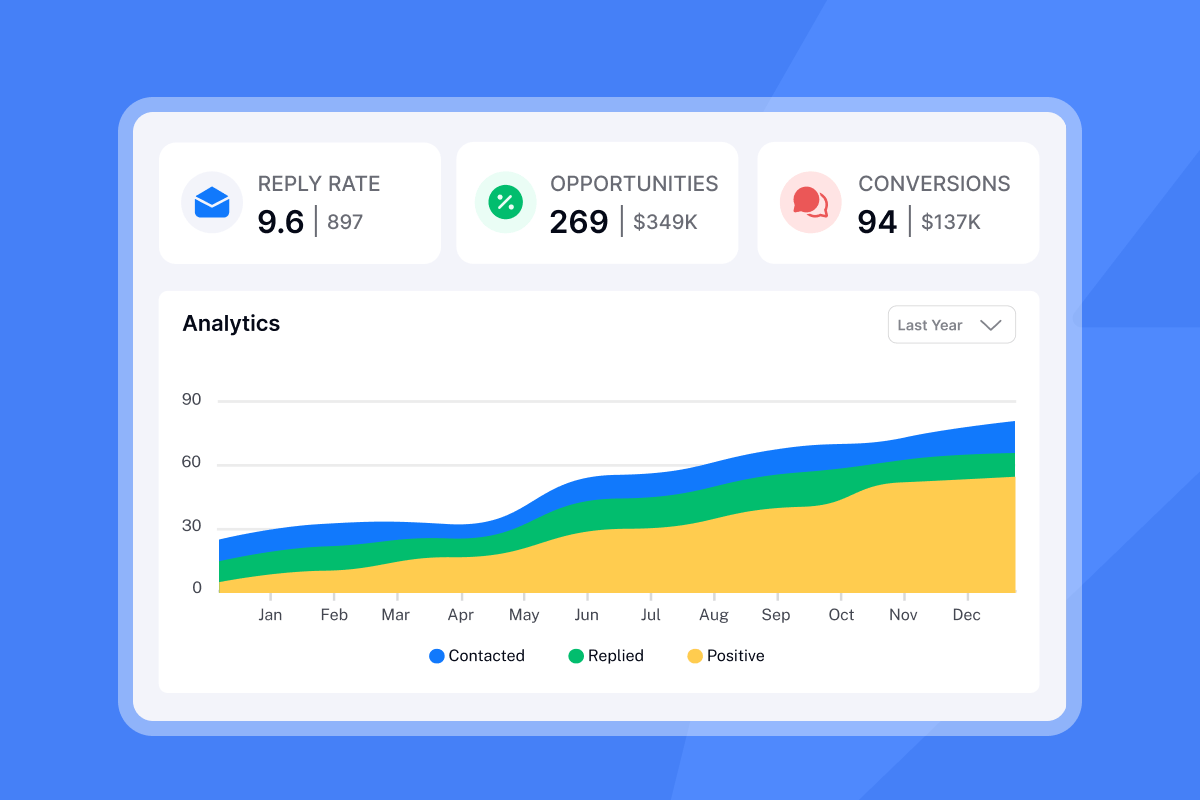
Example: Variant A generated 320 opens and 22 replies (6.9% reply rate) from 320 delivered emails. Variant B generated 340 opens and 31 replies (9.1% reply rate) from 340 delivered. Plug these numbers into an A/B test calculator to confirm the 2.2 percentage point lift is statistically significant at 95% confidence. If yes, adopt Variant B and archive Variant A.
When to kill a losing variant: If one variant is clearly underperforming halfway through the test (for example, 3% reply rate versus 8% after 500 sends each), you can stop early to preserve deliverability and list quality. Do not waste good contacts on bad copy.
When to double down: Once you identify a winner, roll it out to your full team and build the next test. For example, if your winning subject improved reply rate from 6% to 8%, test body copy next on that winning subject.
Testing across sequence types:Cold outreach sequencesfocus on reply rate because you are prospecting. Nurture sequences focus on click-through rate because you are educating. Inbound follow-up sequences focus on meeting booked rate because you are converting warm leads.
For advanced analytics training, see this guide to cold email deliverability which covers how engagement metrics feed back into sender reputation.
Advanced strategy: Testing for deliverability
Deliverability hides beneath every A/B test. If Variant A lands in primary inbox and Variant B lands in spam, your test results reflect infrastructure problems, not copy quality. We recommend verifying inbox placement before and during tests.
Plain text versus HTML
Plain text emails generate 21-42% more clicksand avoid spam filters. Email service providers prefer plain text for cold outreach because HTML emails with inline tracking images signal marketing intent, pushing messages to promotions or spam.
We recommend plain text for cold email to improve inbox placement. Use the inbox placement test tool to check where your emails land before launching large campaigns.
Tracking links and pixels
Email service providers detect tracking pixels. We recommend testing emails with zero links against emails with one contextual link (no UTM parameters). Compare reply rates and inbox placement. In many cases, removing links improves deliverability enough to offset the loss of click tracking.
Spam trigger words
Test subject lines and body copy with and withoutspam trigger words like "free," "urgent," "limited time," or "act now"which can raise red flags with spam filters. Track bounce rates and spam complaints. Common triggers also include all-caps text, excessive punctuation (!!!), deceptive tags like "RE:" when not a true reply, and high image-to-text ratio.
"I use Instantly for warming up my mails, and it really helps with deliverability. I like its ease of use, especially the email warm-up feature." - krish k. on G2
Positive engagement's role: Fix deliverability first, then test copy. Use Instantly's warmup feature to pre-warm new domains for 30 days. Keep bounces under 2%. If health dips, pause and run the hygiene checklist.
For a full walkthrough on domain health monitoring, watch this video on deliverability.
5 common A/B testing mistakes to avoid
Most A/B tests fail for predictable reasons. Avoid these traps.
1. Testing too many variables at once:
If you change the subject, body, and CTA all at once, you cannot attribute which change drove the 4 percentage point reply rate lift. Testing multiple elements simultaneously makes attribution impossible. Multivariate testing requires significantly larger sample sizes and more complex analysis. Stick to one variable per test, document your learnings, and move to the next element.
2. Ignoring sample size:
If you send each variant to 20 or 30 recipients, outliers skew the data. Forcold email A/B testing, aim for at least 1,000 recipientsper variant to detect smaller differences with confidence. Use sample size calculators before launching tests.
3. Testing on bad data:
Deliverability issues undermine A/B tests. If one variant lands in spam while the other reaches inboxes, test results reflect technical problems, not copy effectiveness. Monitor bounce rates, spam complaints, and inbox placement closely. Verify email lists and ensure deliverability infrastructure is solid before testing. Instantly's warmup filters automate this for Google and Microsoft inboxes.
4. Focusing on opens instead of replies:
Use reply rate as the primary early pipeline KPI because privacy features inflate open rates. Pair it with meetings, cost per meeting, and time-to-first-meeting. Open rate is a diagnostic metric for subject lines, not a revenue metric.
5. Not running tests long enough:
An A/B test needs at least 48 hours, often longer, toachieve statistical significance. Decision-makers need time to work through their inbox. Wait for adequate sample size and duration before declaring a winner.
For more on avoiding these mistakes, check out this video showing a live campaign fix in 20 minutes.
Success metrics for your test
Track these benchmarks to measure test effectiveness:
- Minimum viable: 5% reply rate sustained over 1,000 sends with bounce rate under 2%.
- Good performance: 8-10% reply rate with 60%+ positive sentiment ratio.
- Excellent: 12%+ reply rate with meeting booked rate above 25% of positive replies.
Summary checklist for your next experiment
Use this checklist to keep tests valid and repeatable:
- Define hypothesis: "Changing [variable] from [A] to [B] will increase [metric] by [X]%."
- Select one variable: Subject, body, CTA, or send time. Change nothing else.
- Calculate sample size: Use a calculator to determine minimum sends for 95% confidence.
- Set primary metric: Reply rate for cold outreach, click rate for nurture, meeting booked rate for inbound follow-up.
- Build variants in Instantly: Use the A/Z testing feature to test multiple angles simultaneously.
- Verify deliverability: Check inbox placement and keep bounces under 2%.
- Launch and wait: Run until you hit calculated sample size, at least 48 hours.
- Analyze with significance test: Use a statistical calculator to confirm 95% confidence before adopting the winner.
- Document learnings: Record what worked, what failed, and the lift percentage in a shared testing log.
- Iterate: Roll out the winner and build the next test on a different variable.
For more templates and sequences, explore Instantly's library of 600+ cold email templates.
Ready to run your first valid experiment?
Systematic testing builds a predictable revenue engine. Start with subject lines because you get fast feedback and easy isolation. Once you identify a winning subject, move to body copy, then CTA, then timing. Each compounding lift reduces your cost per meeting and protects domain health by keeping engagement high.
We give you the volume, the A/Z testing infrastructure, and the deliverability monitoring to run valid experiments without per-seat penalties or five disconnected tools. Try Instantly free and use the ramp template inside the app to launch your first test today.
Frequently asked questions
How long should I run an A/B test?
Run tests for 48-72 hours minimum for open and initial reply metrics. Reply rate and meeting booked tests may require 5-7 days. Base duration on reaching statistically significant sample size, not just time elapsed.
What is a good reply rate for cold email?
A good cold email reply rate is 5-10% for most B2B teams. Top performers hit 15%+ on focused, well-timed campaigns with verified contacts and strong inbox placement. The key is beating your current control consistently.
Can I test more than two email versions at once?
Yes, A/Z testing allows you to test up to 26 variants in one campaign step on Instantly. This accelerates learning compared to traditional A/B tools.
Does changing the subject line affect deliverability?
Subject lines affect opens more than deliverability, unless they include spam trigger words like "free," "urgent," or "act now." The more significant deliverability factors are technical setup (authentication, sender reputation, list quality).
How many contacts do I need for a valid test?
Aim for at least 1,000 recipients per variant to detect smaller performance differences with confidence. Use calculators to determine the specific number needed for your baseline reply rate and desired minimum detectable effect.
Key terms glossary
A/B Testing: Split testing two variants of a single variable (subject, body, CTA, or timing) to determine which performs better on a defined metric.
A/Z Testing: Testing multiple variants (three or more, up to 26) simultaneously in one campaign to accelerate learning and compound wins faster.
Statistical Significance: The probability that the difference between control and test variant is genuine, not random chance. Target 95% confidence level.
Confidence Level: How certain you are that test results are accurate. 95% confidence means results would occur by chance only 5% of the time.
Sample Size: The number of recipients needed per variant to prove the result is statistically valid. Larger samples reduce error margin.
Reply Rate: Total replies divided by delivered emails. The primary metric for cold outreach effectiveness.
Positive Reply Rate: Qualified or interested replies as a percentage of total replies. Filters out "not interested" responses.
Bounce Rate: Percentage of emails that fail to deliver. Keep under 2% to protect sender reputation.


