.svg)
%20(1).svg)


Updated March 12, 2026
TL;DR:
Open rates are no longer a reliable indicator of human interest. Apple Mail Privacy Protection (MPP) pre-fetches every email image through a proxy server before the recipient sees it, registering phantom opens for the roughly 51-55% of email opened on Apple clients, while enterprise spam filters add more false positives by scanning all links and pixels before delivery. Meanwhile, tracked redirect links actively hurt your inbox placement. The primary metrics that drive revenue are positive reply rate and meetings booked. We built Instantly around that reality: deliverability first, vanity metrics never.
The more you try to track whether someone read your email, the less likely they are to actually receive it. That's not a theory. It's what happens when tracking pixels and redirect links hit modern spam filters and privacy layers.
Yet most sales teams still report on open rates as a measure of rep performance, copy quality, or campaign health. The dashboards look active. The numbers feel good. And the pipeline stays empty.
The core tracking pixel mechanism has changed little technically, but the email client environment around it has been transformed. Apple's 2021 MPP rollout, Gmail's image caching, and enterprise security gateways have collectively made open rates an unreliable signal for anything beyond infrastructure health. This article breaks down the technical reality, explains why modern privacy features render open rates useless for sales decisions, and shows how to build reporting your CFO can actually trust.
The mechanics of tracking pixels and why they fail
How a tracking pixel actually works
A tracking pixel works as a 1x1 transparent GIF image embedded in your email HTML as a hidden <img> tag. Each recipient gets a unique URL. When their email client loads the email, it fetches the image from your server, and that request logs an "open" in your dashboard. The whole process takes milliseconds and is invisible to the recipient.
That mechanism works cleanly when a human eye triggers it. The problem is that humans aren't the only things loading email images anymore.
The bot problem
Enterprise spam filters from providers like Mimecast and Barracuda scan every link and download every image in an email before it reaches the recipient's inbox. This is intentional: they check for malware, phishing redirects, and malicious attachments in a sandboxed environment. The side effect is that your tracking pixel fires, your analytics log an "open," and no human has seen a single word yet.
This creates three specific problems for your analytics:
- False positive opens: Your tracking pixel fires when the bot scans it, logging an "open" before any human sees the email.
- Inflated engagement data: Your dashboard shows activity that never happened.
- Broken attribution: You can't tell which opens are real and which are bot-generated.
Instantly's help documentation on SEG detection (Secure Email Gateways) explains how to identify when bot traffic is inflating your open data and what to do about it.
The core takeaway: A pixel fire does not equal human eyeballs. It equals "something loaded this image," which could be a spam filter, a cache server, or a privacy proxy.
The reality of Apple Mail Privacy Protection (MPP)
Apple launched Mail Privacy Protection in September 2021 with iOS 15. When a user enables it, Apple routes emails through a proxy server to pre-load all message content, including tracking pixels, before the email is delivered to the recipient's device. Apple then stores those images locally on its privacy cache.
The result: according to Paubox's analysis of MPP, your tracking pixel fires for every Apple Mail user, regardless of whether they opened the email at all. Postmark's technical breakdown confirms this means you could see a 100% open rate for your entire Apple Mail audience.
Apple Mail commands 51-55% of global email clients, so the impact on your aggregate open rate is enormous. Open rates across B2B cold email now sit at 35-45%, up from the pre-2021 baseline of 20-25%. That's not better copy. That's phantom opens.
The damage to A/B testing is direct. If you're testing subject lines and measuring success by open rate, you're optimizing against a metric that is partly random for half your list. A/B subject line tests built on open rates are, in practice, statistically meaningless for any list with significant Apple Mail representation.
Myth 1: High open rates mean your copy is working
The implied logic is: better subject line → higher open rate → more interest → more pipeline. Each step in that chain is broken.
A high open rate in the post-MPP era tells you one of three things:
- Apple Mail proxy: A large portion of your list uses Apple Mail, and the proxy fired for all of them.
- Bot filter scan: Your email hit an enterprise spam filter that pre-scanned it before delivery.
- Genuine open: A human actually opened it.
You can't tell which one is happening from the open rate number alone. Instantly's help article on tracking discrepancies explains the technical reasons behind the gaps teams see between expected and reported open data.
High opens paired with zero replies is the signal worth paying attention to. It often means you triggered bot filters, wrote a subject line that didn't match the body, or your list has poor targeting. None of these are problems a higher open rate resolves.
The better signal: Positive reply rate. A reply requires a human to read your email, decide you're worth responding to, and take action. Bots don't reply. Apple's proxy doesn't reply. Reply rate is the truest indicator of whether a cold email sparks genuine interest, because it represents the start of a real two-way conversation.
One practitioner in a HubSpot community discussion on Apple Mail opens summarized it plainly: teams should "stop looking at or using open rates for anything" other than a vanity metric, and focus instead on replies and clicks for high-intent assets.


Myth 2: Click tracking does not affect deliverability
This is the myth with the most direct technical cost. Click tracking works through redirects. A normal link goes straight to your destination. A tracked link routes the click through a third-party domain first, records the click event, then passes the user through to the destination.
Spam filters treat redirect links with suspicion because redirects are a common phishing technique. Attackers use them to hide the real destination URL. When your tracked link runs through a redirect, filters may flag your email before it reaches the inbox. According to Suped's deliverability research, using multiple redirects raises red flags for spam filters because it signals you may be masking where the link actually goes.
The shared domain problem compounds this. Many tracking platforms route all their customers through the same tracking domain. If another sender on that shared infrastructure uses it in a spam campaign, your emails now share a domain with spam, and filters can penalize you for it. You had no involvement. You still take the reputation hit.
One of the simplest ways to protect your email deliverability is to remove tracking pixels, especially in cold outreach where spam filter scrutiny is highest.
The custom tracking domain solution
If you need click tracking, use a custom tracking domain to isolate your reputation from shared infrastructure. A custom tracking domain creates a URL specific to your organization. Your sending domain and your tracking domain match, which removes the domain inconsistency that flags your emails as suspicious. Using two different domains in the same email (your sending domain and a third-party tracking domain) raises suspicion among ESPs because it resembles phishing behavior. A custom domain eliminates that inconsistency, and no other sender can drag down your reputation because the only emails using your domain are yours.
Myth 3: You need granular tracking to manage sales reps
The fear here is real: "If I stop tracking opens, I lose visibility into what my reps are doing." But open tracking measures the wrong thing, and managing to it creates bad behavior.
When reps are measured on open rates, they optimize for open rates rather than meaningful outcomes. Time goes into activity volume rather than conversation quality. None of that moves pipeline.
Outcome-focused metrics provide a more accurate read on performance than activity-based data. The shift is from "what did my rep do?" to "what did my rep produce?" That's a more defensible coaching conversation, a more honest quota review, and a cleaner picture for CFO reporting.
The coaching difference is concrete:
- Tracking opens leads to conversations about send volume and subject line testing built on unreliable data.
- Tracking replies leads to conversations about objection handling, targeting quality, and offer fit.
One is micromanagement dressed up as analytics. The other is revenue enablement. Activity without results means nothing, and a high volume of opens that never convert to replies is exactly that.
Instantly's help documentation on reply rate discrepancies also explains why even reply counts can have reporting gaps, and what to audit when your CRM data and campaign data don't reconcile.
Using Instantly to monitor deliverability without vanity metrics
Open rates are not useless. They're misapplied when used as a proxy for prospect interest or rep performance. Their correct use is as a directional signal for infrastructure health.
Here's the diagnostic framework:
- Opens holding steady at 30-45%: Normal range, no infrastructure concern.
- Opens drop from 40% to 10% in 48 hours: This is a burn signal, not a copy problem. Your domain or IP likely hit a blacklist, or your send volume triggered a filter. Stop sending, run a deliverability check, and diagnose before resuming.
- Opens at 80%+ across the board: Likely heavy Apple Mail audience or bot scanning. Don't celebrate or optimize for it. Run a reply-rate check to get the real signal.
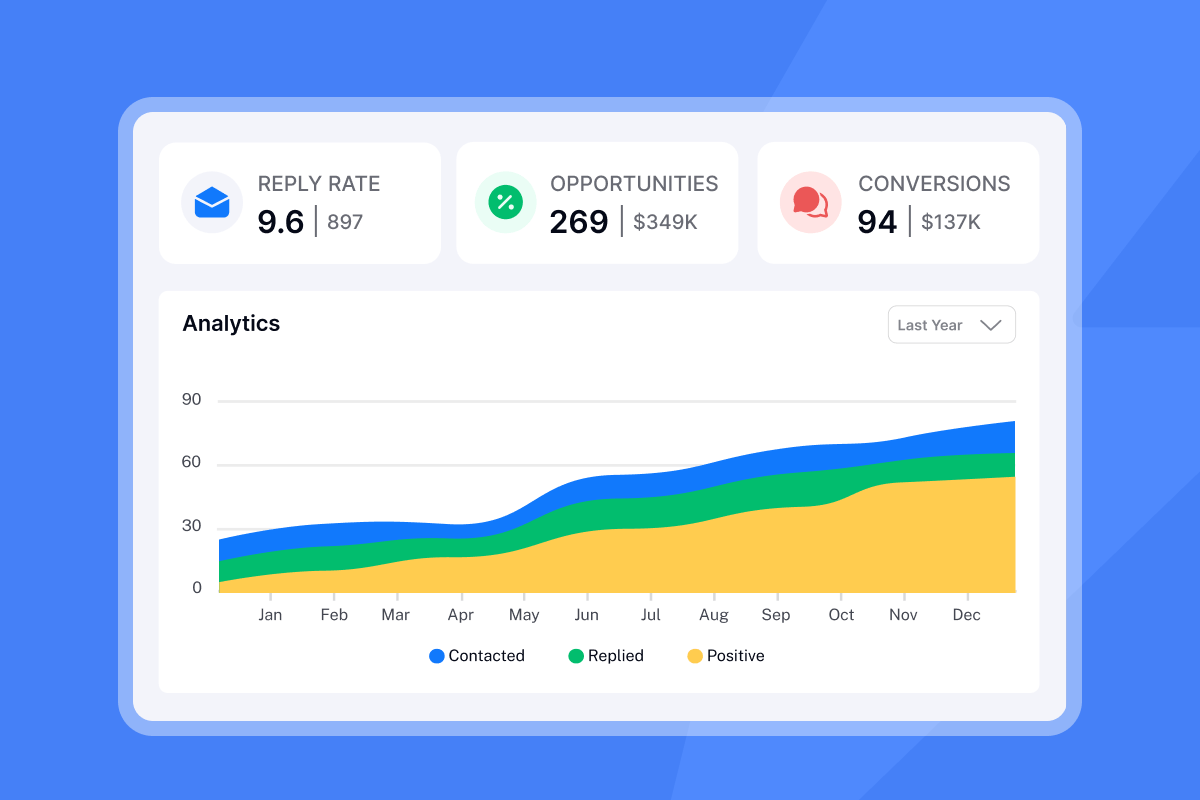
We built Instantly's analytics dashboard around this principle. The focus is on replies and opportunities, not raw open counts. Campaigns surface reply rate, positive reply rate, and opportunities created, so your weekly review starts with revenue-relevant numbers.
We run warmup emails through our dedicated sender reputation network of 4.2M+ accounts, which keeps warmup activity out of your campaign analytics. You get a clean read on campaign performance without warmup traffic distorting your numbers.
"I appreciate Instantly for its intelligent handling of domain and mailbox rotation as well as provider matching, which is critical for ensuring that my emails land directly in the primary inbox instead of getting caught in spam filters." - Richard E. on G2
The Instantly deliverability guide covers the full warmup-to-campaign ramp if you want a walkthrough of how health monitoring works in practice. The 2026 cold email rules video also addresses how infrastructure management has replaced tracking granularity as the key variable in campaign performance.
You can also reduce fingerprinting risk by sending as plain text, which Instantly supports through its Delivery Optimization Tool. Fewer HTML elements mean fewer tracking opportunities for filters to flag.
How to measure genuine engagement and pipeline health
Stop using open rate as a KPI. Use this three-metric revenue scorecard instead.
Metric | What it measures | Healthy range (B2B cold email) |
|---|---|---|
Verified contact rate | List hygiene, data quality | Below 2% bounce rate |
Positive reply rate | Market fit, messaging quality | 5-10% is solid, 10%+ is excellent |
Meeting booked rate | Offer fit, call-to-action effectiveness | 1-2% of delivered emails |
Verified contact rate is the foundation. Bad data poisons everything downstream. Bounces above 2% signal you're sending to stale or unverified contacts, which damages sender reputation and skews every other metric. This is the water filter analogy in practice: dirty input corrupts the output regardless of how good your copy is.
Positive reply rate is your copy and targeting truth signal. Our 2026 benchmark report shows an overall average reply rate of 3.43%, with top performers exceeding 10%. According to B2B reply rate benchmarks, 5-10% is solid and 10%+ is excellent. Calculate it as: positive replies divided by delivered emails, then multiply by 100. If your reply rate is healthy but your positive share is low, your targeting is right but your offer isn't.
Meeting booked rate closes the loop between email and pipeline. According to MySalesCoach's metrics research, meetings as an output metric show whether all your upstream inputs are working. If it's not moving, something upstream needs to change, whether that's the list, the sequence, or the call to action.
One more practical rule: if you choose to use click tracking, consider applying it only to high-intent assets, such as contract links, case study downloads, or pricing pages, not every link in top-of-funnel cold outreach. This reportedly limits redirect exposure to interactions where the insight is worth the deliverability tradeoff.
The 10 years of advice video and the 1,000,000 cold emails study from Instantly both reinforce this point: the teams that consistently book meetings focus on verified contacts, inbox placement, and a simple ask rather than tracking granularity.
Build reporting your CFO can trust
Stop obsessing over the pixel. Open rates are a technical artifact, not a sales signal, and optimizing your team's behavior around them is counterproductive. Every tracking redirect and shared domain you add chips away at the inbox placement that makes cold email work, as Instantly's documentation on email fingerprinting and deliverability makes clear.
Build a reporting stack your ops team and your CFO can audit. Positive reply rate, meetings booked, and verified contact rate are all objective, CRM-reconcilable, and tied directly to revenue. That's the system worth building.
Ready to scale your outreach based on revenue, not vanity metrics? Get started with Instantly and get the deliverability truth your sales team needs.
FAQs
How accurate is email open tracking in 2026?
Open rates are significantly inflated for most B2B senders. Apple Mail, which holds over 51% of email client market share, pre-fetches all email images through a proxy server under MPP, registering opens regardless of whether the recipient actually read the email. Enterprise spam filters add further false positives by scanning pixel images before delivery.
Does email tracking affect deliverability?
Yes, if you use shared tracking domains or redirect links. Redirect links mimic a phishing tactic by masking the true URL destination, which spam filters flag. If another sender abuses the same shared tracking domain, your reputation can suffer through association. Custom tracking domains isolate your reputation and reduce this risk.
Should I turn off open tracking completely?
Not entirely. Keep open tracking enabled as a directional signal for deliverability issues: a sudden drop from 40% to 10% overnight indicates a burn event, not a copy problem. What you should remove is open rate from your rep scorecards. Measure rep performance on positive reply rate and meetings booked, and use opens only to spot infrastructure problems.
What is a good cold email open rate in 2026?
Open rates are no longer a useful benchmark because of Apple MPP and bot scanning. The better question is: what's your positive reply rate? For B2B cold email, 5-10% is solid and top-performing campaigns exceed 10%, according to Instantly's 2026 cold email benchmarks.
Key terms glossary
MPP (Mail Privacy Protection): Apple's privacy feature, launched in iOS 15, that pre-loads all email images through Apple's proxy servers before delivering the email to the recipient, triggering tracking pixels regardless of whether the email was actually opened.
Tracking pixel: A 1x1 transparent image embedded in email HTML that fires a request to a tracking server when loaded, logging the event as an "open." It cannot distinguish between a human opening the email and a bot or proxy loading the image.
False positive open: An open event logged in your analytics that was not triggered by a human reading the email, including opens caused by Apple MPP, enterprise spam filter scanning, or Gmail image caching.
Custom tracking domain: A tracking URL specific to your organization, set up via a DNS record, that replaces a shared third-party tracking domain. It isolates your sender reputation from other users on shared infrastructure and aligns your tracking domain with your sending domain to reduce spam filter flags.
Positive reply rate: The percentage of delivered emails that receive a reply showing genuine interest, calculated as interested replies divided by total delivered emails multiplied by 100. This is the primary copy and targeting signal for cold email campaigns.



