


TL;DR: Calculating the ROI of your cold email and sales engagement software is essential for smart growth. Common pricing models range from per-user fees (averaging $71/month) to flat-fee structures with unlimited accounts. To project accurately, factor in software subscriptions, lead data, AI credits, deliverability tools, and labor costs. Instantly offers flat-fee pricing starting at $37/month with unlimited sending accounts, a 4.2M+ deliverability network, 450M+ verified leads, and AI agents that reduce manual work. Use Instantly and our formula to project revenue based on your email volume, conversion rates, and deal values, then track reply rates, meetings booked, and cost-per-meeting to validate real performance.
Updated October 26, 2025.
Why calculating cold email ROI matters for your business
Investing in cold email and sales engagement software drives pipeline, but understanding your true financial return separates smart operators from those guessing at budget decisions. Most sales leaders invest in sales engagement platforms, making the critical question which platform delivers predictable returns at scale.
Justify investment and budget allocation
Clear ROI math lets you defend your software stack to CFOs and partners. When you show that a $97/month platform generates 15 meetings at $45 each versus a $1,200/month competitor delivering 18 meetings at $67 each, the budget conversation becomes data-driven. Agencies managing client accounts need this precision to avoid compounding per-seat costs that erase margins as teams grow.
Optimize performance and strategy
Tracking cost-per-meeting reveals which campaigns justify expansion and which need pausing. If your reply rate drops from 5.4% to 3.1%, ROI calculations immediately flag the revenue impact and trigger hygiene checks before domain reputation degrades further. Watch how to achieve top-tier reply rates with Instantly in this tutorial:
Drive predictable revenue growth
ROI frameworks convert abstract metrics into pipeline forecasts. When you input safe sending volumes across multiple warmed inboxes, a 5% positive reply rate, a 20% meeting rate, and a 15% close rate with $5,000 deals, you project monthly revenue and compare platforms on total cost of ownership, not just sticker price.
Common pricing models for outreach and sales engagement software
Sales engagement platforms use four primary pricing structures, each with distinct cost implications as your team scales.
Per-user or per-seat pricing
Most enterprise platforms charge monthly per active user. Traditional sales engagement tools typically price from $49 to $149 per user per month with annual billing discounts, with some enterprise platforms starting around $100 per user per month and requiring minimum seat commitments of three to five users.
- Pros: Predictable budgeting for fixed headcount, clear alignment between seats and active senders.
- Cons: Costs compound as you add SDRs or client workspaces. A 10-person agency at $100/seat pays $12,000 annually versus a flat-fee alternative at $1,164 for unlimited accounts.
Per-email volume pricing
Some tools charge based on monthly sending limits or contacts stored, with overages triggering additional fees.
- Pros: Pay-as-you-grow model suits low-volume senders.
- Cons: Volume spikes during campaigns push you into higher tiers. Forecasting becomes harder when reply surges or A/B tests increase sends.
Watch a practical guide on how to run A/Z testing with Instantly:
Flat-fee pricing with unlimited accounts
Instantly and a few peers offer monthly flat fees covering unlimited sending accounts and warmup. Growth starts at $37/month, Hypergrowth at $97/month, and Light Speed at $358/month, all with unlimited email accounts and built-in deliverability features.
- Pros: Agency operators scale clients without per-seat penalties. Predictable TCO regardless of team size.
- Cons: Higher single-plan cost if you only need one or two inboxes, though breakeven occurs quickly.
Credit-based pricing for AI and add-ons
Platforms increasingly use credits for AI features, data enrichment, and exports. Some platforms charge approximately $0.20 per credit for mobile data and exports beyond monthly limits. Instantly's AI Reply Agent consumes 5 credits per AI-handled reply, with SuperSearch plans ranging from 150 credits at $9/month to 10,000-200,000 credits at $197/month.
- Pros: Pay only for advanced features you use.
- Cons: Unpredictable costs if AI usage spikes. Track credit burn rates closely to avoid surprise invoices.
Watch Instantly's AI Reply Agent in action below:
Key factors influencing your total investment
Subscription fees represent only part of your true cost. Accurate ROI calculations require factoring in these often-overlooked expenses.
Core features versus add-ons
Base plans typically include sending, basic analytics, and CRM sync. Advanced features like calling and SMS in Instantly's CRM at $97/month, AI agents, or white-label portals cost extra. Enterprise platforms often require implementation and onboarding fees ranging from $1,000 to $8,000 depending on complexity and seat count.
AI features and credit usage
AI-powered personalization, reply handling, and lead research accelerate workflows but consume credits. Businesses leveraging AI for sales see up to 50% more leads and 25-35% higher conversion rates through optimized targeting. Instantly's AI Copilot assists with campaign creation and analytics, while the AI Reply Agent automates responses in under 5 minutes. Budget for credit packs based on expected volume, tracking consumption weekly to avoid shortfalls mid-campaign.
"The email warmup feature was a lifesaver, literally freeing up 40hrs of our staff members' time every day." - Carson S. on G2
Deliverability tools and their value
Warmup, inbox placement testing, and reputation monitoring directly impact whether emails land in Primary versus Spam. Instantly includes automated Inbox Placement tests and a 4.2M+ account deliverability network on all plans. Light Speed adds SISR with dedicated IP pools for $358/month. Without deliverability infrastructure, even low-cost tools waste budget on emails that never reach inboxes. For a comprehensive video walkthrough of cold email deliverability best practices, check out this deliverability guide on YouTube.
Support, onboarding, and integrations
Responsive support reduces downtime during critical campaigns. Integration costs for connecting CRM systems like Salesforce and HubSpot via OutboundSync or iPaaS tools like Zapier add complexity. Enterprise platforms with lengthy onboarding cycles delay time-to-first-meeting, pushing back ROI realization by weeks or months.
Annual versus monthly billing
Annual plans typically offer 15-20% discounts. Instantly's Growth plan drops from $37/month to $30/month annually. Balance savings against flexibility. Lock into annual only after pilot validation, especially if deliverability or integration depth remains uncertain.
Comparative pricing for leading email outreach and sales engagement platforms
Understanding how platforms structure pricing helps you model true TCO and predict costs as volume grows.
Instantly: Flat-fee, unlimited scale, all-in-one
Instantly combines outreach, lead data, CRM, and AI on a flat monthly fee with no per-seat penalties. Pricing tiers include Growth ($37/month or $30 annually), Hypergrowth ($97/month or $77.60 annually), and Light Speed ($358/month or $286.30 annually) for SISR. SuperSearch adds 450M+ B2B leads with waterfall enrichment starting at $9/month for 150 credits, scaling to $197/month for 10,000-200,000 credits. CRM options start at $47/month for Growth CRM and $97/month for Hyper CRM with calling and SMS.
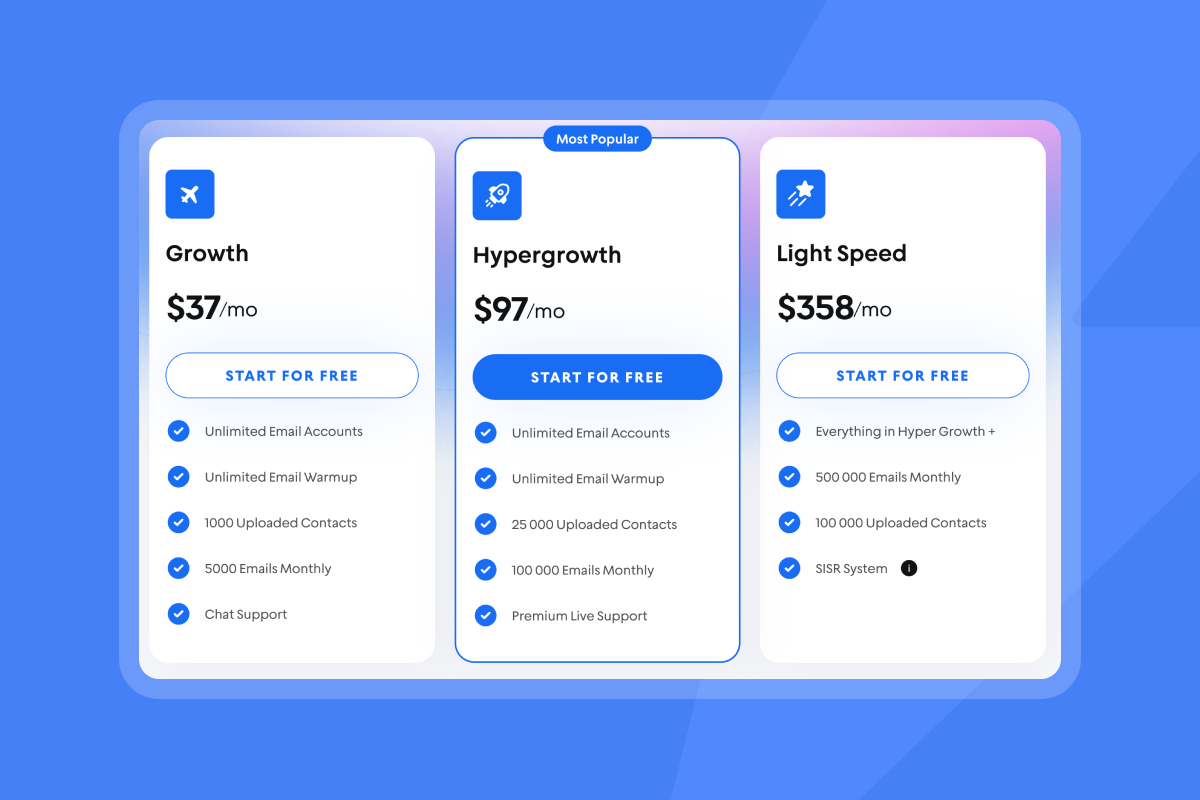
- Best for: Agency operators managing multiple client domains, founders scaling without headcount, and lean sales teams prioritizing deliverability and predictable costs.
- Example stack: Hypergrowth Outreach ($97) + SuperSearch Hyper Credits ($197) + Hyper CRM ($97) = $391/month for unlimited accounts, 10,000+ lead credits, and full CRM.
"Instantly has transformed my outreach process. The platform is intuitive, has a ton of cool features and delivers great results. Customer support is pretty reliable." - Jon M. on G2
Traditional enterprise platforms: Per-user multichannel orchestration
Enterprise-grade sales engagement platforms target large sales organizations with multichannel orchestration, deep CRM integration, and governance controls. These platforms typically start around $100-$120 per user per month, with implementation fees from $1,000 to $8,000 and voice add-ons increasing total cost. Many require minimum seat commitments of three to five users.
- Best for: Mid-market and enterprise teams with established CRM workflows and budgets for per-seat pricing.
- Not for: Agencies needing unlimited accounts or startups watching every dollar.
Here's a visual walkthrough on how Instantly's CRM helps you book more calls:
Mid-market cold email tools: Personalization and multichannel
Mid-market cold email platforms typically start around $50-$60 per user per month with features like visual personalization, multichannel sequences, and LinkedIn integration. Per-seat pricing and mailbox caps increase costs as teams grow.
- Best for: Teams prioritizing creative personalization and multichannel touches.
- Not for: High-volume senders needing unlimited accounts without per-seat penalties.
Sales intelligence platforms: Data and outreach combined
Sales intelligence platforms bundle contact databases with email, calling, and CRM sync, typically pricing from $49 to $149 per user per month. Credits for mobile data and exports cost around $0.20 each beyond monthly limits.
- Best for: Teams valuing integrated data and multichannel outreach in one platform.
- Not for: Cold-email-first operators who don't need the full data suite and want flat-fee economics.
If you want to generate validated, qualified leads on demand with Instantly checkout our video on Youtube for a deep dive walkthrough:
Simple automation tools: Low-cost entry points
Entry-level cold email automation tools start around $13-$15 per month for basic automation, appealing to solo founders and small teams.
- Best for: Low-volume senders needing straightforward automation without advanced deliverability tools.
- Not for: Agencies scaling across dozens of inboxes or requiring AI features and deep analytics.
Understanding pricing transparency issues
Not all platforms publish pricing openly. Many enterprise tools require sales calls for quotes, adding friction during evaluation. Instantly publishes full pricing details on our pricing page, letting you model ROI before demos. When comparing, request itemized quotes including setup fees, integration costs, support tiers, and overage rates to avoid surprises post-signature.
Evaluating ROI and cost-effectiveness for your business
Accurate ROI projections require a structured framework that connects inputs, costs, and revenue.
The ROI calculation framework
Use this five-step model to calculate cold email ROI:
- Project initial engagement: Multiply daily email volume by open rate, reply rate, and positive reply rate to estimate engaged prospects. Example: For a campaign sending 30 emails total per day across multiple warmed inboxes (e.g., 2 inboxes sending 15 emails each) × 30 days × 40% open × 12% reply × 60% positive = 26 positive replies/month.
- Estimate sales opportunities: Multiply positive replies by meeting rate. 26 × 25% = 6 meetings booked.
- Forecast closed deals: Multiply meetings by closing rate. 6 × 15% = 1 deal closed (round to 1-2 deals monthly).
- Calculate projected revenue: Multiply closed deals by average deal value. 1 × $5,000 = $5,000/month revenue.
- Apply ROI formula:
ROI = ((Projected Revenue - Total Campaign Cost) / Total Campaign Cost) × 100. If total cost (software + data + labor) is $1,500/month, ROI = (($5,000 - $1,500) / $1,500) × 100 = 233%
Cost-per-meeting as a key metric
Cost-per-meeting isolates platform efficiency. Divide total monthly costs by meetings booked. A $400/month platform generating 15 meetings costs $26.67 per meeting. A $1,200 competitor generating 18 meetings costs $66.67 per meeting, making the lower-priced tool more efficient despite fewer total meetings.
Persona-specific ROI considerations
- Agency operators prioritize flat-fee models that don't penalize client growth. When managing 10 clients with 5 inboxes each, per-seat pricing at $100/user reaches $60,000 annually versus Instantly's Hypergrowth at $1,164 annually.
- Startup founders need low upfront costs and fast time-to-first-meeting. Platforms with complex onboarding delay ROI realization. Instantly's self-serve setup and automated warmup compress ramp time. Watch this full tutorial on YouTube to see how to launch campaigns in minutes.
- Sales leaders evaluate sales cycle length, CAC, and pipeline generated to justify headcount. AI automation saves 1-5 hours weekly on manual tasks, letting reps focus on live conversations.
How Instantly simplifies the process
Instantly's platform allows you to track reply rate, meetings booked, closed deals, and customer acquisition cost weekly to validate projections. Adjust send volumes, sequence variants, and targeting when real metrics diverge from forecasts. Compare pricing models to evaluate cost per meeting and pipeline for your specific volume and conversion assumptions. Learn how to optimize your campaigns with this lead generation tutorial on YouTube.
"Instantly is for me the Apple of Cold Outreach tools. Easy to use, intuitive, minimal clicks/steps to get stuff done, and things just work." - Thomas D. on G2
Make data-driven decisions for your outreach success
Calculating cold email ROI transforms software selection from guesswork into a repeatable, evidence-based process. Factor in all costs including subscriptions, lead data, AI credits, onboarding, and labor to build realistic projections. Choose pricing models that align with your growth trajectory, whether per-user for stable teams or flat-fee for agencies scaling accounts. Validate projections by tracking reply rates, meetings booked, closed deals, and CAC, adjusting campaigns when performance dips. Platforms like Instantly that combine unlimited accounts, deliverability infrastructure, verified leads, and AI agents deliver predictable costs and measurable returns, letting you scale safely while protecting sender reputation.
Calculate your cold email ROI with Instantly
Use Instantly and our formula to project your financial returns based on your email volume, conversion rates, and deal values. Compare pricing models, factor in AI credits and deliverability tools, and discover how flat-fee unlimited accounts can maximize your outreach budget. Start your free trial at Instantly to test deliverability, SuperSearch data quality, and AI agents before committing.
Frequently asked questions
What is the average cost of sales engagement software?
Sales engagement platforms average approximately $71 per user per month, though pricing varies widely. Enterprise tools charge $100-$120 per user monthly, while simpler tools start around $13-$15/month. Flat-fee platforms like Instantly offer unlimited accounts from $37/month, making them cost-effective for agencies and growing teams that would otherwise face compounding per-seat fees.
How do AI features impact cold email tool pricing?
AI features add value through automation and personalization but consume credits. Instantly's AI Reply Agent uses 5 credits per reply, with SuperSearch credit packs ranging from $9/month for 150 credits to $197/month for 10,000-200,000 credits.
Can I get unlimited email accounts with a flat fee?
Yes. Instantly offers unlimited email accounts and warmup on all plans, starting at $37/month for Growth, $97/month for Hypergrowth, and $358/month for Light Speed with SISR. This flat-fee model eliminates per-seat penalties, making it ideal for agencies managing multiple client domains or teams scaling outreach without increasing headcount costs.
How do I calculate the ROI of my cold email campaigns?
Calculate ROI using this formula: ROI = ((Revenue Generated - Total Campaign Cost) / Total Campaign Cost) × 100. Include all costs: software subscriptions, lead data, AI credits, labor, and onboarding. Project revenue by multiplying email volume by open rate, reply rate, meeting rate, close rate, and average deal value. Track cost-per-meeting, pipeline generated, and CAC to validate projections and adjust campaigns when performance shifts.
Key terminology glossary
Per-user pricing: Subscription model charging a fixed fee for each active user or seat, common in enterprise sales engagement platforms.
Flat-fee pricing: Fixed monthly cost covering unlimited accounts or features, eliminating per-seat penalties as teams grow.
Credit-based pricing: Model where users purchase credits to access AI features, data enrichment, or premium actions beyond base plan limits.
ROI (Return on Investment): Financial metric calculated as ((Revenue - Cost) / Cost) × 100, showing percentage return relative to investment.
Cost-per-meeting: Total campaign cost divided by meetings booked, isolating platform efficiency independent of deal value.
Deliverability: Measure of emails reaching Primary inbox versus Promotions or Spam, influenced by warmup, sender reputation, and list hygiene.
Sender reputation: Trust score mailbox providers assign to domains and IPs based on sending behavior, bounce rates, and recipient engagement.
Warmup: Controlled sending to build trust signals before production campaigns, typically 30 days ramping from 10-30 emails per inbox daily.
List hygiene: Ongoing verification and cleaning of email lists to remove invalid addresses, reducing bounces and protecting sender reputation.
Reply rate: Percentage of delivered emails receiving responses, with 5% or higher indicating strong targeting and copy.
Meeting rate: Percentage of positive replies converting into scheduled meetings, reflecting qualification effectiveness.
Close rate: Percentage of meetings or opportunities converting into closed deals, measuring sales process efficiency.
Customer acquisition cost (CAC): Total cost to acquire one new customer, including software, labor, and lead data expenses.
Sales cycle length: Average time from initial contact to closed deal, indicating process efficiency and forecasting accuracy.


