


TL;DR: Lookalike company search uses AI to find new B2B accounts that closely match your Ideal Customer Profile or best customers. It expands your market, improves targeting, and produces higher‑quality leads than manual firmographic filters. Results depend on three things: a clear ICP and good seed data, AI that reads real buyer signals, and deliverability that lands emails in the primary inbox. Evaluate tools on data quality, pricing clarity, integrations, AI guardrails, reporting, and deliverability.
Updated September 24, 2025
B2B buyers spend only about 17% of their buying time with all suppliers combined, according to a Gartner analysis of the B2B buying journey. Your message needs to reach the primary inbox and get to the point fast, which puts list quality and deliverability at the center of your plan.
For sales leaders, a narrow ICP often caps pipeline. Lookalike discovery expands the set of right‑fit accounts by analyzing how your best customers actually behave, not just the industry code on their website.
What are lookalike companies and why are they essential for B2B?
Lookalike companies share key traits with your Ideal Customer Profile or your most successful customers. Instead of guessing by industry codes or company size, lookalike search models combine many signals to find companies that act like your best buyers.
Why it matters:
- Market expansion. You find adjacent accounts you never considered, while maintaining ICP fit.
- Better lead quality. Similar tech stacks, budgets, and triggers create cleaner conversations.
- Targeting accuracy. AI can read unstructured website copy and hiring signals, not only NAICS tags.
In outbound, accuracy protects sender reputation. Cleaner targeting reduces bounces, spam flags, and waste.
The AI engine: How machine learning powers lookalike discovery
Modern tools apply multiple models to your seed list:
- Vector similarity from NLP. Natural language processing turns website and LinkedIn text into embeddings, allowing the model to match companies with similar narratives, customers, and use cases.
- Clustering and nearest neighbors. Companies group into clusters based on multi‑dimensional similarity. Candidates nearest to your seed cluster rise.
- Graph signals. Shared technologies, partner networks, or vendor ecosystems form relationships that AI can analyze for similarity strength.
- Ensemble scoring. Platforms blend firmographic, technographic, and growth features into one similarity score.
Signals commonly used:
- Industry and sub‑industry identified from site copy, beyond NAICS keywords.
- Employee bands by function and hiring velocity.
- Revenue or funding stage to gauge buying capacity.
- Tech stack fingerprints from public tags and DNS.
- Geography and go‑to‑market model.
- Website content themes and product language.
- Buying triggers like role openings or tech migrations.
Well‑designed systems learn from outcomes. As reply and meeting data rolls in, the next lookalike batch gets sharper.
Getting started: Input requirements for lookalike tools
The quality of your lookalike list depends on the quality of your input. Gather:
- Clear ICP. Industry focus, employee range, revenue band, tech environment, geography, and disqualifiers.
- Seed list. 25 to 250 of your best customers or high‑potential opportunities with company domain and known outcomes.
- Example URLs. Three to five customer websites that represent your ideal fit.
- Exclusions. Current customers, competitors, partners, and no‑go industries.
- Optional context. Average deal size, target personas, champion titles, and common pains.
Quick list to screenshot for your team:
- ICP fields
- 25–250 seed domains
- Exclusion list
- 3–5 example URLs
- Champion titles
Key criteria: What defines a lookalike company?
Most tools rank similarity across:
- Industry depth. Go beyond broad labels to micro‑segments like HR tech for mid‑market manufacturers.
- Company size. Employee bands and GTM headcount mix.
- Revenue and funding. Capacity to buy and timing for expansion.
- Tech stack. Core systems like CRM, billing, cloud, data warehouse, or category‑specific tools.
- Location. Legal and timezone fit, plus your team’s coverage.
- Growth signals. Funding, hiring bursts, site changes, or tech installs and uninstalls.
- Buying center. Presence of target roles and seniority bands.
- Channel motion. Self‑serve, partner‑led, or field sales.
Define knockout rules early. If on‑prem is mandatory or public sector is excluded, encode those before you search.
Step‑by‑step guide: Performing your first lookalike company search
- Document your ICP and disqualifiers
Deliverable: A one‑page ICP with must‑haves and no‑gos.
Done when: Every required field has a value and sales agrees. - Build a clean seed list
Deliverable: A CSV of 25–250 best customers including domain, industry, employee band, ARR, tech tags, and champion title.
Done when: Duplicates are removed and each domain is valid. - Import your seed into a lookalike tool
Deliverable: Uploaded list mapped to the right fields.
Done when: The tool preview shows correct field mapping. - Configure filters and thresholds
Deliverable: Saved search with geography, size bands, tech stack filters, and exclusions.
Done when: The preview aligns with your ICP and excludes blocked accounts. - Generate your first lookalike list
Deliverable: Ranked account list with similarity scores.
Done when: Top 50 accounts are spot‑checked and make sense. - Enrich with verified contacts
Deliverable: Decision‑maker contacts with verified emails and roles.
Done when: Hard bounce risk is low and each account has at least two target personas. - Export and launch controlled outreach
Deliverable: Two sequence variants and a safe send ramp with placement checks.
Done when: Inbox placement tests pass and the campaign is live. - Score outcomes and retrain the query
Deliverable: A report with reply rate, meetings booked, and lessons by segment.
Done when: Filters and thresholds are adjusted for the next batch.
Tips:
- Start with one narrow segment. Add more after the first meets placement and reply targets.
- Require verified contacts to hold hard bounces at or below 1%.
- Cap initial send windows and ramp slowly to protect sender reputation.
Here's a tutorial walking through Instantly's SuperSearch which has a native company lookalike feature
Essential features of top lookalike company discovery tools
What to expect from strong platforms:
- Waterfall data enrichment. Multiple providers and verification layers raise hit rates and cut bounces. Instantly SuperSearch uses a waterfall approach across 5+ providers and offers 450M+ B2B leads for discovery and enrichment.
- Advanced filtering and segmentation. Filters for tech installs, hiring, funding, geography, and keywords from NLP on site copy.
- Similarity scoring and explainability. A score you can sort by plus reasons an account matches.
- Verified contacts. Deliverable emails for target titles with clear validation status.
- CRM and Sales Engagement integrations. Export to HubSpot or Salesforce and to your sending engine through native connectors, API, and partners.
- Deliverability controls. Warmup, blacklist monitoring, and automated Inbox Placement tests to protect domain health.
- AI assistants. Research and campaign setup help. Instantly Copilot supports targeting, campaign creation, and analytics summaries.
- Reply handling AI. Reduce manual triage with human‑in‑the‑loop options. Instantly AI Reply Agent responds in under 5 minutes and costs 5 credits per AI reply.
- Team governance. Workspaces, admin controls, and user roles to standardize execution.
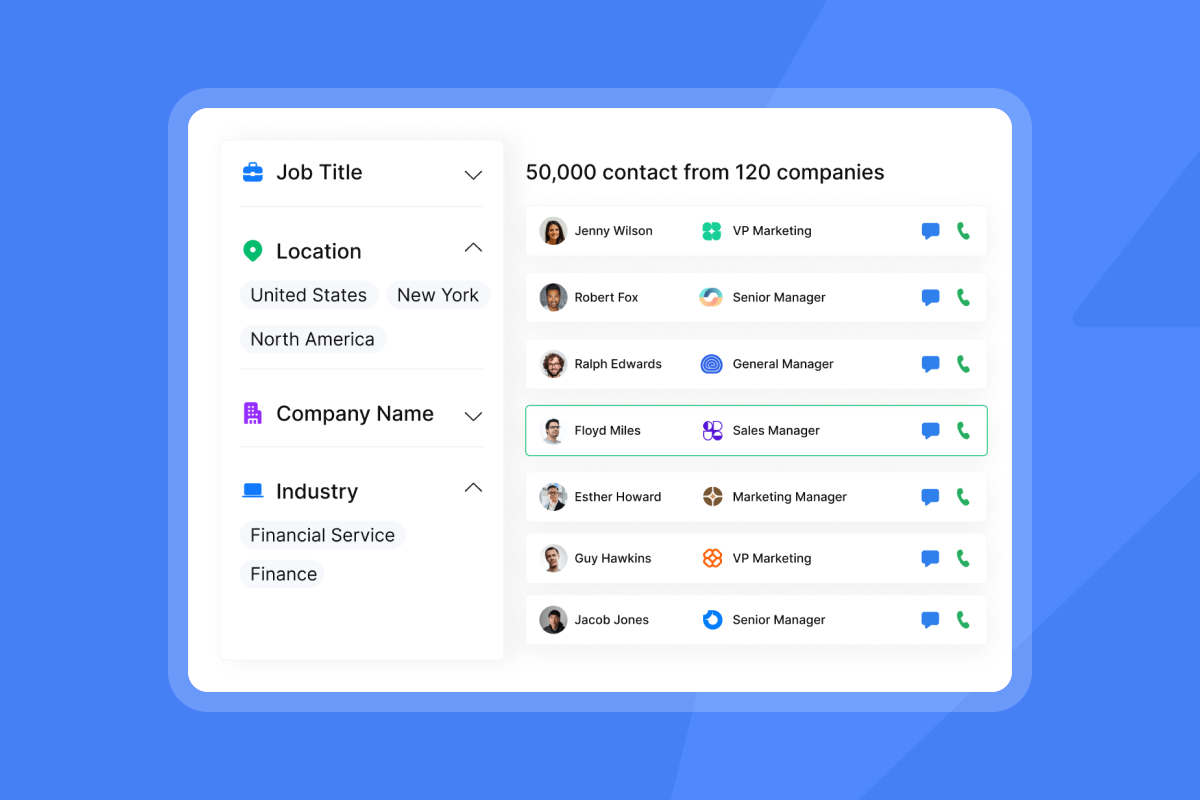
Free access matters during evaluation. A start‑free path lets you test discovery and deliverability before rollout.
Evaluating lookalike tools: Critical considerations for your business
Consider data, deliverability, governance, and the path to booked meetings, not only search capabilities. Use this checklist with your team.
Data quality and hygiene
- Verification hit rate. Favor match and verification rates on your ICP, not global counts.
- Bounce rate reduction. Hold hard bounces at or below 1%. Re‑verify before big sends.
- Freshness and cadence. Ask how often company and contact data refresh and how fast takedowns propagate.
- Deduping and suppression. Validate global block lists and domain‑level suppression to avoid duplicates and customer outreach.
- Waterfall enrichment. Multiple providers reduce single‑source blind spots.
Pricing and ROI
- Model clarity. Flat‑fee vs per‑seat vs credit bundles. Flat‑fee can remove seat math as inboxes grow.
- Total cost of ownership. Include data credits, AI usage, integrations, and warmup costs in one forecast. Instantly’s outreach plans include unlimited email accounts and warmup across tiers.
- Credits math. Know the unit cost. Instantly’s AI Reply Agent consumes 5 credits per reply.
- ROI framing. Use pipeline per dollar and time‑to‑first‑meeting as decisive metrics.
Example ROI frame:
- Inputs: 1,000 verified contacts, two sequence variants, 30 day warmup, placement checks passing.
- Targets: replies, meetings, bounce rate, complaint rate, and booked meetings per 1,000 sends.
Reporting and analytics
- Counting logic. Clear definitions for delivered, opened, replied, qualified, and booked.
- A/B or A/Z testing. Test many variants without harming sender reputation.
- Pipeline tie‑back. Meeting and opportunity attribution that reconciles with CRM.
- Dashboards for leaders. Team‑level views for throughput, reply mix, placement scores, and reputation trends.
Seamless integration and team collaboration
- CRM sync. Field mapping, dedupe rules, and bidirectional updates for HubSpot and Salesforce. API and webhooks support advanced workflows.
- Unified inbox. Centralize replies to reduce missed meetings and speed follow‑ups.
- Admin controls. Templates, global block lists, and send windows at the workspace level.
AI capabilities and ethical use
- Guardrails and review. Human‑in‑the‑loop modes for AI replies and on‑brand outputs.
- Source transparency. Ask how models are trained and how data is sourced.
- Ethical prospecting. Respect opt‑outs and regional constraints, and maintain documentation on your data posture. Instantly publishes a Data Processing Addendum under Foo Monk LLC with sub‑processor details.
Ensuring deliverability and protecting sender reputation
- Warmup at scale. Warm inboxes and domains before production sends.
- Placement testing. Run automated seed tests frequently. Instantly’s Inbox Placement tests and alerts are built in.
- Blacklist and health monitoring. Catch incidents early and pause sends if needed.
- Private deliverability network. Controlled engagement networks matter. Instantly describes a deliverability network of 4.2M+ accounts as part of its warmup approach, as detailed in its agency comparison blog post.
- Authentication and complaint thresholds. Gmail’s 2024 bulk sender requirements call for SPF, DKIM, and DMARC, and complaint rates below 0.3%. See Google’s summary of the Gmail security and authentication update.
- DMARC alignment. DMARC helps align identity across SPF and DKIM and gives receivers enforcement options. See the DMARC specification (RFC 7489).
Cold email at volume carries risk. Build safeguards. Ramp carefully. Keep an incident playbook ready.
Scaling capabilities for agencies
- Unlimited accounts. Scaling across many clients and inboxes should not trigger per‑seat penalties. Instantly includes unlimited email accounts on all outreach plans.
- Workspaces and roles. Separate client data and sequences cleanly.
- Credit planning. Model contact and AI usage against retainer revenue.
Security and privacy considerations
- Legal entity and DPA. Confirm who processes data, the address, and audit rights. Instantly operates as Foo Monk LLC with a published DPA.
- Sub‑processors list. Review provider roster and update policies.
- Compliance posture. Map GDPR and regional requirements to your workflows. Avoid restricted data categories.
- Status transparency. Check the vendor’s public status page for uptime history.
Lookalike tool evaluation table
Use this table during your proof of concept.
| Criteria | Instantly | Standalone lookalike tool | Enterprise SEP |
|---|---|---|---|
| Data and enrichment | SuperSearch with 450M+ B2B leads and waterfall enrichment | Broad company database, mixed enrichment | Often partner data or add‑ons |
| Pricing model | Nano plan starts at $9/mo. Flat‑fee outreach with unlimited inboxes. Credits for data and AI | Credits for data and matches | Per‑seat plus add‑ons, higher TCO |
| Deliverability | Warmup, Inbox Placement tests, blacklist monitoring, private deliverability network claim of 4.2M+ accounts | Minimal deliverability tooling | Some deliverability features, often not warmup‑native |
| AI and automation | Copilot for targeting, AI Reply Agent at 5 credits per reply | Discovery AI only | Workflow AI, heavier ops |
| Integrations | HubSpot and Salesforce via partner, Slack, API, webhooks | CSV and limited native sync | Deep CRM native sync |
| Team scale | Unlimited accounts per plan with admin controls | Single team focus | Strong governance, enterprise price |
Note: Choose based on fit. If primary inbox placement and repeatable execution matter more than multichannel extras, prioritize deliverability systems and verified contacts.
Real‑world impact: Demonstrated outcomes and success stories
Teams that combine discovery with deliverability report faster time to value.
- "Deliverability has been excellent, and the automation features save time." G2 review by James M.
- "The platform is super intuitive, easy to set up." G2 review by Shaiel P.
- "Great deliverability and amazing support." G2 review by Andrei D.
- "We increased our revenue by six figures within 4 months." Trustpilot review by Alexander
- "You can hop on a live chat with a real person in minutes." G2 review by Evan T.
- "Instantly.ai has assisted us in creating outbound email systems that reach your ideal buyer's inbox and foster meaningful connections." Trustpilot review by Richard
You can also watch practical walkthroughs to see the workflow end‑to‑end.
Your next best customers resemble your best
Lookalike company search expands your market by cloning what already works. The formula is simple: sharp ICP, strong seed data, discovery AI that reads real buyer signals, and deliverability you can trust. When tied into a sending engine with private warmup and clear credits, this becomes a repeatable path from search to meeting.
Start a free trial of lookalike discovery and outreach inside Instantly. Use SuperSearch to find similar companies, enrich verified contacts, and launch deliverability‑checked sequences. Book a tailored demo to see a ramp plan for your team.
Further reading & watching
- Instantly product walkthrough: Instantly.ai full tutorial & review by LeadSwift
- Feature spotlight: Done-For-You email setup by Instantly
- Workflow ideas: 5 AI agents every agency needs by Instantly
- Independent review: Instantly AI review 2025 by Speak About Digital
FAQ: Your lookalike company search questions answered
- How big should my seed list be for accurate lookalikes?
25 to 250 strong customer domains is a practical range. Variety matters more than raw count. - What reply and meeting rates should I expect from lookalikes?
Benchmark against your baseline. Track replies and meetings per 1,000 sends with bounces at or below 1%. - How do I keep bounces low with new lookalike lists?
Use verified contacts, re‑verify before send, and pause if hard bounces approach 1%. - Can I automate replies from new lookalike leads safely?
Yes. Use human‑in‑the‑loop AI. Instantly AI Reply Agent responds in under 5 minutes and consumes 5 credits per AI reply. - How do I keep my domain safe while ramping volume?
Warm for 30 days, run Inbox Placement tests, throttle sends by inbox, and monitor blacklist alerts. - Does Instantly include a built‑in lead database?
Yes. SuperSearch lists 450M+ B2B leads with waterfall enrichment and exports to campaigns.
Key terms glossary
- Lookalike companies: Firms similar to your ICP or best customers.
- ICP: Ideal Customer Profile with must‑have traits and no‑gos.
- AI‑driven discovery: Using machine learning to find similar companies.
- ML: Models that learn patterns from past outcomes.
- NLP: AI that reads and interprets website and profile text.
- Waterfall enrichment: Multiple data providers to improve coverage.
- Deliverability: Ability to land in the primary inbox.
- Sender reputation: Trust mailbox providers assign to your domain and IP.
- Warmup: Controlled sending to build sender reputation.
- List hygiene: Ongoing checks that remove risky or stale contacts.
- Verified contacts: Emails confirmed deliverable by a verifier.
- Send windows: Time ranges when your system sends emails.
- Reply rate: Replies divided by delivered emails.
- Booked meetings: Confirmed calendar events from outreach.
- Unified inbox: One place to triage and act on replies.
- Credits: Units for data lookups or AI actions.
- Throughput: Total sends across connected inboxes per period.


