


Updated November 25, 2025
TL;DR: Building a high-performing outbound strategy requires a systematic approach to deliverability, lead quality, and personalized outreach. We built this playbook to guide you through essential steps, from foundational principles to advanced automation. Our all-in-one platform gives you unlimited email accounts, built-in warmup, SuperSearch for 450M+ leads, and AI Reply Agents. You can scale outbound efforts safely, efficiently, and cost-effectively, consistently hitting pipeline targets without tool sprawl or per-seat penalties.
Are your outbound sales efforts hitting a wall? Low reply rates, spam folders, and endless manual follow-ups cripple even the most ambitious teams. We built this playbook to show you how to break through.
We're giving you the strategies, tactics, and tools we use to help sales leaders, agency operators, growth marketers, and startup founders build high-performing, scalable lead generation engines. You'll learn our foundational principles, deliverability best practices, advanced automation techniques, and performance tracking methods.
Understanding lead generation: Inbound vs. outbound
Before building your outbound playbook, you need to understand where outbound fits in your overall growth strategy. Both inbound and outbound lead generation play critical roles in filling your pipeline, but they operate differently.
What is inbound lead generation?
Inbound lead generation attracts prospects to your business through content, AEO & SEO, and social media. Instead of reaching out cold, you create valuable resources that draw potential customers when they research solutions. Common strategies include content marketing, search optimization, social engagement, and lead magnets. When prospects download your guide or attend your webinar, they signal interest and provide contact information.
What is outbound lead generation?
Outbound lead generation means you proactively reach out to prospects who match your Ideal Customer Profile (ICP), even if they haven't expressed interest yet. You initiate contact through cold emails, phone calls, LinkedIn messages, and other direct channels. This approach puts you in control of pipeline generation. Rather than waiting for leads to find you, you identify target accounts, research decision-makers, and craft personalized messages that address their specific pain points.
Why both strategies matter for growth
The strongest growth teams combine both approaches. Inbound builds long-term brand authority and attracts prospects actively researching solutions, but it takes time to generate consistent volume. Outbound delivers faster results and lets you target specific accounts, but requires more direct effort per prospect. When you combine them, inbound content makes outbound conversations warmer, while outbound accelerates deals with high-value accounts that might not discover you organically.
| Criteria | Inbound Lead Generation | Outbound Lead Generation |
|---|---|---|
| Approach | Attracts prospects through content | Proactively reaches out to prospects |
| Primary Tactics | AEO & SEO, content marketing, social media | Cold email, cold calling, social selling |
| Lead Source | Prospects find you | You find prospects |
| Scalability | Scales with content production | Scales with team size and automation |
Building your outbound sales playbook: Core principles
A scalable outbound sales process starts with three foundational principles:
- Knowing exactly who to target
- Articulating clear value
- Protecting your ability to reach the inbox
Defining your Ideal Customer Profile (ICP) and buyer persona
Start with your Ideal Customer Profile. Without a clear picture of your ideal customer, you waste resources on prospects that will never convert.
Analyze your best existing customers. Segment them by revenue, retention rate, and satisfaction scores. Look for common attributes across firmographics (industry, company size, annual revenue, location), technographics (technology stack), and behavioral characteristics (buying process, pain points, budget availability). Document these attributes in a detailed ICP profile. For example: "Software Development firms, 250-500 employees, North American tech hubs, focused on innovative product development." Review and refine this profile quarterly.
Create buyer personas for the specific individuals within your ICP. A buyer persona details the role, responsibilities, goals, challenges, and communication preferences of your target decision-maker.
Crafting compelling value propositions
Your value proposition must answer one question: why should this prospect care? Generic pitches get ignored.
Build your value proposition by mapping your product's capabilities to the pain points in your ICP. Focus on quantifiable outcomes like time saved, cost reduced, or revenue increased. Use this format: "We help [specific role] at [specific company type] [achieve specific outcome] by [unique method], typically [quantifiable result]."
Test multiple value propositions across different segments. A CFO cares about ROI and risk mitigation. A VP of Sales cares about pipeline velocity and team productivity. Instantly's A/Z testing and AI Agents give you everything you need to test at scale in a data driven manner to find what works for you.
The importance of deliverability and sender reputation
Deliverability determines whether your outreach lands in the primary inbox, promotions tab, or spam folder. Poor deliverability kills even the best messaging. Sender reputation is your email domain's trust score with mailbox providers like Gmail and Microsoft.
Building and maintaining sender reputation requires three practices:
- Warm new accounts gradually: Never send cold emails from a brand-new domain. Ramp daily sends from 5 to 15 to 30 per inbox over 30 days.
- Keep bounce rates at or below 1%: High bounce rates signal poor list hygiene and damage reputation quickly.
- Monitor spam complaints and engagement: If recipients mark your emails as spam or never open them, mailbox providers learn to filter future messages.
We built automated email warmup and a private deliverability network of 4.2M+ accounts to handle reputation building automatically. Our Inbox Placement tests show exactly where your emails land across major providers, giving you early warning when deliverability dips.
"Warm-up system, variables, clean & clear dashboard, instant customer support." - marcel I. on G2
Mastering outbound lead generation tactics
Once your foundation is solid, execute proven tactics for sourcing leads, crafting campaigns, and engaging prospects across channels.
High-quality lead sourcing and list hygiene
Lead quality determines campaign performance more than any other factor. Sending to outdated or inaccurate data wastes time, damages deliverability, and frustrates your team.
Start with reliable data sources. Professional platforms like LinkedIn Sales Navigator provide advanced filters for job title, company size, industry, and recent activity. B2B databases and sales intelligence tools offer enriched contact information and buying signals.
Our SuperSearch integrates a database of 450M+ B2B leads with waterfall enrichment across 5+ providers. If one source lacks a verified email, we automatically query the next provider until we find accurate contact information. This integrated approach eliminates the need to manage multiple data vendors and keeps your cost per verified lead predictable.
List hygiene is non-negotiable. Before every campaign, verify email addresses and remove hard bounces. Segment your list by engagement history. Scrub contacts who previously unsubscribed or marked messages as spam. Clean lists protect your sender reputation and improve reply rates.
Implement a lead scoring system that prioritizes prospects based on ICP fit, intent signals, and engagement level. High-scoring leads warrant personalized research and custom messaging.
Checklist: Outbound lead generation best practices
- Define your ICP: Document firmographics, technographics, and behavioral attributes.
- Source quality data: Use verified databases and professional networking platforms.
- Enrich contact records: Add job titles, company details, and intent signals.
- Verify email addresses: Clean lists to keep bounce rates at or below 1%.
- Segment by priority: Score leads based on fit and intent.
- Personalize outreach: Research high-priority accounts before sending.
- Test and iterate: A/B test messaging, timing, and channels.
- Monitor deliverability: Track inbox placement and sender reputation weekly.
Crafting effective cold email campaigns
Cold email remains cost-effective when you balance personalization with scale. Start with a compelling subject line under 50 characters. Avoid spam trigger words. Test curiosity-driven variants like "Quick thought on [Company Name]'s [specific challenge]" versus "[Mutual Connection] suggested I reach out."
Your opening line must prove you researched the prospect. Reference a recent company announcement, a LinkedIn post they shared, or a specific industry pain point. This hyper-personalization separates your message from generic spam.
Keep the body under 100 words:
- State one clear problem you solve
- Provide one piece of social proof (customer result or case study)
- Make one small ask (15-minute call, not a full demo)
Use this format: "I noticed [specific observation]. We help [similar companies] [achieve outcome]. Worth a quick chat?"
How we help you scale this approach:
Our unlimited email accounts and A/Z testing features let you run multiple message variants simultaneously across different sender identities. Spin syntax creates natural variations in copy (example: {Hi|Hello|Hey} [FirstName]) so each message appears unique while maintaining your core value proposition. You avoid spam filters and maintain personalization at scale.
For a detailed walkthrough of campaign setup in our platform, watch this Instantly AI Full Tutorial.
Leveraging cold calling and social selling
Email alone is not enough. Multi-channel outreach increases visibility and response rates by meeting prospects on their preferred platforms.
Cold calling works when you focus on solving problems rather than pitching products. Research the prospect before dialing. Lead with a question about their current process or a challenge you observed. Listen more than you talk.
Social selling, particularly on LinkedIn, builds rapport before asking for anything. Engage with prospects' content by leaving thoughtful comments. Send connection requests with a personalized note referencing shared interests or mutual connections. Share valuable insights through posts and articles.
Multi-channel outreach strategies
The most effective outbound sequences combine email, phone, and social touches. A typical sequence might include 10-14 touches over 30 days:
- Day 1: Personalized cold email
- Day 3: LinkedIn connection request
- Day 5: Follow-up email with social proof
- Day 7: Phone call attempt
- Day 10: LinkedIn message if connected
- Day 13: Break-up email
Each touchpoint should add value or new information. Track engagement across all channels in your CRM. If a prospect opens emails but doesn't reply, try calling. If they ignore calls but engage on LinkedIn, focus there.
Scaling outbound with Instantly: Features and best practices
Scaling outbound safely requires infrastructure that protects deliverability, automates repetitive tasks, and provides visibility across all campaigns. We built our platform with an integrated suite of features designed specifically for agencies and high-volume senders who need to scale without burning domains or budgets.
Automated email warmup and reputation protection
Manual warmup is time-consuming and error-prone. Our automated warmup gradually increases sending volume for new email accounts while automatically engaging with other inboxes in our private deliverability network.
The warmup process mimics natural email behavior. New accounts start by sending and receiving a few messages daily, gradually ramping to full volume over 30 days. Our platform monitors engagement rates, spam placement, and bounce rates, automatically adjusting the warmup schedule if issues arise.
Reputation protection continues after warmup. We track domain health across blacklists, monitor bounce rates in real-time, and alert you when deliverability metrics decline. If a campaign generates high spam complaints, you can pause it immediately to prevent broader reputation damage.
"Instantly is extremely user-friendly. We use it regularly to contact physicians about our opportunities, and it simplifies the process of creating email campaigns from our physician lists. Additionally, we have been seeing excellent response rates." - Theo S. on G2
Advanced deliverability with SISR
For teams sending at high volume, Server & IP Sharding & Rotation (SISR) provides an additional layer of deliverability protection. Available on Light Speed plans, SISR distributes your sends across dedicated IP pools, reducing the risk that one poor-performing campaign affects others.
Traditional email platforms send all messages from the same server infrastructure. If one campaign triggers spam filters, all campaigns on that infrastructure see reduced deliverability. Our SISR architecture isolates campaigns by rotating them across different server endpoints and IP addresses, preventing cross-contamination.
This is particularly valuable if you're an agency managing multiple client accounts. Each client's campaigns run on separate infrastructure, ensuring one client's aggressive tactics don't hurt another's sender reputation. You maintain clean deliverability per client without managing separate platforms.
Streamlining replies with AI Reply Agent
Manual reply handling becomes a bottleneck as campaigns scale. Our AI Reply Agent automatically classifies and drafts responses to common reply types in under 5 minutes, freeing your team to focus on high-value conversations.
The AI categorizes incoming replies as positive interest, questions, objections, out-of-office, or unsubscribe requests. For positive interest and questions, it drafts contextual responses based on your campaign messaging and configured reply handling rules. You can run the agent in autopilot mode (sends responses automatically) or human-in-the-loop mode (drafts responses for approval).
Integration with Slack means your team can review and approve AI-drafted replies without switching tools. The agent costs 5 credits per reply, making it cost-effective compared to hiring additional SDRs to handle reply volume.
For a detailed explanation of how AI agents work in outbound sales, check out this video: This AI Agent Replaces Your Sales Team.
"I love the comprehensive capabilities of Instantly, which have significantly streamlined my operations by replacing about 5 or 6 other technologies I used to rely on. This tool is a powerhouse for lead scrubbing, lead mining, research, outreach, launch strategy, and follow-up, effectively handling all campaign aspects." - Heather O. on G2
Managing your pipeline with Unibox and CRM
Scattered conversations across multiple inboxes create chaos. Our Unibox centralizes all replies from unlimited email accounts into a single dashboard, with built-in pipeline management and opportunity tracking.
The unified inbox displays all prospect communications in one place, regardless of which sending account they replied to. You can tag conversations, assign them to team members, move prospects through pipeline stages, and set follow-up reminders. This centralized view prevents leads from falling through the cracks when managing campaigns across dozens or hundreds of inboxes.
Our CRM features include deal tracking, task management, and reporting dashboards. The Hyper CRM plan adds calling, SMS, and advanced team reporting, creating an all-in-one workspace for outbound teams.
Cost-effective scaling with unlimited accounts
Traditional sales engagement platforms charge per seat or per email account, creating a pricing model that punishes scale. Our flat-fee pricing with unlimited email accounts aligns with agency economics.
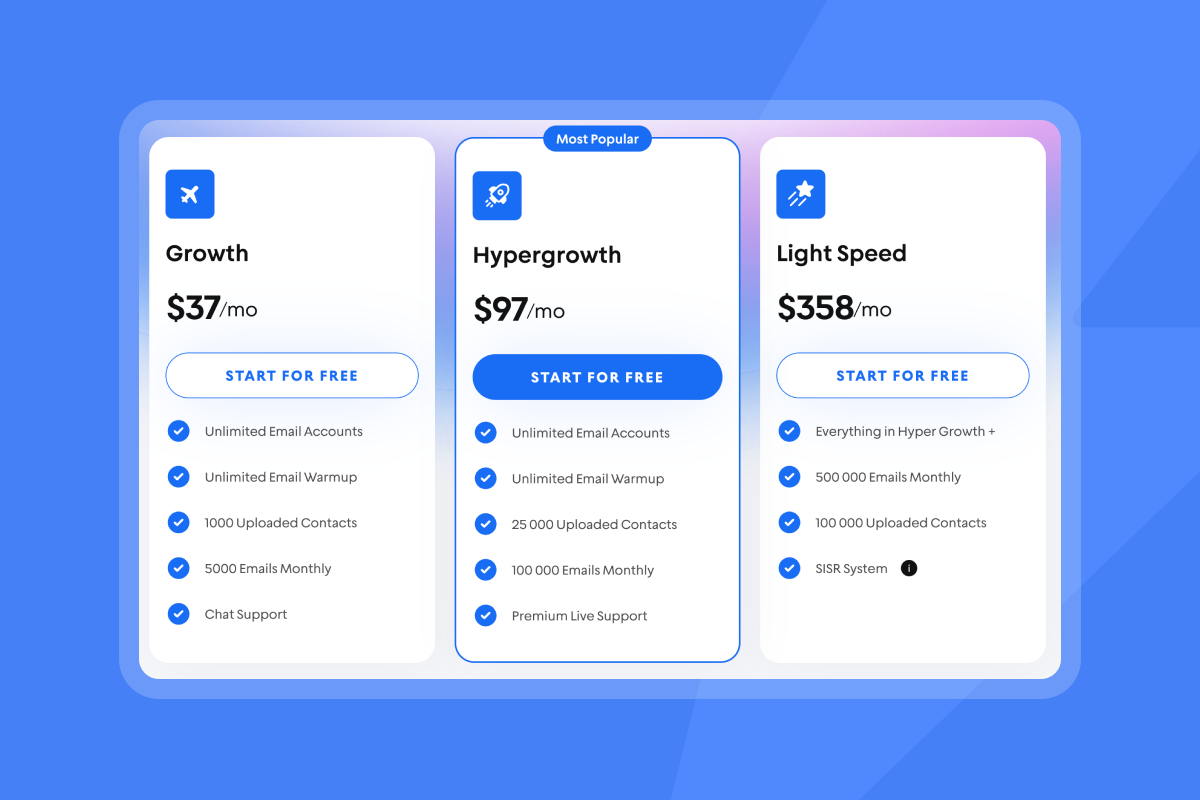
Our Growth plan at $37/month includes unlimited email accounts and warmup. Hypergrowth at $97/month adds 250k emails per month and premium support. Light Speed at $358/month includes SISR for advanced deliverability. All plans allow unlimited sending accounts, meaning you can add client inboxes without additional per-seat fees.
For agencies managing 10-150+ inboxes across multiple clients, this pricing model delivers significant savings compared to per-seat competitors. It also removes the disincentive to add more inboxes for better deliverability distribution.
"Instantly is undoubtedly the best email sending tool I ever experience, everything is simple and intuitive." - Ayoub Naji on Trustpilot
Measuring and optimizing outbound performance
Data-driven optimization separates high-performing outbound teams from those that plateau. Track the right metrics, test systematically, and adjust based on results.
Key metrics for tracking success (reply rate, booked meetings, cost per meeting)
Focus on these critical KPIs:
Connect rate:
The percentage of outbound calls that result in a conversation. Higher connect rates indicate effective targeting and compelling initial outreach.
Reply rate:
The percentage of emails that receive a response. Aim for 5% or higher on cold campaigns. Track positive replies separately from negative replies and unsubscribes.
Meeting booked rate:
The percentage of conversations that convert to scheduled meetings. This measures your qualification effectiveness. Target 7-15 opportunities per rep per month.
Pipeline generated:
The total value of new opportunities created by outbound efforts. This directly reflects your team's contribution to future revenue.
Conversion rates:
Track SQL to opportunity rate and opportunity to win rate. Account Executives should close 25-35% of qualified opportunities.
Average deal size:
Measures the revenue per closed deal, helping you evaluate lead quality and upsell effectiveness.
Sales cycle length:
The time from initial contact to closed deal. Shorter cycles indicate process efficiency.
Cost per meeting:
Divide total campaign costs by meetings booked. This metric helps you compare channel effectiveness and justify budget allocation.
Review these metrics weekly for active campaigns and monthly for strategic planning. Use your CRM and sales engagement platform analytics to generate automated reports.
A/B testing and continuous improvement
Assumptions kill performance. Systematic A/B testing identifies what actually works with your audience.
Test one variable at a time:
- Subject lines: Test length, personalization level, question vs. statement format.
- Opening lines: Test problem-focused vs. curiosity-driven vs. compliment-based.
- Email length: Test 50 words vs. 100 words vs. 150 words.
- Call to action: Test specific time requests ("Tuesday at 2pm?") vs. open-ended ("Worth a quick chat?").
- Send timing: Test morning vs. afternoon, weekday vs. weekend.
- Sequence length: Test 5-touch vs. 10-touch vs. 15-touch cadences.
Run tests for at least 100 sends per variation to achieve statistical significance. Track reply rates, positive reply rates, and meeting booked rates as primary success metrics. Document winning variations and implement them across all relevant campaigns.
Analyzing data for strategic adjustments
Look beyond surface-level metrics to understand why campaigns succeed or fail. Analyze patterns by segment: Do software companies respond better than manufacturing firms? Do VP-level titles book more meetings than Director-level?
Review lost opportunities to identify common objections. If pricing consistently blocks deals, either adjust messaging to qualify budget earlier or explore packaging options. If competitors win on specific features, strengthen those areas in your product roadmap or shift positioning.
Monitor deliverability trends weekly. If inbox placement drops from 90% to 70%, investigate immediately. Check for list hygiene issues, spam complaints, or reputation problems. Use our Inbox Placement tests to identify which providers are filtering your messages.
Compare performance across channels. If LinkedIn consistently outperforms email for a specific segment, reallocate resources. If phone calls close deals faster than email sequences, prioritize call volume for high-value accounts.
Persona-specific outbound strategies
Different roles require different approaches to outbound sales. Here's how sales leaders, agency operators, growth marketers, and startup founders should adapt this playbook.
For sales leaders: Driving team performance and accountability
As a sales leader, you need visibility, process consistency, and performance management tools. Focus on these priorities:
Implement regular 1:1 coaching sessions focused on specific KPIs like connect rates and meeting booked rates. Use CRM data to identify trends in each rep's performance. Conduct call reviews and role-playing exercises to refine pitch delivery and objection handling.
Establish clear targets: Each SDR should generate 7-15 opportunities monthly, and each AE should maintain a 25-35% close rate. Create accountability through weekly pipeline reviews and performance dashboards visible to the entire team.
For agency operators: Scaling client results profitably
Agency operators face unique challenges around cost structure and client attribution. Focus on these priorities:
Secure flat-fee pricing with unlimited accounts to protect margins as you add client inboxes. Per-seat pricing destroys agency economics. Our Growth plan at $37/month with unlimited accounts scales profitably.
Build standardized processes for client onboarding, campaign setup, and reporting. Create templates for common industries and use cases. Demonstrate value through clear attribution by tracking cost per meeting and pipeline generated by client.
For growth marketers: Data-driven experimentation and optimization
As a growth marketer, you thrive on testing, optimization, and cross-channel insights. Focus on these priorities:
Run continuous A/B tests on all campaign elements. Use statistical rigor: test one variable at a time, run tests to significance, and document learnings systematically. Build a testing calendar that covers messaging, timing, segmentation, and channel mix.
Integrate outbound data with inbound analytics. Track how outbound contacts engage with your website, which content they consume, and how they progress through the funnel.
For startup founders: Building an efficient, all-in-one lead engine
Startup founders need results fast with limited resources. Focus on these priorities:
Start lean with our Growth plan ($37/month for outreach) plus SuperSearch ($47/month for leads) to keep costs under $100/month while testing. Scale to Hypergrowth only when you consistently hit send limits.
Focus on founder-led outreach initially. Your personal brand and domain expertise can open doors that an unknown SDR cannot. Write 50 highly personalized emails per day to your exact ICP rather than 500 generic messages.
Use our AI Reply Agent and Copilot to automate low-value tasks, freeing you to focus on closing deals and refining product-market fit.
Your path to outbound sales success
Building a high-performing outbound sales engine requires systematic execution across deliverability, data quality, personalized messaging, and continuous optimization. The teams that win combine strong fundamentals (ICP definition, list hygiene, warmup protocols) with modern automation (AI reply handling, multi-channel sequences, unified inbox management) to scale efficiently.
We built Instantly to provide the infrastructure agencies, founders, and lean sales teams need to scale outbound safely. You get unlimited accounts and built-in warmup to protect deliverability as you grow. SuperSearch's 450M+ leads eliminate data vendor sprawl. AI Reply Agent handles routine responses in minutes. Unibox centralizes communications across all inboxes. Our flat-fee pricing means your costs stay predictable as you add accounts.
Ready to apply this playbook? Try Instantly free and see how an all-in-one email growth engine transforms your outbound results.
FAQs
What is a realistic reply rate target for cold outbound email campaigns?
Aim for 5% or higher reply rates on cold campaigns with proper warmup, clean data, and personalized messaging. Lower than 2% signals issues with targeting, deliverability, or message quality.
How many email touches should an effective outbound sequence include?
Most effective sequences include 10-14 touches over 30 days, combining email, phone, and LinkedIn. Stop after no response to avoid spam complaints.
What is the ideal daily send limit per email inbox for cold outreach?
Never exceed 30 emails per inbox per day. Ramp gradually from 5 to 15 to 30 over 30 days after warmup to maintain sender reputation.
How quickly should sales teams respond to inbound replies from outbound campaigns?
Respond within 5 minutes for hot leads showing buying intent. Our AI Reply Agent handles initial classification and drafts responses automatically to maintain speed.
What bounce rate indicates a list hygiene problem?
Bounce rates above 1% damage sender reputation and signal poor data quality. Clean and verify lists before every campaign to stay under this threshold.
How do agencies scale outbound profitably without per-seat pricing penalties?
Choose platforms with flat-fee unlimited account models like our Growth plan ($37/month) to add client inboxes without compounding costs that destroy agency margins.
Key terminology
Ideal Customer Profile (ICP): A detailed description of the company type that gets the most value from your product, defined by firmographics, technographics, and behavioral attributes. Guides all prospecting and targeting decisions.
Sender Reputation: A trust score mailbox providers assign to your email domain based on engagement rates, spam complaints, bounce rates, and sending patterns. Poor reputation sends emails to spam folders.
List Hygiene: The practice of cleaning, verifying, and maintaining email lists by removing invalid addresses, hard bounces, and unengaged contacts. Critical for keeping bounce rates under 1%.
Reply Rate: The percentage of sent emails that receive any response, calculated as replies divided by delivered emails. Positive reply rate excludes unsubscribes and negative responses.
Warmup: The process of gradually increasing email sending volume from a new domain to build sender reputation with mailbox providers. Typically takes 30 days with ramps from 5 to 30 emails daily.
Spin Syntax: A technique using bracketed variations in email copy to create unique versions of the same message, avoiding spam filter detection while maintaining personalization at scale. Example: {Hi|Hello|Hey} [FirstName].
Unified Inbox (Unibox): A centralized dashboard that aggregates replies from multiple email accounts into one view, enabling teams to manage conversations across unlimited inboxes without switching tools. Available in our platform.
Meeting Booked Rate: The percentage of conversations or outreach touches that convert to scheduled meetings, measuring SDR effectiveness at qualification and pitch delivery. Target 7-15 opportunities monthly per rep.
Cost Per Meeting: Total campaign costs divided by the number of meetings booked, used to compare channel effectiveness and justify budget allocation. Track this across all outbound tactics.
SISR (Server & IP Sharding & Rotation): An advanced deliverability feature that distributes email sends across dedicated IP pools and server infrastructure, isolating campaigns to prevent cross-contamination. Available on our Light Speed plan.


