


Strong outbound sales email templates are built on proven systems. High-quality lead data, contextual personalization, clear timing, and low-friction CTAs matter more than wordsmithing.
The best-performing templates follow proven frameworks, adapt to specific segments, and evolve through testing. Treat templates as flexible blueprints and scale what earns replies.
Cold email is still the fastest and most controllable way to add qualified prospects to your outbound sales pipeline. It scales cleanly, it’s easy to test, and it doesn’t require paid traffic to work.
The mistake most teams make is using templates poorly. Outbound sales email templates are meant to give you structure. The best teams treat templates as flexible frameworks. They adapt them to timing, context, and intent, then repeat what works.
Below, we'll break down how to build and use outbound sales email templates that earn replies. Not by copying scripts word for word, but by understanding the mechanics behind relevance, personalization, timing, and low-friction asks.
What Makes a Good Outbound Sales Email Template?
There's no “secret sauce” when it comes to outbound sales emails. The best teams repeat what works at scale. You’ll have to do a bit of testing yourself to find what’s best for your workflow and the audience you’re trying to connect with.
But you don’t have to start from scratch. There are reliable frameworks and fundamentals that any team can use to improve their outbound sales email campaigns. Here’s what to look into:
Quality Lead Data and Enrichment
Before examining the examples, it’s essential to note that effective emails begin with the lead generation process. Remember, great copy won’t matter if you’re targeting the wrong people, sending emails to outdated addresses, and getting sent to spam due to a lack of relevance.
With Instantly SuperSearch, you can create high-quality and pre-verified lead lists that match your ideal customer profile (ICP).
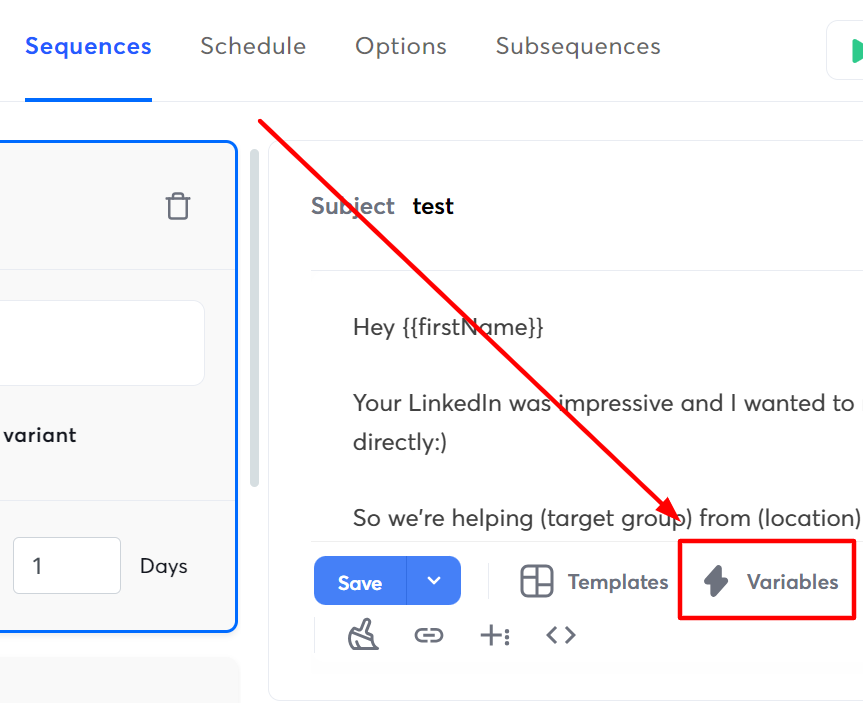
You can also enrich your lead list to get in-depth information, which you can use as {{custom variables}} when personalizing your sales email.
Subject Lines That Create Intrigue Through Value
To get people to open your email, start by writing winning subject lines. Ask yourself what’s most important for your prospects and what you can provide that aligns with that. This combination creates both intrigue and value.
Let’s say your prospect is a dental practice owner struggling to keep chairs full. A weak subject line might be something generic like “Quick question” or “Marketing services for your practice.”
A stronger value-driven subject line would look like:
- Playbook + outcome + handling objection: “3 ways to add 20+ new patients this month without ad spend.”
- “Simple Tweak” + Tangible Benefit: “The simple follow-up tweak that adds $10k+ in monthly production.”
- “Stop & Think” Pattern (Warning + How to Fix): “Before you spend more on Google Ads, read this.”
Contextual Personalization, Relevance, and Value in Email Body
Subject lines get prospects interested enough to open an email. The email body is what turns interest into action. That starts with creating an outbound sales email that feels one-on-one. The best way to achieve this is through contextual personalization.
This type of personalization leverages lead data to create unique selling points tailored to each prospect. You can do this at scale with the help of AI email personalization tools. Let’s look at this example using ChatGPT:
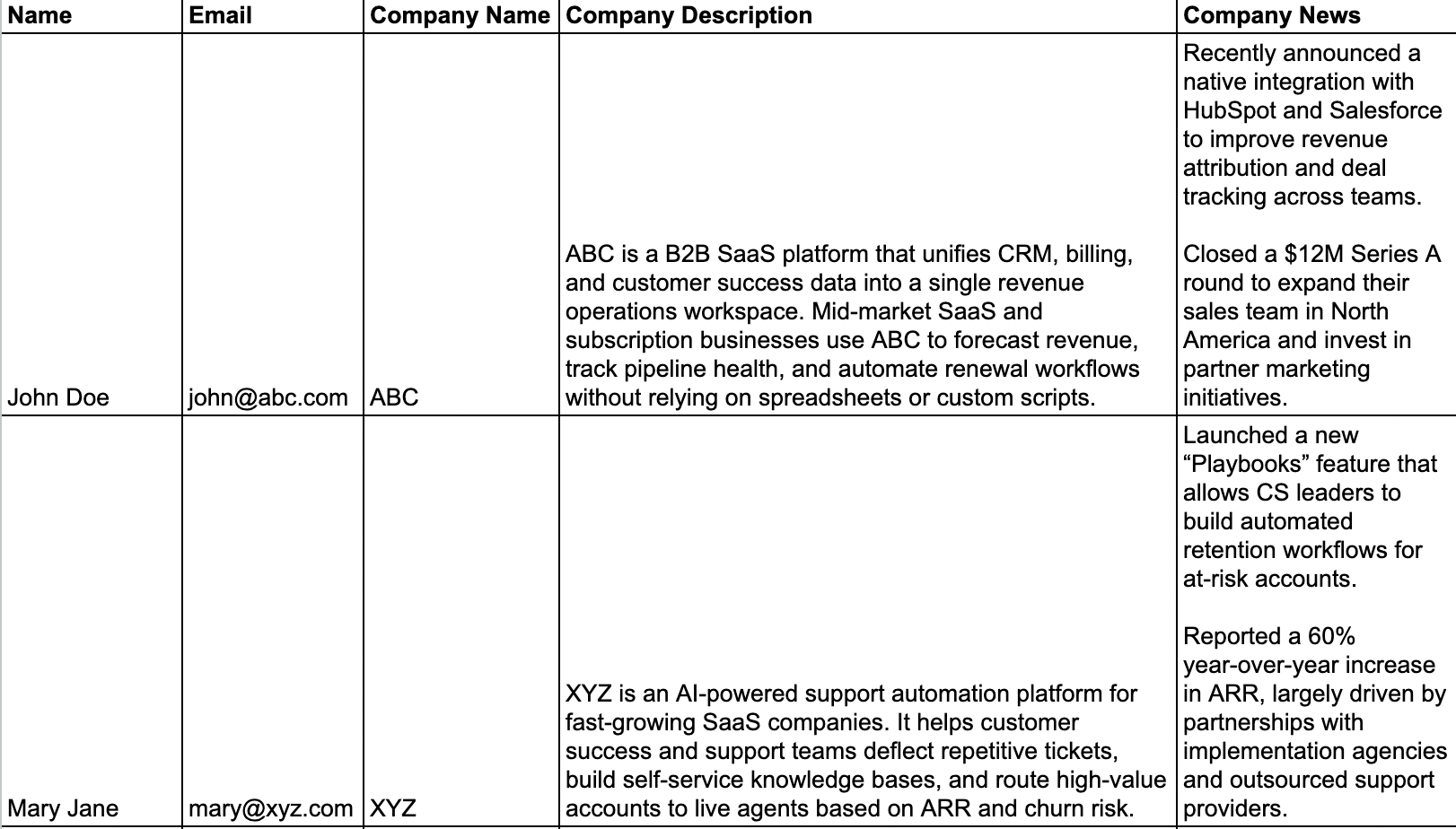
Based on the example company description and recent news, we asked ChatGPT to generate two new columns, {{value proposition}} and {{pain point}}, which we can plug into Instantly’s email editor as {{custom variables}}.
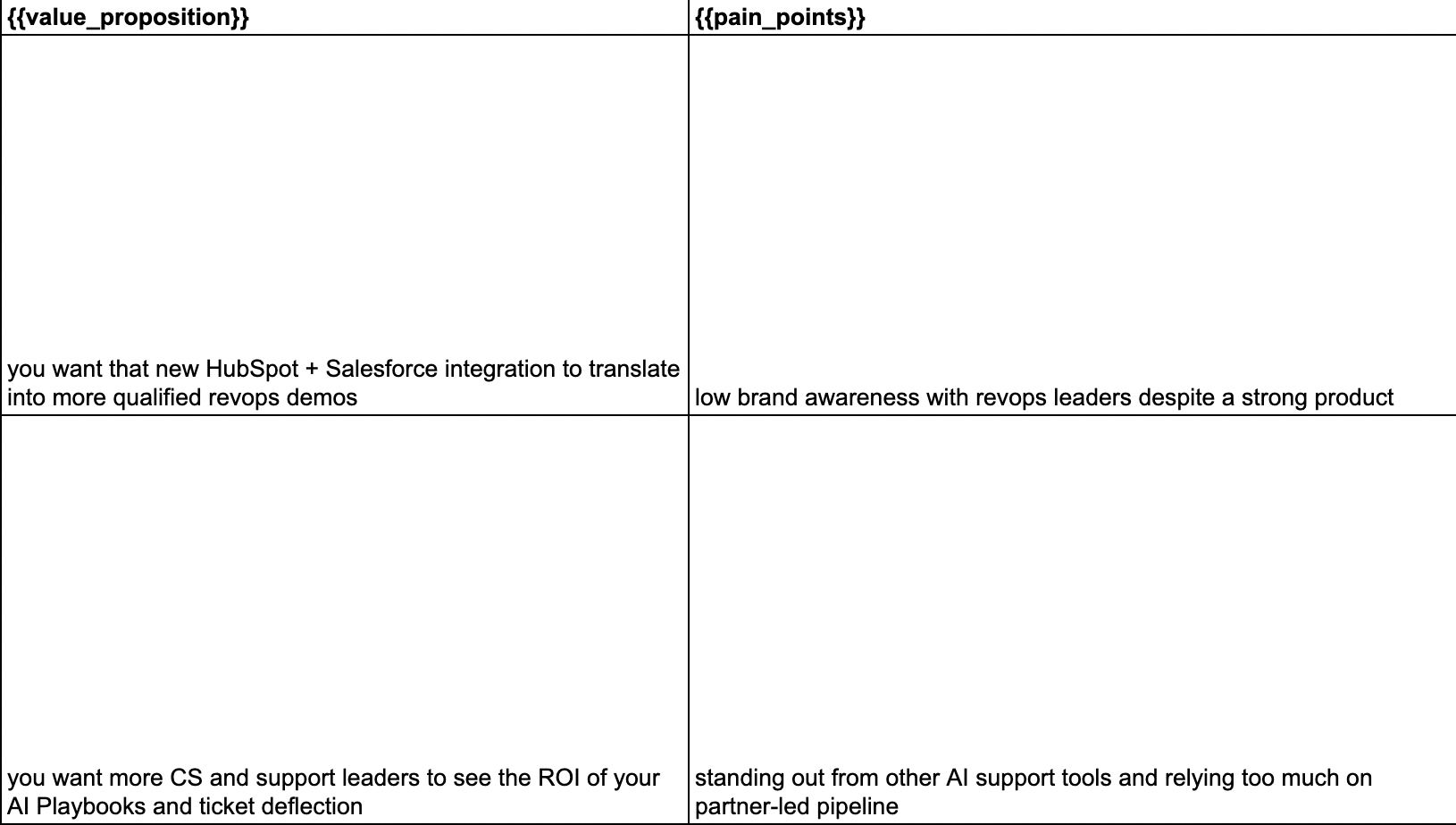
So if you have a sales email template that looks like this:
Hey, {{first name}},
Congratulations on the {{recent company news}}! I'm reaching out today because {{value proposition}}. We've helped companies like {{company name}} deal with {{pain point}}.
The final email your prospects see would look something like:
Hey, John,
Congratulations on the partnership with HubSpot. I’m reaching out today because you’re scaling your sales team and need more qualified demos every month. We’ve helped companies like ABC improve brand awareness with RevOps leaders...
Low-Friction Call-to-Actions (CTAs)
A sale or a closed deal is the end goal. However, it’ll take more than one email to go from cold prospect to client. Instead of going immediately for the hard sell, use low-friction CTAs instead. These are easy, no-brainer CTAs that help you keep the conversation going.
For example, instead of asking, “Do you have 30 minutes next week for a demo?” you might say, “Would it be worth sending over a 2 to 3-sentence teardown of how we’d improve your current outbound?”
Timing (When and Why You’re Sending)
Outbound emails that get replies are anchored to the question “Why now?” There should be context as to why you’re sending an email at the moment that you do. For example, a prospect might have completed a funding round, experienced a hiring spike, or launched a feature.
When your message lines up with something that’s already happening in their world, it feels timely, relevant, and harder to ignore than a vague, evergreen pitch.
And the best way to answer the “when” and the “why” is through enriched lead data. The best combination for that is Instantly & Clay for lead enrichment and personalization.
Best Outbound Sales Email Template Worth Replying To
If you’re looking to scale outbound sales through cold email, you’ll need to segment your lead list first. Each segment should have its own template. This helps you create emails that feel 1:1. Here are example templates and segments you can work with:
Problem + Reframing + Solution
Most people already have their own biases and established beliefs about the things in their lives and work. Sometimes, the best way to get their attention is by challenging that belief. You don’t repeat what they think is true. Instead, you reframe their beliefs first.
Let’s set the stage. Say you’re part of a digital marketing agency that helps contractors and local businesses get more customers for their services.
Subject line: Is {{old strategy}} holding you back?
Hey {{first name}},
Problem: HVAC suppliers have strong relationships with reps, distributors, and trade shows, so it’s easy to assume that’s “good enough” for demand. The pattern I keep seeing is that even with solid relationships, prospects often fail to find {{company}} when searching, comparing brands, or pricing out projects online.
Reframing: So, the real issue isn’t just “more leads”; it’s that a lot of quiet digital demand never reaches your sales team.
Solution: We help HVAC suppliers turn that invisible demand into booked conversations by building targeted landing pages, SEO around high-intent searches, and follow-up campaigns that drive contractors back to your reps instead of to competitors.
Would it be a bad idea if I sent over a quick 2–3 sentence teardown of how I’d improve {{company}}’s online presence for contractors in your region?
Best,
{{your name}}
Audit Insight + Gap Highlight + Next Step
Sometimes the easiest way to earn a reply is to show you’ve done your homework. With this framework, you lead with a quick audit insight, show the gap that insight reveals, and then provide a clear next step that feels light and specific.
You're pointing to something tangible that you can see from the outside, then connecting it to a missed opportunity, and offering a small, concrete action they can say yes to. You can structure it like this:
Subject line: Quick audit of {{company}}’s {{channel}}
Hey {{first_name}},
Audit insight: I took a quick look at {{company}}’s {{channel you checked}} and noticed you are already getting solid {{signal}} from {{source}}. For example, {{short specific observation you can see from the outside}}.
Gap highlight: What stood out is that there is no clear path from that interest to a sales conversation. Right now, a lot of people who raise their hand by {{behavior you saw}} never get guided toward {{desired action}}. That is likely leaving {{type of outcome}} on the table each month.
Next step: I can send over a short audit with 2–3 specific tweaks I would make to turn that existing interest into booked calls for your team. It would be tailored to {{company}} and take you about 3 minutes to skim.
Would it be a bad idea if I sent that over?
Best,
{{your name}}
Outcome + Social Proof + Curiosity Hook
This framework works well when you already have results or wins you can reference. You lead with a clear outcome, back it up with social proof, then end with a curiosity hook that makes replying feel natural.
You show how you helped someone similar get a result they care about. Then you invite them to lean in with a small question that opens a loop in their mind.
Subject line: How we added {{outcome}} for a {{prospect-type}} like {{company}}
Hey {{first name}},
Outcome: We recently helped a {{company lookalike}} go from {{starting point}} to {{specific result}} in about {{timeframe}} by {{strategy}}.
Social proof: They were in a similar spot as {{company}}. Strong {{strengths}}, but missing {{gap}} in their {{process}}. After updating {{specific thing you did}} and adjusting {{second thing}}, they saw {{outcome}} month over month.
Curiosity hook: I noticed a few of the same patterns on {{company}}’s {{channel you checked}}. Out of curiosity, would it be helpful if I shared the one change that made the biggest difference for them?
Best,
{{your name}}
With Instantly SuperSearch, you can find prospects similar to your current or past clients using the Lookalikes filter.
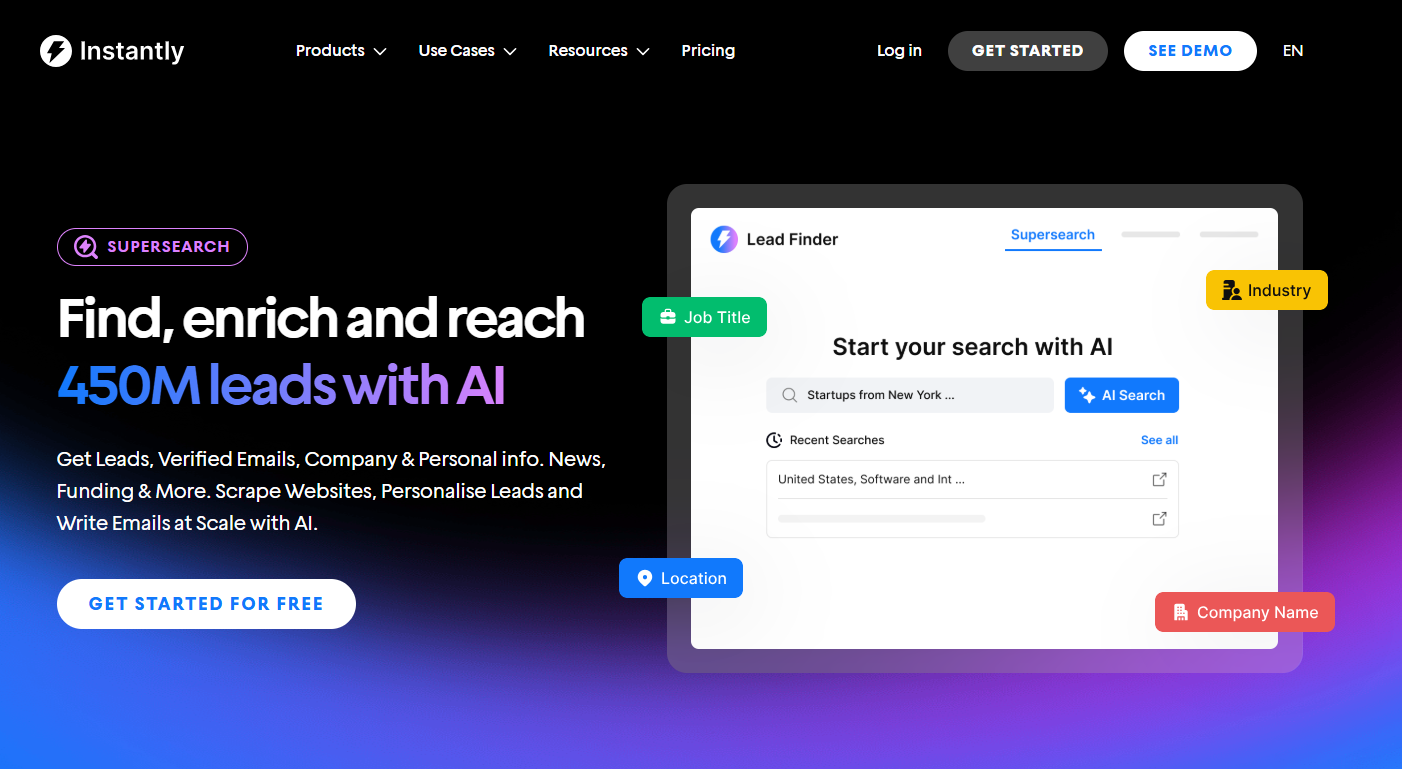
You gain access to over 450 million B2B leads, each already pre-verified and ready for contact.
Personal Trigger + Hypothesis + Binary Question
We can’t really know what’s going on inside a prospect’s business from the outside. The dashboards, internal debates, and real bottlenecks are all behind the curtain. But we can make a strong guess based on something specific they’ve done, such as:
- Hiring for a new position
- A Product launch
- Location expansion
- Pricing change.
That “personal trigger” gives you a reason to reach out and a foundation for a sharp hypothesis about their priorities. With this framework, you don’t pretend to know everything. You’re leading with the right questions that get you through the door.
Subject line: Saw the {{trigger}} at {{company}}
Hey {{first name}},
Personal trigger: I noticed {{company}} recently {{opened a new office in {{region}}. That usually means {{short, reasonable interpretation of what that implies}}.
Hypothesis: I might be wrong here, but when teams hit this stage, {{common challenge}} often becomes the main bottleneck. My hunch is that you are trying to {{specific goal}} without {{objection or constraint}}.
Binary question: Am I even close? If so, would it be a bad idea if I sent 2–3 ideas on how teams in a similar spot are handling this?
Best,
{{your name}}
Risk Reversal + Specific Outcome + Low-Friction Trial
This framework is perfect when you know your prospect is skeptical or burned by previous vendors. You lower their guard by removing risk, naming a specific outcome, and proposing a small test that is easy to say yes to. You are basically saying:
“I know you have every reason not to trust another vendor. Here is a clear result we would go for, a small way to test it, and you can walk away if it does nothing.”
Subject line: Try this for {{timeframe}}. If it does nothing, walk away.
Hey {{first name}},
Risk reversal: I know you probably get a lot of emails promising “more {{leads/customers/revenue}}.” If this is not useful, you should not work with us. Simple as that.
Specific outcome: The only reason I am reaching out is because I can see a path to adding {{X measurable result}} for {{company}} over the next {{timeframe}} by tightening up {{lever you pull}}.
Low-friction trial: If you are open to it, we can run a small test together. One narrow play, over {{short timeframe}}, with a clear success metric. If it does not move the needle, we part ways. If it does, you will know exactly what working together looks like before making a bigger decision.
Are you available for a brief 10-minute call next week to discuss this?
Best,
{{your name}}
Key Takeaways
Outbound sales email templates serve as a starting point. What’s more important is understanding what your audience truly needs. From there, you can build your own templates and scale what works.
If you want to automate the process and make the most of your templates, you’ll need an email automation tool that can create and use {{custom variables}} for your sales team. Start your free Instantly trial.


