


Updated November 15, 2025
TL;DR: Outsourced appointment setting can scale your B2B meetings, but success hinges on choosing the right service model and provider. Sales leaders must evaluate providers based on their process transparency, deliverability strategies, data quality, and reporting accuracy. The three main pricing models are pay-per-meeting ($15-100 per appointment), monthly retainer ($3,000-$5,000+ per month for dedicated resources), and pay-per-lead (volume-focused but quality varies). Critical evaluation criteria include deliverability infrastructure, lead sourcing methods, reporting transparency, pricing clarity, CRM integration depth, and compliance posture. Instantly's platform provides the foundational tools to either power your internal team or provide auditable infrastructure for your outsourced partner, ensuring primary inbox placement and predictable meeting generation.
If you're a Head of Sales or RevOps leader managing 3-15 reps at a B2B company and evaluating outsourced appointment setting to scale pipeline without expanding headcount, this guide gives you the criteria, pricing models, and infrastructure requirements to choose wisely and avoid common traps.
Why sales leaders consider outsourced appointment setting
Your sales team needs more qualified meetings to hit pipeline targets, but building or scaling an internal SDR function takes months, requires significant training investment, and ties up capital in salaries, benefits, and technology before you see a single booked demo.
Outsourcing appointment setting addresses three specific constraints that sales leaders face when trying to scale meeting generation.
Scaling challenges: Internal team limitations and cost
Hiring, training, and ramping a new SDR takes 2-4 months before they consistently deliver qualified meetings. During that period, you pay full salary and benefits while productivity remains low. Outsourced appointment setting services bypass these upfront costs entirely, delivering experienced setters who already know cold email best practices, qualification frameworks, and objection handling.
The economics favor outsourcing when you need results quickly. Internal teams require investment in CRM licenses, sales engagement platforms, data providers, and dedicated management time. According to Callbox's research, established outsourced appointment setting providers bring pre-built processes, advanced technologies, and access to experienced SDRs, reducing ramp time from 90-120 days (typical internal hire) to 30-45 days and cutting time-to-first-meeting by more than half.
"Instantly have gone out of their way to create resources to help understand how to use the platform. It did not take me long to get up to speed with it all. Customer service is great, they answer my questions and help me along the way." - Manikaa on G2
Focus on core competencies: Freeing up AEs for closing
Your Account Executives close deals more efficiently when they spend less time on prospecting and initial outreach. According to SalesRoads' sales productivity research, internal sales teams stretched between prospecting, nurturing, and closing see reduced overall efficiency across all three activities. Typical costs for outsourced services range from $15 to $100 per appointment, depending on your industry complexity and the qualification level required.
Outsourced setters handle the resource-intensive early stages of lead qualification, allowing your AEs to focus on live conversations with prospects who have already expressed interest, understand your value proposition, and meet basic qualification criteria. This specialization shortens sales cycles and improves conversion rates because each role concentrates on what it does best.
Access to expertise: Specialized setters and market knowledge
Experienced appointment setting providers bring proven playbooks, established best practices, and industry-specific messaging that would take months to develop internally. Providers who specialize in your industry arrive with market knowledge about buyer personas, common objections, and effective positioning. They understand which decision-makers to target and how buying committees operate in your sector, reducing the learning curve that internal hires face.
Understanding outsourced appointment setting models
Three primary service models dominate the outsourced appointment setting market, each with distinct cost structures, risk profiles, and alignment with different business goals.
Pay-per-meeting: How it works, pros, and cons
Pay-per-meeting (PPM) or pay-per-booking models charge you only for qualified appointments that show up on your calendar, with pricing varying based on industry complexity and qualification requirements.
Pros:
- Direct ROI alignment: You pay only for tangible outcomes, making budget justification straightforward.
- No upfront commitment: Most PPM arrangements require no initial payment, reducing financial risk.
- Clear accountability: The provider owns meeting quality because their revenue depends on it.
Cons:
- Volume over quality risk: Providers might prioritize booking quantity over true qualification to maximize billable appointments.
- Misaligned incentives: The provider earns revenue when meetings are booked, not when deals close, potentially leading to lower-fit prospects.
- Hidden qualification gaps: Without clear BANT criteria enforcement, you might spend AE time on unqualified prospects.
According to Uplift Sales' research, PPM works best when you have tight qualification criteria documented upfront and can provide rapid feedback on meeting quality.
Retainer-based services: Structure, benefits, and risks
Monthly retainer models charge a fixed fee for dedicated setter resources and consistent effort from the outsourced team. This structure typically includes a committed number of hours, outreach volume targets, and agreed-upon quality standards.
Pros:
- Quality focus: Fixed fees incentivize providers to deliver qualified meetings that convert, protecting their reputation and client retention.
- Relationship building: Retainer arrangements encourage long-term thinking about messaging refinement and audience targeting.
- Predictable budgeting: Fixed monthly costs simplify financial planning and forecasting.
Cons:
- Upfront investment: You pay regardless of initial results during the ramp-up period.
- Longer commitment: Many providers require 3-6 month minimums to demonstrate value.
- Capacity constraints: Your meeting volume may plateau at the team's capacity without negotiating additional resources.
According to TLM Inside Sales' guidance, retainer models work well for businesses prioritizing long-term relationship building and consistent pipeline generation over short-term cost optimization.
Hybrid models: Combining internal and external efforts
Some sales leaders deploy hybrid approaches where internal SDRs handle warm leads and account-based outreach while external teams tackle high-volume cold prospecting. Others use outsourced setters to test new markets or verticals before committing internal resources.
When hybrid models work:
- Market expansion: Test new geographies or industries without full-time hires.
- Seasonal scaling: Add capacity during peak quarters, scale down after.
- Skill gaps: Outsource cold calling while internal teams focus on email and social selling.
The key to hybrid success is clear territory delineation and tight CRM integration to prevent prospect overlap and maintain consistent messaging across teams. A final option here is to leverage Instantly's AI Copilot as a sales appointment setter, watch it run campaigns end to end below:
Key takeaway: Each model has different cost structures and risk profiles
Your choice depends on three factors: budget flexibility, risk tolerance, and timeline urgency. PPM minimizes upfront risk but requires vigilant quality monitoring. Retainers offer predictability and alignment but need patience during ramp-up. Hybrid models provide flexibility but demand strong coordination.
Use these tables to compare models against your constraints:
Outsourced Appointment Setting Models - Cost & Risk
| Model | Upfront Cost | Risk Level | Typical Cost Range |
|---|---|---|---|
| Pay-per-Meeting | Low (pay as you go) | Low (pay only for outcomes) | $15-$100 per appointment |
| Monthly Retainer | Medium (fixed monthly) | Medium (committed period) | $3,000-$5,000+ per month |
| Hybrid Internal/External | Varies | Medium (coordination complexity) | Depends on scope |
When Each Model Works Best
| Model | Best For | Typical Timeline to Results |
|---|---|---|
| Pay-per-Meeting | Testing new channels, tight budgets, direct ROI tracking | 2-4 weeks for first meetings |
| Monthly Retainer | Predictable pipeline, quality focus, long-term relationship | 4-8 weeks for consistent delivery |
| Hybrid Internal/External | Market expansion, seasonal scaling, skill gaps | 3-6 weeks (depends on coordination) |
Essential criteria for evaluating appointment setting providers
Selecting a reliable outsourced appointment setting provider requires evaluating six critical dimensions that directly impact meeting quality, deliverability, and ROI.
Deliverability and domain health strategy: How providers ensure emails land in the primary inbox
Deliverability determines whether your outreach reaches prospects or dies in spam folders. No placement, no replies. No replies, no meetings. Inbox placement below 80% kills campaign ROI regardless of messaging quality. According to B2B Appointment Setting's research, poor deliverability is one of the top reasons outsourced campaigns fail to produce results, and providers recommend a 90-day test window before evaluating overall program success.
Ask providers for their 30-day placement average across Gmail, Outlook, and Yahoo, then verify it in writing. Demand to see evidence from previous campaigns showing sustained primary inbox placement above 85% for Gmail and 80% for Outlook.
Ask potential providers:
- What is your warmup process? Reputable providers implement slow ramp warmup for new domains, gradually increasing over 2-4 weeks. Warmup takes 14-28 days to reach 80%+ primary inbox placement. Anything faster than doubling volume every 7 days risks triggering spam filters. Instantly automates this process through its built-in warmup feature, which sends and receives emails within a private deliverability network, simulating natural engagement (opens, replies, moving messages from spam to inbox) to build sender reputation.
- How do you monitor inbox placement? Providers should test placement rates weekly using seed lists across Gmail, Outlook, and Yahoo. Demand to see their average primary inbox placement (target: 85%+ for Gmail, 80%+ for Outlook). Instantly offers automated inbox placement tests that alert you when placement drops below your custom thresholds, enabling immediate campaign adjustments before reputation damage compounds.
- What triggers campaign pauses? Establish automatic pause rules when hard bounces exceed 2%, spam complaints hit 0.3%, or inbox placement falls below 80%. Instantly's Rules & Alerts feature automates these safety mechanisms, protecting domain reputation even when human monitoring misses warning signs.
- Do you use dedicated or shared IP pools? Dedicated IP pools provide reputation isolation for high-volume campaigns, protecting your deliverability from other senders' mistakes. Instantly's Light Speed plan includes SISR (Server & IP Sharding & Rotation) with dedicated IP pools for maximum control.
"Instantly.ai has assisted us in creating outbound email systems that reach your ideal buyer's inbox and foster meaningful connections. Also, their customer support is next level, 10/10." - Verified user on G2
Watch this full tutorial on cold email deliverability to understand what infrastructure your provider should have in place.
Lead sourcing and data quality: Verification processes, list hygiene
Low-quality data kills campaigns before they start. Bounce rates above 2% damage sender reputation, trigger spam filters, and waste setter time on invalid contacts. For every 100 bounces, expect a 5-10% drop in inbox placement for 7-10 days while reputation recovers. According to Leads at Scale's research, poor data quality is a primary cause of low conversion rates and extended sales cycles.
Evaluate providers on:
- Data sources: Ask where they source contacts. Request an itemized breakdown showing provider mix (e.g., "40% ZoomInfo, 30% Apollo, 20% Clearbit, 10% manual research"). Premium providers use multiple vendors and waterfall enrichment to verify accuracy. Instantly's SuperSearch aggregates 450M+ B2B leads with waterfall enrichment across 5+ providers, improving match rates and data freshness.
- Verification process: Demand to see their verification workflow. They should validate emails before upload using services that check syntax, domain validity, and mailbox existence. Ask: "What is your average bounce rate?" (Red flag if above 2%.) Request proof from recent campaigns. Reference this guide to email verification to understand what proper verification entails.
- List hygiene cadence: How often do they scrub suppression lists, remove bounces, and deduplicate? Strong providers implement weekly reviews and maintain a global suppression list. Instantly provides automated bounce removal and duplicate detection, maintaining clean lists without manual intervention.
- Catch-all handling: Catch-all emails (domains that accept all addresses) account for 20-30% of B2B contacts but have 40-60% actual deliverability rates. Providers must use advanced verification that tests actual inbox existence, not just domain acceptance. Watch this tutorial on verifying catch-all emails to understand proper handling techniques that reduce effective bounce rates below 3% on catch-all lists.
Process transparency and reporting: Dashboards, communication, auditability
Sales leaders need to audit campaign performance without requesting custom reports. Lack of visibility into outsourced activities creates blind spots that prevent optimization and erode trust. Absence of timely feedback loops causes scripts and strategies to stagnate, leading to plateaued results.
Demand from providers:
- Real-time dashboard access: You should see campaign metrics, email engagement, and appointment status without requesting reports. During the demo, ask them to show you a live sync including custom field mapping and activity logging. Screen-record it. Instantly's analytics dashboard displays open rates, reply rates, and meeting conversion by campaign in real time.
- Weekly performance reviews: Schedule standing meetings to review call recordings, email threads, and lead quality feedback. Bi-weekly check-ins during the first 90 days provide timely feedback and course corrections.
- CRM integration: Insist on direct integration with your Salesforce, HubSpot, or CRM system so all activities, notes, and status changes sync automatically. Siloed provider CRMs create data gaps and duplicate work. Shared dashboards ensure everyone operates from a single source of truth, facilitating real-time reporting and seamless lead progression.
- Comprehensive reporting: Reports should cover research accounts contacted, messaging effectiveness by variant, engaged contacts by stage, and scheduled appointments with qualification notes. The provider should deliver detailed reports covering research accounts, contacts, messaging effectiveness, engaged contacts, and scheduled appointments.
"I love that Instantly just works and does the basics exceptionally well, focusing on the 'simple things that actually matter'. The interface is intuitive, making the setup process smooth and straightforward." - Chico C. on G2
Pricing structure and hidden fees: Flat fees vs. per-meeting, credit consumption
Pricing ambiguity damages trust and creates budget surprises. Unclear cost structures are a top trust destroyer.
Clarify these pricing elements:
- Base fees: What does the monthly retainer or per-meeting fee include? Hours, email volume, call attempts, data credits? Request an itemized breakdown showing what happens at 100, 500, and 1,000 contacts per month.
- Setup charges: Are there onboarding, domain setup, or email account provisioning fees? These can range from $500-$3,000 at some providers and should be disclosed upfront.
- Overage costs: What happens when you exceed included volume? Overages that cost more than 2x the base unit rate signal pricing designed to trap you after commitment.
- Tool costs: Do you provide the tech stack (CRM, email platform, data providers) or does the provider? Who pays for licenses? Calculate the all-in cost including your platforms plus their fees to understand true total cost of ownership.
Instantly's transparent pricing model offers unlimited email accounts and warmup on all plans, eliminating per-seat penalties that compound costs as you scale. See the pricing breakdown below for Instantly's predictable cost structure.
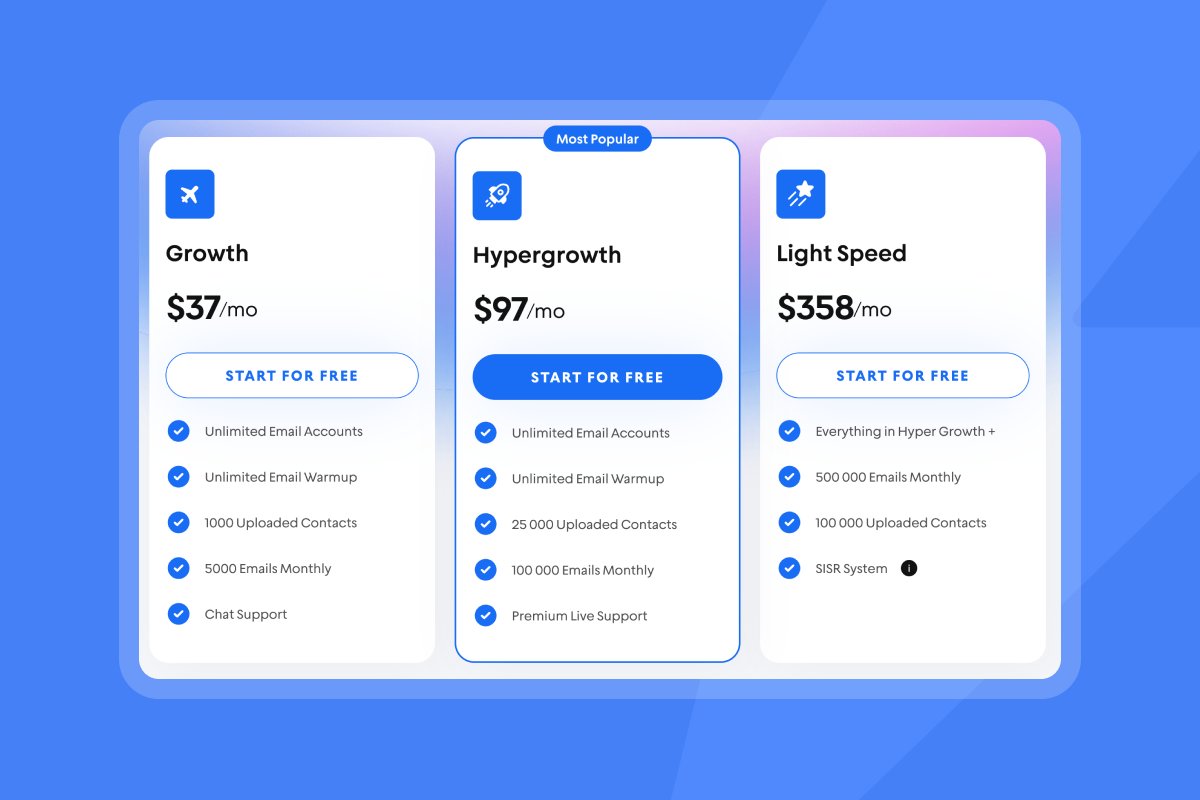
Instantly Pricing Summary
| Plan | Monthly Price | Annual Price | Key Features |
|---|---|---|---|
| Growth Outreach | $37 | $30/mo | Unlimited email accounts, automated warmup, Unibox, A/Z testing |
| Hypergrowth Outreach | $97 | $77.60/mo | Everything in Growth + priority support, advanced analytics, 100k emails/mo |
| SuperSearch Growth | $47 | $42.30/mo | 1,500-2,000 enrichment credits, 450M+ B2B database, LLM enrichment |
| Light Speed | $358 | $286.30/mo | SISR, dedicated IP pools, private deliverability network |
A sales leader managing 5 clients through an outsourced provider might need 15-20 sending identities to protect deliverability. At $50 per inbox on per-seat platforms, that's $750-$1,000 monthly before any data or sending costs. Instantly's unlimited accounts model removes this scaling penalty, keeping your all-in cost at the $37-$97 monthly tier regardless of inbox count.
Integration with your tech stack: CRM, calendar, sales engagement tools
Integration friction creates data silos, manual work, and delayed lead handoffs. Tech stack incompatibility is a leading cause of outsourcing failure.
Assess integration capabilities:
- Native CRM connectors: Providers should offer pre-built integrations with your CRM or use iPaaS platforms (Zapier, Make, Pabbly) for custom workflows. During the demo, ask them to show you a live sync including custom field mapping and activity logging. Screen-record it.
- Calendar sync: Meeting scheduling should write directly to your AEs' calendars with proper notifications and reminders to both parties. Test the booking flow live during evaluation.
- Data flow mapping: Document exactly how contact data, interaction history, and qualification notes transfer from provider systems to your CRM. Gaps here cause AEs to enter discovery calls unprepared. Verify the provider can demonstrate end-to-end data flow with sample records.
- API access: For custom integrations, providers should offer API documentation and support. Review their developer documentation to assess integration depth and flexibility.
Instantly integrates with HubSpot and Salesforce, syncs with calendar tools for automated booking, and provides webhook APIs for custom workflows. Integration setup typically takes 2-4 hours for native connectors (HubSpot, Salesforce) or 4-8 hours for iPaaS custom workflows, making it possible to fully deploy within one business week rather than the 30-60 day implementations common with enterprise platforms. Watch this full Instantly tutorial to see the integration ecosystem in action.
Team expertise and training: Setter experience, industry knowledge
Setter quality varies dramatically across providers. Inexperienced setters who lack product knowledge or industry context deliver poor meetings that waste AE time. According to B2B Appointment Setting's research, skipping proper discovery calls can reduce demo effectiveness when sales engineers aren't involved in discovery.
Evaluate team credentials:
- Setter experience: Ask: What is your setter average tenure? (Red flag: under 6 months suggests high churn.) Can I listen to 3 live calls before signing? (If no, walk away.) High churn indicates training or management issues that will surface in prospect interactions.
- Industry specialization: Ask: Will my dedicated setters work exclusively in my industry? (Split focus dilutes expertise.) Have they worked in your sector before? Do they understand your buyer personas, typical objections, and competitive landscape?
- Training program: What onboarding do new setters receive? Providers should invest 5-7 business days (40-56 hours) upfront to ensure cleaner calls for months afterward. This breaks down to: 16 hours product training, 12 hours persona workshops, 8 hours script development and role-playing, 8 hours CRM/tools training, 4 hours for testing and feedback.
- Ongoing coaching: How do they improve setter performance? Regular call reviews, script testing, and knowledge sharing are signs of mature operations. Ask to see their coaching framework and performance improvement processes.
How Instantly supports your outsourced appointment setting strategy
Many outsourced appointment setting providers use shared email infrastructure across multiple clients, creating reputation risks when other campaigns burn domains. Outsourced services perform best when you control the foundational infrastructure for deliverability, lead data, and reply management. Instantly provides these capabilities whether you work with an external partner or build an internal team, giving you visibility and control that black-box provider platforms can't match.
Ensuring primary inbox placement: Automated warmup, inbox placement tests, SISR
Landing in spam defeats even the best copy and qualification process. Instantly's deliverability toolkit includes three layers of protection:
- Automated warmup: All plans include unlimited email accounts and automated warmup. New inboxes gradually increase sending volume to a max of 30 emails per inbox per day over 2-4 weeks while the warmup network simulates natural engagement (opens, replies, moving messages from spam to inbox) to build sender reputation. Track this via weekly placement tests targeting 80%+ primary inbox placement.
- Inbox placement tests: Automated placement testing checks where emails land (primary inbox, promotions, spam) across Gmail, Outlook, Yahoo, and other providers. You receive alerts when placement drops below your threshold, enabling immediate intervention before reputation damage cascades.
- SISR on Light Speed plan: Server & IP Sharding & Rotation provides dedicated IP pools that isolate your reputation from shared sender behavior, critical for agencies managing multiple client campaigns or sales teams running high-volume programs.
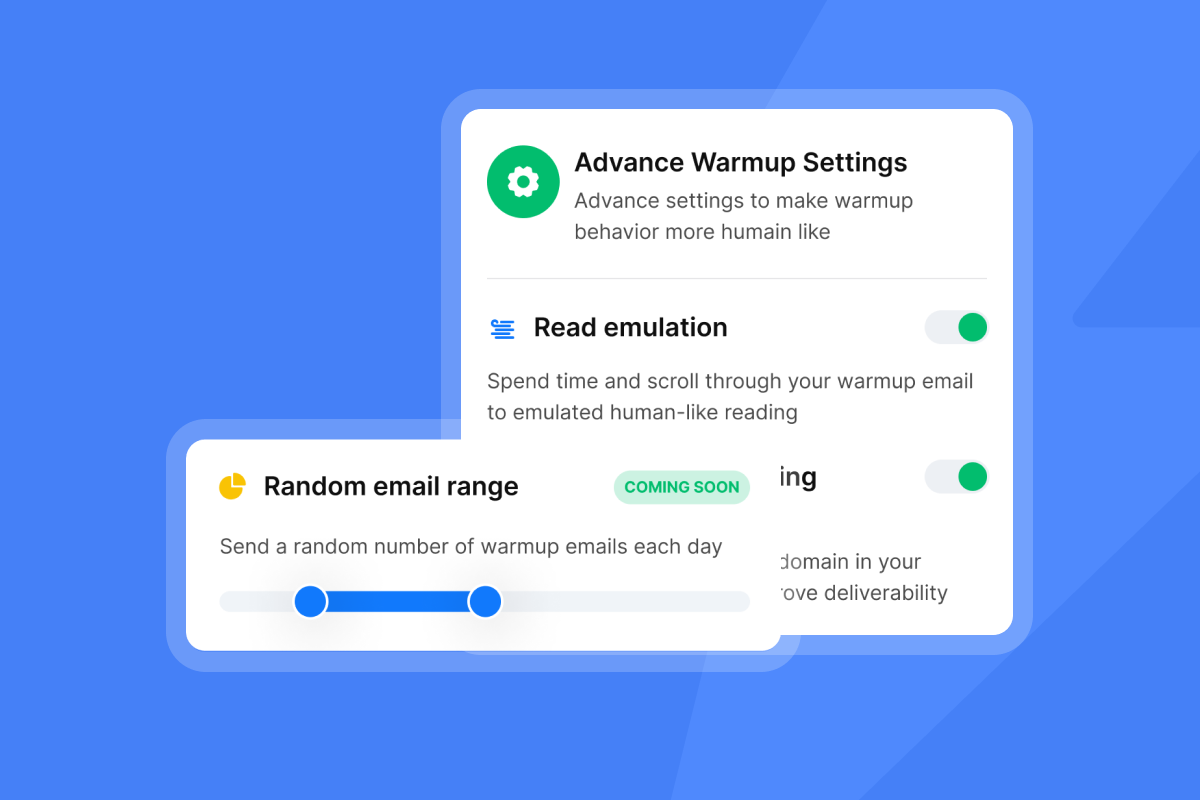
This infrastructure lets outsourced providers focus on messaging and qualification rather than troubleshooting deliverability issues that stem from infrastructure weakness.
Powering lead generation: SuperSearch for high-quality, verified contacts
Providers who control data sourcing can obscure low-quality lists behind vague claims like "proprietary database." When you source and verify contacts independently through SuperSearch, you can audit bounce rates, replacement rates, and list quality without trusting provider claims. Instantly's SuperSearch aggregates 450M+ B2B leads with waterfall enrichment across 5+ data providers, LLM-assisted enrichment, and AI template generation. Credits-based pricing (starting at $47/month for 1,500-2,000 credits) lets you scale data access as campaigns grow.
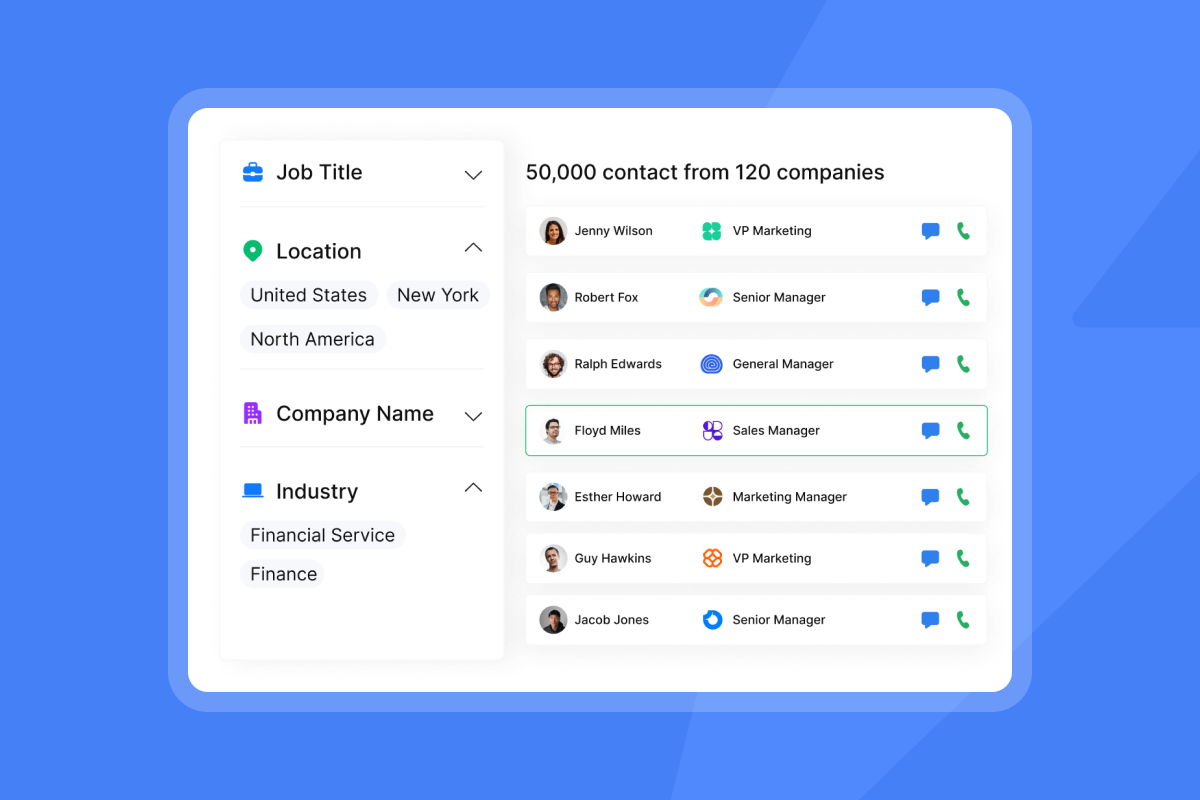
SuperSearch integrates directly with campaign creation, allowing your outsourced team or internal SDRs to build targeted lists, verify emails, and launch sequences without switching tools. Export to major CRMs maintains data consistency across systems.
Automating reply handling: AI Reply Agent for faster, consistent responses
Instantly's AI Reply Agent handles inbound lead replies in under 5 minutes, categorizing interest levels, drafting contextual responses, and routing qualified prospects to AEs. You configure human-in-the-loop review or full autopilot mode based on risk tolerance. Each AI-generated reply consumes 5 Instantly credits, providing predictable per-interaction economics.
AI reply handling is particularly valuable when working with outsourced teams across time zones. The agent maintains response velocity even when human setters are offline, preventing qualified leads from going cold due to delayed follow-up. Watch it in action in this tutorial below:
Cost-effective scaling: Unlimited accounts, predictable pricing
Most cold email platforms charge per seat or inbox, creating compounding costs as you scale accounts to protect deliverability. Instantly's unlimited email accounts model on flat-fee plans removes this constraint, particularly valuable when working with outsourced providers who need multiple sending identities for client campaigns.
"I've been using instantly.ai for my cold email outreach, and it has completely changed the way I run campaigns. The platform is super intuitive, and I was able to get up and running in minutes. Deliverability has been excellent, and the automation features save me hours every week." - James M. on G2
Building your outsourced appointment setting playbook
Successful outsourced appointment setting requires more than selecting a provider. You need a documented playbook that governs targeting, messaging, goal-setting, and continuous optimization. Without this playbook, your provider will make assumptions about who to target and what to say, leading to misaligned results and wasted spend. Build your playbook across five dimensions:
Define your ideal customer profile and messaging
Vague ICPs produce vague results. Companies with less than 10% of customers fitting their ICP face significantly lower survival rates over five years, as sales and marketing spend targets the wrong audience.
Build your ICP:
- Firmographic criteria: Company size, revenue, industry, geography, growth stage
- Technographic signals: Technology stack, tools used, integration needs
- Behavioral indicators: Recent funding, leadership changes, hiring patterns, content engagement
- Pain points and triggers: Problems your solution solves, events that create urgency
Craft core messaging:
- Value proposition: Outcome they care about, tailored to each persona
- Proof points: Case studies, metrics, customer quotes that demonstrate results
- Differentiation: Why you vs. alternatives, specifically addressing competitive positioning
- Clear call-to-action: What you want prospects to do (book demo, schedule assessment, etc.)
Provide your outsourced team with case studies, demo videos, live FAQs, and recorded sales calls so they understand how successful conversations unfold and can handle objections effectively.
Set clear, measurable goals
Define success in quantifiable terms so both you and your provider can track progress. Measuring outcomes (pipeline value, closed revenue) rather than just activity (dials made, emails sent) ensures alignment with business goals.
Essential metrics to track:
- Appointments booked: Raw volume of scheduled meetings (target: 10-25 per month per setter after ramp-up)
- Show-up rate: Percentage of booked meetings that occur (target: 75-85%)
- Qualified meeting rate: Percentage of attended meetings that meet BANT criteria (target: 70-80%)
- Reply rate: Percentage of emails generating responses (target: 5-10% is good, 10%+ is strong)
- Cost per meeting: Total program cost divided by qualified appointments
- Pipeline generated: Estimated dollar value of opportunities created
- Conversion to SQL: Qualified meetings advancing to sales-qualified lead status
To estimate your monthly cost, multiply your target appointment volume by your industry's typical PPM rate, or size retainers based on 1 setter delivering 15-25 qualified meetings monthly. Add 20% for tools and data costs if not included in the base fee.
Review these metrics weekly during ramp-up, then monthly once performance stabilizes.
Establish a robust onboarding and training process
Inadequate onboarding creates knowledge gaps that surface in every prospect interaction. Investing 5-7 business days (40-56 hours) upfront ensures cleaner calls for months afterward. This breaks down to: 16 hours product training, 12 hours persona workshops, 8 hours script development and role-playing, 8 hours CRM/tools training, 4 hours for testing and feedback.
Onboarding checklist:
- Product training: Features, benefits, use cases, pricing, competitive positioning
- Persona workshops: Buyer roles, pain points, objections, decision processes
- Script development: Approved email templates, call flows, objection responses
- CRM training: How to log activities, update stages, transfer qualified leads
- Role-playing: Practice discovery questions, qualification criteria, meeting scheduling
- Tool access: Email platform, data provider, scheduling system, communication channels
Expect a 2-4 week onboarding period before initial outreach begins, with ongoing coaching and refinement continuing through the first 90 days.
Implement continuous monitoring and optimization
Appointment setting performance improves through iterative testing and refinement. Businesses committed to continuous improvement during the first 90 days establish more reliable revenue streams.
Optimization cadence:
- Weekly: Review lead quality feedback from AEs, adjust messaging based on objection patterns, test subject line variants
- Bi-weekly: Analyze reply rate trends by campaign, review call recordings for coaching opportunities, update qualification questions based on learnings
- Monthly: Assess cost per meeting vs. budget, evaluate show-up rate trends, refine ICP based on which prospects convert to pipeline
- Quarterly: Review overall program ROI (pipeline generated vs. investment), renegotiate provider terms if needed, plan expansion or contraction
Watch this video on cold email strategy for 2025 to stay current on best practices as the channel evolves.
Use Instantly for consistent execution and insights
Whether you manage an outsourced provider or internal SDR team, Instantly provides the infrastructure for reliable execution. You can calculate your cold email reply rate and tie it to pipeline metrics like cost per meeting to measure program effectiveness.
The platform's combination of unlimited accounts, automated warmup, verified lead data through SuperSearch, AI-powered reply handling, and centralized analytics gives you the control and auditability that outsourced arrangements require.
Drive predictable meetings with a smart outsourcing approach
Outsourced appointment setting works when you treat provider selection as a strategic partnership rather than a vendor transaction. Define your ICP precisely, establish clear qualification criteria and KPIs, demand deliverability transparency, and maintain active oversight through regular feedback loops.
When you pair a strong outsourced partner with reliable infrastructure like Instantly's deliverability network, verified lead data, and AI-powered reply handling, you create a predictable meeting generation engine that scales with your business needs.
Ready to build a predictable meeting engine? Try Instantly free for 14 days with no credit card required.
FAQs
What is the average cost of outsourced appointment setting?
Pay-per-meeting models typically range from $15 to $100 per qualified appointment depending on industry complexity and qualification requirements. Monthly retainer models vary widely based on team size and service scope, often starting at $3,000-$5,000 per month for dedicated setter resources. Pay-per-lead arrangements can be more cost-effective for rapid scaling but may deliver lower-quality prospects, with costs varying by target audience and data requirements.
How long does it take to see results from an outsourced service?
Initial leads typically appear within 2-4 weeks after campaign launch. Expect 3-7 qualified appointments in the first 30 days as the team learns your ICP and refines messaging. By day 60, performance improves to 10-20 qualified meetings per month as targeting and qualification become more consistent. By day 90, you should see 15-25+ qualified appointments monthly with show-up rates of 80-85%.
What are the key metrics to track for outsourced appointment setting?
Track five core metrics: Appointments booked (raw volume scheduled), Show-up rate (percentage of booked meetings that occur, target 75-85%), Qualified meeting rate (percentage meeting BANT criteria, target 70-80%), Reply rate (target 5-10%, with 10%+ considered strong according to our cold email reply rate benchmarks), and Cost per qualified meeting (total program cost divided by qualified appointments).
Can Instantly integrate with my existing CRM for outsourced campaigns?
Yes, Instantly offers native integrations with HubSpot and Salesforce for bidirectional data sync. For other CRMs, you can use iPaaS platforms like Zapier, Make, or Pabbly to build custom workflows that sync contact data, activity logs, and meeting outcomes. Instantly's webhook API provides additional flexibility for technical teams to create deeply integrated workflows.


