


Updated September 05, 2025
Why SDR teams need an AI playbook (and the risks of not having one)
AI can boost throughput, but ad‑hoc automation is risky. About one in six legitimate emails fail to reach the inbox on average, and deliverability has been trending harder per Validity and EmailToolTester. Without guardrails, AI‑generated volume can spike bounces and complaints, crash reputation, and stall pipeline. A documented playbook gives you the controls: who you email, how fast you ramp, what you measure, and when to pause.
Risks to manage:
- Deliverability risk. New or poorly authenticated domains that jump to high volume trigger filters. Warm gradually and verify placement before scaling. See Instantly’s warmup guide and Inbox Placement automated tests.
- Compliance risk. CAN‑SPAM requires truthful headers and subject lines, a physical address, and honoring opt‑outs within 10 business days. GDPR allows direct marketing on legitimate interest with conditions, and UK PECR restricts emailing individuals without consent while permitting B2B corporate emails with opt‑outs. CPRA ended California’s B2B exemption on January 1, 2023. See the FTC CAN‑SPAM rule update, GDPR Recital 47 (legitimate interest), UK ICO guidance on email marketing rules, and CPRA briefing on the B2B exemption expiry.
- Process risk. Rogue templates and tools create inconsistent data and hard‑to‑debug failures. Centralize sequences, approvals, and analytics.
The 4 pillars of a safe AI lead generation system
- Domain health
Authenticate every sending domain with SPF, DKIM, and DMARC. Misconfigured records lead to spam or rejection. Track DMARC alignment as you scale. See Cloudflare’s guide. - Data hygiene
Email lists decay fast. External tests show 22-28% annual decay, which drives bounces and spam traps if you do not re‑verify. Keep bounces under 2-3% and suppress risky addresses. See ZeroBounce’s report via Newswire. - Controlled warmup and ramp
Warm for at least 2-4 weeks. Start at roughly 20-30 emails per inbox per day, then increase as placement holds. Continue a trickle of warmup messages even after go‑live. See Instantly’s warmup guide. - Continuous monitoring
Set guardrails: pause sends if placement dips, if complaint rates approach 0.3%, or if bounces spike. Automate placement testing and blacklist checks to catch issues early. See Inbox Placement automated tests and the new Gmail/Yahoo rules.
Instantly ties this together with unlimited warmup, automated Inbox Placement tests, SuperSearch for 450M+ B2B contacts, Copilot for copy, and an AI Reply Agent, plus Light Speed SISR for dedicated IP pools.
Practical AI lead generation use cases for SDRs (with examples)
Lead list building and enrichment
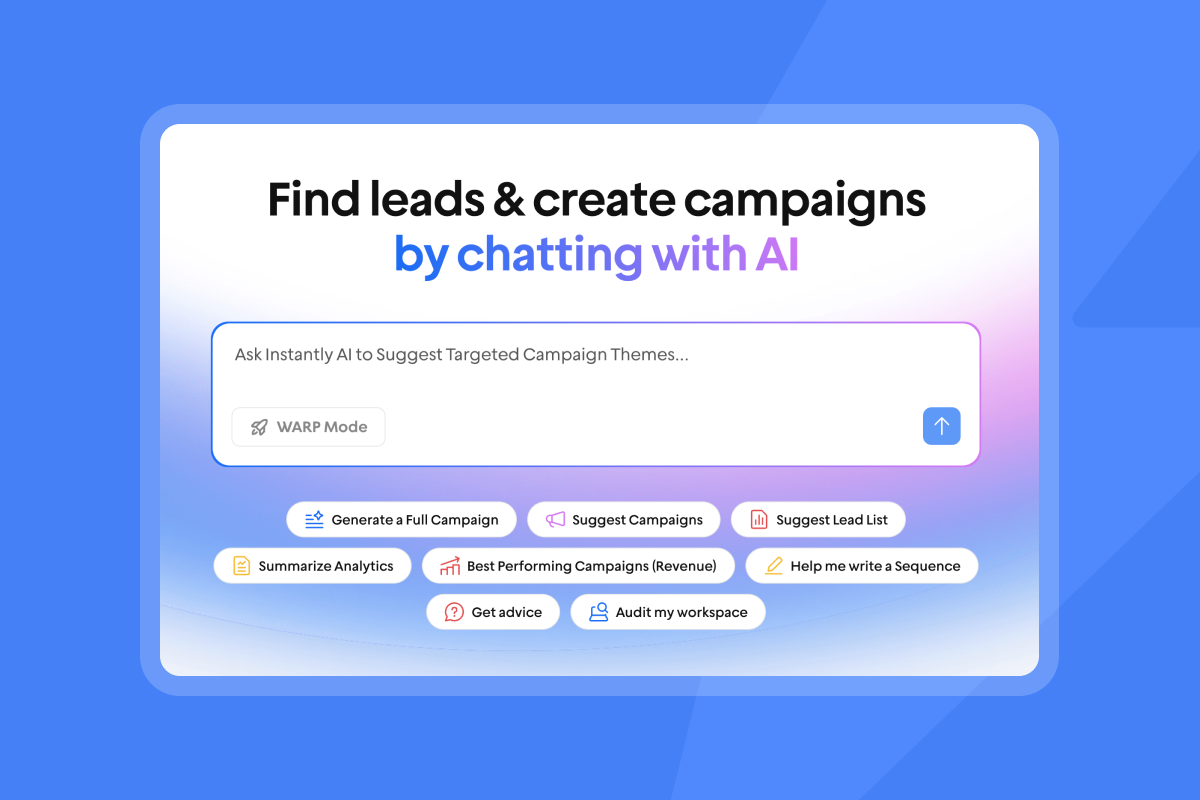
Use AI‑assisted search to source ICP‑fit accounts and verified work emails, then enrich with firmographics and recent news or funding. Example: filter US fintechs, 20-200 employees, using a target tech, pull 300 contacts and enrich with funding signals for tiered sequencing. Instantly SuperSearch lists 450M+ contacts with waterfall verification and in‑app AI enrichment.
AI‑assisted personalization
Have AI draft first‑line intros and subject variants from company context. Example: generate three subject lines and two openers per persona, then A/B test while holding the offer constant. Copilot inside Instantly can produce deliverability‑aware sequence drafts from short prompts.
Automated follow ups and smart scheduling
Sequence logic handles OOO replies, throttles by time zones, and sends plain‑text first touches to improve placement. Tip: keep follow ups short and value‑focused, and separate content tests from ramp decisions. See advanced deliverability tips.
Reply classification and triage
Route replies into Interested, Objection, Not now, or Not a fit. Instantly’s AI Reply Agent replies in under 5 minutes, books via your calendar link, and runs in human‑in‑the‑loop or Autopilot, with Slack alerts. Price and behavior are documented in the AI Reply Agent guide.
Want a quick look at the workflow? Watch the Instantly AI full tutorial on YouTube or the co‑founder demo walkthrough for campaign setup and inbox rotation best practices on YouTube.
Navigating compliance: GDPR, CCPA, and CAN‑SPAM for AI outreach
CAN‑SPAM (US)
Include accurate headers and non‑deceptive subjects, a physical address, and an easy opt‑out. Honor opt‑outs within 10 business days. These are enforced and have led to past settlements. Build one‑click unsubscribe into every template and auto‑suppress across workspaces. See the FTC CAN‑SPAM rule update.
GDPR and EU/UK rules
GDPR allows direct marketing on legitimate interest if it is proportionate and respects objection rights. In the UK, PECR prohibits unsolicited marketing emails to individual subscribers without consent, but allows B2B emails to corporate subscribers if identity is clear and opt‑outs are offered. Maintain a lawful basis record for each list and honor Article 21 objections. See GDPR Recital 47, UK ICO guidance on email marketing rules, and UK ICO on B2B marketing.
CCPA/CPRA (California)
The B2B exemption expired on January 1, 2023. Covered businesses must support access, deletion, and opt‑out rights, and can face civil penalties of up to $2,500 per violation or $7,500 per intentional violation. Recent settlements show active enforcement. Publish a clear privacy notice and route data rights requests to Ops. See the B2B exemption expiry, IAPP’s explainer on CPRA penalties, and the California AG’s CCPA settlement announcement.
Compliance is table stakes. Add sender‑side rules from mailbox providers: bulk senders must keep spam complaint rates under 0.3% and target below 0.1% to stay safe. Use Postmaster data to watch complaints daily and pause fast if rates climb. See the new Gmail/Yahoo rules.
The AI warmup and deliverability checklist
Use this as your team’s pre‑flight and weekly ops review.
- Authenticate the domain: See Cloudflare’s guide. Done when SPF, DKIM, DMARC, and PTR checks all pass.
- Add inboxes and enable warmup: Done when each inbox completes 2-4 weeks of warmup and shows healthy placement on seeds. Keep an always‑on warmup trickle.
- Set a conservative ramp plan:
- Week 1: 20-30/day per inbox.
- Week 2: 30-50/day. Add inboxes rather than spiking one box. Document per‑box caps. See our warmup guide.
- Verify data quality: Run verification on your leads or use pre-verified lead from SuperSearch. Drop risky statuses leads. Target bounces under 2-3% on any send.
- Build compliant templates: Clear identity, physical address, one‑click unsubscribe. Map GDPR lawful basis for EU datasets. See the FTC CAN‑SPAM update and GDPR Recital 47.
- Launch a pilot batch: Create a capmaign with Instantly's AI Copilot. 50-100 leads per segment, keep it focused. Watch placement, bounces, and early complaints overnight before scaling. Use Inbox Placement automated tests.
- Run Inbox Placement tests: Test across Gmail, Microsoft, Yahoo. Auto‑pause if placement drops under your threshold and switch a mailbox to warmup only. See the Inbox Placement feature.
- Monitor complaint rates: Keep spam complaints under 0.1% with a hard stop at 0.3%. Add a rule that pauses all sends from any domain if complaints spike. See the new Gmail/Yahoo rules.
- Triage replies with AI: Auto‑label and draft responses. Require human approval for edge cases. Book interested replies within minutes. See the AI Reply Agent guide.
How Instantly powers your AI lead gen playbook
- Unlimited warmup and multi‑account scale
Warm as many inboxes as you need and rotate sends across accounts. Instantly also offers pre‑warmed accounts for faster starts. See Warmup FAQs. - Automated Inbox Placement tests and alerts
Test inbox vs spam across providers, monitor 90+ blacklists, and set automations to pause mailboxes or enable slow ramp if placement dips. - SuperSearch data and in‑app AI
Find and enrich 450M+ B2B contacts, then write sequences without leaving the app. - AI Reply Agent
Handle replies in under 5 minutes with HITL (human in the loop) or Autopilot. Send calendar links and log outcomes, priced in Instantly credits. - Private warmup network & SISR
4.2M+ private deliverability network used for AI warmup with server and IP Sharding.
Here is a quick walkthrough of our Copilot feature:
AI at scale without getting burnt
AI works when it runs inside a controlled system. Authenticate domains, verify data, warm up and ramp with intent, test placement often, and keep your complaint rate ultra‑low. Then let AI handle the heavy lifting on enrichment, personalization, and replies while your team focuses on conversations. If you want these guardrails built in, start your free trial of Instantly and use this playbook in your first campaign.
Frequently asked questions (FAQ)
How many emails per inbox is safe on a new domain?
Start 20-30 per day in week one, 30-50 in week two, provided placement remains strong. Add inboxes rather than spiking one box. See Instantly’s warmup guide.
What is a healthy bounce rate?
Aim for under 2-3% per send. If you cross 3%, pause and re‑verify.
What spam complaint rate should I target?
Keep it below 0.1% and never sustain 0.3% or higher. Crossing 0.3% is a red flag for mailbox providers. See the new Gmail/Yahoo rules.
How long should I warm up before full sends?
Plan 2-4 weeks for new inboxes and keep a small ongoing warmup volume after go‑live. See Warmup FAQs.
Can I cold email in the EU?
To corporate subscribers, B2B emails are generally allowed under PECR if you identify yourself and include opt‑out. For individuals and sole traders, consent rules apply and GDPR still governs personal data processing. Always offer opt‑outs.
What are the must‑have CAN‑SPAM elements in each email?
Accurate headers and subject, clear ad identification if applicable, a working one‑click unsubscribe, and a physical postal address. Honor opt‑outs within 10 business days. See the FTC CAN‑SPAM update.
What metrics should I review weekly?
Inbox placement per provider, bounces, complaint rate, reply rate, booked meetings, and domain health signals. Automate placement tests and alerts. See Inbox Placement automated tests.
Do I need a lawful basis under GDPR for B2B prospecting?
Yes. Most B2B programs use legitimate interest with a balancing test and clear opt‑out handling. Document your assessment. See GDPR Recital 47.


