


Updated September 12, 2025
TL;DR: Most sales engagement platforms charge per seat and meter usage, which makes your software bill grow with headcount and email volume. Instantly uses a flat monthly fee with unlimited sending accounts and built-in deliverability tooling on the Instantly pricing page, so you can scale safely without per-seat penalties or surprise overages. For product-aware sales leaders who need predictable costs and reliable inbox placement, this pricing model is the simplest path to pipeline growth.
Your sales engagement bill should not mirror your headcount. If each new SDR or team members adds another license, implementation, and a handful of add-ons before they send a single email, your stack is taxing growth. Multiple buyers describe steep annual costs and rigid renewal terms in per-seat tools, including a $6,000 Outreach subscription with poor early support in vendor reviews and 60‑day auto‑renew clauses in SK’s Salesloft Trustpilot review.
Instantly takes the flat-fee route. One subscription. Unlimited sending accounts and premium deliverability as a system. You can see these limits and inclusions on the Instantly pricing page and watch a full product walkthrough in LeadSwift’s tutorial on YouTube. Alexander’s Trustpilot review also highlights revenue impact after switching, noting a six-figure increase within four months.
The hidden costs of per-seat sales engagement platforms
The common model is per seat, annual contract, plus credits or volume caps. Two examples that many teams evaluate:
- Outreach sells per seat on annual terms. Recent buyers cite high total cost and strict cancellation windows, and buried notice requirements in Phelps Jackson’s Outreach Trustpilot review.
- Salesloft typically runs about $125 to $165 per user per month, or roughly $2,000 per seat per year, as summarized by Saaslucid. Contract friction is a common theme for some buyers in Marios’ detailed Salesloft Trustpilot review.
For a 10‑rep team, that is $12,000 to $20,000 a year in licenses before onboarding services or usage fees. Credit-based systems add another layer. Apollo.io, for instance, prices per user and meters access with email, mobile, and export credits, as shown on the Apollo pricing page on G2. Exceeding your bundle means buying more credits, which expire on cycle, a pattern also described by Reachstream’s Apollo.io pricing overview and Cognism’s Apollo.io pricing breakdown. For a quick side-by-side, Software Scope’s video on YouTube compares Apollo and Instantly.
Why this matters to a sales leader:
- A tax on growth. Each hire or pilot seat increases fixed cost. Seat minimums and annuals increase risk when your plan changes midyear. You can see the per-seat ballpark for Salesloft on Saaslucid and read contract friction examples in the Salesloft Trustpilot reviews we mentioned earlier.
- Budget drift. Credits and usage add-ons make monthly spend hard to forecast. Apollo uses credit bundles on its G2 pricing page, and third-party summaries by Reachstream and Cognism explain how overages and credit expirations affect spend.
- Admin overhead. Reps already spend a minority of their week selling. Roundups estimate roughly 30 percent of rep time goes to selling, with the rest in admin and prep, as summarized by Fit Small Business and Forecastio’s sales engagement software guide. Positive user commentary also ties organized cadences to productivity.
The result is a stack that penalizes scale. Your CFO sees a spiky cost curve, and your team throttles sending to stay under caps when they should be testing, learning, and booking. If you want a quick primer on a flat-fee alternative and how it works in practice, watch Instantly’s spam‑avoidance tutorial on YouTube.
A transparent alternative: Instantly’s flat-fee model explained
Instantly was built to remove per-seat friction. Pricing is simple and predictable:
- Growth is $37 per month. You get unlimited email accounts and warmup, 1,000 uploaded contacts, and 5,000 emails per month.
- Hypergrowth is $97 per month. You get unlimited accounts and warmup, 25,000 uploaded contacts, and 100,000 emails per month.
- Light Speed is $358 per month. You get everything in Hypergrowth, plus 100,000 uploaded contacts, 500,000 emails per month, and access to the SISR help article for server IP sharding and rotation.
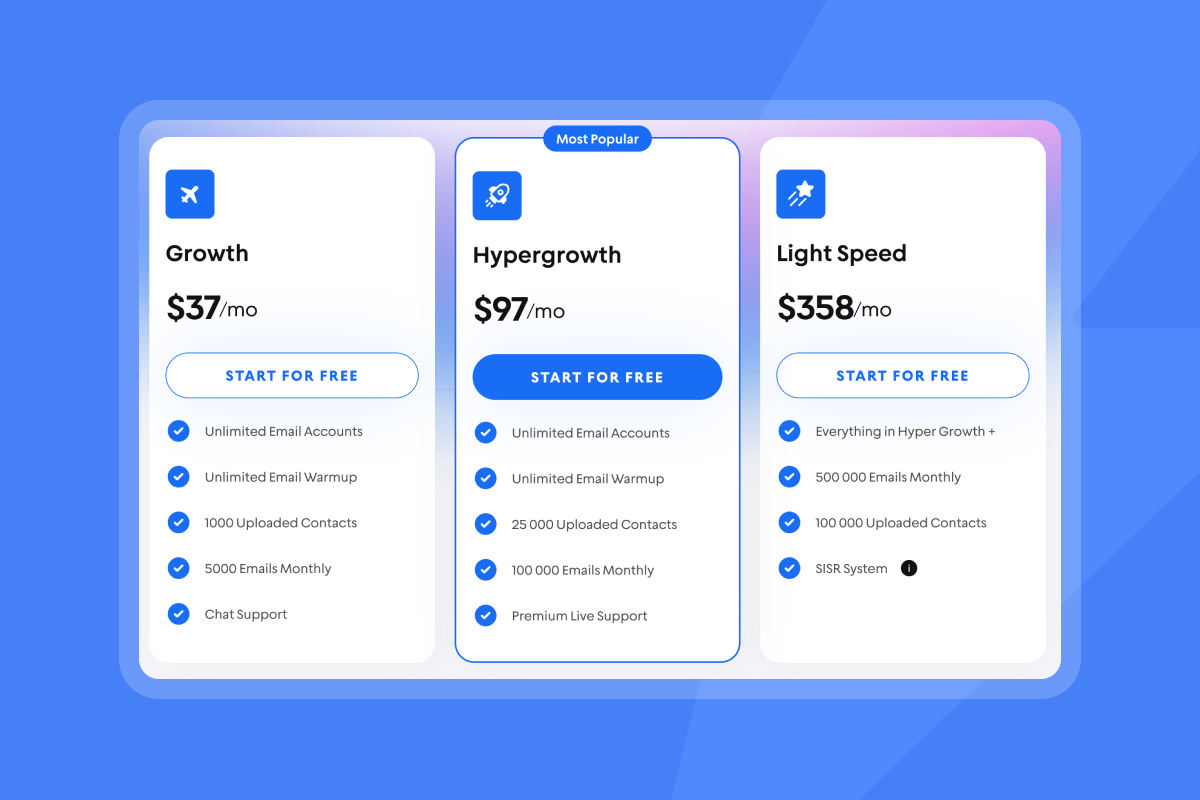
What that means in practice:
- Unlimited sending accounts. Add inboxes without buying seats. Spread sends across many domains to protect reputation, as stated on the Instantly pricing page and demonstrated in the Instantly.ai demo on YouTube.
- Deliverability as a system. You get automated warmup on all plans, unlimited inbox placement tests, blacklist monitoring, and SISR on Light Speed to rotate away from underperforming IPs, all covered on the Instantly inbox placement page and the SISR help article.
- All-in-one workflow. Pair outreach with a large lead database and a built-in CRM with a master inbox to cut tool sprawl and admin hops on the Instantly pricing page. Felipe Fuhr’s feature walk‑through on YouTube shows how these modules connect in real campaigns.
“We increased our revenue by six figures within 4 months of starting with Instantly.” - Alexander’s Trustpilot review
Comparative analysis: Instantly vs leading platforms
A platform’s value shows up in adoption, inbox placement, and pipeline, not just a feature list. G2 ratings provide a useful baseline:
Outreach averages 4.3 out of 5 on G2
Salesloft averages 4.5 out of 5 on G2
Apollo averages 4.7 out of 5 on G2
Instantly averages 4.8 out of 5 across 3,700+ reviews on the Instantly page on G2.
User experience varies by team and configuration. Some threads describe Outreach as complex, for example this Reddit sales discussion, while analyst coverage describes the category as a unified interface for multichannel execution and AI guidance tied to CRM on Gartner’s market page. Balance peer feedback with a contained pilot and your own metrics.
Quick-scan comparison table
| Platform | Pricing model | Key features | G2 rating |
|---|---|---|---|
| Instantly | Flat monthly per workspace, unlimited accounts on the pricing page. | Cadences, AI Copilot, Unibox CRM, leads & A/B, see the product demo. | 4.8/5 on G2. |
| Salesloft | Per-seat annuals per Saaslucid. | Multichannel cadences, AI, convo intel, forecasting, CRM | 4.5/5 on G2. |
| Outreach | Per-seat annuals | Cadences, deal management, forecasting, AI (see an overview). | 4.3/5 on G2. |
| Apollo.io | Per seat + credits on the G2 pricing page. | Sales intelligence + engagement, dialer & CRM compare in this video. | 4.7/5 on G2. |
| HubSpot Sales Hub | Per seat + contact tiers per Forecastio. | Cadences, templates, reporting inside HubSpot. | 4.4–4.5/5 in Forecastio. |
Beyond price: Why integrated deliverability is non-negotiable
Hitting the primary inbox is a system, not a toggle. The necessary pieces live across domains, accounts, sends, and content. Look for these controls to protect sender reputation and scale safely:
- Warmup and pacing. Auto-warm every new account. Ramp sends gradually. If health dips, slow or pause sends automatically. Instantly warms unlimited accounts on all plans and shows an account health score on the Instantly pricing page. The Instantly spam‑avoidance tutorial on YouTube explains pacing.
- Inbox placement testing. Run automated tests across Gmail, Outlook, and more. Trigger alerts and pauses when placement falls below thresholds. Instantly provides unlimited automated tests with blacklist monitoring and content spam checks on the Instantly inbox placement page. Felipe Fuhr’s feature walk‑through on YouTube demonstrates placement testing in action.
- IP and server hygiene. High senders need isolation. On Light Speed, Instantly’s SISR assigns dedicated or private IP pools, swaps out flagged IPs, and rotates based on performance in the SISR help article. You can also review best practices in Instantly’s YouTube guide.
- Data hygiene. Verified contacts, deduping, and enrichment improve placement and reply rates. SuperSearch includes waterfall work‑email enrichment from multiple providers as described on the Instantly pricing page. For a strategy overview, see How to Achieve 90%+ Cold Email Deliverability in 2025.
- Content variation and testing. Use A/B tests and spin syntax to reduce repetition and tune reply rates. Keep bounce rates under 1 percent and complaint rates under 0.3 percent as standard guardrails, a pattern echoed in the Instantly spam‑avoidance tutorial on YouTube and the Instantly inbox placement page.
When deliverability is a first-class system, you remove a top risk to monthly targets. It also saves time. Research puts reps at only about 30 percent of their week selling, with the rest in admin and prep, according to Fit Small Business. Effective sales engagement software can reclaim a chunk of that admin time when it centralizes workflows and automation, as discussed in Forecastio’s sales engagement software guide and echoed by users like the Verified User’s Salesloft review on G2.
Choosing the right platform: A checklist for sales leaders
Use this to pressure-test vendors and run a fair pilot.
- Pricing model and predictability
- Flat monthly fee without per-seat penalties.
- Clear volume caps and overage math. No forced annuals.
- Deliverability system
- Automated warmup for every inbox.
- Inbox placement tests with alerts and auto-pauses.
- Blacklist monitoring and authentication checks like SPF, DKIM, and DMARC.
- Dedicated IP options for high volume.
- Data hygiene and integrity
- Verification and bounce protection.
- Waterfall enrichment and dedupe rules.
- Clear counting logic in reports that you can reconcile with CRM.
- A/B testing and experimentation
- Subject lines, copy blocks, send windows, and spin syntax.
- Per-variant analytics you trust.
- Admin controls and governance
- Roles, workspaces, and sequence governance.
- Global blocklists and sending quotas.
- Audit-friendly activity capture and export.
- Integrations and handoffs
- CRM sync that matches your object model.
- Calendar and meeting flows your AEs already use.
- API and webhooks for ops automation.
- Support and off-ramps
- Fast human support when placements dip.
- Simple cancellation and month-to-month options.
Instantly checks these boxes with flat pricing on the Instantly pricing page, unlimited accounts and inbox placement automation on the Instantly inbox placement page, and private IP rotation explained in the SISR help article. You can preview the workflow in the Instantly demo on YouTube.
What to do next
Run a smarter pilot with two lanes:
- Placement and ramp lane. Warm domains for 30 days. Start at modest daily caps across many inboxes. Require 80 percent or higher inbox placement and under 1 percent bounces before scaling. Instantly’s YouTube guide explains the guardrails.
- Sequence lane. Launch two cadence variants per ICP. Test subject lines, send windows, and first‑line angles. Standardize reply handling in a master inbox. You can see a step‑by‑step setup in the Instantly.ai demo on YouTube.
Use the checklist above to score outcomes, then decide.
Start a free Instantly trial and model your outreach cost as a fixed operational line instead of a per-seat tax on the Instantly pricing page.
Frequently asked questions
- What is a sales engagement platform, in one line? A system that helps reps execute multichannel outreach with AI guidance and logs activity back to your CRM on Gartner’s market page.
- How does Instantly price compared to per-seat tools? Instantly charges a flat monthly fee per workspace with unlimited sending accounts on the Instantly pricing page. Legacy tools like Outreach and Salesloft price per seat on annual terms, which buyers often describe as costly or restrictive.
- Can sales engagement tools really save time? Teams report large admin loads. Research roundups point to roughly 30 percent selling time and meaningful admin savings when workflows are centralized.
- How does Instantly handle deliverability risk at scale? Unlimited warmup, automated inbox placement tests with alerts, blacklist monitoring, and private IP rotation via SISR on Light Speed, with details on the Instantly pricing page and the SISR help article. For setup guidance, see Instantly’s spam‑avoidance tutorial on YouTube.
Sales engagement platform terminology
- Sales engagement platform. One interface to plan, execute, track, measure, and optimize seller–buyer interactions at scale, as defined on Gartner’s market page.
- Sales cadences. Scheduled steps across email, calls, and tasks that guide consistent outreach.
- Deliverability. The ability for emails to reach the primary inbox, not spam or other tabs.
- Sender reputation. Domain and IP trust signals mailbox providers use to accept or filter mail.
- AI revenue orchestration. AI that prioritizes who to contact, when, and with what message across the funnel.
- AI revenue workflow. Task lists and automations AI builds from engagement and deal signals.
- Waterfall enrichment. Chaining multiple data providers until a verified field is found.
- Spin syntax. Controlled text variations that reduce repetition within templates.


