


Updated March 06, 2026
TL;DR: Pixel-based open rates are no longer reliable. Apple Mail Privacy Protection (MPP) now affects over 55% of global email opens, making open rate data a misleading signal for individual lead scoring. Track reply rate, AI-classified sentiment, and inbox placement rate instead. Those three metrics map directly to booked meetings and withstand CFO scrutiny. Sales teams that keep chasing inflated open rates build pipelines on false signals. Teams that shift to AI sentiment scoring and deliverability monitoring book more meetings with less noise.
Email tracking has reached a turning point. Privacy filters, regulatory pressure, and spam filter evolution have broken the pixel-based model the industry relied on for a decade. What replaces it, AI-driven sentiment analysis and infrastructure-level inbox health monitoring, gives you far more actionable data than open rates ever did. Because sales teams keep chasing inflated open rates to build pipelines on false signals, teams using the right cold email platform shift to reply rate and inbox placement data that actually predicts meetings.
The shift from vanity metrics to revenue outcomes
Open rates were always a proxy, and the question they answered ("Did this person see my email?") was never the question that drove revenue. The question that matters is, "Did this person reply, and do they want to talk?"
That proxy has now become unreliable for even its narrow purpose. According to Litmus research on Apple MPP, Apple accounts for 49.29% of email opens and its Mail Privacy Protection pre-loads all email images, including tracking pixels, before a user ever reads the message. Research from Eksido estimates that in 2025, up to 75% of reported opens in some segments may be artificial. For cold email, where you need to qualify genuine interest, that level of noise makes open rates useless as a lead signal.
You need to move from activity metrics to outcome metrics. The table below shows the directional shift playing out across sales teams in 2026.
Old metric (2022 and earlier) | 2026 replacement | What it measures |
|---|---|---|
Open rate | Inbox placement rate | Whether your email reached a human inbox |
Click rate | Reply rate | Whether someone engaged with intent |
Open-based lead scoring | AI sentiment score | Whether a reply signals genuine interest |
Pixel fire = "engaged" | Conversation classified | What the reply actually means |
The old metrics tracked activity. The new metrics track outcomes. That distinction directly affects whether your pipeline data is trustworthy and whether your CFO should believe the numbers you report.
Instantly's cold email reply rate benchmarks guide covers what 5–10% looks like across B2B segments, how positive reply rate differs from raw reply rate, and the exact formula for tying reply data to cost per meeting in CFO-ready reporting.
Trend 1: AI email tracking analytics and sentiment scoring
AI email tracking analytics uses Natural Language Processing (NLP) and machine learning to read the content of email replies and classify them by intent, rather than measuring whether a tracking pixel fired. The core question shifts from "Did they open?" to "What did they mean when they replied?"
This is not a small upgrade. It is a fundamental change in what counts as signal. AI email sentiment analysis uses NLP to classify email text as positive, negative, or neutral, and can detect specific emotional signals like interest, frustration, or mixed sentiment that a binary open/click metric cannot capture.
Instantly's AI reply suggestions feature applies this logic inside the platform. Replies are automatically categorized so reps can see the intent of each response without manually reading every reply across a large sequence, saving hours per week at the team level and ensuring no warm reply gets buried.
Instantly's AI email triage guide covers how the classification system works end-to-end from NLP intent mapping and category configuration to CRM routing logic and the human-in-the-loop review process for the first weeks of deployment.
"What stands out to me most is the amazing AI reply agent. It significantly simplifies our tasks by generating very accurate messages that I only need to review, thereby enhancing our efficiency in engaging with long-term leads." - Anne S. on G2
How AI engagement scoring works
An NLP model reads the text of each incoming reply and maps language patterns to intent categories. Over time, the model associates phrases like "let's talk" or "send a calendar link" with a positive or meeting-ready classification, while "remove me" or "not a fit" maps to a disqualified category.
Advanced models evaluate surrounding words, punctuation, capitalization, emojis, and thread structure, not just isolated phrases, as AI sentiment context research describes. That depth is what separates useful AI classification from simple keyword matching. The result is that managers get a dashboard view of prospect sentiment across the full pipeline without relying on reps to self-report.
Practically, this means:
- Interested: Phrases like "send me more info" or "what does pricing look like"
- Meeting booked: Entity recognition flags specific time requests or calendar link clicks
- Objection: Phrases that show conditional interest, useful for follow-up routing
- Not interested: Clear disqualification language that removes the lead from active sequences
Moving beyond basic open tracking
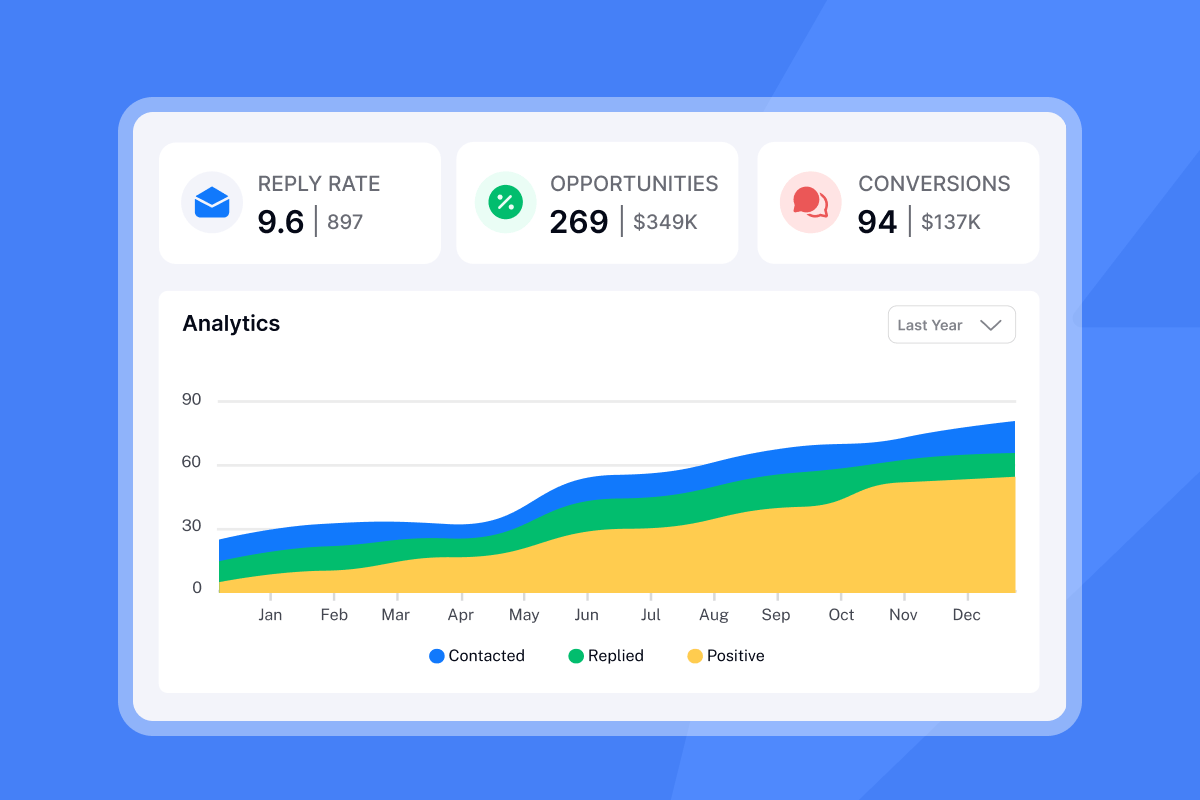
The predictive layer adds the most value for sales leaders. Rather than telling you what happened in a past campaign, AI surfaces patterns from historical sentiment data to predict which message variants are more likely to generate positive replies in future sends.
SentiSum's email sentiment research describes this as moving from reactive reporting to proactive optimization. Instead of running an A/B test on subject lines and waiting for an inflated open rate to declare a winner, you compare reply sentiment scores between variants. The variant that generates more "Interested" classifications wins, regardless of what the open rate shows.
Instantly's reply rate optimization guide covers how to run A/Z tests that auto-promote winners based on reply rate rather than open rate, including the testing cadence, copy variables worth isolating, and how sentiment scoring from the AI Reply Agent feeds back into sequence optimization.
The Instantly co-founder demo walkthrough shows how campaign analytics prioritize reply counts and opportunity classifications over raw open data, reflecting exactly this shift in what the platform treats as meaningful signal.
Trend 2: Privacy-first tracking and regulatory changes
AI gives you better data, but privacy regulation determines whether you can collect it legally in the first place. Privacy-first tracking has become a legal requirement, not just a product trend. Sales leaders who ignore the regulatory context around pixel-based tracking expose their domains and their companies to real risk.
The impact of Apple MPP and GDPR on pixel tracking
Apple MPP works by routing all remote email content through a proxy server before the message reaches the user. As Paubox explains in their MPP analysis, this caching process requires Apple to request all images from the sending server, including open tracking pixels, which registers as an open even if the user never reads the email.
Research on MPP impact found that both total and unique open rates nearly doubled after MPP rolled out, meaning roughly half your open data may carry this distortion. On the legal side, the picture is equally clear. Under the GDPR and the ePrivacy Directive, email pixel tracking requires explicit consent because the ePrivacy Directive functions as the more specific rule and takes precedence over general GDPR legitimate interest claims. France's data protection authority (CNIL) went further, recommending pixel consent requirements aligned with cookie rules under Article 5.3 of the ePrivacy Directive. As more EU regulators align with this interpretation, pixel-based tracking in cold outreach carries growing legal exposure.
Why privacy-compliant tracking builds better domain reputation
Removing tracking pixels from cold email is not just a compliance move. It actively improves deliverability. GlockApps on pixels and deliverability shows that spam filters can flag emails containing pixels from known tracking services as suspicious, particularly when paired with multiple redirect links.
Research from Suped on pixel spam signals documents how Google's updated spam policies flag emails with tracking pixels as potentially suspicious, which can push messages to the spam folder before a recipient ever decides whether to read them. For cold outreach, where your domain is already unknown to the recipient, adding a pixel increases the signal burden your email carries.
The practical takeaway: plain-text or minimal-link cold emails with no tracking pixel reach the primary inbox more consistently than heavily formatted, heavily tracked alternatives. Removing the pixel does not mean losing visibility. It means shifting to metrics that are both more reliable and more legally sound.
Trend 3: Next generation email tracking focuses on deliverability
The most important email tracking metric in 2026 measures whether your email reached a human inbox at all, not what happens after someone reads it.
Monitoring inbox placement instead of individual opens
Inbox placement rate (IPR) measures the percentage of sent emails that land in the primary inbox, not spam, not promotions, not blocked at the server level. The formula: emails in primary inbox divided by total emails sent, multiplied by 100.
Industry data suggests the average inbox placement rate hovers around 83%, meaning roughly 1 in 6 emails never reaches the intended recipient. For cold outreach specifically, inbox placement rates reportedly drop significantly without active warmup, though a structured warm-up process can push rates above 50%. This metric determines whether your outreach program works. A 98% delivery rate with 65% inbox placement means a third of your emails are landing in spam while your dashboard shows green.
Instantly's Inbox Health monitoring dashboard addresses this directly. It runs automated checks on SPF, DKIM, and DMARC record validation, blacklist status across major blocklists, and inbox placement scores updated in real time. The inbox placement automated tests feature sends emails to seed addresses across major providers like Gmail, Yahoo, and Outlook, then reports exactly where they land.
"I appreciate Instantly for its intelligent handling of domain and mailbox rotation as well as provider matching, which is critical for ensuring that my emails land directly in the primary inbox instead of getting caught in spam filters." - Richard E. on G2
Using automated warm-up data as a leading indicator
Warm-up networks provide ground-truth data on where your emails are landing because they have programmatic access to the receiving inboxes. Unlike open rate tracking, which depends on a pixel firing inside a user's inbox, warm-up data is collected by accounts that can directly check whether a message arrived in the primary inbox, promotions folder, or spam.
These networks generate positive engagement signals (opens, replies, spam rescues) across a distributed set of real accounts to teach filters that your sending patterns are consistent. Inbox placement rate is one of the most important metrics to monitor during the warm-up process because it directly reflects how filters are learning to treat your domain.
Instantly runs warm-up across a private deliverability network of more than 4.2 million email accounts. Warm-up runs on all plans, which means inbox placement monitoring is built into the base workflow rather than sold as an add-on. If warm-up data shows your inbox placement rate dropping, that is a leading indicator, not a lagging one. You can adjust send volume, re-verify your list, or pause before a deliverability problem affects your live campaigns.
"I use Instantly for the AI reply agent and finding leads. It saves a lot of time by automatically replying to all of my campaigns on autopilot mode. I especially like the email warm-up tool. This tool automatically mimics human behavior and runs in the background to build a sender reputation for multiple new email accounts, ensuring emails land in the primary inbox rather than spam." - lucky b. on G2

Strategic advice for the Sales Leader: Future-proofing your stack
The three trends above point to a clear direction. Your stack needs to produce data you can trust, protect your domain reputation, and report on outcomes rather than activity. Here is how to audit your current setup and make decisions that hold up under CFO scrutiny.
Auditing for transparent data lineage
Start by asking your current platform one question: how does the open rate dashboard differentiate between a human open and a pre-fetch triggered by Apple MPP or a security scanner? If the answer is vague, or if the platform has not updated its methodology since 2021, your open rate data is compromised. Omeda's MPP guide notes that opens attributed to "Mozilla/5.0" user agents are likely Apple MPP pre-fetches rather than human reads, and that some platforms now offer a checkbox to exclude them from reports.
Run these specific checks on your current stack:
- Pull your open rate vs. reply rate ratio. Because Apple MPP pre-fetches inflate open counts, reply rate is the more reliable signal of actual engagement. MPP distorts open rates by having proxy servers silently load tracking pixels before a human ever sees the message, but it cannot distort reply rates, no proxy server can write and send an actual response on a prospect's behalf.
- Check your inbox placement rate. Use seed lists across Gmail, Yahoo, and Outlook to verify where your emails actually land.
- Audit your tracking pixel use. Every pixel or redirect link in a cold email is a potential spam signal. Remove them and re-test placement.
- Validate your DNS records. SPF, DKIM, and DMARC must be correctly configured. Instantly's SPF, DKIM, DMARC setup guide covers this for common setups.
- Lock down tracking at the admin level. If your platform allows reps to add third-party tracking pixels or browser extensions independently, disable it. Rogue tracking tools introduce spam signals that affect domain reputation for the entire team, not just the rep who installed them.
Instantly's Cold Email Benchmark Report 2026 shows that the overall average reply rate across the platform is 3.43%, with top performers exceeding 10% — useful as a calibration point when auditing whether your current open-to-reply ratio reflects inflated MPP data or a genuine engagement gap.
If you have European contacts in your database, share the EU digital consent requirements resource with your legal team. The legal risk of pixel tracking is real and growing, and a compliance issue that reaches the inbox level will affect your entire outreach program.
The Instantly.ai deliverability analytics guide walks through how to read inbox health data in practice and set thresholds that trigger action before a problem compounds.
Track whether your email reached an inbox, what the reply actually meant, and whether your infrastructure can sustain volume over time. AI sentiment analysis and inbox placement monitoring answer those questions. Open rates do not.
Run the audit checklist above on your current stack. If your platform still leads with open rate as its primary signal, you are building pipeline on false data. Try Instantly free, shift to inbox health monitoring and AI reply categorization, the two metrics that predict meetings instead of noise.
Frequently asked questions about email tracking trends
Is email tracking legal under GDPR?
Sending B2B cold email can rely on legitimate interest under GDPR, but tracking pixels specifically require explicit consent under the ePrivacy Directive. If any contacts in your database may reside in the EU, the safest approach is to remove tracking pixels and rely on reply-based analytics.
How does AI improve email analytics?
AI uses Natural Language Processing to read reply content and classify intent (Interested, Meeting Booked, Not Interested). This gives you a more accurate signal of genuine prospect intent than a pixel firing when Apple's proxy server pre-loads images.
What is the best alternative to open rates?
The two most reliable replacements are reply rate (what percentage of prospects responded with genuine intent) and inbox placement rate (what percentage of your emails actually reached the primary inbox). Reply rate is not distorted by Apple MPP because it requires a human response, and inbox placement rate measures folder delivery directly through seed-list testing.
Does removing tracking pixels hurt my ability to measure campaigns?
No. Reply rate, inbox placement rate, and AI sentiment scoring all provide more accurate and actionable data than open rates. Removing pixels can also improve deliverability because it reduces the spam signals your emails carry, as GlockApps documents.
How often should you monitor inbox health?
Check inbox placement scores at least weekly during active campaigns and any time you add new sending accounts. Instantly's automated inbox placement tests run continuously so you catch placement drops before they affect your live pipeline.
Key terms glossary
Apple MPP (Mail Privacy Protection): A feature in iOS 15+ and macOS Monterey+ that routes email content through Apple proxy servers and pre-loads tracking pixels regardless of whether the user reads the email, inflating open rate data.
Sentiment analysis: A Natural Language Processing technique that reads reply text and classifies it by emotional tone and intent, such as Interested, Objecting, or Not Interested. It answers "what did they mean?" rather than "did they click?"
Inbox placement rate (IPR): The percentage of sent emails that land in the recipient's primary inbox, calculated as (emails in primary inbox / total emails sent) x 100. Most legitimate emails reach the primary inbox, while cold email typically performs significantly lower without active warm-up.
False positive (open rate): An open event recorded when a tracking pixel fires due to a bot scan, security gateway pre-fetch, or Apple MPP proxy cache, rather than a human actually reading the email.
ePrivacy Directive: EU legislation that governs electronic communications privacy and functions as the specific rule governing email tracking consent, taking precedence over general GDPR legitimate interest claims when tracking pixels are used.


