.svg)
%20(1).svg)


Updated February 24, 2026
TL;DR: Systematic A/B testing transforms meeting scheduling from guesswork into a predictable revenue engine. Test specific variables (subject lines, CTAs, send time, length, social proof) one at a time to isolate what actually drives bookings. Statistical significance requires volume, which is why Instantly's unlimited sending accounts and A/Z testing feature (now available on the Growth plan at $47/month) matter. Expect to send 3,800+ emails per variant to detect a 20% lift with 95% confidence. The best agencies treat every campaign as an experiment and use analytics to show clients exactly how they optimized booking rates.
Most agencies lose leads in the scheduling ping-pong. You got the reply, but you did not get the meeting. The culprit is almost never the prospect. It is your template, your timing, or your ask. Buyers spend only 17% of their time meeting with all suppliers combined, which means every email in your sequence must earn attention. You cannot scale what you do not measure. This guide covers the exact variables to test in your meeting scheduling emails, the statistical frameworks to ensure your data is real, and how to set up automated A/Z tests in Instantly to fill your calendar.
Why A/B testing is the only way to scale meeting bookings
In cold email marketing, what drove results last quarter may actively hurt you today. Buyer behavior shifts, inboxes get noisier, and competitors copy every winning template. Best practices expire. What worked in Q4 2024 might fail in Q1 2026 because buyer behavior shifts, inboxes get noisier, and your competition copies winning templates. A/B testing gives you a system to find what works right now for your specific audience.
We can show you the math. A/B testing directly impacts Cost Per Meeting by improving conversion rates at each stage of your funnel. If your campaign costs $1,000 and you book 2 meetings at baseline, your Cost Per Meeting is $500. Improve your reply-to-book rate by 50% and you book 3 meetings, dropping your cost to $333 using standard cost-per-conversion calculations. Scale that improvement across 10 client accounts and you add five figures to annual revenue without spending more on leads. Running this math across 10 client accounts is only possible when your email outreach software gives you the volume, analytics, and variant control needed to test at scale.
Agencies that show clients exactly how they tested and improved booking rates keep those clients. Operators treat every campaign as an experiment and use campaign analytics to document the lift.
"Deliverability is great and the analytics give us exactly what we need to optimize campaigns quickly." - Ajay K. on G2
For a walkthrough on how top performers approach cold email experimentation, watch booking 113 sales calls in 30 days using systematic testing.
5 high-impact variables to test in your scheduling emails
Test one variable at a time. Changing multiple elements in the same variant creates a multivariate mess where you cannot isolate the driver. Here are the five variables that move reply-to-meeting conversion rates the most.
| Element Tested | Variant A | Variant B | Expected Outcome |
|---|---|---|---|
| Subject line | "Quick question about [Company]" | "Meeting: [Specific benefit] for [Company]" | 10-15% lift in qualified replies |
| CTA format | "Are you free Thursday at 2 PM EST?" | "Grab a time: [calendar link]" | 15-25% lift in booking rate |
| Email length | 50-75 words, 2-3 sentences | 125-150 words, 5-6 sentences | Varies by audience, test both |
| Send window | 8:00-10:00 AM prospect timezone | 1:00-3:00 PM prospect timezone | 5-10% lift in open rate |
Subject lines: curiosity vs. clarity
Curiosity-driven subject lines increase open rates but can reduce qualified replies if prospects feel tricked. Clarity-driven lines set expectations and filter for intent.
Test examples:
- Curiosity: "Quick question about [Company]"
- Clarity: "Meeting: [Specific benefit] for [Company]"
Run both variants and track which one converts opens into actual meetings, not just replies. The best cold email strategy balances curiosity with value so prospects know why they should care before they open.
The call to action: specific times vs. calendar links
Some prospects prefer low-friction calendar links. Others respond better to specific time slots because it removes decision paralysis.
Test examples:
- Specific time: "Are you free Thursday at 2 PM EST?"
- Calendar link: "Grab a time that works: [calendar link]"
We see agencies split on this. Track your booking rate (clicks on calendar link or replies confirming time) to determine which format your audience prefers.
"Instantly is extremely user-friendly. We use it regularly to contact physicians about our opportunities, and it simplifies the process of creating email campaigns from our physician lists. Additionally, we have been seeing excellent response rates. I highly recommend it." - Theo S on G2
For more on structuring your meeting requests, explore turning interested leads into meetings.
Social proof and case studies
Including a one-sentence case study adds credibility but increases email length. Test whether your audience converts better with proof or with a direct ask.
Test examples:
- Included: "Similar to how we helped [Client] achieve [15% reply rate lift]..."
- Omitted: Direct value proposition without case study reference
Industry data shows cold B2B reply rates typically fall between 5-10%, with top performers hitting 15%+ on focused campaigns. Reference specific metrics when you include social proof, and test whether those numbers improve your booking rate or just your open rate.
Email length and formatting
Shorter emails respect time. Longer emails build context. Your audience dictates which works.
Test examples:
- Short: 50-75 words, 2-3 sentences
- Long: 125-150 words, 5-6 sentences
Send both variants as plain text. HTML and heavy formatting can trigger spam filters and hurt deliverability. Instantly's delivery optimization tool strips HTML to keep your emails in the primary inbox. If your tests show inconsistent open rates across variants, you likely have a technical issue. Follow this guide to improve meeting deliverability before drawing conclusions from your data.
Send windows and timing
Timing tests matter because your prospect's local morning is not your morning. Test send windows to find when your audience actually reads and replies.
Test examples:
- Morning: 8:00-10:00 AM in prospect's timezone
- Afternoon: 1:00-3:00 PM in prospect's timezone
We recommend setting send windows in Instantly to match your prospect's local business hours. Avoid testing during holiday weeks or end-of-quarter crunches. Those periods introduce seasonality noise that skews results.
For additional examples of what to test, see cold email A/B testing examples that agencies use to improve reply rates. For data-backed benchmarks on when to send before you start testing, see the research on the best time meeting scheduling emails land in the primary inbox.

The growth marketer's toolkit for A/B testing
You need three categories of tools to run valid tests at scale:
- Sending and automation: Instantly handles unlimited email accounts and warmup, which means you can reach the volume needed for statistical significance without per-seat penalties. The rotating IP and sending algorithms built into the platform reduce the risk of burning domains during high-volume tests.
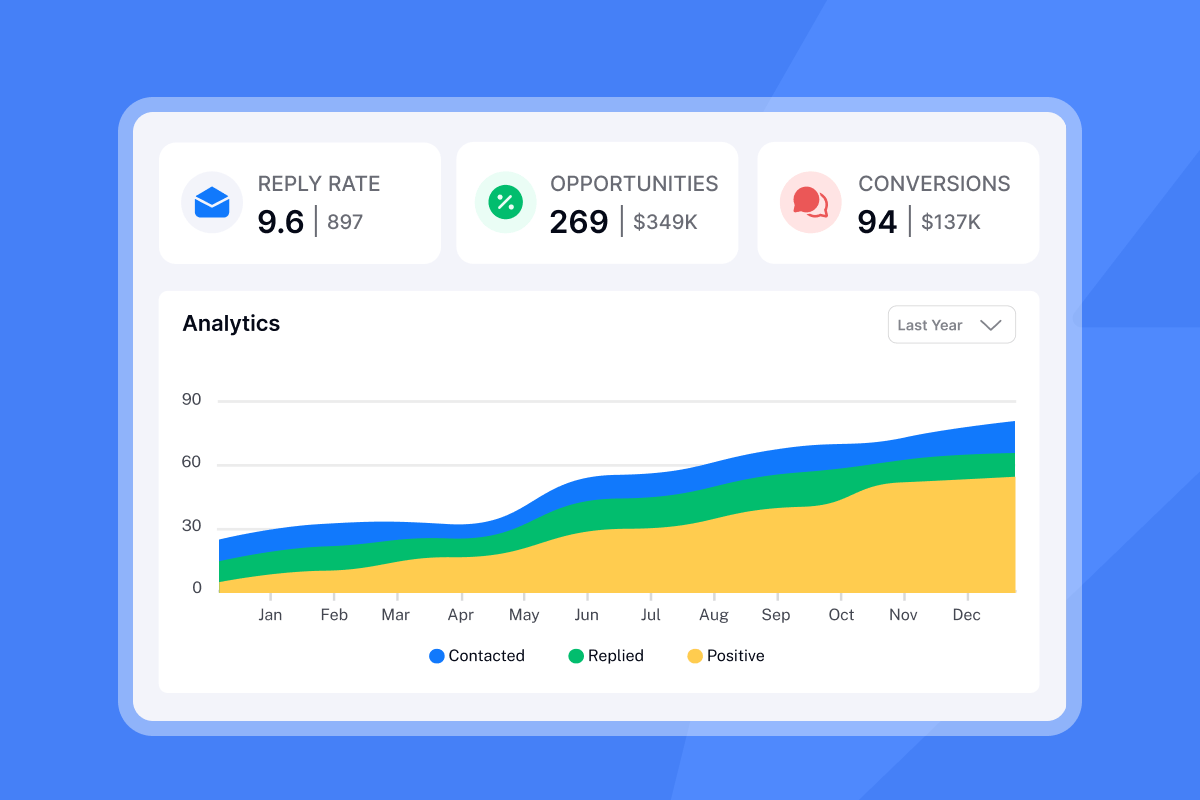
- Analytics and tracking: Instantly's campaign analytics show side-by-side performance for each variant, including opens, clicks, replies, and positive reply rate (filtered by sentiment). Integration with HubSpot and Salesforce lets you track which variant actually influenced revenue, not just which one got a reply.
- AI-assisted drafting: Use Instantly's AI Sequence Writer to generate variant copy and the AI Spam Words Checker to flag phrases that hurt deliverability before you send.
"The AI reply agent is a standout feature for me; it efficiently drafts responses based on client replies, saving me valuable time by simply requiring a review before sending."- Sachin J on G2
For a complete system walkthrough, watch speedrunning cold email from 0 to first booked call, which covers how to build your stack and run your first test.
How to set up a statistically significant A/B test
Statistical significance tells you the probability that the difference in performance between two variants is real, not random chance. Think of it like flipping a coin. If you flip twice and get two heads, you cannot be sure the coin is weighted. But if you flip 100 times and get 95 heads, you can be confident something is different.
We use the industry standard of 95% confidence level. If you run a test with 95% significance, you can be 95% confident that the differences are real, according to standard A/B test significance calculators.
Sample size requirements: With a baseline conversion rate of 5% and a goal to detect a 20% lift, you need approximately 3,800-4,000 sends per variant (7,600-8,000 total). Use an A/B test sample size calculator to adjust for your specific baseline and lift target.
| Baseline Conversion Rate | Minimum Detectable Lift | Sends Per Variant | Total Sends Needed |
|---|---|---|---|
| 3% | 20% | 5,200 | 10,400 |
| 5% | 20% | 3,800 | 7,600 |
| 8% | 20% | 2,400 | 4,800 |
| 5% | 30% | 1,700 | 3,400 |
This is why Instantly's unlimited accounts model matters. Smaller platforms cap your sending or charge per seat, which makes reaching statistical significance expensive.
"Also what's convenient that email marketing infrastructure is easy to scale and cheap. And even without lots of technical knowledge it makes easy to implement simple yet profound personalizations. - Deividas I. on G2
Avoid bias through randomization: Instantly's A/Z testing feature automatically rotates through variants for each new lead, ensuring an even and random distribution across your campaign. This prevents you from accidentally sending Variant A only to your best leads and Variant B to the rest.
Run your test until you hit your target sample size or at least 1-2 weeks, whichever comes first.
Step-by-step: Running A/Z tests in Instantly
Instantly's A/Z testing feature is available on the Growth plan ($47/month) and above. Here is how to set up a three-variant test for your next meeting scheduling campaign.
1. Navigate to your campaign and go to the "Sequences" tab.
2. Click "Add variant" to create Variant B, then click "Add variant" again to create Variant C. You can test as many variants as you want in a campaign. Use the toggle to enable or pause variants (blue means enabled, grey means paused).
3. Customize the subject line and email copy for each variant. Test one variable at a time. For example, if you are testing subject lines, keep the email body identical across all three variants.
4. Use Spintax to vary copy within variants. The format is {Option1|Option2|Option3}. Example: {Hi|Hello|Hey} [First Name]. This helps deliverability by making each email appear unique to email providers.
5. Enable "Auto optimize A/Z testing" in Campaign Options. Go to Campaign Options > Advanced Options > Auto optimize A/Z testing, then select your winning metric (reply rate for meeting-focused campaigns). The algorithm analyzes variants automatically and deactivates underperforming versions once it identifies a clear winner.
6. Set your send window and launch. Configure send windows to match your prospect's timezone and cap daily sends at 30 per inbox to protect sender reputation.
For a visual walkthrough, watch fixing a cold email campaign, which shows exactly how to configure A/Z tests inside Instantly.
Analyzing results: Metrics that actually matter
Track these four metrics to understand which variant drives meetings, not just inbox noise.
Open rate: Measures subject line effectiveness. A strong open rate (40-60% for warm lists, 20-40% for cold) means your subject line earned attention. If your rate drops below these benchmarks, read our guide on what to do when open rates are low and test different curiosity or clarity angles.
Reply rate: Measures pitch resonance. Industry data shows cold B2B emails typically achieve 5-10% reply rates, with top performers hitting 15%+. If you hit this range, your value proposition is working.
Positive reply rate: Use Instantly's AI Custom Reply Labels to filter sentiment. The platform automatically categorizes responses as Interested, Not Interested, or Out of Office. Calculate positive reply rate by dividing "Interested" replies by total sends. This metric matters more than raw reply count because it removes "stop emailing me" noise.
Booking rate (conversion): The ultimate metric. Did they click the calendar link or confirm a time? Track this in the Analytics tab of your campaign, where you can view performance breakdown by variant side-by-side over a longer time range (at least 4 weeks for complete results).
"The most helpful part is the detailed reporting. It shows clear data like open rates, replies, and bounce rates, which I can easily use for analysis and integrate with other BI dashboards." - Anjali T. on G2
For deeper context on what metrics drive pipeline, explore cold email copywriting frameworks that connect reply quality to booked meetings.
Common A/B testing pitfalls that kill conversions
Avoid these three mistakes that create false positives or waste volume.
Testing too many variables at once: Testing a new subject line AND a new CTA AND new email length all in the same variant creates a multivariate mess. Test one variable at a time, according to sequence A/B testing best practices. If Variant B wins, you need to know whether it was the subject line or the CTA that drove the lift.
Calling the winner too early: Declaring Variant B the winner after it gets 5 replies from the first 50 sends is noise, not data. Let tests run long enough to reach statistical significance, typically requiring 100-200+ sends per variant for reliable data.
Use an A/B test duration calculator to estimate how long your test needs to run based on your traffic and baseline conversion rate.
Ignoring seasonality: Running a test between Christmas and New Year's and assuming the low reply rate is due to the copy is a mistake. Seasonality (holidays, end-of-quarter crunches, industry events) skews results. Run your tests during normal business weeks and avoid major holidays.
For additional pitfalls and how to avoid them, see subject line A/B testing for cold email, which covers common mistakes agencies make when optimizing open rates.
Make A/B testing your competitive advantage
Test, measure, iterate. That is the system. Agencies that document lift and show clients exactly how they optimized booking rates keep those clients. Operators run at least one A/Z test per client per quarter and use the results to adjust pricing, messaging, and ICP targeting.
Instantly's unlimited sending accounts, built-in A/Z testing, and unified analytics remove the friction between hypothesis and proof. You get the volume needed for statistical significance without per-seat taxes, the automation to rotate variants without manual tagging, and the dashboards to show clients the exact percentage lift you delivered.
Start with one variable this week. Test two subject lines, track the booking rate, and document the lift. Then move to CTAs, then send timing. After three tests, you will have a data-backed playbook that no competitor can copy because it is built on your audience's behavior, not someone else's best practices.
Ready to apply this playbook? Try Instantly free and use the A/Z testing template inside the Growth plan to run your first statistically significant test.
For a complete reference on building your cold email system from scratch, watch 39 things I wish I knew when I started cold email, which covers testing frameworks and common mistakes to avoid. Once you've optimized your templates, make sure your sequences stay within legal boundaries, review the meeting scheduling email compliance guide before scaling volume across client accounts.
Frequently asked questions about meeting email testing
How long should an A/B test run?
At least 1-2 weeks or until you reach statistical significance (typically 3,800+ sends per variant for a 5% baseline with 20% lift goal). For opens, read early signals within hours. For replies and bookings, run longer.
What if my test results are inconclusive?
Revert to the control version and test a new variable with a more dramatic change. If differences are too small to detect, increase the contrast between variants.
How many variants should I test at once?
Two to four variants (A/B/C/D) provide a good balance between speed and insight without overwhelming your sample size requirements. Use Instantly's Auto-optimize feature to pause weak performers automatically.
Key terms glossary
A/Z Testing: An advanced form of A/B testing that allows you to test multiple variants (A, B, C, D, etc.) simultaneously rather than just two, enabling faster experimentation by comparing many variations at once to identify the best performer.
Statistical Significance: A measurement of the probability that the difference in performance between two variants is not a result of chance, typically requiring 95% confidence level. It provides assurance that the observed effect reflects a genuine impact rather than noise in the data.
Conversion Rate: The ratio of conversions (booked meetings) over total sends. If you send 100 emails and book 10 meetings, your conversion rate is 10%.
Split Testing: Also known as A/B testing, an experimental method of testing at least two versions of a variable at the same time to decide which version drives more business metrics such as reply rate or meetings booked.
Positive Reply Rate: The percentage of replies categorized as "Interested" or positive intent, filtered by sentiment analysis to remove "stop emailing me" and other negative responses from your total reply count.



