.svg)
%20(1).svg)


Updated on 22 May 2026
TL;DR: Choosing the right B2B email list provider comes down to database depth, pricing structure, and whether the platform includes native deliverability tools. Apollo offers a broad sales engagement platform with 210M+ contacts and CRM sync, but charges per seat. Hunter focuses on domain-based email verification with transparent credit pricing and includes intent data through its Signals feature. ZoomInfo delivers enterprise intent data starting at $15,000/year with annual-only contracts. None of the three include native email warmup. Instantly combines 450M+ verified contacts with a 4.2M-account warmup network and flat-fee pricing, giving you data and deliverability in one place.
Most sales teams obsess over database size when evaluating a B2B email list provider and ignore the deliverability infrastructure required to actually reach those prospects. The result is a clean list of 10,000 verified contacts that lands in spam because the sending domains never warmed up properly.
Choosing between Apollo, Hunter, and ZoomInfo comes down to data accuracy, platform features, and budget. But clean data is only half the equation. Hitting pipeline targets consistently requires a system that pairs verified B2B contacts with strict deliverability protections, transparent pricing, and clean CRM handoffs. This comparison covers each dimension so you can match the right tool to your team's actual needs.
Apollo, Hunter, ZoomInfo: core offerings
These three platforms dominate B2B data conversations but serve meaningfully different buyer profiles. Understanding their core positioning first saves you from evaluating the wrong tool against the wrong criteria.
Apollo's verified B2B contacts
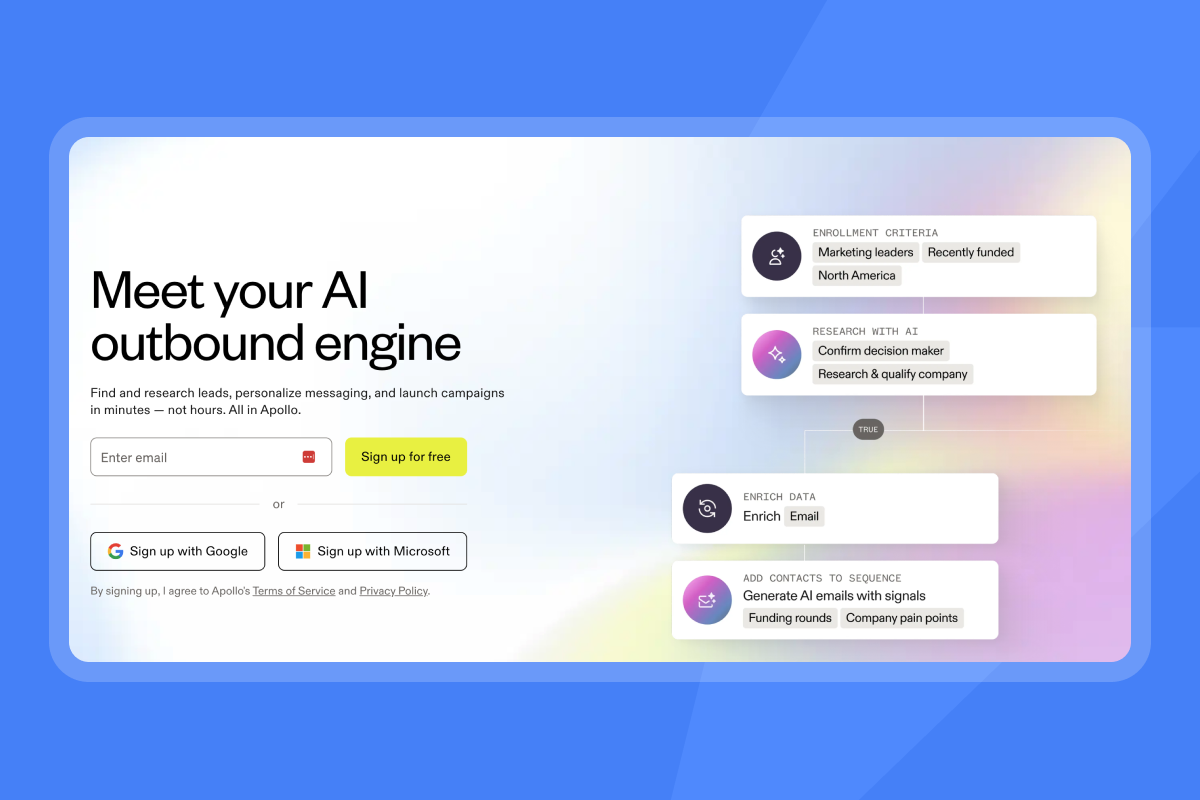
Apollo runs as a sales engagement platform that combines a contact database of 210M+ verified contacts and 73M+ companies with built-in sequencing, calling, and CRM integrations. It targets SDRs, account executives, and growth teams from solo founders up to enterprise organizations. The platform lets you prospect, automate outreach, and sync activity to your CRM from one interface, which is its main appeal for teams consolidating tools.
Apollo's data covers 65+ attributes per lead, including technographics, hiring signals, and buyer intent filters. That enrichment depth makes it useful for segmented outreach, but the per-seat pricing model means costs compound as your team grows.
Hunter: email finder and verifier
Hunter is a domain-based email verification tool used by more than 6,000,000 professionals. Rather than maintaining a static database, Hunter indexes the live web to surface and verify professional email addresses on demand. The primary workflow is straightforward: enter a company domain, retrieve associated email addresses, and verify them before sending. For targeted, low-volume outreach, that simplicity is a genuine advantage.
ZoomInfo: enterprise intelligence and intent data
ZoomInfo positions itself as an AI-powered go-to-market intelligence platform rather than just a contact database. Its global database covers more than 235 million B2B professional profiles and 100 million companies worldwide. The platform adds intent data, organizational chart mapping, and workflow automation through products like ZoomInfo Copilot and GTM Studio.
ZoomInfo's depth is genuine, and for enterprise teams running account-based marketing (ABM) strategies at scale, the intent signals and org-chart data are hard to replicate elsewhere. That capability comes at a cost: contracts start at $15,000 annually for small teams.
Feature-by-feature comparison matrix
Here is how the four platforms stack up across the factors that matter most to a sales leader managing a team of SDRs with quota accountability.
Feature | Apollo | Hunter | ZoomInfo | Instantly |
|---|---|---|---|---|
Database size | 210M+ contacts | 150M+ emails (indexed) | 235M+ profiles | 450M+ verified contacts |
Primary use case | All-in-one sales platform | Email finder and verifier | Enterprise ABM and intent | Outreach with built-in deliverability |
Native email warmup | No | No | No | Yes (4.2M+ account network) |
Pricing model | Per-seat ($49-$119/user/month annual) | Credit-based ($34-$209/month annual) | Annual contracts ($15K-$35K+/year) | Flat-fee, unlimited accounts |
CRM sync | Native (HubSpot) | Native (HubSpot via free integration) | HubSpot (varies by contract) | HubSpot native, Salesforce via integration |
Intent data | Yes (65+ filters) | Yes (via Signals feature) | Yes (advanced) | Limited enrichment filters |
API access | Available (advanced features on Organization plan) | Available on paid plans | Custom contract | Available |
Provider data update cycles
Apollo refreshes data in real-time whenever its system captures a data signal, such as a job change, a new phone number, or an updated email address. That continuous refresh model reduces stale contact risk for active prospecting.
Hunter's freshness depends on how recently a company updated its public website, since the tool indexes live web pages rather than maintaining a curated database. Well-maintained sites return current data. Smaller businesses with infrequent web updates produce addresses that can lag.
ZoomInfo uses a team of 300+ dedicated researchers who proactively gather and verify data, supplemented by automated technology that fills profile gaps. The combination produces strong data quality for enterprise accounts, and the price reflects that investment.
Verified email bounce rates
The average B2B email bounce rate sits at 2.48% across industries, with sectors like B2B sales and recruiting often seeing hard bounce rates between 0.7% and 1.5%. Keeping bounces below 1% is the threshold that protects your sender reputation.
Apollo's seven-step email verification process targets catch-all domains specifically, predicts likely bounces before you send, and auto-cleans invalid emails. Hunter's verification assigns a confidence score to addresses it can't fully confirm, giving your team a practical way to filter risky contacts before upload. Instantly's catch-all email verification applies a waterfall enrichment model across 5+ providers to cross-reference contact validity before you spend sending credits on a bad address.
What contact information is included?
Apollo provides 65+ data attributes per lead, including direct dials, technographics, hiring activity, and buyer intent signals. That's the strongest enrichment layer of the three platforms for teams segmenting by tech stack or buying stage.
Hunter surfaces email addresses and confidence scores only, with no phone numbers, firmographics, technographics, or organizational charts. For sales teams that need full contact context before outreach, that gap is meaningful.
ZoomInfo delivers the deepest enrichment: org charts, buying signals, and AI-powered GTM intelligence tools that map the entire buying committee at a target account. That depth is overkill for SMBs but genuinely valuable for enterprise AEs working six-figure deal sizes.
API capabilities and rate limits
Apollo provides API access on all plans, with advanced API features available on the Organization plan at $119 per user per month on annual billing, with a three-user minimum. Basic and Professional plans have API access with more limited call rates, which restricts custom workflow building for smaller teams with technical ops capacity.
ZoomInfo's API access typically requires a custom enterprise contract. Rate limits and scope vary by agreement, which makes integration development hard to plan without direct sales engagement.
Streamlined CRM connections
Apollo offers native bidirectional integrations with HubSpot on its Basic plan, with activity write-back for calls, emails, and sequences built in. That reduces the manual data entry that erodes CRM hygiene over time.
Hunter offers native integrations with HubSpot. The free Salesforce integration automatically exports newly generated leads and saves them to Salesforce, while the HubSpot integration sends contacts directly to create leads and deals.
ZoomInfo's Salesforce, HubSpot, and MAP integrations vary by contract tier and package. Budget accordingly if CRM sync is a requirement. Instantly connects to HubSpot natively and to Salesforce via OutboundSync, with Zapier recipes available for routing interested leads directly to your CRM on trigger.
Pricing transparency is one of the clearest differentiators across these platforms. Per-seat models, annual lock-ins, and opaque credit systems are the billing traps that most commonly cause sales leaders to overpay relative to the value they receive.
Apollo plans: levels and inclusions
Apollo's pricing runs on a per-seat model. On annual billing, the Basic plan is $49 per user per month, the Professional plan is $79, and the Organization plan is $119 with a three-user minimum. Monthly billing adds roughly 20% to each tier. A team of five SDRs on Professional annual billing runs $395 per month
($79 × 5), before additional credit purchases for data exports beyond plan limits. As team size grows, the cost grows proportionally, and that math gets harder to defend as you expand past 10 reps.
Hunter's pricing is credit-based and transparent. The Starter plan costs $34 per month on annual billing and includes 2,000 Unified Credits per month with auto-verification included. However, real-world enrichment rates matter more than pricing-page math. A 2025 benchmark testing 20,000 contacts across 15 tools found Hunter's effective enrichment rate sits at 32.5% with an 11.2% hard bounce rate. Using those numbers, your real cost per deliverable email lands around $0.059 on annual billing and $0.085 on monthly billing. All plans include unlimited team members at no extra cost, which gives Hunter a structural cost advantage over per-seat tools for growing teams.

ZoomInfo does not publish list pricing. Based on reported contract data, small teams typically start
between $15,000 and $25,000 annually, and mid-sized teams of five to ten seats are most commonly quoted $25,000 to $35,000 per year. ZoomInfo does not offer monthly contracts. Some agreements include automatic renewal price increases of 10% to 20%, and starter plans typically include only 2,500 annual credits, which runs out quickly under regular prospecting. Additional credit purchases are common and add materially to the base cost.
Here is an illustrative cost-per-lead comparison based on published pricing:
- Apollo Professional (5 seats, annual): $395/month ($79 per user × 5). With the credit model tied to subscription value and complex limits, real per-contact costs depend on your data export volume and plan credits.
- Hunter Starter (annual): $34/month. At real-world enrichment rates (32.5% effective with 11.2% bounce), cost per deliverable email lands around $0.059 on annual billing.
- ZoomInfo (mid-market contract): Reported contracts range from $25,000 to $35,000 per year for mid-sized teams, with starter plans typically including 2,500 annual credits. Bulk credit pricing reportedly starts around $0.60 per credit for 5,000 credits, decreasing with volume.
- Instantly Lead Finder (Growth plan): $47/month for 1,500-2,000 credits with 450M+ contacts available. At 1,500 credits per month, that's approximately $0.031 per contact, with unlimited sending accounts and built-in warmup included at no additional per-seat cost.
Apollo's value proposition is consolidation. For teams that previously ran separate tools for prospecting, sequencing, and CRM sync, bringing those workflows into one platform reduces context switching and the data gaps that appear when tools don't talk to each other cleanly.
Team workflows and onboarding
Apollo includes A/B testing, multi-step sequences, and team-level templates on paid plans. Sales leaders can standardize copy and cadence across the SDR team from a single campaign management interface, which reduces rep-to-rep variation in outreach quality. The platform also supports scheduling, follow-up automation, and reply detection within its sequence builder.
Apollo's self-serve onboarding is fast. Most teams complete their first sequence in a single 30-60 minute onboarding session, and new reps benefit from a well-documented Help Centre with video training resources. The interface is purpose-built for sales workflows, which shortens ramp time compared to a tool like ZoomInfo that requires more configuration before it becomes usable.
Dashboard transparency and reporting
Apollo's pricing is tiered and visible, which makes budget conversations straightforward. Each plan's feature set is documented clearly, and per-seat cost is predictable on a fixed team size. The limitation is scalability: as team size grows, so does the monthly bill at a fixed per-rep rate. For RevOps leaders optimizing cost-per-meeting, that math gets harder to defend as the team expands past 10 reps.
Hunter's edge: precision and simplicity
Hunter's advantage is precision. For teams doing highly targeted outreach to specific companies or domains, Hunter's verification accuracy and simplicity make it fast to go from a target account list to a verified contact.
Domain search and UI simplicity
Hunter's domain search is its core feature. Input a company domain, and the tool returns all publicly indexed email addresses associated with that domain, along with a format pattern for addresses it can infer. For sales teams with a defined target account list (TAL), this workflow is highly efficient. You pay for verified addresses against your specific targets rather than purchasing access to a broad database.
Hunter's UI is intentionally minimal. Hunter offers basic campaign features and native CRM integrations with HubSpot, but lacks the full sequencing engine and advanced enrichment features found in all-in-one platforms. For a small team or solo rep doing focused outreach, that simplicity is a feature. For a 10-rep SDR team that needs standardized sequences, reporting, and pipeline visibility, it's a hard ceiling that most teams hit quickly.
Hunter's free plan for verified leads
Hunter offers a free tier that includes 25 monthly searches and 50 verifications. For an individual contributor testing a targeted account list before committing budget, that's a useful evaluation window. At any meaningful outreach volume, the free tier exhausts within the first few hours of active use. The Starter plan at $34/month on annual billing is where Hunter becomes genuinely useful, providing roughly 2,000 verifications per month at a cost that is hard to beat for pure email validation.
ZoomInfo's enterprise-grade intelligence
ZoomInfo's data depth is its clearest competitive advantage. For enterprise sales teams where a single closed deal covers the entire annual contract, the investment in intent data and organizational mapping makes strategic sense.
Data accuracy and intent signals
ZoomInfo's verification process combines automated technology with 300+ human researchers who proactively collect and validate data. That multi-layer approach produces strong accuracy for enterprise account contacts, where direct dials and confirmed titles are harder to verify through automated indexing alone. That verification process improves data accuracy and reduces bounces, though it's worth noting that low bounce rates also depend on your sending infrastructure and domain warmup, which ZoomInfo does not provide.
ZoomInfo's intent data helps you identify companies actively researching topics relevant to your product, so you can prioritize outreach to accounts already in a buying cycle. That signal, combined with organizational chart data showing the full buying committee, gives enterprise AEs the context they need to run complex multi-threaded deals. For SMBs running volume-based outreach, that level of intelligence is often more than they need and adds cost without proportional pipeline return.
Priority support for sales ops
Enterprise ZoomInfo contracts include dedicated account managers, structured onboarding, and priority support escalation paths. If you're managing a large deployment across multiple teams and regions, you'll find that white-glove service model valuable. For teams under 20 reps, it's priced well above what most budgets can sustain.
The right provider for your sales pipeline
Choosing the right B2B email list provider depends on your team size, outreach volume, and how much your pipeline depends on deliverability precision versus data breadth.
Building B2B lists for startups
For a lean team of one to three reps running targeted outreach to a defined account list, Hunter's Starter plan at $34/month gives you verified emails at a transparent cost structure. Pair it with Instantly's Growth Outreach plan at $47/month for unlimited email accounts and built-in warmup, and you have a functional outbound stack for under $100/month. The key constraint at this stage is list quality over list size. A verified list of 300 contacts with clean domain health outperforms an unverified list of 10,000.
Mid-market sales data quality
A team of five to fifteen reps managing structured sequences, CRM sync, and rep-level reporting may benefit from Apollo's consolidation approach, which brings prospecting, sequencing, and CRM sync into one platform. The gap to fill is deliverability. Apollo's built-in warmup capabilities are limited, and adding Instantly's deliverability infrastructure protects the sender reputation you've built during ramp.
Scaling B2B email lists for enterprise
For large sales organizations running ABM programs across named accounts with complex deal cycles, ZoomInfo's intent data and org-chart depth may justify the cost. The annual contract is a material commitment, so run a structured pilot with a defined set of target accounts before signing. Push your ZoomInfo account team for data processing agreements, sub-processor lists, and credit consumption projections during negotiation. The contracts that spiral in cost usually do so because of credits, not base seats.
Powering high-volume sales sequences
High-volume outreach exposes the deliverability gap in all three traditional providers. None of Apollo, Hunter, or ZoomInfo include native peer-to-peer email warmup. Almost 50% of all emails across all B2B email categories land in spam, and that rate can climb for cold outreach on domains without proper warmup history and send pacing.
For teams sending at scale, best practices recommend keeping individual inboxes to a maximum of 30 emails per day. Scaling throughput typically requires adding sending domains and inboxes, not just raising the daily cap on a single account, as explained in Instantly's secondary sending domains strategy guide. Rotating IPs and send algorithms further protect primary inbox placement and are standard practice for maintaining deliverability at high volume.
Improve deliverability with targeted lists
Paying a premium for enterprise intent data is a waste of budget if your sending infrastructure leaves verified contacts unread in the spam folder.
The structural problem with Apollo, Hunter, and ZoomInfo as a group is that they all stop at data. None include the deliverability infrastructure that determines whether your verified contacts actually see your message. As this Apollo vs. Instantly comparison from Savvy Search Solutions illustrates, these tools solve fundamentally different problems, and layering them creates complexity that most teams don't have the bandwidth to manage.
Instantly's Lead Finder combines a 450M+ verified B2B contact database with native outreach and a deliverability network of 4.2M+ accounts used for warmup and engagement. You find, verify, warm up sending domains, and launch sequences from one platform, without stitching together three separate tools.
The Inbox Placement test gives you visibility into where your emails land across major mailbox providers before you send a live campaign, so deliverability failures show up in a dashboard rather than in your meetings-booked metrics at the end of the month.
"I like that Instantly is intuitive and everything is done in one place, from lead sourcing to writing campaigns to reaching out to them. I appreciate how it helps with warming up and managing email inboxes." - Noureddine K. on G2
"Instantly makes cold outreach operationally simple at scale. The interface is straightforward, setting up campaigns with multiple inboxes is fast, and the warm-up system helps maintain deliverability when sending higher volumes." - ivar s. on G2
"Been using Instantly for our cold email agency for a while now. Running like 24 inboxes and the warmup actually works, deliverability stays solid. API is great for automating stuff, CRM catches replies nicely." - Necmeddin Talha Ucar on Trustpilot
The flat-fee pricing model removes the per-seat penalty that makes Apollo expensive for growing teams. On Instantly's Outreach Growth plan at $47/month (or $37.60/month billed annually), you get unlimited email accounts and warmup regardless of how many senders your team runs. Note: the $131/month stack figure in the same paragraph ($37 + $47 + $47) should be $141/month if all plans are billed monthly. Add Lead Finder at $47/month and a Growth CRM at $47/month, and you have a full outbound stack at $141/month (Outreach Growth at $47 + Lead Finder at $47 + CRM Growth at $47). The $131 figure appears to use the incorrect $37/month for Outreach.
For teams already on Instantly, the email tracking integrations guide covers how to connect your CRM and calendar workflows without creating data silos between your outreach tool and pipeline reporting. The 30-day implementation checklist maps out a full rollout with send ramp schedules and team role setup to protect domain reputation from day one.
For a broader view of how Instantly stacks up against Apollo, the Apollo vs. Instantly video from Tinkr and the Lead Gen Jay breakdown of combining Apollo, Clay, and Instantly as a lead gen stack are both worth watching before you finalize your tool selection.
Ready to scale outreach without per-seat penalties? Start Instantly for free and run your first sequence with built-in warmup and 450M+ contacts in Lead Finder.
Read next
- Email deliverability for sequences: warmup, health monitoring, and compliance
- Email tracking integrations: how to sync CRM, calendar, and workflows without data silos
- Subject line testing at scale: a governance framework for sales leaders
FAQs
Do any of these providers charge exit fees?
Apollo and Hunter do not charge documented exit fees, but annual plans are non-refundable once committed. ZoomInfo contracts reportedly include automatic renewal clauses with potential price increases at renewal, so read the contract terms in full before signing.
Which providers meet GDPR data protection standards?
ZoomInfo, Apollo, and Hunter all include data processing terms in their standard agreements. Instantly's Data Processing Agreement details sub-processor listings and data categories for GDPR compliance.
How does Salesforce sync work across these platforms?
Apollo offers native bidirectional Salesforce sync on its Basic plan at $49 per user per month annually, with activity write-back included. Hunter offers free native Salesforce integration that automatically exports leads, plus native HubSpot integration. ZoomInfo's Salesforce integration terms vary by contract. Instantly connects to Salesforce via OutboundSync and supports HubSpot natively.
Key terms glossary
Email warmup: The process of gradually increasing send volume from a new inbox to build sender reputation with mailbox providers and improve primary-inbox placement rates.
Catch-all domain: A domain configured to accept email sent to any address at that domain, making verification difficult because the server never returns a bounce regardless of whether the specific address exists.
Intent data: Behavioral signals (web searches, content downloads, vendor review visits) that indicate a company is actively researching a category or solution, used to prioritize which accounts to contact first.
Sender reputation: A score assigned by mailbox providers to your sending domain and IP address, based on bounce rates, spam complaints, engagement rates, and sending volume history. Poor reputation sends email to spam.
SISR (Server and IP Sharding and Rotation): A deliverability architecture that distributes sends across dedicated servers and IP pools to reduce the risk of a single IP block affecting all outbound mail. Available on Instantly's Light Speed plan.



