


Updated February 24, 2026
TL;DR: If you run an agency, you know that getting prospects to accept meetings is harder than earning their initial interest. Gartner research on B2B buying journeys shows that buyers spend only 17% of their time meeting with suppliers, dropping to 5-6% per supplier when comparing multiple options. The difference between "Let me know when works" and "Tuesday at 2 PM or Wednesday at 10 AM" drives 13x more bookings. We'll show you how to apply cognitive ease, reciprocity, scarcity, social proof, and authority to reduce friction and convert replies into confirmed meetings. The best psychology means nothing in the spam folder, so we'll cover the deliverability foundation that makes these tactics work.
Gartner projected that by 2025, 80% of B2B sales interactions would occur in digital channels, and when buyers compare multiple suppliers, they spend only 5–6% of their time with any single rep. You're fighting for attention scraps against every other calendar demand.
Behavioral science gives us repeatable patterns to reduce friction and increase acceptance. Here's how to apply them.
Why prospects ignore your meeting requests
Internal corporate meeting requests get mindless accepts. Your boss sends a Friday 3 PM invite, and you click yes without thinking. But cold outreach triggers skepticism, evaluation, and often silence.
The difference is cognitive load. Cognitive Load Theory research proves that working memory holds only four to seven new items simultaneously. When you write "Let me know what time works," you force the prospect to mentally juggle their calendar, availability constraints, meeting preferences, and time zones.
Add decision fatigue research to the mix. Baumeister's Strength Model suggests that we deplete internal resources when processing decisions, though the size of this effect remains debated among researchers.. Your brain looks for shortcuts and defaults to the easiest option, which is often no response at all.
Internal meeting requests bypass these filters because authority and existing relationships provide context. External requests have no such advantage. You must engineer cognitive ease into every sentence.
The 5 psychological triggers that drive "Yes"
We use Cialdini's principles of persuasion, reciprocity, scarcity, authority, commitment/consistency, liking, social proof, and unity, as our framework for ethical influence, supplemented by Kahneman's concept of cognitive ease as a foundation. Here's how they apply to meeting scheduling.
1. Cognitive ease (Specificity)
Proposing "Tuesday at 2 PM or Wednesday at 10 AM" beats "next week" because it changes the mental task from creation to selection. Instead of scanning a calendar and generating options, the prospect evaluates two concrete choices.
A scheduling software study sent 50 emails with calendar links and another 50 with specific time suggestions. Calendar links converted at 1.9%. Suggested times generated 13x more bookings simply by reducing the recipient's cognitive work.
2. Reciprocity
We're wired to return favors and pay back debts. Cialdini's reciprocity principle proves that you must be the first to give, and what you give must be personalized and unexpected.
In meeting requests, this means offering value before asking for time:
- "I audited your homepage and found three conversion issues costing you qualified leads. Can I walk you through the fixes on Thursday at 10 AM or Friday at 2 PM?"
- "I noticed your team is hiring SDRs. Watch this video on our cold email framework. Would Tuesday at 3 PM work to discuss applying this at scale?"
3. Social proof
Show prospects that similar companies trust you and their perceived risk of wasting 15 minutes drops. We look to others' behavior to guide our decisions, especially under uncertainty.
Effective social proof in meeting requests includes:
- "We just helped [Similar Industry Company] increase pipeline by 32% in 90 days using this approach."
- "We work with 20+ agencies in your vertical to improve deliverability and reply rates."
Specificity matters. Named companies, quantified results, and relevant industries create tangible validation.
'One standout feature that I particularly like is the way Instantly maintains my email reputation, preventing my emails from being marked as spam and instead landing in the recipients' inboxes.' - Adnan K. on G2
4. Scarcity
When you signal genuine scarcity, you trigger urgency. People want more of what they can have less of, but the line between ethical and manipulative scarcity is clear.
Ethical Scarcity | Unethical Scarcity |
|---|---|
"I have two consultation slots remaining this week. After that, I'm booked through March." | Countdown timers that reset for each visitor |
"This offer is for the first 10 respondents in your vertical." | "Only 3 spots left" for unlimited digital products |
Both are verifiable constraints | "This price will never be offered again" when regularly repeated |
Research on false scarcity shows that artificial limitations exploit FOMO and damage long-term trust. The most effective scarcity is based on truth.
5. Authority
Authority builds trust through demonstrated expertise. In cold email, authority signals include professional credentials, industry recognition, and verifiable track record.
Your email signature structure should include:
- Professional headshot (business casual, well-lit)
- Job title showing expertise (not "Sales Rep" but "Enterprise Sales Director, FinTech")
- Quantified proof point ("Helped 50+ agencies scale outbound 3x")
- Domain health (proper SPF, DKIM, DMARC signaling legitimacy)
How to apply these principles at scale
Theory means nothing if you can't operationalize it across 10, 50, or 150 client inboxes. Platform architecture matters.
A/Z testing for psychological triggers
Standard A/B testing forces you to pick one variable and wait weeks for statistical significance. Instantly's A/Z testing feature lets you test up to 26 variants simultaneously within a single campaign, comparing different psychological angles at once.
You can run:
- Variant A: Reciprocity focus with upfront value
- Variant B: Scarcity angle with limited slot availability
- Variant C: Social proof with client results
- Variant D: Combination of reciprocity and scarcity
The platform evenly distributes sends and tracks reply rate, click rate, and open rate for each variant. When auto-optimize is enabled, the system identifies the highest-performing version and automatically deactivates underperformers.
The Instantly blog on A/B testing optimization shows how this approach lets you learn faster from finite prospect lists and make data-driven decisions about which psychological triggers resonate.
Spin syntax for unique copy at scale
Deliverability requires unique emails. Mass sending identical copy triggers spam filters. Spin syntax (spintax) solves this by creating variations within a single template using {option1|option2|option3}.
Scarcity example with spintax:
"I have {two|a couple of} slots {available|open} {this week|in the next few days} for {a quick audit|a 15-minute review}."
This generates:
- "I have two slots open this week for a quick audit."
- "I have a couple of slots available in the next few days for a 15-minute review."
Flat-fee economics enable experimentation
Most sales engagement platforms charge per seat, making large-scale testing prohibitively expensive. Add 10 email accounts to test new copy angles, and your monthly bill jumps $500-1,000.
Instantly's outreach pricing includes unlimited email accounts and warmup on every tier. Growth starts at $47/month, Hypergrowth at $97/month, and Light Speed at $358/month. You can connect and warm as many inboxes as needed to reach proper sample sizes without per-seat penalties.
Compare our pricing plans to see how unlimited accounts remove testing barriers.
'The unlimited email accounts feature and the automated warm-up are essential for protecting domain reputation while reaching a high volume of leads.' - Adnan K. on G2
The technical prerequisite: Psychology means nothing without deliverability
The best psychological copy fails if the email lands in spam. Email service providers like Google and Microsoft filter mail using domain reputation, sender history, email authentication, and content patterns.
Warmup builds the foundation
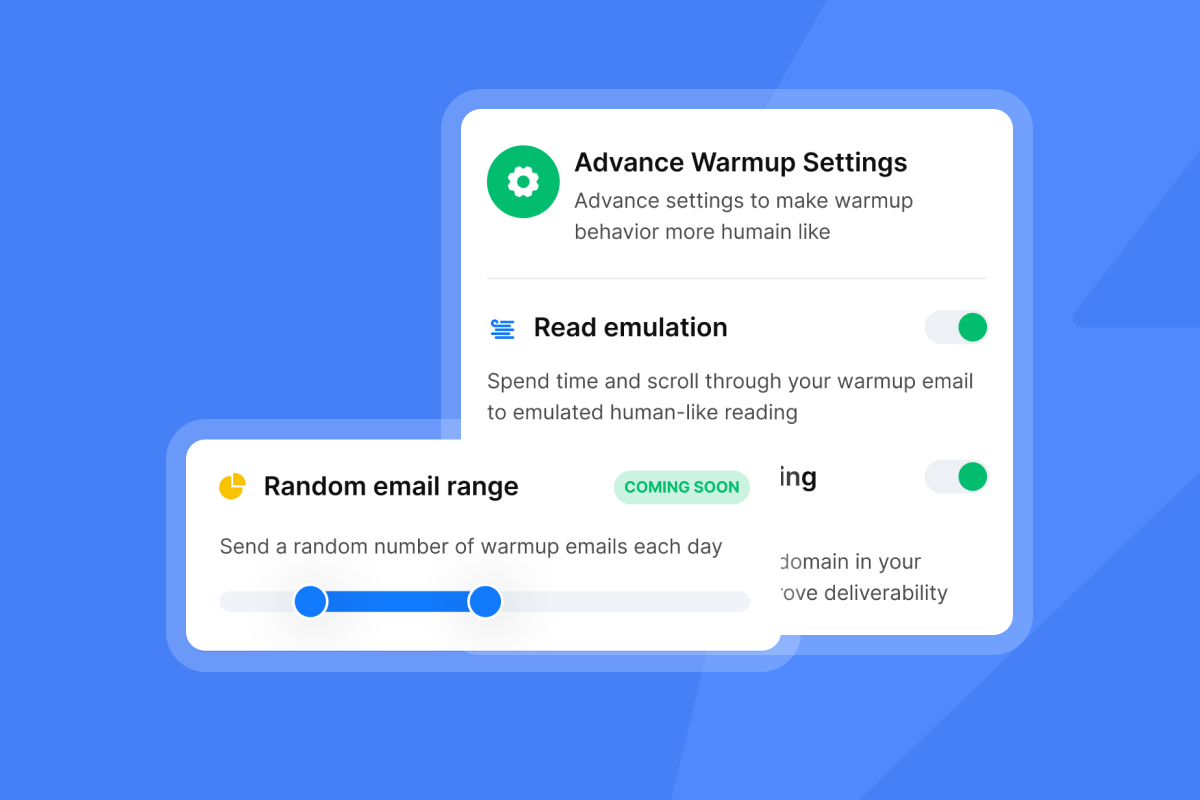
New domains have zero reputation. Sending high volumes immediately flags you as a spammer. Instantly's warmup feature gradually increases sending volume while engaging with Instantly's deliverability network of 4.2M+ accounts to build positive sending history.
The recommended warmup strategy includes:
- 30-day warmup period before launching campaigns
- Ramp daily sends gradually from low volumes (5-10 emails) up to a maximum of 30 per inbox
- Keep bounce rate at or below 2% using list verification
- Monitor health scores daily and pause if metrics dip
"I love the automation features of Instantly, especially the automatic email scheduling. It saves me time by sending emails at optimal times, reducing the chances of them being marked as spam. The setup was very easy and straightforward. I also find the email warming feature useful." - Arshad M. on G2
Inbox placement testing validates your setup
You can write perfect psychological copy and still land in spam if technical setup is wrong. Instantly's Inbox Placement feature runs automated tests showing where your emails land across major providers: primary inbox, promotions tab, or spam folder.
Run placement tests before launching high-stakes campaigns. If 40% of your emails hit spam, fix your domain authentication and warmup before testing psychological copy variants.
Technical controls include global block lists, bounce detection, send window controls, and volume caps. The campaign options guide details how to configure these settings.
3-Step framework to rewrite your scheduling emails
Here's a practical before-and-after process to apply psychological principles to your current templates.
Step 1: Audit for high-friction language
High-friction words suggest prospects have to give up something: time, money, or energy. They describe things people have to do, not things people want to do.
High Friction | Why It Fails | Low Friction Alternative |
|---|---|---|
"Pick your brain" | Suggests extracting value without reciprocity | "Show you a 3-point plan" |
"Hop on a quick call" | Minimizes but doesn't eliminate commitment | "Walk you through the data" |
"Let me know when works" | Forces calendar scanning and decision-making | "Tuesday at 2 PM or Wednesday at 10 AM" |
"Grab a coffee" | Vague coordination requirement | "15-minute calendar review" |
Scan your current templates and highlight every phrase that requires mental effort from the prospect.
Step 2: Inject reciprocity and specificity
Replace vague asks with concrete value and specific options.
Before (High Friction):
"Hi [Name], I'd love to pick your brain about your email strategy. Let me know when you have time for a quick call this week. Thanks!"
After (Optimized):
"Hi [Name], I noticed your team is scaling outbound. I recorded a 90-second walkthrough showing three improvements that typically increase reply rates 20-30%. Would Tuesday at 2 PM or Wednesday at 10 AM work for a 15-minute call to discuss how we'd apply this to your ICP?"
What changed:
- Reciprocity: Provided a specific, useful video upfront
- Specificity: Two concrete time options instead of open-ended ask
- Authority: Referenced measurable outcomes (20-30% increase)
- Cognitive ease: Changed task from creation to selection
Step 3: Add ethical scarcity or social proof
Layer in urgency or validation depending on your positioning.
Scarcity version:
"I have two strategy session slots left this week before I'm booked through March. Would Tuesday at 2 PM or Wednesday at 10 AM work for 15 minutes?"
Social proof version:
"We just helped [Similar Company] increase pipeline 32% in 90 days using this approach. Would Tuesday at 2 PM or Wednesday at 10 AM work to walk through how we'd customize this for [Prospect Company]?"
Both versions maintain specificity and reciprocity while adding a psychological trigger that increases perceived value or urgency.
Handling the "Yes" without breaking the spell
Once they reply positively, speed matters. Faster responses correlate with higher booking rates. Delay kills the dopamine hit of the decision.
The 5-minute rule
When a prospect replies "Tuesday works," you have a narrow window to confirm before competing priorities reclaim their attention. Manual response delays of hours or days increase no-show rates.
Instantly's AI Reply Agent uses natural language processing to detect positive intent, then drafts replies or automatically confirms meetings in under 5 minutes. You configure keywords like "Tuesday works" or "let's do it" that trigger automated booking confirmation, and the AI maintains your voice by learning from your previous replies. The feature consumes 5 credits per automated reply but maintains the critical response velocity that manual teams can't match.
Calendar link as backup, not primary
It's recommended to start by proposing specific times first, then offering a calendar link as a backup if neither option works.
Optimized confirmation reply:
"Perfect, I've got you down for Tuesday, March 12 at 2 PM ET. I'll send a calendar invite with the Zoom link. If something changes, here's my calendar: [link]."
The primary action is stated declaratively. The calendar link is positioned as a fallback.
Instantly's Unibox feature centralizes all campaign replies into a single interface. Instead of checking 50 Gmail tabs or forwarding replies to a spreadsheet, you triage all positive responses in one view and maintain sub-5-minute reply times even at scale.
Ready to test these psychological principles at scale? Start with Instantly's free trial and use the 3-step framework above to rewrite your top-performing sequence. Then set up A/Z testing to compare your reciprocity variant against your scarcity variant across at least 100 sends per version.
Frequently asked questions
Does fake urgency hurt my brand long-term?
Yes. False scarcity shows that artificial limitations exploit FOMO and damage trust. Only claim limited availability when it's genuinely true.
Should I use a calendar link or propose specific times?
Propose times first. Reducing cognitive load through specific options dramatically outperforms calendar links alone. Offer the link as a backup.
Can I test these principles without expensive tools?
Unlimited accounts on a flat fee remove the testing barrier. Instantly's Growth outreach plan starts at $47/month with unlimited sending accounts, making large-scale psychological testing economically viable for agencies.
Key terminology
Cognitive Load Theory: Your working memory holds only four to seven items at once. Emails demanding excessive mental processing increase the chance of no response.
Decision Fatigue: The depletion of mental resources after making numerous choices, leading to lower-quality decisions or default inaction.
Reciprocity: Cialdini's principle stating that humans feel compelled to return favors. In meeting requests, offer value before asking for time.
Ethical Scarcity: Using genuine limitations like calendar availability to create urgency, as opposed to artificial scarcity that manipulates through false claims.
A/Z Testing: Testing up to 26 email variants simultaneously within one campaign to identify which psychological triggers generate the highest reply and booking rates.
Spintax: Template format using {option1|option2} to create unique email variations that maintain psychological principles while improving deliverability.


