.svg)
%20(1).svg)


Updated on 07 May 2026
The pay-per-lead model promises to quickly fill your pipeline, but the economics hinge on lead quality and conversion rates. With average B2B leads hovering around $200 and some exceeding $600, a weak fit only inflates customer acquisition costs.
While PPL can work for rapid market testing, sustainable growth comes from owning your infrastructure. In other words, building an in-house engine lets you control the messaging, the data, and ultimately, the revenue.
When B2B teams need more pipeline, they often look for ways to get there faster. Pay-per-lead (PPL) sounds like exactly that: you're paying for leads, not for the work that goes into finding them.
The model has grown popular across industries, from home services to SaaS, mostly because it promises predictable costs while someone else handles lead prospecting.
That's the idea, anyway. In practice, a lot depends on the provider. Some deliver. Others leave you with a lighter budget and not much to show for it. That raises the question: Is PPL even worth it? Or are you better off building your own pipeline?
This guide helps you decide. We'll break down what the model pay-per-lead truly costs, when the model makes strategic sense, and why many companies eventually decide to build a pipeline they fully own.
How the Pay-Per-Lead Model Works
With most marketing models, you're paying for activity rather than outcomes. You run ads, pay for every click, and hope enough of those clicks turn into something useful. Maybe they do, maybe they don't. Either way, the bill is the same.
Pay-per-lead works a bit differently. Instead of paying for clicks or impressions, you pay a vendor, agency, or affiliate a fixed fee for each lead they actually deliver to you.
That could be someone filling out a contact form, booking a demo, or downloading a resource. The point is that you're only charged when a specific action happens. Compare that to the other common models:
- Pay-per-click charges you every time someone clicks your ad, regardless of whether they become a lead or not. You're essentially paying for traffic and hoping some of it converts.
- Pay-per-conversion only charges you when a lead becomes a paying customer. Great in theory, but providers charge a premium for taking on that risk.
Pay-per-lead sits somewhere in the middle. You're not paying for raw clicks, but you're also not paying for closed deals. You're paying for potential.
What counts as a "lead" depends on the arrangement you set up with your provider. The most common setups look like this:
- Pay-per-appointment: You pay for scheduled meetings. Some providers charge when the meeting is booked, others only when it actually happens.
- Pay-per-form-fill: You pay when someone submits contact information through a landing page or lead capture form.
- Pay-per-qualified-lead: You pay only for leads that meet criteria you've agreed on in advance, like job title, company size, or industry.
That's the basic structure. What you actually end up paying is a different story.
What Does Pay-Per-Lead Actually Cost?
PPL pricing varies widely depending on industry, lead type, and how "qualified" the lead needs to be before you're charged.
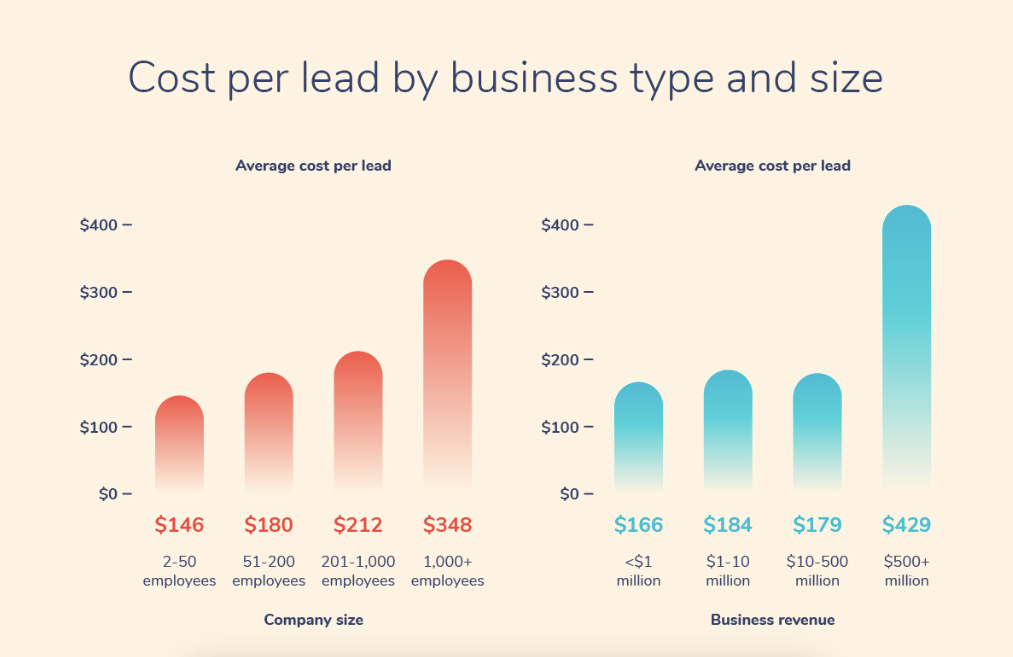
For B2B, most providers charge somewhere between $50 and $650 per lead. According to Sopro's benchmarks, the average cost per lead across B2B industries is around $200. But that number changes significantly based on company size and sector:
- Enterprise companies ($500M+ revenue) pay an average of $429 per lead
- SMBs (under 50 employees) pay closer to $146 per lead
- Legal and financial services see the highest CPLs, often above $600
- E-commerce and retail fall on the lower end, around $90-$150
These are just the per-lead fees. Many PPL providers also charge setup costs, monthly minimums, or retainers on top of the per-lead rate.

There's also the question of what you're actually paying for. Different providers define "lead" differently, and the more qualified the lead, the higher the price (and the stricter the terms around what counts).
When you factor in close rates, the numbers look different. If you're paying $200 per lead but only 10% convert to customers, your effective cost per customer is $2,000. And that's before accounting for the sales time spent working leads that go nowhere.

The Downsides of Outsourcing Your Leads
PPL sounds efficient on paper, but there are a few recurring problems worth understanding before you sign anything.
Lead quality is inconsistent
Most PPL providers are optimized for volume, not fit. Their job is to deliver leads that meet the agreed-upon criteria, but that doesn't mean those leads are actually a good match for your product or ready to buy.
According to Gleanster Research, only 25% of leads are legitimate and should advance to sales. This stat applies to leads generally, but with third-party providers, the gap can widen. They don't know your ICP the way your internal team does, and they're not incentivized to be picky.
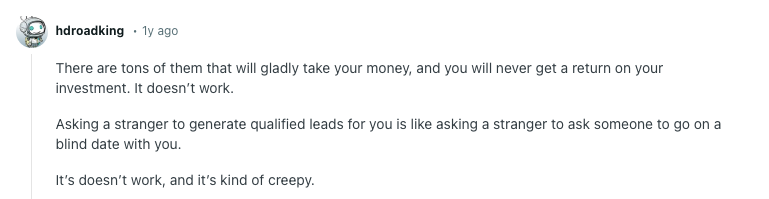
It's a good analogy. A provider might check the boxes on paper, but that doesn't mean the lead is a fit for what you're selling.
Leads are often shared
Unless you're paying a premium for exclusivity, the lead you just bought might also be going to two or three of your competitors. That means you're not just competing on your offer. You're competing on speed, and whoever follows up first usually wins.
Some providers are upfront about this; others aren't. So if exclusivity matters to you, ask directly and get it in writing.
You lose control over messaging
When someone else is doing your prospecting, you don't control how your brand shows up. You’re not writing the emails, choosing the targeting, or seeing what's being said until after a lead lands in your CRM.
For some companies, this is fine. For others, especially in competitive or trust-sensitive markets, that lack of visibility is a dealbreaker.
There's no long-term asset
When you stop paying, the leads stop coming. There's no list to keep, no data on what worked, nothing that carries over.
You're essentially renting a pipeline instead of building it. That might be acceptable in the short term, but it's worth factoring into the real cost.
When Does Pay-Per-Lead Make Sense?
PPL isn't the right fit for every team, but there are a few situations where it can work well.
- You need to fill the pipeline fast: If you're launching in a new market, ramping a sales team, or just need meetings on the calendar quickly, PPL can get you there faster than building from scratch. You're trading cost efficiency for speed, and sometimes that tradeoff makes sense.
- You're testing a new audience or offer. Before investing in a full outbound program, PPL can help you validate demand. If leads from a certain segment aren't converting, you'll find out quickly without having built the infrastructure yourself.
- You have strong closers but weak prospecting. Some teams are great at running demos and closing deals, but don't have the bandwidth or skill set to fill the top of the funnel. PPL can cover that side without hiring.
- You've found a provider who specializes in your niche. Generic lead gen services tend to underperform. But if you find a provider with deep experience in your industry, real relationships with your buyer persona, and a track record of delivering qualified leads, the math can work in your favor.
Bonus tip: Before signing anything, ask for references from companies in your space. A good provider should be able to connect you with clients who've seen real results, not just technically valid leads that went nowhere.
When Building Your Own Pipeline Makes More Sense
For a lot of teams, PPL ends up costing more than it's worth. Once the costs and tradeoffs start piling up, building in-house starts to make more sense.
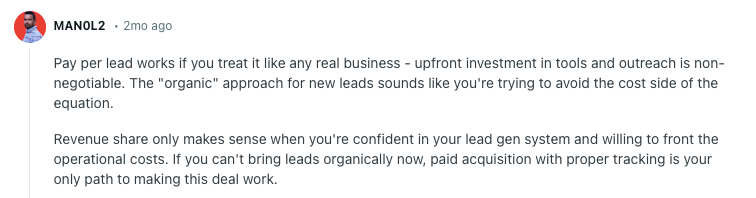
There's some truth to this. Building your own outbound system takes more effort upfront, but the economics tend to favor it over time. What you build doesn't disappear, and every campaign you run teaches you something about what resonates with your audience.
According to a SalesHive study, referrals bring in leads at around $25 each, and multi-channel prospecting averages $188 per lead. Compare that to what most PPL providers charge, and you start to see why teams look elsewhere.
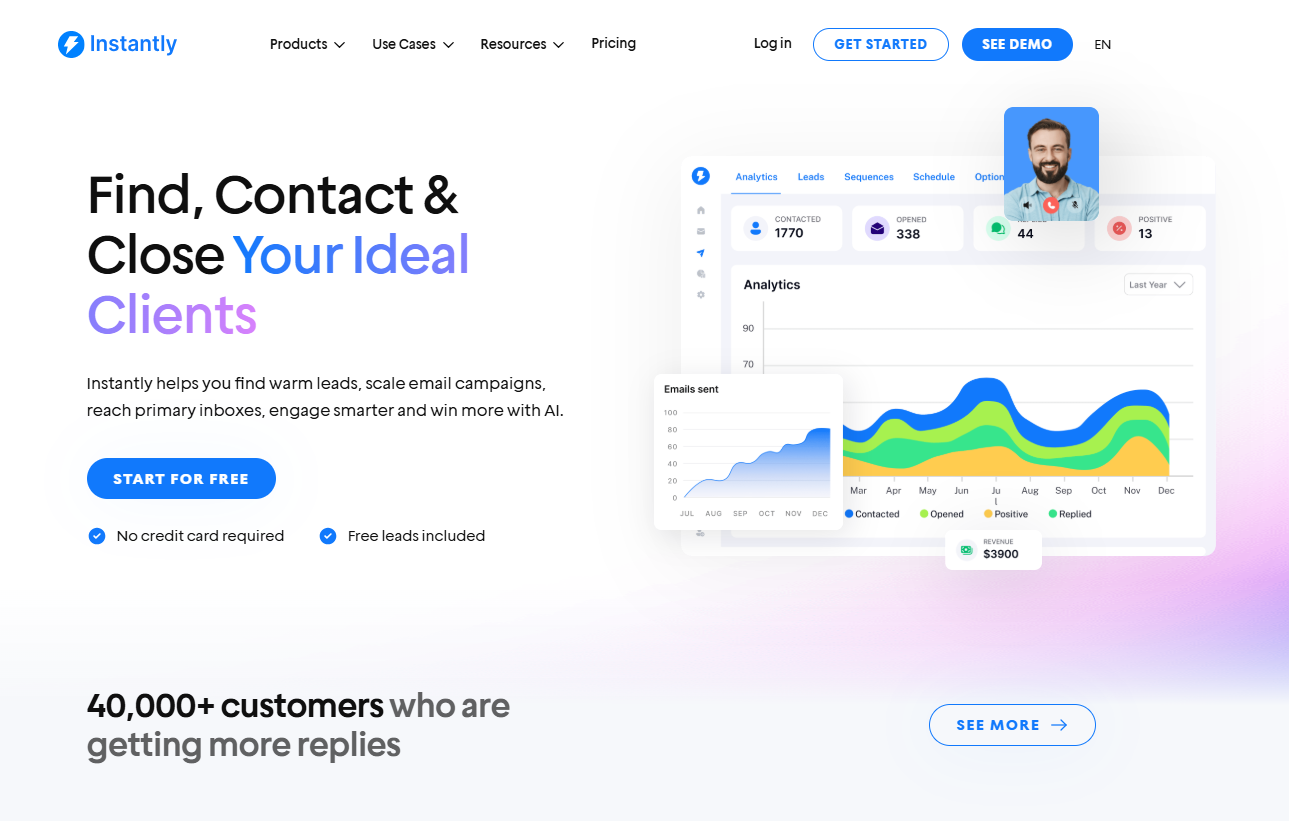
Now, building in-house does require the right infrastructure, and that's where a platform like Instantly becomes indispensable.
G2 Rating: 4.8/5 ⭐ from 4,002 reviews
Instantly combines lead sourcing, email warmup, campaign automation, reply management (and much more) all under one roof. Here's what that looks like in practice:
- SuperSearch gives you access to a database of more than 450 million verified B2B contacts. You can filter by job title, industry, location, company size, revenue, and tech stack, then verify emails through a waterfall system that checks multiple providers before anything hits your list.
- Email warmup runs in the background through Instantly's deliverability network. It protects your sender reputation so your emails actually land in the inbox when you start sending real campaigns.
- Campaign automation handles sequences, follow-ups, A/Z testing, and send scheduling. You can also use spin syntax to create variation across emails without writing dozens of versions manually.
- Unibox pulls replies from all your connected accounts into one place. If you're running outreach from ten or fifteen inboxes, this is the difference between staying organized and losing track of half your conversations.
With Instantly, most teams can get a basic campaign live within a day or two. The video below walks you through the full flow, from finding leads to launching a sequence in about 10 minutes.
Key Takeaways
Pay-per-lead can work, but it's not the shortcut it's often sold as. Before signing with a provider, it's worth knowing what you're getting into and what you're giving up. A few things to keep in mind:
- PPL pricing ranges from $50 to $650 per lead, depending on industry, lead type, and provider. Setup fees and minimum commitments add to the real cost.
- The biggest downsides of PPL are shared leads, inconsistent quality, and zero ownership.
- Pay-per-lead makes sense when you need a pipeline fast, you're testing a new market, or you've found a niche provider with a strong track record.
- Building in-house takes more effort upfront, but the cost per lead drops the longer you do it, and you keep everything you build.
So if you're thinking about building your own pipeline instead, Instantly makes it pretty easy to get started. You can pull leads, set up a sequence, and start sending the same week. Try it for free today and see how it works for your team.



