TL;DR: What we discovered

In 2026, cold email is about resonance, not reach. Reply rates remain stable despite growing volume proving that relevance, not quantity, drives conversations.

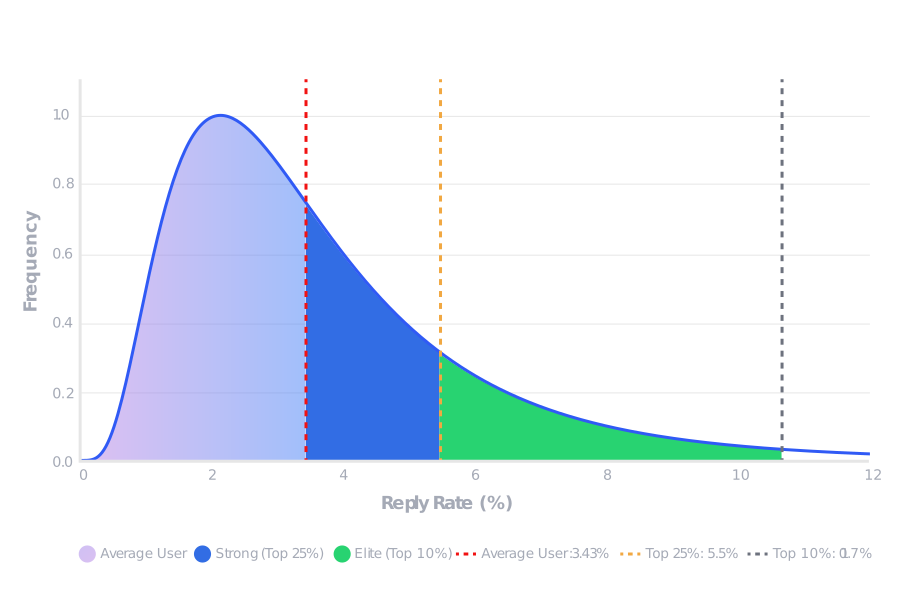
  • The overall average reply rate is 3.43% with top-performers of users exceeding 10% reply rates (2-4x higher)
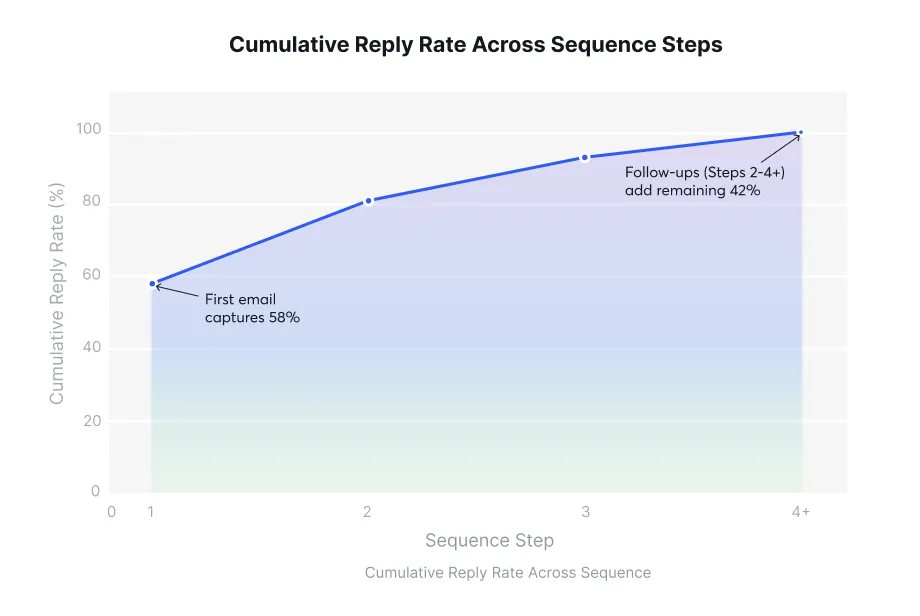
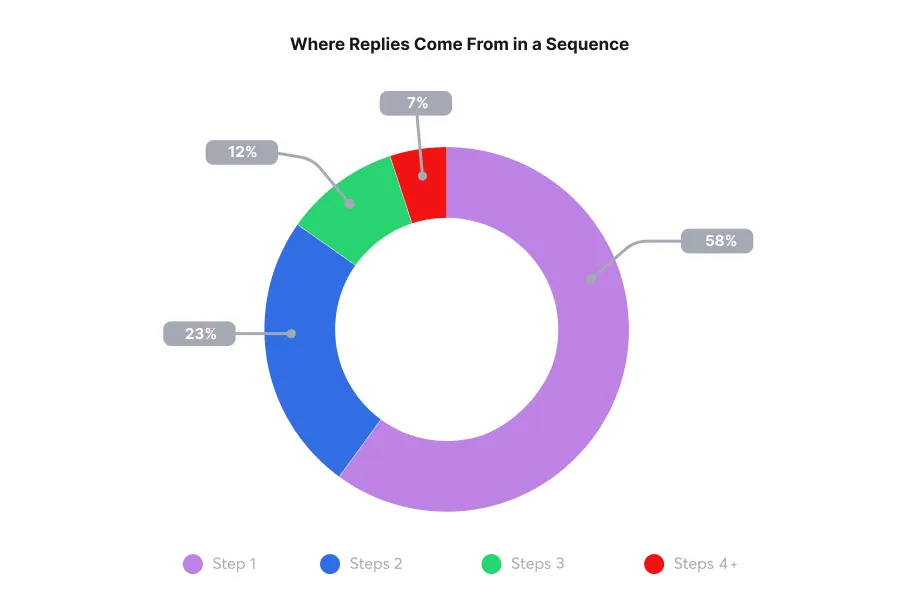
  • 58% of all replies are generated from step one in a cold email campaign
  • Remaining follow-ups contribute 42% of total replies proving follow-ups are worth the effort
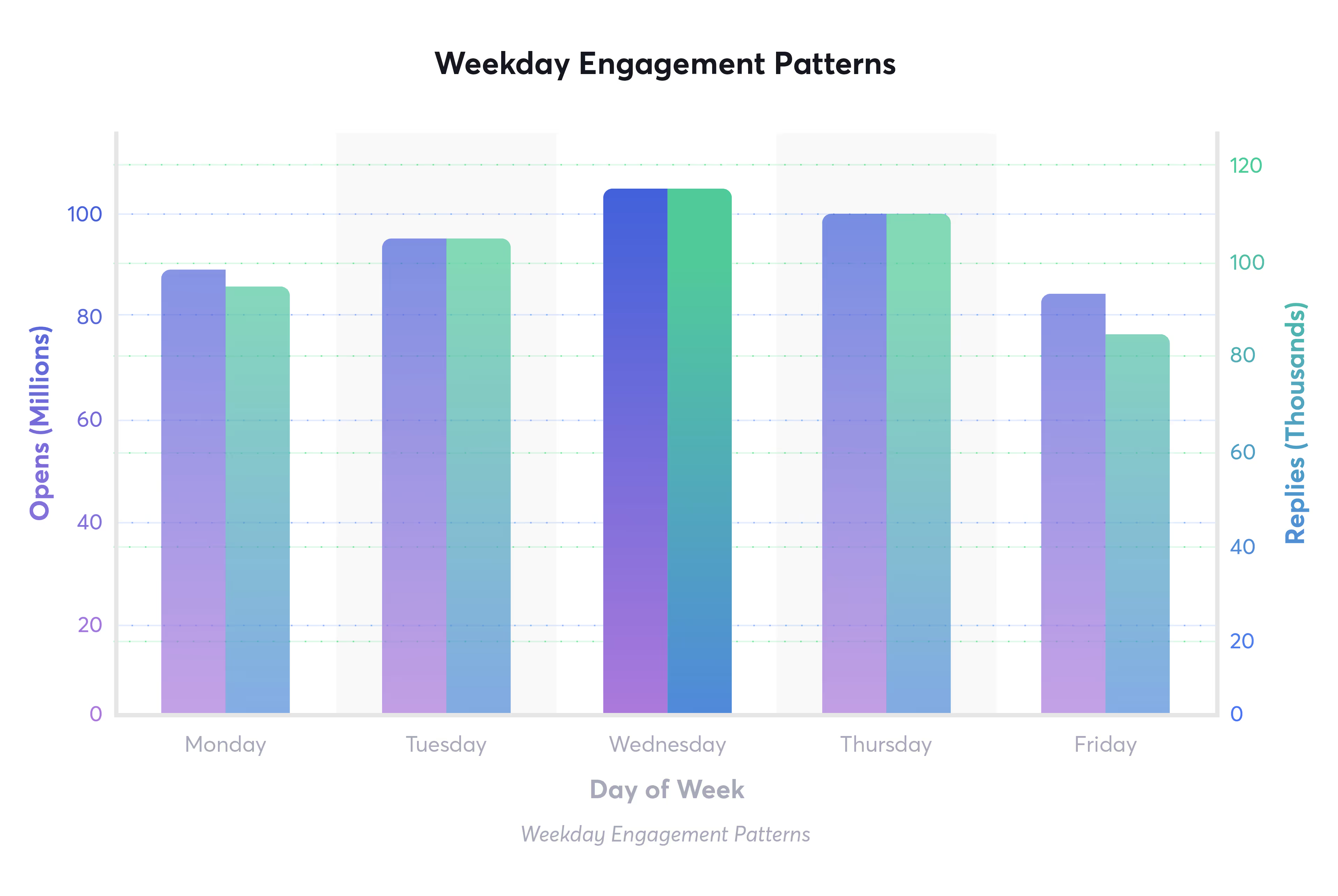
  • Tuesday-Wednesday see peak reply rates, Wednesday is highest
  • Best performing email campaigns maintain <80 word emails and A/B test new messaging weekly

Key performance metrics for cold email campaigns

Our data methodology 

This benchmark report analyzes billions of cold email interactions across thousands of active workspaces to provide you with recent cold email statistics. All metrics have been aggregated and anonymized to ensure benchmark accuracy while protecting user privacy.

Data Sources

  • Email send and reply events tracked across the platform
  • Sequence performance data from active campaigns
  • Timing and engagement pattern analysis
  • Top-quartile and elite performer benchmarks

Key Definitions

How we define Overall Reply Rate
Percentage of all replies received (including follow-up responses) divided by total emails sent.
How we define First-Touch Reply Rate
Percentage of leads who reply to the very first email in a sequence.
How we define First-Touch Send
The initial campaign email a lead receives when a sequence begins for them.
How we define Top Performers / Elite Tier
Users exceeding 10% reply rates or higher, representing the top 10% of all senders.
What’s a good cold email reply rate?

Our analysis found that top performing (“elite”) cold email campaigns exceed a 10% reply rate, top quartile achieve 5.5% reply rates, and a average reply rate of 3.43%. In other words, the typical cold email response rate falls around lower single digits.

The biggest contributing factors to top performing campaigns are micro-segmentation, problem-focused messaging, frequent A/B testing and smart automation such as auto-triaging cold email replies and auto-scheduling follow-ups through subsequences.

Reply Rate Distribution Across All Campaigns

Table: Breakdown of cold email response rate tiers

Tier
Reply rate
Explanation
Tier 1 (Top 10%)
10.7%+ reply rate
Campaigns in tier 1 demonstrate precision. Senders use micro-segmentation, continuous A/B testing and smart automation.
Tier 2 (Top 25%)
5.5%+ reply rate
Campaigns in tier 2 demonstrate better targeting. Senders invest time in building targeted lead lists, segmentation, and message personalization.
Tier 3 (Average)
3.43% reply rate
Campaigns in tier 3 demonstrate healthy inbox placement, proper technical controls for deliverability, reasonable sending volume, and acceptable bounce rates - but lack targeting precision and messaging refinement of higher tiers.

How to improve your reply rate

Elite senders (2-4x higher reply rates) earn out-sized replies combining hyper-relevant subject lines, emails under 80 words, a single call-to-action and problem-first positioning.

Your first email sets the ceiling for the whole cold email sequence. In our dataset, the first email captures 58% of the replies with the remaining 42% being captured by follow-ups.

Use these tactics to improve your reply rates:

Generic subject lines get ignored. Subject lines that reference a specific problem, outcome, or situation relevant to the prospect's world get opened
Elite performers average fewer than 80 words per first-touch email. Brevity forces clarity. Every word must earn its place
Multiple CTAs dilute focus. Top performers use binary questions or simple requests that require minimal cognitive load: 'Does this make sense?' or 'Worth a quick call?'
Lead with the problem, not your solution. Prospects care about their challenges first, your product second
Our winning CTA of 2025 was ‘Would you have a couple minutes to chat about this over the next few days?
Mike Ellis
Agency founder

How important are follow-ups and what’s the optimal sequence length?

58% of replies arrive on Step 1, the remaining steps contribute another 42% replies, proving follow-up persistence can improve campaign results. The sweet spot for sequence length is 4-7 touchpoints: under four gives up too early and beyond seven diminishes returns unless each touch adds genuine new value.

Best practices for follow-ups
1
Each follow-up adds new value or angle: Never just 'checking in'
2
Best Step 2 emails feel like replies, not reminders: 'Quick follow-up on my note below-worth a look?' outperforms formal follow-ups by ~30%
3
Space touches 3-4 days apart to maintain momentum without overwhelming
4
Use different angles in each step: case study, social proof, different pain point, value add
The Long Tail
Replies continue even beyond step 10, though at much lower rates. This long-tail effect proves that well-paced sequences catch prospects at different moments of readiness. Timing matters as much as messaging.

When is the best time to send cold emails?

Align sends to natural weekly engagement patterns: launch on Monday, push follow‑ups on Wednesday (peak engagement), and triage Friday auto‑replies so conversations restart on Monday. Timing matters almost as much as copy, our data shows teams that respect these windows compound replies across the week.

Best days to send cold emails (what our data shows)

Our weekday analysis shows a clear mid‑week sweet spot. Wednesday consistently delivers the highest engagement, Monday is the ideal day to launch new sequences, Friday produces an auto‑reply surge as prospects set OOO. Use these patterns to decide what to send on each day, not just when.

Monday: Launch Day
Highest send volume across the platform. Monday mornings are when prospects return with fresh inboxes and clearer priorities. It's the ideal day to launch new sequences and plant seeds for the week ahead.
Wednesday: Peak Engagement
Wednesday consistently delivers the highest engagement metrics. Prospects have settled into the week but haven't yet started winding down for the weekend. This is when persuasive follow-ups convert best.
Friday: Auto-Reply Surge
Friday sees the highest volume of auto-replies as prospects set out-of-office messages and prepare for the weekend. Smart automation can triage these responses and reschedule follow-ups for Monday, maintaining sequence momentum.

Cold email campaign schedules enable you to control when your emails are sent. You can also use subsequences that trigger follow-up emails based on keywords (like “Out of office”) or lead statuses to ensure better lead coverage.

Weekly cadence framework for maximum replies

Monday
Launch new sequences and campaigns
Wednesday
Send follow-up touches for maximum engagement
Friday
Auto-triage responses, schedule Monday re-engagement
Friday is a great day to take a look at our campaigns and make adjustments to messaging. Cold email is not just a set it and forget it system, there are always pivots needing to be made.
Will Butler
Agency founder

Domain Health & Deliverability for cold email

Why deliverability improves cold email performance (the engagement loop)

Inbox placement is governed by engagement signals (opens, replies, reading). High engagement → better placement → even more engagement, creating a positive feedback loop, whereas low engagement works in reverse. This is why reply rate matters beyond conversion.

  • Consistency pays: Teams that keep domain health stable and send consistently see +15–20% higher replies in our dataset.
  • Optimize for engagement, not sends: Target better, write shorter, and pace outreach to protect infrastructure health.

Deliverability Fundamentals (what to fix first)

Here are some non‑negotiables to protect sender reputation and inbox placement.to “how precisely can we target?”

Gradual Domain Warm-Up
New sending domains need time to build a reputation. Starting slow with 5-10 emails per day initially, then gradually increasing over 4-6 weeks signals to email providers that you're a legitimate sender, not a spam operation firing up overnight. Automated cold email warmup can manage this for you.
Consistent Sending Patterns
Erratic volume kills deliverability. Sending 500 emails Monday, nothing Tuesday-Thursday, then 1,000 Friday looks suspicious. Set campaign limits to maintain predictable daily volumes that email providers learn to trust.
Infrastructure Distribution
Concentrating all volume on a single domain creates risk. Distributing sends across multiple domains within a deliverability optimized infrastructure prevents any single domain from being overloaded and triggering spam filters. Think of it as not putting all your eggs in one basket.
Bounce Rate Discipline
Keep bounce rates below 2% (ideally much lower). Every bounced email damages your sender reputation. Clean your lists frequently, use email verification before sending, and remove addresses that consistently bounce.
Engagement Signal Management
Email providers watch how recipients interact with your emails. High open rates, replies, and low spam complaints signal value. Low engagement signals spam. The quality of your targeting and messaging directly impacts your infrastructure health.
Domain Authentication
Properly configured SPF, DKIM, and DMARC records are non-negotiable. These protocols verify you're authorized to send from your domains and prevent spoofing. Use done-for-you accounts to skip the hassle.
Enterprise Email Gateway Awareness
Large companies use security layers (Proofpoint, Mimecast, Barracuda) that aggressively filter bulk senders. You’re usually better off not sending to these inboxes at all, or have a specific strategy for engaging them.
Catch-All Email Caution
Catch-all domains accept any email address format, making validation difficult. These addresses carry higher bounce risk and should be approached carefully or avoided entirely to protect your sender reputation. Instantly's verification system handles catch-alls for you.
Domain Rotation & Aging
Domains fatigue with heavy use. Resting overused domains and bringing them back gradually maintains long-term health. Think of it like rotating crops: you can't farm the same field continuously without depleting it.
Inbox Placement Monitoring
Don't assume your emails land in the primary inbox. Use inbox placement monitoring (sending to test accounts across Gmail, Outlook, etc.) to verify actual placement. Catching deliverability drops early prevents compounding damage.

The Prediction

The next frontier is intent-driven outreach; reaching the right people at the right moment, not just the right people.
Hans Dekker
Head of outreach innovation

Next steps for you to improve cold email performance

Audit Your Current Performance
Compare your reply rates against the benchmarks in this report. Identify which tier you're currently in and what specific gaps exist.
Consistent Sending Patterns
Erratic volume kills deliverability. Sending 500 emails Monday, nothing Tuesday-Thursday, then 1,000 Friday looks suspicious. Set campaign limits to maintain predictable daily volumes that email providers learn to trust.
Implement Top-Quartile Best Practices
Start with the fundamentals: shorten your emails, improve first-touch relevance, add 2-3 more touchpoints to your cold email platform sequences, and align sending with optimal timing windows.
Test, Iterate, Optimize
Elite performance doesn't happen overnight. Commit to weekly A/B testing, continuous data review, and iterative improvement. Track your progress and refine relentlessly.

FAQ (Frequently Asked Questions)

What is a good cold email reply rate in 2026?

Our research found that “elite” cold emailers exceed a 10% reply rate with 3.43% being the average.

How many follow-ups should I send for a cold email?

4-7 emails is an ideal sequence length to maximise reply rate. Our research found that 58% of replies arrive on Step 1 of a cold email campaign with Steps 2-4 contributing another 42% replies. Our advice would be to have at least 4 emails in your campaign.

What’s an acceptable bounce rate for cold email?

A bounce rate under 2% is ideal. Any higher than this and you may see cold email campaign performance drop. If you’re seeing high bounce rates, pause your campaign and clean your lead list before continuing.

How long should a cold email be (word count)?

Our research found the best performing cold email campaigns to have a word count of less than 80 words, indicating this to be the sweet spot for performance. It’s enough to get your point across without wasting the reader’s time. The key is to be concise, personalized, and focused on a single message/ask.

* * *
Data reflects platform-wide performance
January 1 – December 18, 2025