


TL;DR: Sales leaders can dramatically improve follow-up email effectiveness and meeting booking rates by applying proven content balance rules like the 60/40 principle. This guide shows you how to structure messages that blend 60% informative content with 40% persuasive calls to action, preventing overwhelm while driving engagement. Instantly's platform ensures consistent execution at scale with built-in warmup, inbox placement testing, and AI-powered reply management so your balanced follow-ups land in the primary inbox and convert.
Updated October 31, 2025.
Are your sales follow-ups falling flat? The secret might not be what you say, but how much you say of what. For practical examples, check out supercharging sales outreach with automation. Effective sales follow-up emails require a structured approach. This guide reveals how applying content balance rules can transform your outreach, showing you how to blend informative content, social proof, and a clear call to action to drive higher engagement and booked meetings.
Why content balance is critical for sales follow-ups
The problem with unbalanced emails
Most sales follow-ups fail because they tip too far in one direction. Learn more in our email automation for outreach campaigns guide. They either pack in too much information and overwhelm the prospect, or they push too hard for the close with overly aggressive sales language. Research on email marketing mistakes shows that finding the right balance between value and persuasion prevents "follow-up fatigue" and keeps prospects engaged.
When your follow-up email is too heavy on the pitch, prospects disengage or feel pressured. Generic, one-size-fits-all emails often get dismissed and deleted because they lack personalization and fail to demonstrate understanding of the prospect's specific needs.
On the flip side, emails that offer no new insights or helpful information come across as a waste of time. Every follow-up is an opportunity to add value, not just occupy inbox space.
How content balance impacts reply rates
The structure of your follow-up directly influences whether prospects engage. Open rates primarily indicate subject line effectiveness, but click-through rates and reply rates measure how well your internal content drives action.
When emails show high open rates but low click-through rates, the content failed to deliver sufficient value or a clear path to action. This signals an imbalance where either too much value exists without direction, or a weak value proposition overshadows a strong call to action.
According to Instantly's data on cold email reply rates, a 5-10% reply rate is good, while 10%+ is strong. Achieving these benchmarks requires balancing informative content with persuasive elements. Sales teams using structured follow-up sequences consistently hit these targets by maintaining content discipline across touchpoints.
"Instantly has been a game changer for my vertical in merchant service where email marketing is key. I've converted several leads into deals using Instantly and it's paid for itself 5x." - Philip Hendrich on Trustpilot
Understanding the 60/40 content balance rule for sales emails
What is the 60/40 rule?
The 60/40 rule is a content allocation principle that suggests dedicating approximately 60% of your email content to providing value and information, and 40% to persuasion and calls to action. This approach helps prevent emails from feeling overly sales-focused and instead positions them as helpful resources that guide prospects toward action.
The 60% value portion reinforces the discussion from your call, offers additional insights, addresses pain points, or provides relevant resources that solve their challenges. The 40% persuasion portion guides the prospect toward the next logical step without being pushy.
| Email Section | Recommended % | Purpose | Example Content |
|---|---|---|---|
| Opening | 10-15% | Context & relevance | "Thanks for yesterday's discussion about your bounce rates climbing to 3.2% in Q3..." |
| Body | 45-50% | Value & proof | Case study showing 62% to 87% inbox placement improvement; link to deliverability guide addressing their Microsoft challenges |
| Closing | 35-40% | Clear CTA & next step | "Would Tuesday at 2 PM or Wednesday at 10 AM work for a 20-minute walkthrough of the warmup settings we'd recommend?" |
Applying the 60/40 rule to sales follow-ups
In practice, the 60/40 split means your follow-up email should dedicate most of its content to reminding prospects of specific points from your conversation, sharing a case study demonstrating how your solution helped a similar company, or providing an article that expands on a topic you discussed.
For example, after a discovery call about improving email deliverability, your 60% might include a brief recap of their current bounce rate challenge, a link to your guide on email deliverability best practices, and data showing how similar companies improved placement rates. Your 40% would clearly state what you want them to do next and explain the benefit of taking that action.
"I appreciate the guidance Instantly offers for the warm-up stage of cold email campaigns, which was entirely new to me. This feature is vital, guiding me according to my needs and current understanding of cold email outreach." - Cyril T. on G2
Other content balance principles
While 60/40 is the most common framework, some email marketers reference a 30/30/50 rule, which allocates 30% to the problem, 30% to the solution, and 50% to social proof and credibility. For more detail, see cold email framework. Regardless of the exact ratio, the principle remains: provide value before asking.
The key is ensuring every email has a clear purpose and benefits the recipient rather than just serving your sales goals. As we emphasize in our follow-up email strategy video, adding new value with each touchpoint keeps prospects engaged throughout your sequence.
Structuring your sales follow-up emails for maximum impact
A well-structured follow-up follows a logical progression that builds value before asking. Use these five components in order:
1. Opening: Reiterate value and context
Your opening should immediately remind the prospect of your last interaction. Mentioning specific points, challenges discussed, or agreed-upon items shows you were listening and remember the details.
Start with a personalized greeting using their name, then reference the conversation: "It was great speaking with you yesterday about your team's struggle with inbox placement rates dropping below 70%." This contextual opening establishes credibility and relevance immediately.
2. Body: Provide proof and address pain points
The body is where your 60% value lives. Explain how your solution addresses their specific pain points and provide a valuable resource directly related to their needs.
This might include:
- Case study: Show results from a similar company in their industry demonstrating measurable outcomes
- Industry insight: Share recent data that relates to their specific challenge, such as benchmark reports or trend analysis
- Customized proposal: Provide specific recommendations tailored to their current setup or pain points
- Educational content: Link to a relevant guide, playbook, or video they can reference
For instance, if your prospect mentioned concerns about email deliverability, you might share Instantly's slow ramp warmup guide or explain how their deliverability network of 4.2M+ accounts helps protect sender reputation. Another option is directing them to Instantly's complete deliverability tutorial for a visual walkthrough.
"The platform is super intuitive, easy to set up, and makes it simple to manage multiple domains and inboxes at scale. Deliverability is great and the analytics give us exactly what we need to optimize campaigns quickly." - Shaiel P. on G2
3. Closing: Clear, single call to action
Your closing contains the 40% persuasion. Focus on one primary call to action per email to avoid overwhelming the recipient and causing inaction.
Make the requested action easy to understand and perform. Instead of open-ended questions like "Let me know when you're free," offer specific options: "Would you be available for a 15-minute call next Tuesday at 11 AM or Thursday at 3 PM to discuss how we can improve your inbox placement?"
Frame each call to action around the specific value the prospect will receive, connecting the next step directly to their stated pain points or goals.
4. Subject lines and preheaders: The first impression
Your subject line is critical for initial engagement. Incorporate contextual details like their company, industry, or a specific topic from your previous conversation rather than just using their first name.
Examples of strong follow-up subject lines: We break this down further in converting sales subject lines examples.
- Following up on our call about inbox placement rates
- Resources for improving your Microsoft deliverability
- Acme Corp's 30-day deliverability roadmap
Avoid misleading subject lines that don't relate to the email body, as this damages trust before the relationship begins.
5. Personalization: Beyond just the name
Personalization significantly boosts engagement in sales follow-up emails. Go beyond inserting their name and directly recall details from your conversation.
Mention a particular pain point they shared, a goal they expressed, or a specific solution you discussed. For example: "I enjoyed our conversation about your bounce rate climbing to 3.2% in Q3 and wanted to follow up with additional insights on list hygiene practices."
Tailor the benefits you highlight to align with their unique needs. Show how your product specifically addresses their challenges rather than presenting generic value propositions. For practical examples, watch this guide on personalization techniques that drive higher reply rates.
Instantly's approach to executing balanced follow-up sequences
Ensuring deliverability with built-in warmup and Inbox Placement tests
Content balance means nothing if your emails never reach the inbox. Instantly provides automated email warmup across unlimited accounts to protect domain reputation and ensure consistent primary inbox placement.
The platform's Inbox Placement testing automates deliverability checks, alerting you when placement drops below safe thresholds. This allows you to pause campaigns automatically when deliverability signals weaken:
- Inbox placement falls below 80-85%
- Hard bounces exceed 2%
- Spam complaints rise above 0.3%
Learn how to setup warmup on Instantly in just a few minutes:
"I like that instantly can handle large scale email campaigns without worrying about deliverability. The automation for inbox rotation, warm up and sending limits makes outreach very smooth and saves a lot of manual work." - Anjali T. on G2
Scaling outreach with unlimited email accounts
Sales leaders need consistent execution across their team. Instantly's unlimited email accounts on all plans mean you can scale accounts and deliverability without per-seat penalties or headcount taxes.
This architecture enables you to implement the same balanced follow-up sequences across multiple domains and inboxes while maintaining sender reputation through proper slow ramp warmup protocols.
Streamlining replies with Unibox and AI Reply Agent
After sending balanced follow-ups, managing replies efficiently is critical. Instantly's unified inbox (Unibox) centralizes all responses, while the AI Reply Agent handles lead replies in under 5 minutes.
The AI Reply Agent can operate in Human-in-the-Loop mode for review or Autopilot mode for full automation, allowing your team to focus on live conversations while maintaining consistent follow-up execution. Watch how this works in Instantly's AI agent overview video or see how Instantly's CRM streamlines the entire deal process.
Maintaining list hygiene with SuperSearch
Quality data is the foundation of effective follow-ups. Instantly's SuperSearch with 450M+ B2B contacts includes waterfall enrichment with 5+ providers and LLM-assisted data enhancement.
Clean, verified contacts keep bounce rates below the critical 2% threshold, protecting your sender reputation and ensuring your balanced follow-ups reach real prospects. Learn more about optimizing send windows and data quality for better results.
A/B testing content balance for optimal results
The best way to find your ideal content balance is through systematic testing. Instantly enables A/Z testing across subject lines, copy, and CTAs to identify what resonates with your audience.
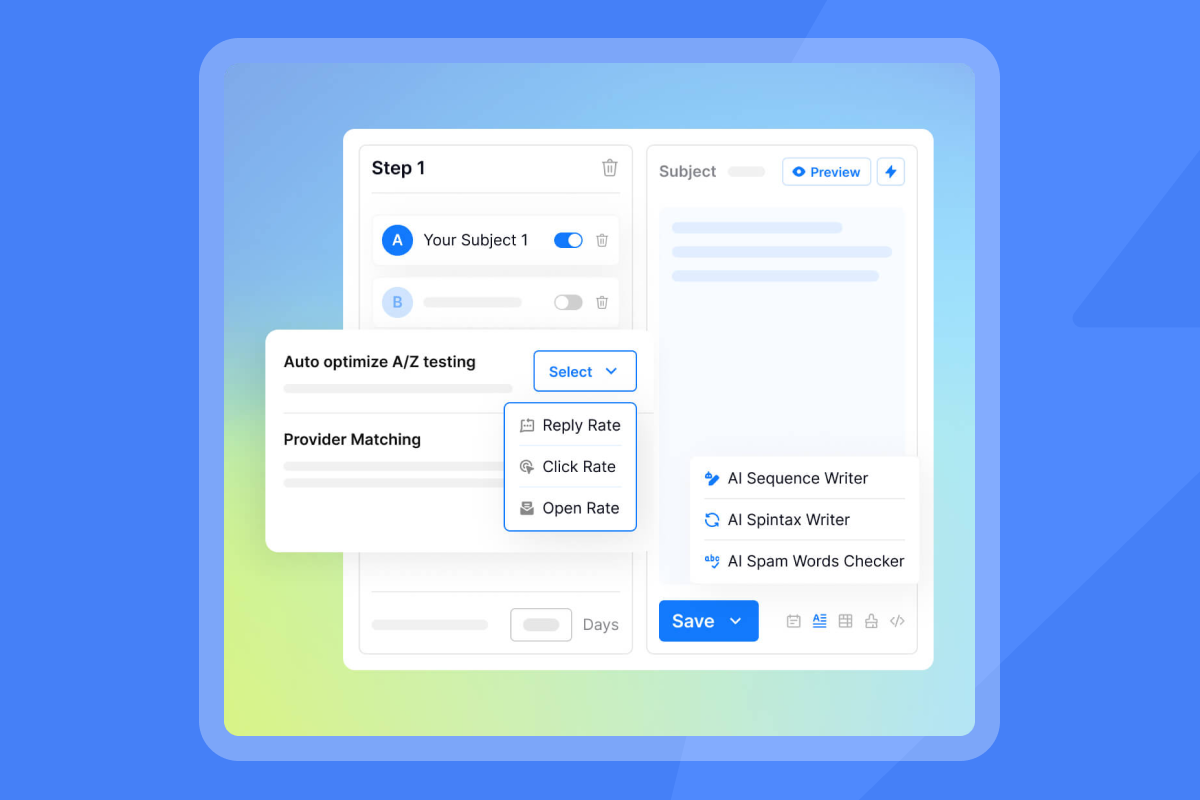
Test variations of your 60/40 split. Try 70/30 for early-stage prospects who need more education, or 50/50 for hot leads ready to move forward. Continuously measure reply rates and meeting bookings to optimize your approach.
| Feature | Benefit for Content Balance |
|---|---|
| Automated Warmup | Ensures your balanced emails reach the primary inbox by building sender reputation gradually |
| Unlimited Accounts | Scale consistent follow-up sequences across your team without per-seat costs |
| Unibox & AI Reply Agent | Manage responses efficiently while maintaining personalization at scale |
| SuperSearch | Verify contacts to keep data quality high and bounces below 2% |
| A/B Testing | Test content balance ratios to find your optimal value-to-CTA split |
"Instantly has transformed my outreach process. The platform is intuitive, has a ton of cool features and delivers great results. Customer support is pretty reliable. Yet to find a better all in one cold outreach tool." - Jon M. on G2
Real-world examples of balanced sales follow-up emails
Use these three templates based on where your prospect sits in the follow-up sequence:
- Post-discovery call follow-up: Sent immediately after initial conversation (60/40 value to CTA)
- Value-add follow-up: Sent when no reply received (65/35 value to CTA)
- Re-engagement follow-up: Sent after multiple non-responses (40/60 value to CTA)
Example 1: Post-discovery call follow-up
Subject: Resources for improving Acme Corp's inbox placement
Body:
Hi Sarah,
Thanks for the detailed conversation yesterday about your team's deliverability challenges. I know you mentioned bounce rates climbing above 3% last quarter and inbox placement dropping to 65%.
I pulled together a case study showing how a similar SaaS company improved their placement from 62% to 87% in 30 days using a slow ramp warmup protocol. I've attached it to this email.
Based on what you shared about managing 15 sending domains, Instantly's automated warmup across unlimited accounts could eliminate the manual rotation work your team is doing now.
Would Tuesday at 2 PM or Wednesday at 10 AM work for a 20-minute screen share to walk through the specific warmup settings we'd recommend for your setup?
Best,
Michael
Balance: 60% value (recap, case study, specific recommendation), 40% CTA (clear meeting request with options).
Example 2: Value-add follow-up (no reply)
Subject: One more resource on Microsoft deliverability
Body:
Hi Sarah,
Following up on my last email about inbox placement strategies. I wanted to share one more quick resource since you mentioned struggling with Microsoft deliverability specifically.
Our team just published a complete guide to cold email deliverability with a section dedicated to Microsoft's unique filtering behavior. See how our scalable cold email software can help improve deliverability. Pages 8-10 cover the exact authentication and content patterns that work best for O365.
No pressure to respond if timing isn't right, but I'm here if you'd like to discuss how these tactics could apply to your current setup.
Michael
Balance: 65% value (highly specific resource), 35% soft CTA (low-pressure availability statement).
Example 3: Re-engagement follow-up
Subject: Should I close your file?
Body:
Hi Sarah,
I haven't heard back since our call three weeks ago about your deliverability challenges. I'm guessing one of three things happened:
- You solved it internally
- Timing isn't right
- My follow-ups missed the mark
If it's #2 or #3, I'd love to know. If it's #1, congrats and no worries at all.
Should I close your file, or is there a better time to reconnect?
Michael
Balance: 40% value (respectful acknowledgment), 60% CTA (direct question requiring response). Note: Later-stage follow-ups can shift the ratio toward persuasion.
Master your follow-ups, master your pipeline
Content balance transforms sales follow-ups from ignored messages into valuable touchpoints that move deals forward. The 60/40 principle ensures you provide enough value to maintain engagement while including clear calls to action that drive meetings and bookings.
Instantly provides the deliverability foundation, automation tools, and AI-powered reply management to execute these balanced strategies at scale. Unlimited accounts, automated warmup, inbox placement testing, and centralized reply handling mean your team can standardize effective follow-up processes without complexity or per-seat penalties.
Start implementing the frameworks in this guide across your sequences with a 14 day free trial. Your reply rates and booked meetings will reflect the difference.
Related videos:
- Watch real user success stories demonstrating these principles in action to see how effective follow-up sequences convert prospects into customers.
- Learn how to implement warmup safeguards in Instantly's full platform tutorial.
FAQs:
How many follow-up emails should I send after a sales call?
Send 3-5 follow-ups spaced appropriately over 2-3 weeks. Research shows that persistence matters, but sending too often frustrates prospects. Space emails 3-4 days apart initially, then extend to 5-7 days for later touches.
What's the ideal length for a sales follow-up email?
Keep follow-ups to 75-125 words. Brief emails respect the recipient's time and improve readability on both desktop and mobile. Write one idea per paragraph, maximum 3-4 short paragraphs plus your CTA.
Should I always include a case study or resource in follow-ups?
Not always, but each follow-up should add new value. Your first follow-up might include a case study, your second might share an industry insight, and your third might offer a custom recommendation. Add distinct value with each touch rather than repeating the same pitch.
How do I know if my content balance is working?
Track reply rates and positive reply sentiment, not just open rates. Aim for 5-10% reply rates as a baseline, with 10%+ as strong performance. Monitor click-through rates and reply sentiment to measure content engagement once prospects open your email.
What if prospects don't respond to balanced follow-ups?
Test variations of your value-to-CTA ratio and personalization depth for subject lines and copy. Verify your deliverability is healthy with 85%+ inbox placement and under 2% bounces before assuming content is the issue.
Key terminology glossary
60/40 rule: Content balance principle allocating 60% of email content to value and information, 40% to persuasion and calls to action.
30/30/50 rule: Alternative content balance principle allocating 30% to the problem, 30% to the solution, and 50% to social proof and credibility.
Primary inbox: The main inbox folder where important emails land, as opposed to spam, promotions, or other filtered folders.
Reply rate: Percentage of sent emails that receive a direct response from recipients. Benchmark: 5-10% is good, 10%+ is strong.
Inbox placement: Percentage of emails that reach the primary inbox rather than spam or promotions folders. Target: 80-85% minimum.
Warmup: Gradual process of building sender reputation for new email accounts through controlled sending volume increases and engagement signals.
List hygiene: Practice of maintaining clean, verified contact data to minimize bounces and protect sender reputation. Target: under 2% hard bounce rate.
Slow ramp: Gradual increase in daily sending volume over 2-4 weeks to build trust with mailbox providers and ensure consistent deliverability.
Call to action (CTA): Specific request in an email directing the recipient to take a desired next step, such as booking a meeting or reviewing a proposal.


