.svg)
%20(1).svg)


Updated October 21, 2026
Updated on 11 September 2026
TL;DR: A cold email sequence is an initial cold email followed by two or three spaced follow-ups, usually three to four emails spread across roughly two weeks. In 2026, sequences win replies through tighter targeting, real personalization, and deliverability guardrails, not volume, a pattern our cold email benchmark report confirms. Use a different sequence for lead generation, referrals, meeting requests, non-responders, and warm prospects who've gone quiet, give every follow-up a fresh reason to reply, and stop the moment a prospect says yes or no. Instantly's AI Sequence Writer, proven templates, cold email automated follow-up rules, and reply analytics run it all at scale.
You line up your prospects. You hit send. The silence that follows tells you everything. Too many cold email sequences fizzle out before they reach a real conversation.
The problem isn’t always effort or intent. Without a sharp approach, one built for today’s inboxes, you're bound to keep missing the mark while your sender reputation quietly sinks. Every effective cold email outreach system in 2026 starts with better targeting and real personalization. The sequences that book meetings consistently are built on ICP alignment, not raw volume.
In 2026, building a cold email sequence that gets results is about precision, not volume. Smart senders lean into better targeting, real personalization, and strict guardrails on deliverability. They use tools (like Instantly) to automate what slows them down and tie every touch back to a bigger strategy.
If you're an agency operator or a sales team running B2B cold outreach at scale, this guide is for you.
Below, we share several ready-to-use cold email sequence templates , from a simple B2B cold email sequence to referral and follow-up campaigns, to inform your strategies going forward. For every sequence, you'll find 3-4 touchpoints that keep replies coming without sounding canned or desperate.
Is this for you?
This is for you if
You're building a multi-touch cold email sequence and want proven structures for lead-gen, referral, or follow-up outreach.
This isn't for you if
You're sending a single one-off email with no follow-up sequence planned.
What is a cold email sequence?
A cold email sequence is a series of emails sent to a prospect over a set period of time, usually starting with an initial cold email followed by several follow-ups if they don’t respond.
Rather than relying on a single email to start a conversation, each step in the sequence gives you another opportunity to provide value and give the prospect a reason to reply. A follow-up might introduce a different angle, share a relevant result or resource or simply make the next step easier.
A typical email sequence includes an initial cold outreach email followed by two or three follow-ups spaced several business days apart. The right number of emails and timing will depend on your audience and campaign goal, so use your reply data to refine the sequence over time.
Cold email sequence examples and templates
There’s no single cold email sequence template that works for every campaign. An introduction to a completely cold prospect, for example, needs a different approach from following up with someone who’s already shown interest.
The cold email sequence examples below cover several common outreach scenarios, including lead generation, referrals, meeting requests and follow-ups.
Here is how the five sequences compare at a glance, so you can pick the right starting point before you read the templates in full.
| Sequence | Best for | Emails | Primary goal |
|---|---|---|---|
| Lead generation | A brand-new prospect who has never heard from you | 3 | Spark interest and open a conversation |
| Referral / mutual connection | A prospect you can reach through a shared contact | 3 | Lead with credibility and earn a call |
| Sales meeting request | A prospect who knows your name but hasn't engaged | 3 | Book a meeting directly |
| Follow-up for non-responders | A prospect who has gone silent after outreach | 3 | Re-earn a reply without nagging |
| Follow-up for interested prospects | A warm prospect who showed interest then went quiet | 3 | Keep the deal moving to a meeting |
Treat them as starting points rather than scripts. Keep what works for your campaign, change what doesn't and personalize the message around the person you're actually contacting.
Lead generation sequence
When your goal is to introduce yourself and spark interest with a new prospect, this sequence keeps things relevant and low-pressure. Instantly, the cold email platform, gives B2B teams and agencies everything they need to run proven cold email sequences, without building from scratch each time.
Start with a hook that fits their business, follow up by offering something useful, then close with a simple, direct ask.
Email 1: introduction
Subject: {{Personalized Reason or Quick Benefit}} for {{Prospect’s Company}}
Hi {{First Name}},
I’m with {{Your Company}}, and I noticed {{specific observation about their company, e.g., “you recently expanded your engineering team”}}. We help companies like {{Prospect’s Company}} {{brief value, e.g., “onboard new engineers faster without adding admin work”}}.
Would it be useful to share one quick idea that’s working for others in your space?
Best,
{{Your Name}}
Email 2: value add
Subject: Quick idea for {{Goal—e.g., “speeding up onboarding”}}
Hi {{First Name}},
Wanted to follow up and share a {{case study/article/tool}} from {{similar company or industry}} that saw {{clear result, e.g., “15% faster onboarding in Q1”}}. Thought you might find it useful.
If you’re open to it, I’m happy to walk through a few ideas tailored to {{Prospect’s Company}}.
Any interest?
Best,
{{Your Name}}
Email 3: direct ask
Subject: Worth a quick chat?
Hi {{First Name}},
If now’s not the right time, no worries. If you’re open to a 15-minute call to see if we’re a fit for {{specific project or pain point}}, just let me know what works.
Thanks either way,
{{Your Name}}
Referral / mutual connection sequence

Referrals and mutual connections open doors that pure cold outreach can’t. This sequence lets you lead with credibility, follow with something helpful, and make your ask without overdoing the name drop.
Email 1: name drop intro
Subject: {{Mutual Contact}} suggested I reach out
Hi {{First Name}},
{{Mutual Contact}} mentioned you’re the right person to speak with about {{project or challenge}}. At {{Your Company}}, we help teams at {{Prospect’s Company or similar companies}} {{brief value, e.g., “improve ramp-up for new hires”}}.
Would it be useful to share a short example from a team like yours?
Best,
{{Your Name}}
Email 2: helpful resource
Subject: Thought this might help with {{Relevant Challenge}}
Hi {{First Name}},
Wanted to follow up with a {{one-pager/resource/toolkit}} we recently shared with {{similar team or company}}. If it sparks any questions or ideas, happy to compare notes.
Let me know if you want to dig into anything specific.
Best,
{{Your Name}}
Email 3: quick check-in
Subject: Open to a call this month?
Hi {{First Name}},
If this isn’t a priority right now, I won’t chase. But if it helps to see how {{Your Company}} works with {{similar client/industry}}, I’m glad to put time on the calendar. Just let me know.
Thanks,
{{Your Name}}

Sales meeting request sequence
When you want to book a meeting with a prospect who knows your name but hasn’t engaged yet, clarity and brevity matter. This sequence gets right to the ask, adds value in the follow-up, and closes the loop without sounding pushy.
Adjust the specifics to fit your audience, but keep the language direct and easy to personalize.
Email 1: direct meeting ask
Subject: Quick call about {{Specific Topic}}?
Hi {{First Name}},
Saw that {{Prospect’s Company}} is focused on {{specific goal or pain point, e.g., “scaling your customer success team”}}. I work with companies in your space who want to {{achieve similar outcome, e.g., “reduce onboarding time without adding more staff”}}.
Would a short call to share what’s working across the industry help you?
Best,
{{Your Name}}
Email 2: proof or perspective
Subject: How {{Similar Company}} approached {{Relevant Topic}}
Hi {{First Name}},
Wanted to send a quick note—{{Similar Company}} saw {{measurable outcome, e.g., “a 20% drop in onboarding time”}} after tweaking their {{process/tool}}. Happy to share what they tested or answer questions.
Let me know if you want the details or prefer to discuss live.
Best,
{{Your Name}}
Email 3: last ping
Subject: Should I close the file?
Hi {{First Name}},
If there’s no interest, just let me know—it helps keep my inbox clean. If timing’s tricky but you want to revisit later, I’m happy to circle back down the line.
Either way, thanks for reading.
{{Your Name}}
Follow-up sequence for non-responders
Sometimes you’ll reach out and get nothing back. A good follow-up sequence repeats your value without nagging, offers something new each time, and makes it easy for the other person to say yes, later, or no.
Keep each message short and change your angle with each touch.
Email 1: light nudge
Subject: Wanted to circle back, {{First Name}}
Hi {{First Name}},
Just checking in to see if my last note landed. Sharing a quick {{case study/article}} that’s helped teams like yours {{achieve X}}. If there’s a better time or someone else I should speak with, let me know.
Thanks,
{{Your Name}}
Email 2: add value or alternative angle
Subject: Quick tip for {{their role or company}}
Hi {{First Name}},
Thought you’d appreciate this {{quick tip/resource}}—it made a difference for {{Similar Company}} handling {{related challenge}}. If you’d prefer I check back next quarter or with a colleague, let me know.
Best,
{{Your Name}}
Email 3: permission to close out
Subject: Should I take this off my list?
Hi {{First Name}},
If now isn’t a fit, no hard feelings. Let me know if another time makes sense.
Thanks,
{{Your Name}}
Follow-up sequence for interested prospects
When someone responds with interest but goes quiet, your next step should be sending a friendly reminder to keep the door open. These follow-ups should feel helpful and low-pressure, not intrusive.
Email 1: meeting reminder
Subject: Still interested in connecting?
Hi {{First Name}},
Wanted to check if you had a chance to look at your calendar. If you’d like to pick a time, here’s a link: {{scheduling link}}. Let me know if another format works better.
Best,
{{Your Name}}
Email 2: gentle value add
Subject: Resource for {{topic you discussed}}
Hi {{First Name}},
Also wanted to share a short {{case study/demo video}} from {{similar company or client}}—thought it might help as you consider next steps. If you need anything else before the meeting, just reply.
Thanks,
{{Your Name}}
Email 3: checking in
Subject: Wanted to close the loop
Hi {{First Name}},
No rush if you’re still working things out. If plans have changed, just let me know. Otherwise, happy to keep the door open for the future.
Best,
{{Your Name}}
What usually goes wrong here
- Using the same sequence for every segment. A lead-gen sequence and a referral sequence need different openers, one script for both reads as generic Personalize per segment
- Sending follow-ups on a fixed schedule instead of based on engagement. A prospect who opened but didn't reply needs a different next step than one who never opened at all Automate the logic
- Writing every step from scratch each campaign. It doesn't scale past a handful of sequences and makes testing variants slower Let AI draft the variants
How to build a cold email sequence
A strong cold email sequence should feel like a conversation developing over several messages, not the same sales pitch repeatedly landing in a prospect’s inbox. Before writing the first email, decide what you actually want the sequence to achieve. That could be starting a conversation, booking a meeting or finding the right person to speak to.
Your first email needs to give the prospect a reason to care. Make it clear why you’re reaching out, connect your offer to something relevant to them and finish with a straightforward next step.
The follow-ups shouldn’t simply repeat that message. Give the prospect something they didn’t have in the previous email. You could share a customer result, add useful context or approach the problem from another angle. A message that says little more than “just following up” gives them no new reason to reply.
You also need to know when to stop. If someone says no, take them out of the sequence. If they respond positively, the automated sequence has done its job and the conversation can take over. Your campaign data can help with the less obvious cases. If a particular step consistently fails to generate replies, look at what you’re sending rather than automatically adding another follow-up.
The same principle applies outside cold outreach. Communication expert Jessica Chen recommends bringing something new to a follow-up rather than simply circling back. Speaking on the Harvard Business Review IdeaCast, she describes the goal as making the information “feel fresh” and “feel new.”
How long should a cold email sequence be?
Most cold email sequences include an initial email followed by two or three follow-ups, three to four emails in total. This gives you several opportunities to reach a prospect without overwhelming them with repetitive messages.
As a starting point, leave around two to four business days between emails. A simple B2B cold email sequence could look like this:
- Day 1: Initial email: Introduce why you’re reaching out, establish relevance and give the prospect a clear reason to respond.
- Day 3–4: First follow-up: Add something useful, such as additional context, a relevant result or supporting proof.
- Day 6–8: Second follow-up: Approach the problem from a different angle rather than repeating your original message.
- Day 10–14: Final follow-up: Close the loop with a simple CTA and give the prospect an easy way to respond.
There isn't one cold email sequence length or cadence that works for every campaign. A Forrester post on cadence optimization states that "cadences influence response rates," pointing to the number of attempts and time between contacts as factors that can affect performance. Your own campaign data can help you work out what timing makes sense for your audience.
If someone replies or gives you a clear no, stop the automated sequence. Continuing to send follow-ups after a prospect has responded can quickly undermine an otherwise well-timed campaign.
How to personalize and use these cold email sequence templates
Personalization is what makes a cold email sequence work. Before you send, swap in details from the prospect's recent news, role, or company focus.
Use their first name, mention what caught your eye (like a recent hire or product launch), and adjust the value proposition so it fits their world and priorities. A sharp subject line matters just as much as the body, since it decides whether the email is opened at all. The best part is, AI can now help you do all these and more in minutes.
Timing matters. Most teams space emails by two to four business days. Track which step gets the most replies and which ones fall flat, then adjust your sequence to fit.
If you get a clear “no,” stop the sequence. If someone refers you to a colleague, reach out to them with the same care. The more your emails feel written for one person, the more likely you’ll get a real reply.
Drive sustainable cold email success with Instantly
G2 Rating: 4.8/5 ⭐ from 4,158 reviews
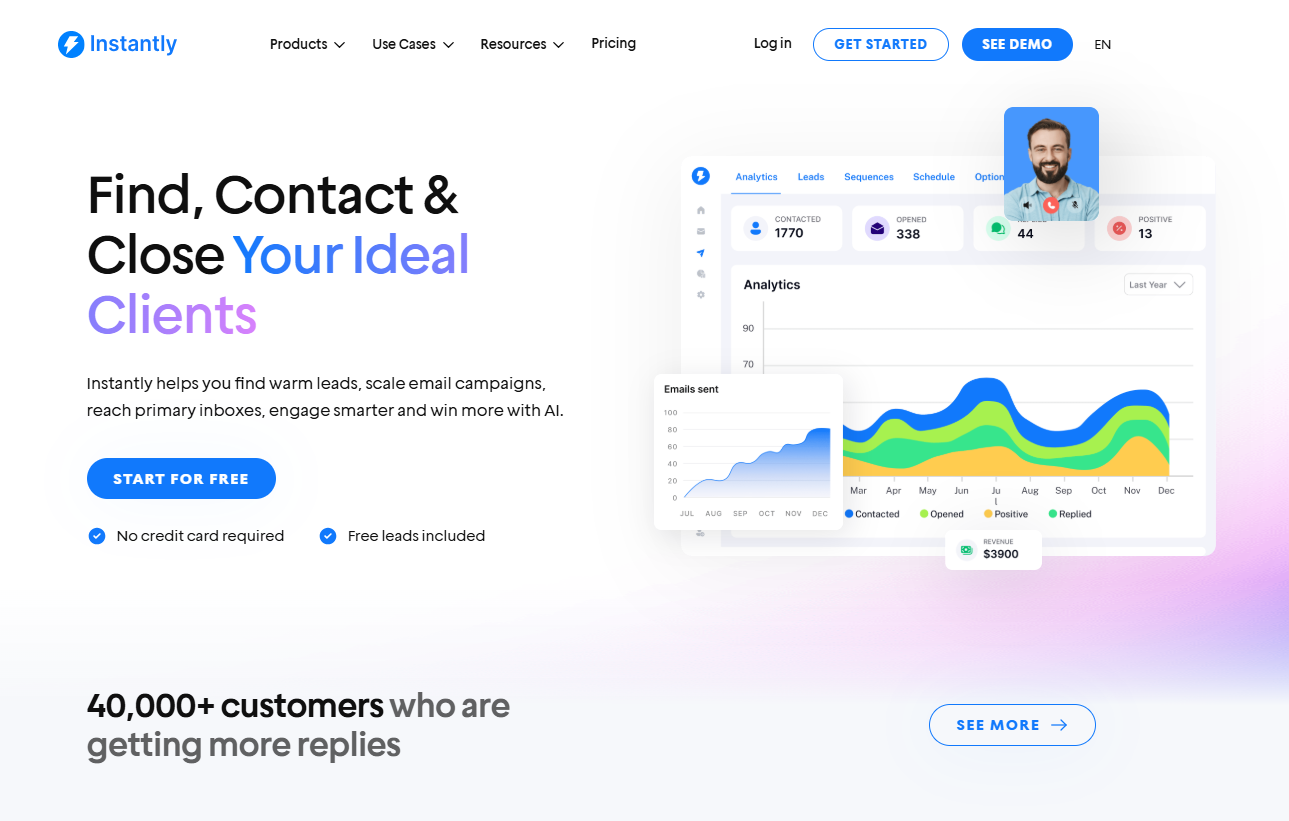
The right tools make these sequences easier to scale, personalize, and measure. Instantly gives B2B teams and agencies everything they need to run proven cold email sequence campaigns, without building from scratch each time.
With Instantly, you get Instantly's AI Sequence Writer, a library of high-performing email sequence templates, automated follow-up rules, and in-depth analytics.
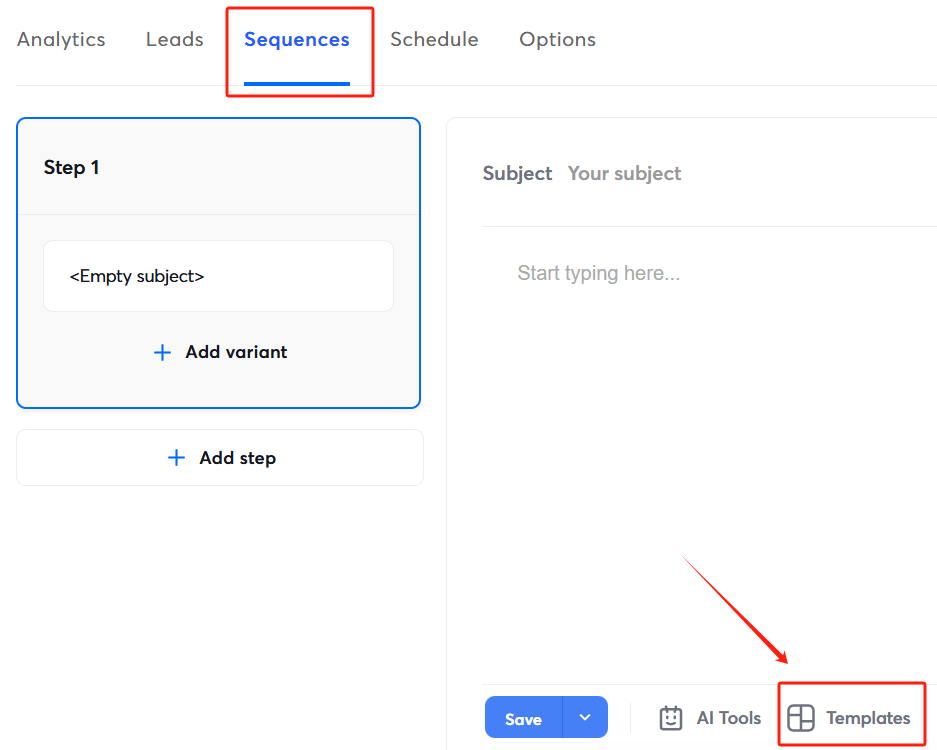
That means you can fill in these frameworks, launch campaigns in less time, and quickly see what gets replies.
If you’re ready to take the manual effort out of cold outreach, Instantly helps you move from copying templates to running tested sequences that fit your brand and your goals.
Why use Instantly for cold email sequences?
Instantly makes it easier to turn a cold email sequence from a static template into a repeatable outreach process. Instead of manually managing each follow-up, you can build personalized cold email sequences around different audiences and automate campaigns as your outreach grows.
With B2B Lead Finder, you can build targeted prospect lists using verified contact data and filters based on your ideal customer profile. Those prospects can then move directly into Outreach, where you can personalize emails, automate follow-ups and manage sequences across multiple sending accounts.
Once campaigns are running, you can see which emails and sequence steps are generating replies and use that performance data to refine your approach over time. This brings prospecting, campaign execution and optimization into the same outreach workflow.
Start your 14 day free trial and build your next cold email sequence with Instantly.
Key takeaways
The right cold email sequence gives you a repeatable way to start real conversations and book meetings without burning bridges or wasting time.
Start with proven fill-in-the-blank frameworks, personalize each touch, and don’t be afraid to tweak as you go. Keep your outreach relevant, your follow-ups brief, and always make it easy for prospects to say yes or no.
Templates do the heavy lifting. Consistency and a few smart adjustments do the rest. Ready to run these sequences at scale? Try Instantly for free today and see how easy it is to launch cold emails that get replies.

Frequently asked questions about cold email sequences
What is a cold email sequence template?
A cold email sequence template is a reusable framework for an initial outreach email and the follow-ups that come after it. It gives you a consistent structure for your campaign while leaving room to personalize each message around the prospect, their needs, and the reason you're reaching out.
What are some effective cold email sequence examples?
Effective cold email sequence examples include lead generation campaigns, meeting requests, referral outreach, and follow-up sequences for prospects who haven't responded. The best approach depends on your goal, but each email should introduce a useful new angle rather than simply repeating the original message.
How many follow-ups should a cold email sequence have?
Most cold email sequences have two or three follow-ups after the initial email, three to four emails in total, spaced two to four business days apart. There is no fixed number that suits every audience. Start with three to four touches, watch where replies drop off, and adjust the length and timing based on your own campaign performance. Stop the moment a prospect replies or gives a clear no.
How do you automate a cold email sequence?
You automate a cold email sequence with a cold outreach tool that sends the initial email, schedules each follow-up, and stops the sequence automatically when a prospect replies. In Instantly, you build the steps once, set the timing and stop rules, and let the Outreach engine run follow-ups across multiple sending accounts while analytics show which steps earn replies.
How do you create an email follow-up sequence?
Start your email follow-up sequence with the context established in your original message, then use each follow-up to add something new. You might share a relevant result, provide a useful resource, approach the prospect's problem differently or reduce the commitment of your CTA. Space follow-ups several business days apart and stop the sequence when the prospect responds.


