.svg)
%20(1).svg)


Email marketing laws serve to protect inboxes, reduce spam, and keep outreach ethical and scalable. To stay compliant, you must use accurate sender info, avoid misleading copy, include an unsubscribe option, maintain clean lists, authenticate domains, and document consent or legitimate interest.
Pay close attention to the rules of CAN-SPAM, GDPR, CASL, ePrivacy Directive, PECR, and other applicable laws to avoid legal troubles while keeping your cold email program healthy and predictable.
Email marketing laws exist for one overarching reason: to keep inboxes usable. These rules require senders to identify themselves, avoid misleading subject lines, include a physical address, and offer working unsubscribe links.
These laws are actively enforced, and companies that violate email marketing laws face fines. Under the GDPR, fines go as high as €20 million or 4% of a company's global annual turnover (whichever is higher). In the U.S., under CAN-SPAM, violations cost $53,088 per email.
For this reason, many businesses hesitate to run cold email marketing campaigns. But the reality is that these enable cold outreach rather than limit it. Clear guardrails filter out spammers, reward legitimate senders, and make it possible to scale campaigns without burning domains or sinking deliverability.
Instantly ensures automated email campaigns are compliant, scalable, and simple, with automated unsubscribe headers, suppression list management, blacklist monitoring, and authentication checks built into every plan.
Why Email Marketing Laws Benefit Cold Email
A Statista study tells us that as of 2023, over 45.6% of the emails globally are spam. Email marketing laws like the GDPR, CAN-SPAM, and Australia’s Spam Act are among years-long efforts from governments worldwide to curb this issue. In practice, they help marketers in the following ways:
Protect Deliverability Rates and Domains
Poor email deliverability rates tanks outreach campaigns. One of the worst offenders for poor deliverability rates is email that lands in spam.
Staying compliant with email marketing laws ensures that you deliver value with every email and scale volume without spamming. For a complete breakdown of how CAN-SPAM, GDPR, and CASL apply specifically to reminder and follow-up sequences, including the mandatory elements every step must include, see the reminder email compliance guide.
For a complete framework on tracking these metrics at the campaign level — bounce rate trends, spam complaint attribution, and reply rate by sequence step — see this email metrics tracking guide.
Build Trust and Authority
Trust is almost non-existent in cold email by default. When a prospect receives an unexpected email, their first thoughts are often:
- "Who is this from?"
- "Is the offer real or just another scam?"
- "Can I trust the sender with my time or data?"
This is where email marketing laws work in your favor. Compliance signals transparency and professionalism. You need accurate sender information, a working unsubscribe link to respect your recipients' choice, and personalized email copy that resonates with your audience.
Scale Sustainably
One of the fastest ways to grow your business is with cold email. But many make the mistake of scaling too soon. Email marketing laws provide the guardrails to keep your outreach ethical, compliant, and scalable.
But that alone isn’t enough. You’ll also need the following:
- Domain authentication: Set up SPF, DKIM, and DMARC correctly. These protocols tell inbox providers your emails are legitimate and not spoofed.
- Warm-up process: New domains and mailboxes require gradual warming up. Sending 1,000 emails on day one is the fastest way to land on blocklists.
- Inbox and domain rotation: As volume grows, spread sending across multiple domains and inboxes. This protects your main brand domain and maintains healthy deliverability.
- List hygiene: Always validate and enrich lists before sending. High bounce rates signal spam behavior and can tank your sender reputation.
For the complete infrastructure checklist on authentication, warmup ramp schedules, and inbox placement monitoring that keeps compliant campaigns in the primary inbox, see this email deliverability guide.
Differentiate from Spammers
Spammers cut corners. Instead of building a strong email infrastructure and maintaining a healthy sender profile, they use spoof accounts and discard inboxes, relying on volume to compensate for quality.
Legitimate cold email marketers do the opposite. Each email is personalized and well-researched, you’re targeting people who need your services, and you’re representing a legitimate business.
What are the Most Prominent Email Marketing Laws?

Different laws can apply to your email marketing activities, depending on where you reside and sometimes the state you’re sending from. These rules define how you can run outreach without risking fines, lawsuits, or deliverability nosedives.
United States: CAN-SPAM Act
In the U.S., email marketing is regulated by the Controlling the Assault of Non-Solicited Pornography and Marketing Act of 2003 (CAN-SPAM Act), which sets the national baseline for commercial email.
Unlike stricter laws abroad, CAN-SPAM doesn't require prior opt-in consent, which means businesses can send cold emails as long as they follow its rules.
The law emphasizes transparency and consumer control, requiring senders to use accurate header information, avoid deceptive subject lines, clearly identify the message as an advertisement, provide a valid physical mailing address, and include a functioning opt-out mechanism.
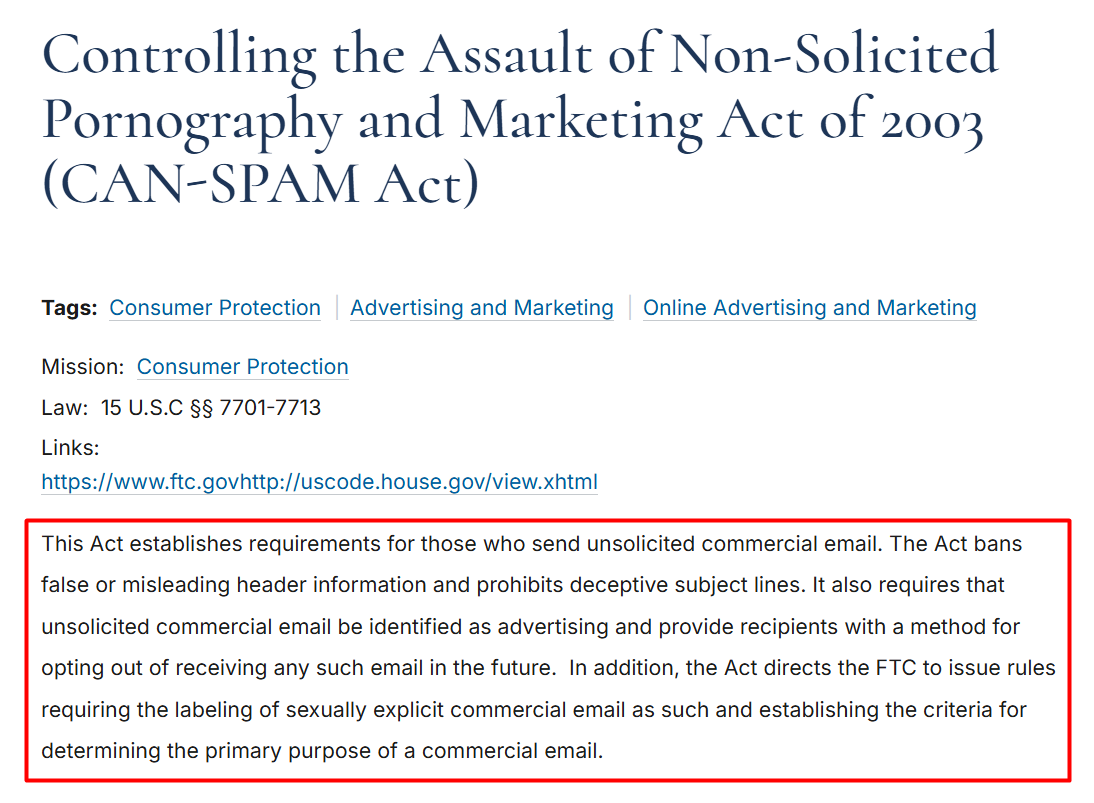
Violations carry steep penalties, with fines of $53,088 per offending email. While CAN-SPAM preempts many state-level spam laws, it does not fully shield businesses from state actions based on fraud, deception, or unlawful data collection.
State-Specific Laws
While the CAN-SPAM Act sets the federal standard, several U.S. states have passed their own anti-spam statutes that impose additional obligations on marketers. California’s law is the most strict.

Under California Business & Professions Code §17529, it is unlawful to gather email addresses, use deceptive subject lines, or misrepresent routing information in commercial emails. What makes California especially strict is that it grants a private right of action.
This means that individual recipients, not just regulators, can sue for damages of up to $1,000 per email, with a cap of $1 million per incident. This opens the door for lawsuits even against small senders who might otherwise never appear on a regulator’s radar.
European Union & United Kingdom: GDPR & ePrivacy Directive
In the European Union, email marketing is governed by a combination of the General Data Protection Regulation (GDPR) and the ePrivacy Directive or Privacy and Electronic Communications Regulations (PECR) in the UK. Together, these laws make Europe one of the strictest regions for cold email outreach.
The GDPR establishes the framework for collecting, storing, and using personal data, while the ePrivacy Directive or PECR provides specific rules regarding electronic communications. This means marketing emails require prior opt-in consent, and that consent must be explicit, informed, and easy to withdraw.
There's some leeway for B2B outreach under the “legitimate interest” lawful basis, but businesses still need their message to be relevant to the recipient’s role and not override their privacy rights. Regulators across the EU regularly issue fines for unlawful email practices.
These include cases where companies sent promotional emails disguised as service updates, failed to honor opt-outs, or emailed individuals without a valid legal basis for doing so. Penalties under GDPR can reach €20 million or 4% of global annual turnover, whichever is higher.
Canada: CASL (Canada’s Anti-Spam Legislation)
Canada enforces one of the strictest email marketing laws in the world through its Anti-Spam Legislation, commonly known as CASL. Unlike the U.S. CAN-SPAM Act, which permits cold email, CASL requires some form of consent before sending.
Consent can be explicit (the recipient clearly opted in, often via a signup or checkbox) or implied (there's an existing business or non-business relationship, such as a recent purchase or inquiry; even so, the window of permission is time-limited).
Penalties can reach up to $1 million CAD for individuals and $10 million CAD for businesses. Compu-Finder was fined CA$1.1 million for sending commercial emails without consent, making it an early cautionary tale for marketers who underestimated CASL’s reach.
How to Scale Email Campaigns While Staying Compliant
One of the most common questions you’ll find in email marketing forums on Reddit or Facebook is about email marketing law compliance. Let’s look at this example from user Jamesdelray. It’s a situation many businesses find themselves in.
They have a product and identified a list of people who can benefit from it. However, they’re afraid to reach out due to potential legal trouble.
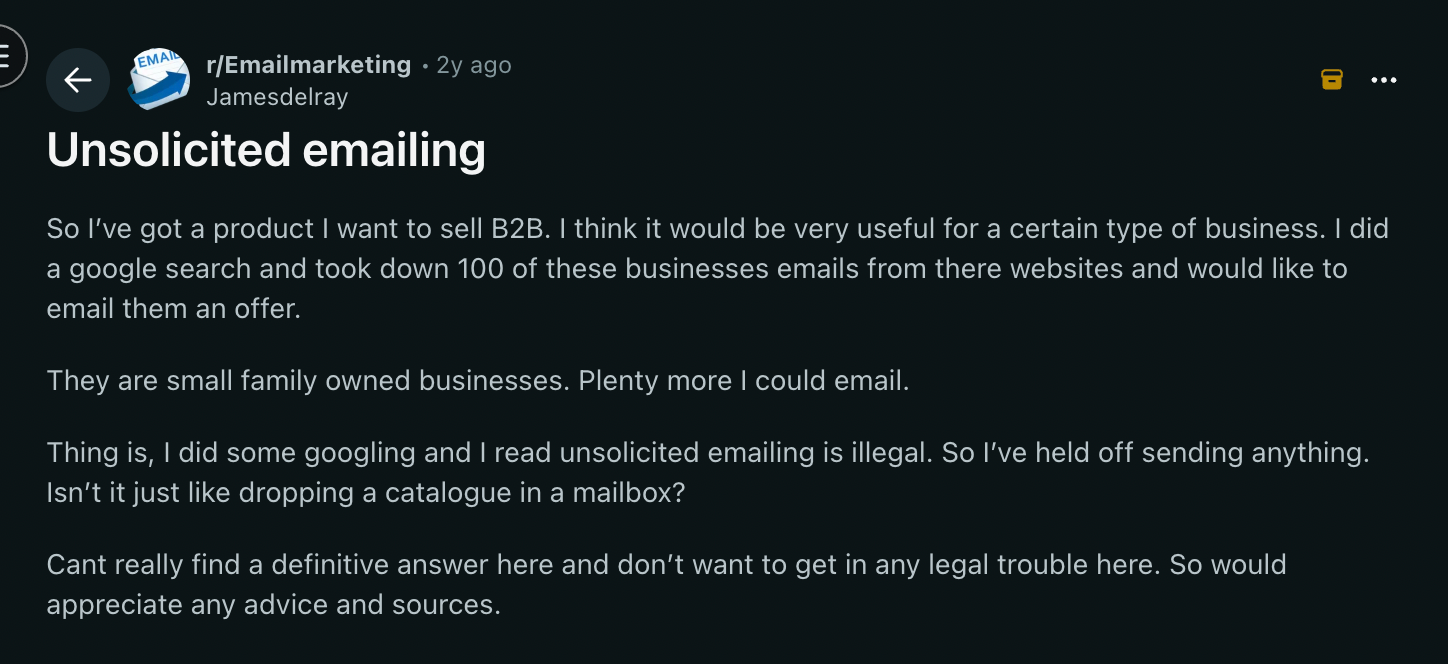
The good news is that in the U.S., the FTC's guidelines are very clear on its stance. You can send unsolicited emails, but you have to be intentional with each message you send. So, how do you scale sending volume while staying compliant? Here’s what we recommend:
Consent and Interest
If you’re promoting something or want to send it directly to consumers, you need to obtain and document their consent. That could be any physical or online form of inbound efforts. To be 100% certain, you can use double opt-ins to ensure you’re sending to people who want to engage.
For cold B2B outreach, document legitimate interest assessments and ensure the email is relevant to the recipient’s role and responsibilities. There are many ways to achieve this in practice.
For example, you can use Instantly’s Website Visitor Identification tool to gather information about people browsing your site.
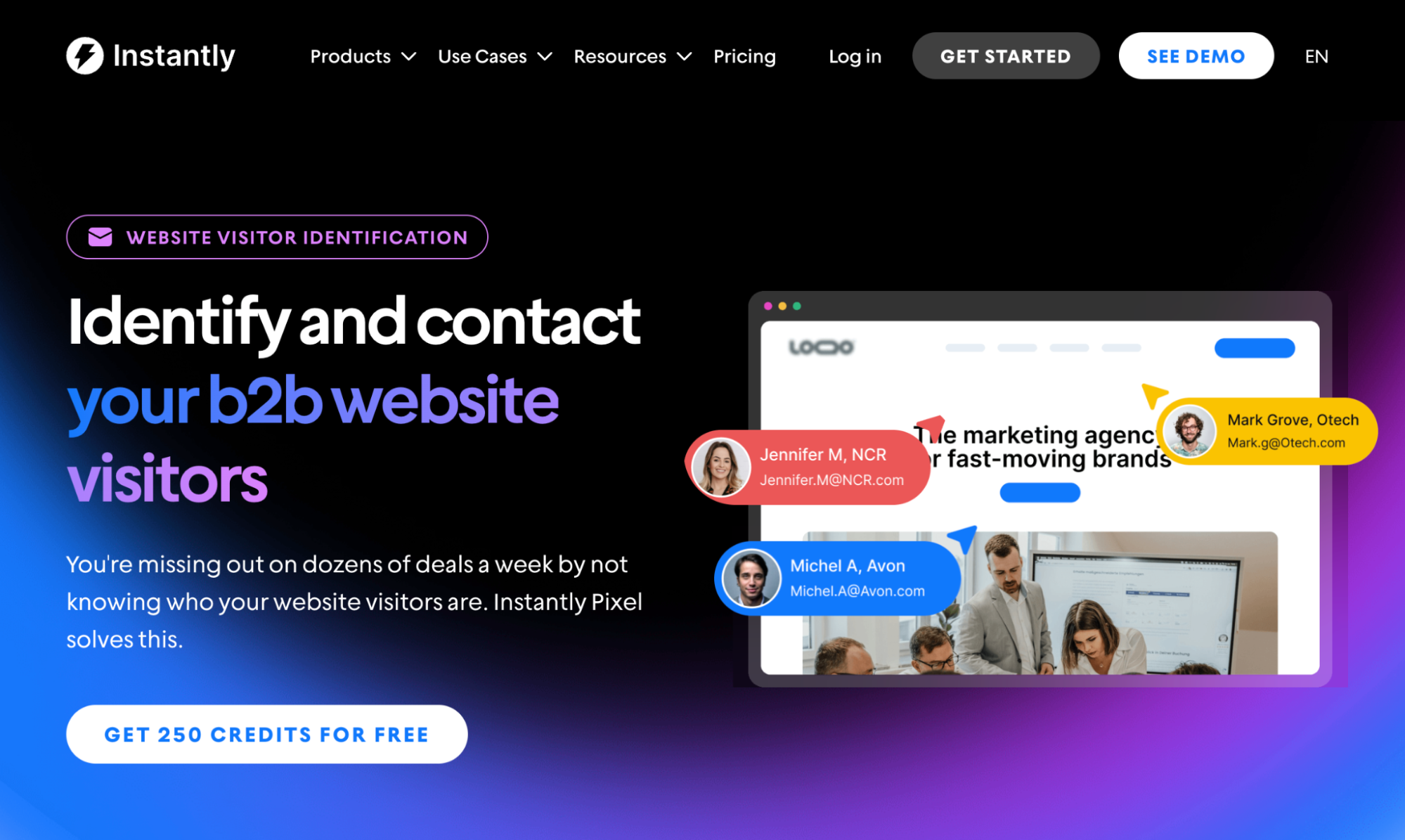
Naturally, if a user frequents your pricing page, that person could be thinking about purchasing. In short, there’s interest.
Find Leads Most Likely to Benefit From Your Offer
Another way to gauge interest starts with your lead generation or prospecting efforts. You need a strategy for finding people most likely to benefit from your offer. The best way to do this is with lead finder tools with advanced search filters.
Let’s say you’re selling a payroll system. Who do you think would benefit most from it? They could be individuals who still use Google Sheets, companies scaling up their hiring processes, or businesses that want to automate. Instantly SuperSearch can help you find these people.
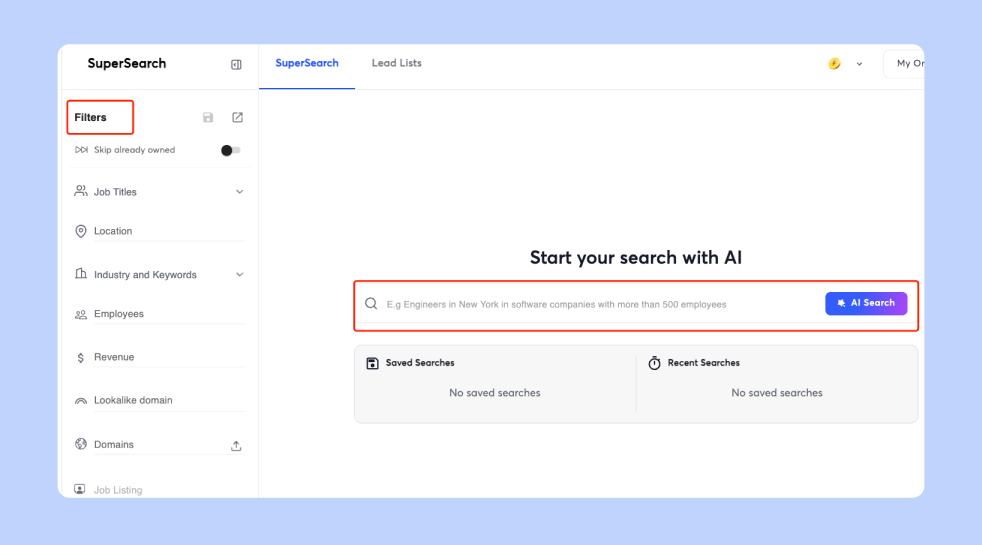
With Instantly SuperSearch, you can apply 13+ advanced search filters, including tech stack, industry news, and company updates. What you get is a combination of pre-verified leads, in-depth data, and the right context for approaching each lead effectively.
Segment and Clean Lists Regularly
Cleaning email lists is just as important as the lead generation process. How would you feel if you’ve seen the same cold email you’ve said no to multiple times already? And with email automation tools, it’s easy to turn on autopilot and forget about housekeeping.
So, ensure that each campaign has its lists cleaned regularly. Remove leads who opted out, those who don’t engage with your follow-ups, and people who explicitly said no. You also have to purge your list for spam traps, unverified leads, and outdated addresses, and catch-all email addresses.
As you scale sending volume and lead lists, this isn’t something you can realistically do manually. So ensure that the email automation software you use has this feature and other essential deliverability tools.
Use Email Automation Tools That Keep Campaigns Compliant
It’s easy to get set and forget campaigns when you’re automating. But there’s more to consider than sending automation alone. You also need to watch out for the following:
- Automated unsubscribe header: Activate the "Unsubscribe" header/feature in email clients like Gmail and Outlook to display a one-click unsubscribe option.
- Suppression list management: Ensures anyone who opts out is automatically removed from future sends, syncing across campaigns without manual effort.
- Authentication checks: Verify that SPF, DKIM, and DMARC are correctly configured to confirm your domain identity and protect against spoofing.
- Data handling and privacy: Tracks and documents how consent was obtained, aligning campaigns with GDPR and other regional privacy requirements.
- Blacklist monitoring: Instantly alerts you if domains or IPs appear on email blacklists, so you can pause, remediate, and protect deliverability before domains get burned.
Always Monitor Key Email Metrics
You need to keep a constant eye on the email metrics that show how your campaigns are performing. Ignoring these numbers is one of the fastest ways to burn a domain, damage deliverability, or even trigger regulatory scrutiny if spam complaints begin to pile up. The core metrics to watch are:
- Open Rates: A sudden drop signals deliverability issues. If authenticated properly (SPF/DKIM/DMARC) and your open rate tanks, you may be landing in spam.
- Reply Rates: Healthy reply rates prove your outreach is relevant. If they decline, your targeting or personalization may not align with recipient expectations.
- Bounce Rates: High email bounce rates are a compliance red flag. They suggest poor list hygiene and, under CASL or GDPR, can imply you’re emailing people without valid consent.
- Spam Complaints: Inbox providers treat spam reports as a critical signal. Crossing thresholds (often around 0.1%–0.3%) can get your domain blacklisted.
- Unsubscribe Rates: Some unsubscribes are natural, but spikes indicate a mismatch between your offer and your audience or that sending frequency is too high.
Key Takeaways
Email marketing laws aren’t the death of outreach. They’re in place to ensure bad actors and spammers don’t have emails landing in people's inboxes. So, if you’re looking to run outreach (e.g., B2B cold emails) in the U.S. or EU, it’s completely legal as long as you comply with applicable regulations.
Being compliant means you’re running outreach within the guidelines of email marketing laws. If you want to scale, you need volume and the right tools and strategies to support it. Instantly ensures automated email campaigns are compliant, scalable, and simple. Start your free Instantly trial.



