.svg)
%20(1).svg)


Updated June 9, 2026
TL;DR:
AI sales agents can speed up repetitive tasks, draft opening lines, and handle routine replies at volume. They cannot guarantee inbox placement, write deeply personalized emails without clean data, compensate for a bad list, or replace the judgment of a trained sales rep. The teams hitting plan in 2026 treat AI as a well-scoped assistant, not a fully autonomous system. Build AI into your process as a force multiplier for human reps, not a replacement. Run 30-day pilots on defined segments, measure reply rate and bounce rate against your baseline, and keep deliverability infrastructure (DNS, warmup, list hygiene) under manual review. Every claim below is backed by how these tools actually work, not how vendors pitch them.
Cold email AI has a marketing problem. Vendors promise autonomous pipelines, guaranteed inboxing, and hyper-personalization at scale. Sales leaders buy in, results disappoint, and trust erodes. If you manage a team with quota accountability, you need to know exactly where AI helps, where it falls short, and what that means for your stack and your domain reputation.
This article breaks down the four biggest myths circulating about AI agents right now and explains what the technology actually does under the hood.
Myth 1: AI guarantees inbox placement
This claim appears in nearly every AI-forward sales tool pitch, and it causes more downstream damage than any other myth in this category. Sales leaders buy in, skip the infrastructure work, and discover the gap when a campaign tanks their domain reputation. By then the cost is not a missed send. It is degraded inbox placement on every campaign that follows, for weeks.
What vendors actually claim
The promise usually sounds like this: "Our AI optimizes your emails for deliverability so you land in the primary inbox every time." Some tools go further, claiming their AI can detect spam triggers, rewrite content on the fly, and adapt sending behavior to avoid filters automatically.
It sounds compelling. It's also technically impossible, and every sales leader who has taken it at face value has eventually paid for it with a flagged domain.
What actually controls deliverability
Inbox placement is an infrastructure outcome, not a content outcome. No platform, AI-powered or otherwise, can guarantee it. Your actual deliverability depends on a cluster of factors that require proper technical setup and sustained discipline:
- Domain authentication: Gmail and Yahoo now require SPF, DKIM, and DMARC for bulk senders transmitting over 5,000 messages per day to their users. These are DNS-level configurations, and getting them wrong means spam folder regardless of your copy.
- Sender reputation: The IP addresses you send from carry cumulative volume history. A sudden spike in sends reads as suspicious to ISPs regardless of how well your subject line tests.
- List quality: High bounce rates trigger increased spam filtering on every subsequent campaign, even clean ones. Reputation follows the sender, not the campaign.
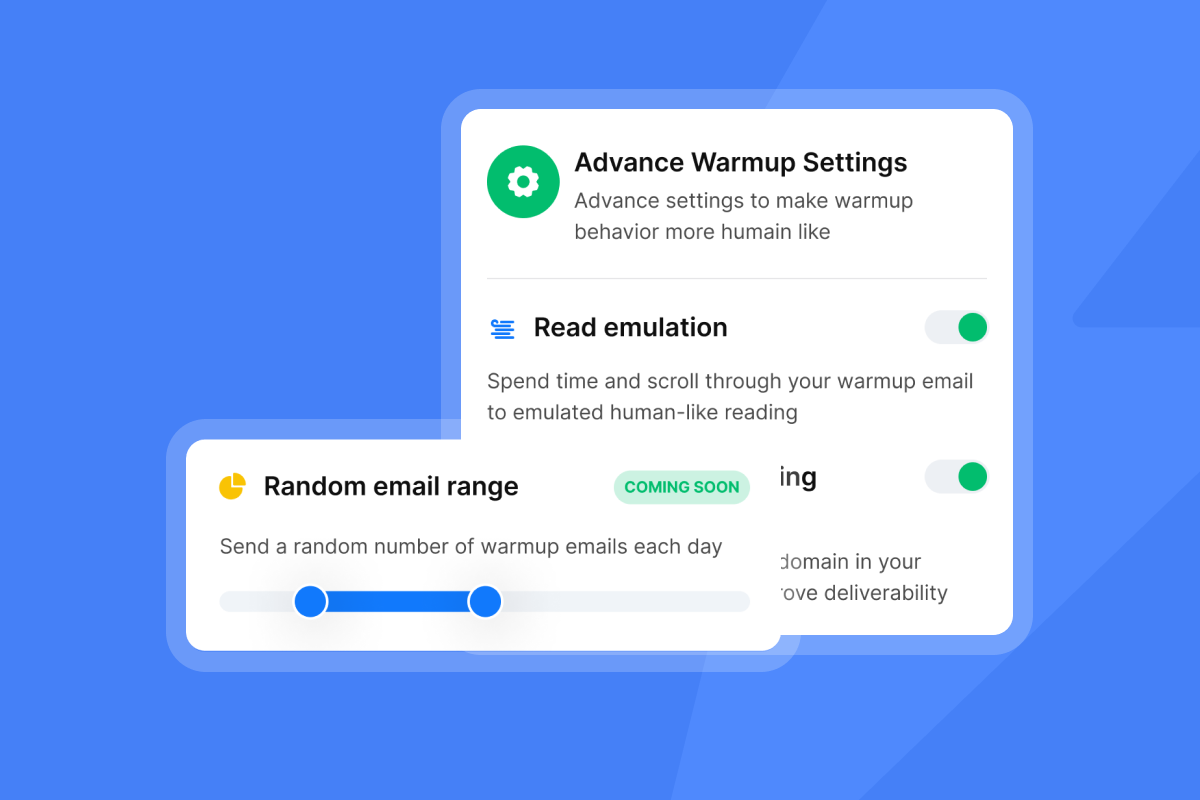
- Mailbox warmup: New inboxes need weeks of gradual engagement before they can handle meaningful send volume. No AI shortcut replaces that ramp.
- Engagement signals: ISPs track open rates, reply rates, and spam complaint rates at the account level. Those signals accumulate over time and reflect sending behavior, not email content alone.
AI tools work across multiple layers: they can flag spam-trigger words, suggest structural improvements, assist with authentication checks like validating SPF records and DKIM keys, and surface reputation shifts before they compound. What they cannot do is override ISP filtering algorithms, substitute for a properly warmed inbox, or compensate for a list decaying at the 22.5-30% annual rate typical of B2B contact databases.Instantly.ai's deliverability guide for agencies puts it plainly: domain setup, mailbox age, sending discipline, and list quality carry most of the outcome. Inbox placement tools and automated placement tests are built to surface infrastructure problems early, not paper over them with AI.
Warmup networks work because they build real engagement signals across aged accounts, not because an algorithm rewrites your subject line. Instantly runs that process across a network of 4.2M+ accounts, with IP rotation and sending algorithms that keep each inbox under daily send caps while scaling total volume.
Here's the honest framing: AI-assisted deliverability tooling helps you catch problems faster, but it cannot prevent them if your infrastructure is not set up correctly. Authentication (SPF, DKIM, DMARC), clean lists, and genuine engagement are the foundation. AI optimizes on top of that foundation. It does not replace it.
Myth 2: AI writes perfectly personalized emails at scale
Personalization is the second-most overhyped promise in AI sales tooling. The myth suggests that AI can read a prospect's LinkedIn profile, website, and recent activity, then produce a tailored opening line that reads as if a thoughtful human wrote it, for every contact in a 10,000-row list. Our guide on AI sales agents for personalization covers what's actually achievable at scale.
The real personalization gap
The failure mode here is specific and repeatable. Most "AI personalization" at scale amounts to token substitution: {{companyName}} gets swapped into a generic template, and a sentence referencing the prospect's industry gets prepended. That's not personalization. It's mail merge with extra steps, and decision-makers recognize it as such.
The deeper issue is that AI models are predictive engines trained on statistical patterns. When the underlying data is incomplete, stale, or thin, the model fills gaps with plausible-sounding but wrong information. These models don't stop and flag uncertainty when context is incomplete. They generate the next most probable token, which means outputs that are confidently wrong on job title, company stage, or relevant context.
According to Instantly's 2026 Cold Email Benchmark Report, the overall average cold email reply rate is 3.43%, with top-performing senders exceeding 10%. The gap between token-substitution personalization and genuine relevance shows up directly in that spread. Senders who invest in tighter segmentation and reviewed personalization consistently appear in the top-performer tier, not the average.
The approach that actually works treats AI as an assistant that drafts concise, factual opening lines from verified data fields, with human review before anything sends. Fully automated deep personalization at scale, without human review or data quality controls, is one of the most common AI sales agent mistakes to avoid, producing output that reads as generic to trained buyers.
What AI-assisted personalization actually looks like
Here's what works in practice:
- Use AI to draft, not to send. Feed verified fields (job title, company size, recent funding, product category) into a constrained prompt. Review the output before it goes into a sequence.
- Cap AI-generated content to the opening line. The value proposition and call to action should be human-written and tested. The AI handles the "I saw that [specific trigger]" opener.
- Segment before you personalize. AI performs better when the input list is already segmented by industry, role, or signal. Trying to personalize a mixed 10,000-row list produces generic output.
- Build constraints into the prompt. Explicitly instruct the AI not to make claims it cannot verify. "Write a two-sentence opener based only on the company description field" produces better output than an open-ended personalization prompt.
Instantly's AI prompt library provides starting templates built around these constraints, and the AI reply suggestions feature operates human-in-the-loop, not on full autopilot.

Myth 3: AI eliminates the need for list quality
This myth is the most dangerous for teams managing sender reputation across a shared domain. The pitch is that AI enrichment can "find" missing data, fill in gaps, and essentially compensate for a poorly built contact list. It can't, and the downstream cost to your sender reputation compounds fast.
Why data quality still drives every outcome
An acceptable email bounce rate sits below 2%. Rates between 2% and 5% indicate potential quality issues, and anything above 5% is a direct threat to your sender reputation that affects all future campaigns from your domain. Email lists degrade at roughly 22.5-30% per year as contacts change jobs, abandon accounts, or shift roles. A list that was clean 18 months ago likely carries a meaningful portion of invalid addresses today.
The cascade effect is particularly harmful. Gmail, Outlook, and Yahoo track your bounce rate and use it as a primary signal for filtering decisions. A 3% bounce rate on one campaign means the next campaign faces increased spam filtering, even if the second list is perfectly clean. Reputation follows the sender, not the campaign. Keep bounces at or below 2% per campaign to stay inside safe operating range.
AI enrichment tools, including the best ones, operate on the data they can access. Stale company records, incorrect job titles, and outdated email formats produce wrong names, wrong roles, and high bounces. No enrichment model can produce a valid address that no longer exists, and no AI can recover a sender reputation damaged by a wave of hard bounces.
What actually reduces bounce rates
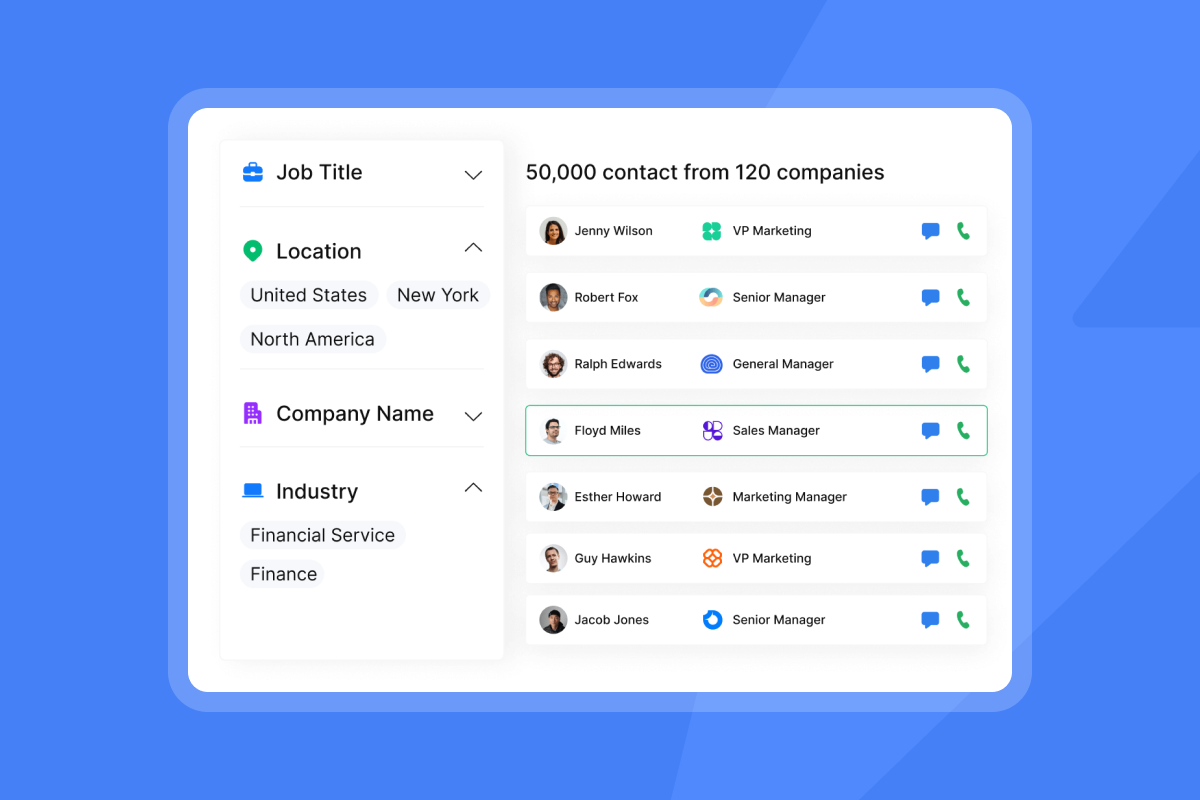
- Verified contacts with waterfall enrichment. Instantly's SuperSearch pulls from 450M+ B2B leads with enrichment across 5+ providers, which reduces the chance of a single stale source polluting your list.
- Hygiene before every campaign. Run verification against any list older than 90 days. Do not assume a previous campaign's list is still clean.
- Bounce monitoring with automatic suppression. Instantly's reputation protection and bounce detection features flag problem addresses before they compound. The cold email strategy guide includes the full hygiene checklist.
- Secondary sending domains. Using secondary domains protects your primary domain during testing or scaling phases when bounce risk is highest.
Myth 4: AI replaces human sales reps
This is the myth that has cost some revenue teams an entire quarter, and it's exactly why it's worth asking whether you need an AI sales agent before restructuring your team around one. The narrative is that an agentic sales agent can handle prospecting, personalization, sequence management, and meeting booking end to end, reducing headcount and eliminating the bottlenecks of managing a human team.
Why full AI autonomy over the pipeline fails
AI sales tools work best as high-volume assistants scoped to repeatable tasks. When teams give AI full autonomy over the entire pipeline, from prospecting to personalization to sequencing, the results consistently fall short because sales judgment is context-dependent in ways that pattern-matching models are not built to handle.
Two structural problems explain why:
- Access limitations: AI agents cannot freely access SaaS tools, websites, and platforms the way a human rep can. Many platforms restrict AI access for privacy or security reasons. This means AI systems operate with incomplete data, missing the same signals a human seller can observe directly.
- Contextual judgment: Prospect research requires reading nuance across company stage, team structure, recent news, and competitive context. AI models rely on pattern-based reasoning. When the context varies considerably from what the model was trained on, it misses the bigger picture that a skilled rep would naturally catch.
The general picture emerging from LLM research and broader AI sales agent trends suggests that scaling these models does not eliminate hallucination, misreasoning, or misalignment. If anything, those failure modes become harder to detect at scale. The practical read is that these systems generate plausible outputs, not verified judgments. In live sales conversations, that gap between plausible and accurate is where pipeline gets lost.
Where AI genuinely accelerates rep productivity
The right frame is AI as a force multiplier for human reps. This is where the category is actually delivering value:
- Automating repetitive follow-ups. AI handles the mechanical cadence of follow-up steps, which frees reps for higher-value conversations.
- Drafting first-pass reply suggestions. The AI Reply Agent handles lead replies in under 5 minutes and runs in either Human-in-the-Loop mode, where responses route to a rep for approval before sending, or Autopilot mode, where replies send automatically without review. Most teams start with Human-in-the-Loop to validate AI accuracy across their first batch of replies, then move to Autopilot for qualified segments once response quality is confirmed.
- Summarizing campaign performance. Copilot surfaces analytics and campaign insights without requiring reps to dig through dashboards manually. The Copilot help doc covers how task automation works in practice.
- Lead sourcing at scale. The AI Sales Agent executes autonomous lead sourcing, but it performs best when scoped to specific segments with defined criteria, not as a general-purpose prospecting engine running without guardrails. Watch the AI Sales Agent product walkthrough to see how it handles sourcing and follow-up within defined parameters.
"I use Instantly for campaign automation and personalization. I really appreciate the smart campaign engine that lets me set up multi-automated emails and follow-ups, saving me a lot of time." - Said K. on G2
AI sales agent myths vs. honest tooling: what to look for instead
The vendors worth trusting explain what their AI cannot do before they explain what it can. Here's the benchmark to hold any tool to:
Claim | What to verify |
|---|---|
"AI guarantees inbox placement" | Ask for seed-list testing methodology and infrastructure docs |
"AI personalizes every email" | Ask to see output samples at 1,000+ contact scale with a real data source |
"AI replaces list hygiene" | Ask about bounce detection, suppression logic, and verification partners |
"AI SDRs replace your team" | Ask for documented reply rate benchmarks from live deployments at your send volume |
Instantly's AI agents are three distinct tools, each scoped to specific tasks rather than claiming end-to-end autonomy. The AI Reply Agent offers configurable Human-in-the-Loop and Autopilot modes, pricing at 5 Instantly Credits per reply. The AI Sales Agent runs on Instantly Credits, with transparent per-action pricing that makes cost-per-lead easy to track and audit. Copilot handles research and analytics summarization. None of them are positioned as a replacement for sender reputation management, list hygiene, or rep judgment.
For teams evaluating the platform, the outreach plans comparison lays out exactly what each tier includes, and which AI features run on Instantly Credits (a separate subscription starting at $9/month) versus what comes with the base Outreach plan. That separation matters when you're projecting cost per meeting with an AI sales agent ROI calculator and need numbers that hold up to CFO scrutiny.
Before committing, watch the co-founder demo walkthrough to see the full feature set in action, or follow the beginner campaign setup guide to build a complete sequence from scratch.
Pricing starts at $47/month for the Growth Outreach plan. A free trial is available with 100 Instantly Credits to test AI features before committing.
Start with a free Instantly trial to test the AI agents against your own campaigns. Use the 100 free credits to run AI Sales Agent on a defined segment, review the output before it sends, and measure reply rate and bounce rate against your current baseline. That pilot structure gives you defensible data before a full rollout, and our AI sales agent implementation guide covers the rollout steps.
FAQs
Can AI sales agents guarantee inbox placement?
No AI sales tool can guarantee inbox placement because deliverability depends on DNS authentication, sender reputation, list quality, and ISP filtering algorithms, none of which AI can override. Proper SPF, DKIM, and DMARC setup combined with a warmed inbox and a clean list drives inbox placement far more reliably than any AI content layer.
Does AI personalization actually improve cold email reply rates?
AI-assisted personalization improves reply rates when it operates on verified, current data and includes human review before sending. According to Instantly's 2026 Cold Email Benchmark Report, the overall average reply rate is 3.43%, but top performers exceed 10%, and the gap consistently traces back to data quality and how deliberately the personalization was reviewed, not how much was automated.
Why does list quality still matter if AI can enrich contacts?
AI enrichment improves a mediocre list by pulling from multiple data sources, but it cannot produce a valid address that no longer exists or recover a sender reputation damaged by a high bounce rate. Email lists decay at roughly 22.5%-30% per year, and bounce rates above 2% begin to affect ISP filtering on all subsequent campaigns, not just the one with the bad data.
How does Instantly's AI Reply Agent handle responses without replacing reps?
Instantly's AI Reply Agent processes incoming replies in under 5 minutes in either Human-in-the-Loop mode, where suggested responses route to a rep for approval before sending, or Autopilot mode, where replies send automatically. The recommended starting point is Human-in-the-Loop to validate tone and accuracy across your first batch of replies before switching to Autopilot for qualifying segments. It runs on Instantly Credits (5 credits per reply) as a separate subscription from the Outreach plan, with Slack integration for fast review.
What is the realistic role of an AI sales agent in a sales team?
The best AI sales agents work as high-volume assistants handling repetitive tasks: follow-up sequencing, reply triage, lead sourcing within defined criteria, and analytics summarization. They do not replace the contextual judgment, relationship nuance, or data interpretation that experienced reps provide, and the teams treating AI as an autonomous replacement for SDRs consistently report worse pipeline outcomes than those using AI to support human-led processes.
Key terms glossary
Sender reputation: Cumulative score ISPs assign to your sending domain and IP addresses based on bounce rates, spam complaints, and engagement signals. A reputation below threshold triggers automatic spam filtering on all future campaigns from that sender.
Warmup: Gradual ramp process where a new inbox sends and receives emails in increasing daily volume over approximately two to four weeks, building positive engagement history before a cold campaign launches. Instantly's own guidance recommends allowing around 14 days minimum before sending at volume. Exact daily send targets vary by domain age, list quality, and engagement signals. A common starting point is 3-10 emails per day in the first two weeks, stepping up to 15-25 per day through weeks three and four, then reaching a ceiling of 30 per inbox per day by weeks five and six. If health metrics dip, reduce volume and run the hygiene checklist before resuming.
Bounce rate: Percentage of emails that fail to deliver due to invalid addresses (hard bounce) or temporary issues (soft bounce). The acceptable threshold is below 2% per campaign, with anything above 5% posing a direct threat to sender reputation.
Human-in-the-Loop (HITL): AI workflow design where the system drafts or suggests actions but routes them to a human operator for review and approval before execution, preserving judgment and accountability at every send.
List hygiene: Process of removing invalid, stale, or unengaged contacts from your email list through verification services, bounce suppression, and regular re-validation, recommended every 90 days for active sending lists.
SPF, DKIM, DMARC: The three DNS authentication standards that Gmail and Yahoo require for bulk senders transmitting over 5,000 messages per day. SPF authorizes sending IPs, DKIM signs messages cryptographically, and DMARC enforces alignment policy between them.
Read next
- How to improve cold email reply rates: A practical breakdown of the variables that move reply rates, from subject line structure and send windows to segmentation and follow-up timing.
- Email Deliverability for Sequences: Warmup, Health Monitoring & Compliance: Covers the full deliverability stack for cold outreach, including inbox warmup, domain health monitoring, and compliance requirements for bulk senders.
- How to Write Follow-Ups for Cold Leads, Warm Leads, Proposals, and Objections: A scenario-by-scenario guide to writing follow-up emails that advance conversations without burning contact goodwill.



