.svg)
%20(1).svg)


Updated: June 2, 2026
TL;DR:
Enterprise buying committees average 13 stakeholders for general B2B purchases, and technology decisions pull in 25 or more people across departments. By the time a rep makes first contact, buyers have already completed roughly 57 to 70% of their evaluation before engaging a sales rep. Relying on a single contact to carry the deal is a structural deal risk. This guide covers 7 roles commonly found across enterprise buying committees, what each one typically needs to move your deal forward, and how to build consensus before the opportunity stalls.
Most enterprise deals don't die to a better competitor. They die because reps talk only to the user buyer while the economic buyer, technical reviewer, and internal blockers shape the outcome privately. Your champion can sell your product across a 12-person committee if you equip them correctly, but no single champion should be your only thread into the account. That's the structural deal risk, and this guide shows you how to remove it.
The enterprise buying team structure
A buying committee is the full group of people who influence, evaluate, or approve a purchase. General B2B purchases now involve an average of 13 stakeholders, and when you're selling technology, that number climbs to 25 or more across departments.
Enterprise risk drives buying teams
Large organizations distribute purchasing decisions across multiple functions to reduce financial and operational risk. When your rep engages only one stakeholder, any unmapped contact can veto the deal without warning. This is structural deal risk, and it's why enterprise deals stall at the final stage even when your champion is enthusiastic.
The fix is multi-threading: building active relationships with each role before the committee meets internally. Gong's analysis of 1.8 million deals found that multithreading boosts win rates by 130% on deals over $50K compared to single-threaded outreach. Use firmographic data to identify which stakeholder types are likely present at each account before your first send:
- Smaller B2B companies (under 200 employees): Budget authority often concentrates with the CEO or a single C-suite executive who covers multiple roles.
- Mid-market companies (200-1,000 employees): IT, finance, and business unit heads each own part of the evaluation, so three or more distinct stakeholder types need separate outreach.
- Enterprises above 1,000 employees: Procurement runs a formal RFP or vendor evaluation process, and legal reviews contracts independently of the business sponsor.
- Regulated industries (finance, healthcare): Compliance and legal teams review data posture and contractual terms alongside procurement, adding review stages before any deal closes.
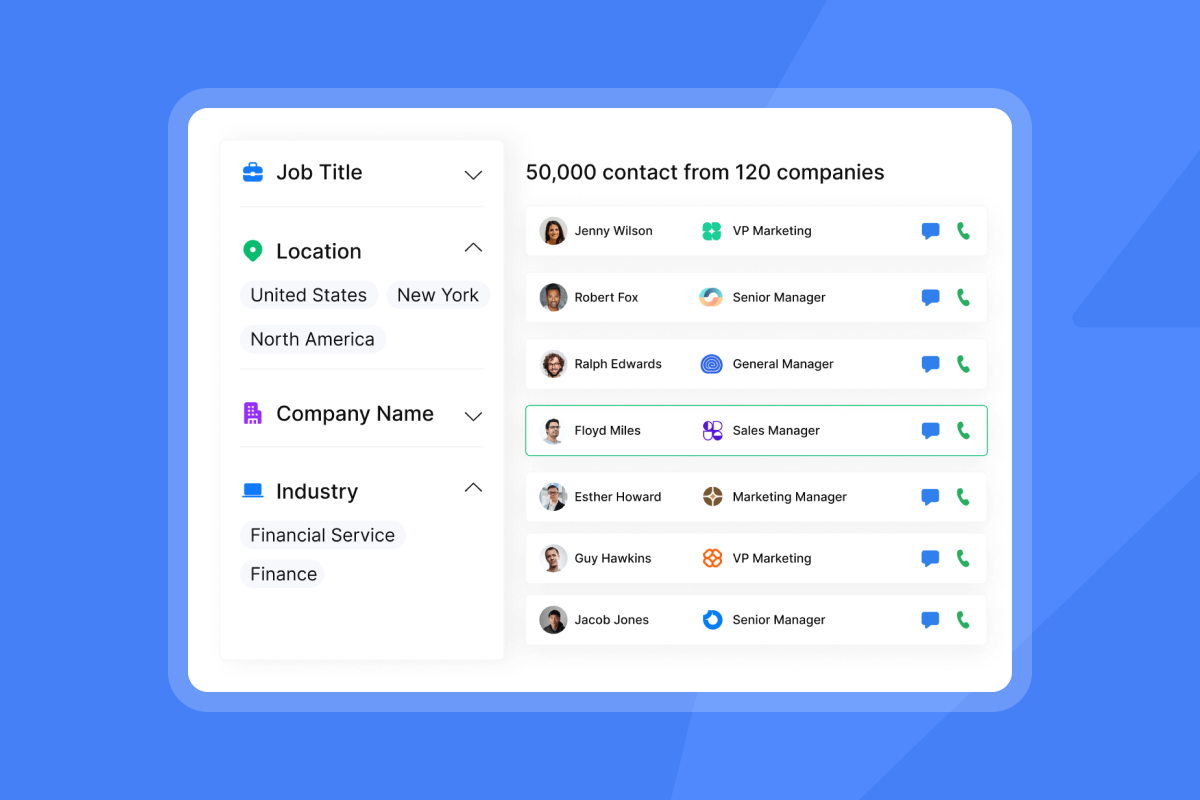
Instantly.ai's SuperSearch lets you filter across 450M+ verified B2B contacts by job title, department, and company size to identify which authority types exist at each target account before your first send.
The economic buyer: identifying the deal's true budget owner
The economic buyer holds final budget authority. They own the P&L and evaluate your solution against three core concerns: costs, time to value, and how confident their team is in the initiative. The MEDDICC framework defines the economic buyer as the person with power to approve a deal when others say no and kill it when others say yes.
Stakeholder type | Primary motivation | Biggest concern | Authority and influence |
|---|---|---|---|
Economic buyer | Revenue growth or cost reduction | ROI and financial risk | Final budget approval |
User buyer | Daily workflow fit and reduced friction for their team | Daily usability and adoption | Influence only, no budget sign-off |
Technical buyer | Security, compliance, and integration validation | Data privacy, integration gaps, and compliance posture | Veto power on technical grounds |
Champion | Personal outcome tied to solution success | Internal credibility with peers | No formal authority, drives internal consensus |
Influencer | Recognition as a credible domain voice | Being treated as a respected expert rather than a standard prospect | No formal approval authority, but their domain opinion shapes how the technical buyer and user buyer evaluate your solution internally |
Blocker | Workflow stability and protection of existing processes | Complexity and disruption | No formal approval authority, but unaddressed concerns can prevent the deal from reaching the economic buyer |
Approver | Procurement and legal process adherence | Contract terms, vendor vetting, and compliance posture | Final contract and procurement sign-off |
Engagement tactics for the economic buyer:
- Lead with a specific financial outcome: cost per meeting, pipeline coverage, or payback period, not a feature list. Prepare a one-page executive summary with ROI ranges under 300 words, and executive buyers at that level consistently prefer materials that are short enough to read, forward, and act on quickly.
- Ask your champion early: "When and how should we bring the CFO or COO into the conversation?" This frames economic buyer access as a shared goal rather than a confrontation.
The user buyer: adoption and workflow
The user buyer will live in your product daily. They evaluate ease of use, workflow fit, and whether adoption will create friction for their team. They influence the deal and can slow it down with objections, but they can't approve unbudgeted spend on their own. A common misframing is treating user buyer enthusiasm as a signal that the deal is moving. Their endorsement still needs a path to the economic buyer to advance the deal. Track reply rate by persona to identify which user buyer messages are landing and which need a rewrite.
Engagement tactics for the user buyer:
- Run a demo mapped to their specific daily tasks, not a general product tour. Show exactly how your solution removes steps from their current workflow.
- Share user-level case studies that highlight workflow time savings and reduced manual steps, so they can see outcomes from people in their exact role.
The technical buyer: addressing technical risks
The technical buyer evaluates whether your product passes security, compliance, and integration requirements. They're usually the CTO, Head of IT, or a security architect. Their "no" carries enormous weight even though they can't approve the deal alone, because a failed technical review stops the deal before the economic buyer ever makes a final call.
Technical buyer security requirements
Technical buyers focus on data privacy, API capabilities, integration depth, and compliance posture. Instantly's transparent DPA, published sub-processor list, and inbox placement documentation give technical reviewers the materials they need to run an evaluation without chasing your team for answers. For sales leaders managing compliance-sensitive deals, the email tracking privacy and GDPR guide covers the data posture questions technical buyers commonly raise.
Engagement tactics for the technical buyer:
- Share security documentation proactively: DPA, sub-processor list, and data-flow diagrams before they request them. Treating compliance as a trust-building step rather than a hurdle shortens technical review cycles.
- Arrange a technical deep-dive with a pre-sales engineer who can cover API endpoints and integration architecture in detail, so the technical buyer hears specifics rather than marketing claims.

The champion: activating internal buy-in
Your champion is the internal advocate who believes in your solution and promotes it to other stakeholders. They understand the business value and align it with internal priorities. Champions don't control budget and can't approve spending unilaterally, but a well-equipped champion can build the internal consensus that makes approval straightforward for the economic buyer.
Early champion identification tactics
Test champion strength early. Ask them to identify the decision-makers and set up an internal introduction. A true champion shows commitment through proactive behavior: they share internal context you didn't ask for, volunteer to make introductions, and advocate for the outcome because they have a personal stake in it. A real champion will pitch your solution to the buying group on their own initiative because they see a personal win tied to the outcome.
How to enable your champion:
- Give them a private demo deck, ROI calculator, and internal proposal template with answers to likely objections from the economic buyer and technical buyer. Champions lose internal credibility when they're caught flat-footed by objections they should have seen coming, so treat them as an extension of your team.
- Loop them into every update with a short summary and one new proof point each time so they always have current information and stay invested in the outcome.
The same claim-evidence-takeaway structure that wins cold email replies is the structure your champion needs for their internal business case.
The influencer: identifying and activating key influencers
Influencers shape committee opinions through domain expertise and professional credibility. A respected IT architect or operations leader can sway the technical buyer and user buyer in a single internal conversation. They hold no formal sign-off authority, but their informal influence is real and often faster-moving than formal approval chains.
The "domino" role
The domino is a high-credibility influencer whose endorsement shapes how other committee members evaluate your solution, because stakeholders often look to trusted peers before forming their own view. When a domino validates your solution, their credibility with other committee members gives your deal stronger internal footing than any external claim your sales team can make. Identifying the domino early gives your outreach a stronger foundation before the committee forms its internal view.
Engagement tactics for influencers:
- Identify who the team looks to for technical or operational validation and prioritize them for early, separate outreach rather than folding them into a general stakeholder sequence.
- Invite them to a working session instead of a sales call, share peer-reviewed benchmarks or technical white papers matched to their domain, and signal you respect their expertise rather than treating them as a standard prospect.
The blocker: identifying deal stoppers
Blockers can stall or kill your deal. They're usually motivated by risk aversion, loyalty to an existing vendor, or fear that your solution adds complexity to their workflow. Forrester 2024 research found that 86% of B2B purchases stall during the buying process, citing tight budgets, AI's influence in buying and selling, negative buying experiences, and long purchase cycles as key drivers. Unaddressed blocker concerns add friction on top of those structural pressures, and dealing with them directly reduces the risk of a deal dying quietly inside the committee. The most common late-stage blocker is a stakeholder who was never mapped into the outreach, making their objection harder to address before it reaches the economic buyer.
Tactics to prevent blocker deal stalls:
- Use your champion to surface the blocker's specific concerns before they escalate. Address them directly with data and a mitigation plan, not dismissal.
- Propose a structured 30 to 90-day pilot with measurable success criteria tied to business outcomes. Pilots reduce perceived risk and convert blockers faster than extended sales cycles, because they replace abstract concerns with concrete results.
The approver: gatekeeper of final sign-off
The approver reviews and confirms the contract is ready to proceed. This role often sits in legal or procurement, and it's distinct from the economic buyer. The economic buyer approves the investment decision. The approver owns the procurement and legal process and confirms that contract terms, compliance posture, and vendor vetting meet organizational standards before the deal moves to final signatures. In some organizations these roles overlap, but in larger enterprises they typically sit with different people, and 79% of software purchases now require CFO-level approval at some stage of the process.
Tactics for engaging the approver:
- Consider timing your outreach early, before formal procurement assigns the approver to your deal and the process becomes harder to influence. Arriving before they're assigned to your deal gives you a chance to shape the process rather than react to it.
- Provide a standard contract template or statement of work to reduce legal review friction and shorten the final stage, so the approver can move quickly once they're engaged.
Track consensus across the buying committee
You need a system to track consensus across 13 or more stakeholders. Map each contact by role, current engagement status, and open concerns. Track which personas have replied positively and which have gone quiet. A rep who shows their manager a live stakeholder map with reply data per role can answer deal health questions with facts rather than estimates. When your manager asks "how close is this deal?" you can answer with engagement counts by role, not a gut feel.
Differentiating engagement by buyer role
Gartner confirms that 80% of B2B sales interactions between suppliers and buyers would occur in digital channels by 2025, a target year that has now passed. Email is one of the core channels for reaching multiple stakeholders across that digital mix, alongside calls and LinkedIn, making role-specific sequences a practical way to build committee-wide awareness at scale. Instantly's Unibox puts all replies from every stakeholder in one centralized view, with AI Custom Reply Labels that automatically categorize each response as Interested, Meeting Booked, Not Interested, or Out of Office, so you're not digging through individual inboxes to piece together where the deal stands.
For a practical walkthrough of building sequences across multiple roles, the cold email copywriting framework covers the message structure that works across different stakeholder types.
Map every committee role. Use Instantly's SuperSearch to filter 450M+ verified B2B contacts by job title and department, then run role-specific sequences across all stakeholders without per-seat penalties. Try Instantly free to build your first buying committee map.
FAQs
What is an enterprise buying committee?
An enterprise buying committee is the full group of people who influence, evaluate, or approve a major purchase decision. For technology purchases, the average committee includes 25 stakeholders, and enterprise IT decisions can involve up to 33 people across departments.
What is the difference between an economic buyer and a user buyer?
The economic buyer holds final budget authority and evaluates ROI and financial impact, while the user buyer evaluates ease of use and workflow fit but cannot approve unbudgeted spend on their own.
How many stakeholders should you target in an enterprise deal?
Target all identified roles in your enterprise accounts. Gong's analysis of 1.8 million deals found that multithreading boosts win rates by 130% on deals over $50K compared to single-threaded outreach.
What is a Champion in a B2B buying committee?
A champion is the internal advocate who promotes your solution to other committee members and understands its business value, but lacks formal budget authority. Test champion strength early by asking them to arrange an introduction to the economic buyer.
What is the difference between an approver and an economic buyer?
The economic buyer controls budget allocation and evaluates financial return, while the approver owns the procurement and legal review process and confirms contract terms and vendor compliance meet organizational standards. In larger enterprises these roles typically sit with different people.
Key terms glossary
Multi-threading: Engaging multiple stakeholders across different roles and departments within a single target account simultaneously, rather than relying on one contact to carry the deal.
Structural deal risk: The deal vulnerability that results from single-threading, where one unmapped or unengaged stakeholder can stall or kill a deal without the rep's knowledge.
Economic buyer: The person in a buying committee who holds final budget authority and evaluates a solution against costs, time to value, and team confidence in the initiative. They can approve a deal when others say no and stop it when others say yes.
User buyer: The person in a buying committee who evaluates a solution based on daily workflow fit and ease of use. They influence the evaluation and can slow a deal with adoption concerns, but they cannot approve unbudgeted spend on their own.
Technical buyer: The person in a buying committee who evaluates whether a solution meets security, compliance, and integration requirements. They typically hold a role such as CTO, Head of IT, or security architect. They cannot approve the deal alone, but a failed technical review stops it before the economic buyer makes a final call.
Influencer: A member of the buying committee who shapes how other stakeholders evaluate your solution through domain expertise and professional credibility. They hold no formal sign-off authority, but their informal opinion often carries more weight internally than their job title suggests. A high-credibility influencer whose endorsement shapes peer evaluation before the committee reaches a formal position is referred to in this guide as a domino.
Domino: A high-credibility influencer whose endorsement creates a cascade of buy-in across other committee members, accelerating internal consensus.
Champion: An internal advocate who promotes your solution within the buying organization but lacks formal budget sign-off authority.
Blocker: A member of the buying committee who can stall or kill a deal through inaction or escalation. Blockers are typically motivated by risk aversion, loyalty to an existing vendor, or concern that your solution adds complexity to their workflow. They hold no formal approval authority, but their unaddressed concerns can prevent a deal from reaching the economic buyer's final sign-off.
Approver: The person in a buying committee who owns the procurement and legal review process and confirms that contract terms, compliance posture, and vendor vetting meet organizational standards before the deal moves to final signatures. This role often sits in legal or procurement and is distinct from the economic buyer. The economic buyer approves the investment decision. The approver confirms the process is complete.
Unibox: Instantly's centralized reply management view that consolidates responses from multiple stakeholders and campaigns into a single filtered dashboard with AI categorization.
SuperSearch: Instantly's B2B lead database with 450M+ contacts, searchable by job title, department, company size, and other firmographic filters for buying committee identification.
Read next
What’s a Good Cold Email Reply Rate? Instantly’s Benchmarks: Understand the reply rate benchmarks that indicate healthy committee engagement and what to adjust when a specific stakeholder role goes quiet.
Email Warmup Process: 4 Stages to Reach Full Sending Capacity: Keep domain health intact as you add inboxes and increase sending volume across a larger number of buying committee contacts.
How to Write Follow-Ups for Cold Leads, Warm Leads, Proposals, and Objections: Build the follow-up cadence that keeps your deal moving across multiple roles without burning out any single stakeholder.