.svg)
%20(1).svg)


Updated October 9, 2026
TL;DR: The platform average cold email reply rate is 3.43%, and top-quartile senders hit 5.5%+, according to Instantly's 2026 benchmark report. The gap is context density, not volume. This library gives you ready-to-use AI prompts for sales, organized by buyer journey stage with deliverability guardrails baked in. Each prompt has bracketed placeholders for lead details. Fill them, cap output at 80 words, and check it with a spam filter before sending. Pair these prompts with Instantly's flat-fee platform to automate the full motion without per-seat costs.
The platform average reply rate for cold email is 3.43%. Top-quartile senders reach 5.5%+, and the top 10% clear 10.7%+, all from Instantly's 2026 benchmark report. A hundred lists of AI prompts for sales teams exist online, but most ignore the two factors that determine success: context density and deliverability physics. A prompt that says "write a cold email for my SaaS" produces generic, spam-flagged copy. A prompt that includes your ICP's title, their specific pain, your proof point, and a word count ceiling produces something a real buyer replies to.
This library is a working prompt stack for founders selling without a sales team. It covers research, outreach, qualification, closing, and retention, with every prompt carrying placeholders for lead-specific context, with word-count guidance aligned to the benchmark recommendation of under 80 words where it applies.
Get the most from your AI sales prompt library
According to Instantly's 2026 benchmark report, the platform average reply rate is 3.43%, top-quartile senders reach 5.5%+, and consistent senders see 15-20% higher replies than sporadic ones. The gap between average and top performance comes down to context.
Every prompt in this library follows the same structure: role, context, constraint, output format. Before running any prompt, add the lead's job title and company, your specific proof point, and a word count ceiling.
The three-part prompt formula:
- Role: "You are an expert B2B copywriter writing for a [industry] SaaS founder."
- Context: Give it the lead's details: title, company, pain point, trigger event.
- Constraint: "Output must be under 80 words. No subject line. Plain text only."
| Element | Generic prompt | Context-dense prompt |
|---|---|---|
| Role | "Write a cold email" | "Write a cold email as a SaaS founder targeting [Title] at [Company]" |
| Context | None | "[Company] just raised [Round]. They use [Tool] and likely struggle with [Pain]." |
| Constraint | None | "Under 80 words. Plain text. End with a single yes/no question." |
| Output quality | Generic, spam-risk | Specific, reply-ready |
Instantly's AI Sequence Writer generates a full multi-step sequence from offer and audience inputs directly inside the platform, capped at 100 generations per workspace per month. The AI Spintax Writer rotates variants automatically so each send stays unique, making it a native platform for running LLM-generated sales sequences.
| Metric | Value | What it means for you |
|---|---|---|
| Platform average reply rate | 3.43% | Your baseline with clean lists and warmup |
| Top quartile | 5.5%+ | Achievable with tight list hygiene and 4-7 step sequences |
| Top 10% | 10.7%+ | Requires consistent A/Z testing and context-dense prompts |
| Optimal sequence length | 4-7 steps | More steps see diminishing returns |
| Best email length | Under 80 words | Longer emails drop reply rates across all segments |
| Warmup timeline | 4-6 weeks | Run campaigns only after warmup completes to protect sender reputation |
| Bounce threshold | Below 2% | Above this, pause and re-verify your list |
Source: Instantly's 2026 benchmark report, data from January 1 to December 18, 2025.
AI strategies for targeted lead discovery
Prospecting prompts work only when you tie them to a specific trigger: a funding round, a new hire, a competitor switch, or a job posting. The SuperSearch database holds 450M+ B2B leads with buyer-intent signals across funding, expansion, and leadership changes built in, so you start every prompt with verified, trigger-rich data instead of stale CSVs.
These are the AI prompts for sales research that consistently outperform generic list blasts.
Company pain mapping
Use when: a trigger event just surfaced for a target account
You are a B2B sales researcher. Analyze [Company Name], a [industry] company with [employee count] employees. Based on their recent [trigger event], identify the top 3 operational pain points most likely affecting their [Department] team. Numbered list. Under 100 words.
Tech stack inference
Use when: you know their current tools from LinkedIn or their website
You are a sales intelligence analyst. [Company Name] uses [known tools]. Based on this stack, infer the gaps causing friction in their [workflow] process. List 3 gaps and a one-sentence reason for each. Under 80 words.
Decision-maker mapping
Use when: you need to identify who to target before pulling contacts
List the three most likely decision-making roles at a [Company Size] [Industry] company for purchasing [Product Category]. For each role, name the title, their primary metric, and their biggest fear. Under 100 words.
ICP sharpener
Use when: running quarterly to tighten targeting
My current ICP is [ICP description]. I have seen the best reply rates from leads who are [top 3 characteristics]. Rewrite my ICP in two sentences a sales rep can use as a filter in a lead search. Under 60 words.
Anti-ICP filter
Use when: building a disqualification checklist for list uploads
Based on an ICP of [ICP description], list 5 characteristics that disqualify a lead. Be specific: company size, tech stack, industry vertical, or behavioral signals. Bulleted list. Under 80 words.
ICP-to-subject-line bridge
Use when: you have an ICP but no subject line variants yet
My ICP is [ICP description]. Their biggest pain is [pain point]. Write 5 cold email subject lines that speak to this pain without sounding like a pitch. Each under 8 words. No questions. Plain text.
Jobs-to-be-done extraction
Use when: a prospect just hit a trigger event and you need to map their priorities
A [Title] at a [Company Size] [Industry] company just [trigger event]. List the top 3 jobs they need to get done in the next 90 days as a result. Each job in one sentence. Under 80 words.
Objection prediction
Use when: drafting a reply-ready version of your outreach
I am reaching out to [Title] at [Company Type]. My offer is [offer]. List the 3 most likely objections they will raise in a first reply, ranked by frequency. Under 80 words.
Competitive displacement opener
Use when: the prospect is known to use a competitor
Write a cold email for a [Title] currently using [Competitor Category]. Our product solves the same need but [key differentiator]. Do not mention the competitor by name. Under 70 words. Plain text. End with a single yes/no question.
Funding-trigger email
Use when: the account just announced a new round
[Company Name] just raised [Amount] in [Round]. Write a 3-sentence cold email to their [Title] that connects their growth goals to [your specific use case]. Under 70 words. No subject line.
The waterfall enrichment guide explains how Instantly's SuperSearch checks seven providers in sequence to verify contact data before you spend a credit.

Crafting high-converting email sequences
Generate openers, subject lines, and follow-up steps with these prompts, then check each output with the AI Spam Words Checker before activating your sequence. Watch the Instantly AI Tutorial for Beginners for the full build from draft to launch.
These ChatGPT prompts for sales cover every step of a 4-7 step sequence.
Trigger-based opener
Use when: lead's company just raised funding, hired, or expanded
Write 5 cold email opening lines for a [Title] whose company just [trigger event]. Each line under 15 words. No pleasantries. Start with an observation.
Problem-first opener
Use when: you know the ICP's pain but haven't met them
Write 3 opening lines for a [Title] that name the problem [pain point] without using our product name. Each under 15 words. Direct tone.
Proof-first opener
Use when: you have a similar-company case study
We helped [Similar Company Type] achieve [outcome]. Write 3 opening lines that lead with this proof without bragging. Under 20 words each.
Curiosity subject lines
Use when: building your first A/Z test set
Write 5 cold email subject lines for [Title] at [Industry] companies. Focus on curiosity, not clickbait. Each under 8 words. No questions. No "quick question." Two with numbers, three without.
Pain-based subject lines
Use when: you want to lead with the ICP's top pain
Write 5 subject lines that speak to [specific pain] for a [Title] at a [Company Size] company. Plain text. Each under 6 words.
A/Z test variants
Use when: you have a working subject line and need test variants
I have this subject line: "[Current subject line]". Write 5 alternative versions that test: length, personalization, urgency, benefit, and pattern interrupt. Each under 8 words.
Company-specific value proof
Use when: adding personalization to a cold opener
Write a 2-sentence value statement for [Company Name] that connects their [recent initiative] to our product's [specific capability]. Under 40 words. No jargon.
Role-specific personalization
Use when: repurposing generic copy for a specific buyer role
I am emailing a [Title] at a [Revenue Range] company. Rewrite this paragraph: "[generic paragraph]" so it speaks to their specific metric: [CAC/LTV/churn rate]. Under 60 words.
Follow-up step 2 (day 3)
Use when: writing the second email in a sequence
Write a follow-up for someone who did not reply to: "[Step 1 email]". Same topic, one new piece of information. Under 60 words. Plain text. No "just following up."
Value-add step 3
Use when: providing standalone value before a soft ask
Write a third follow-up that delivers a stat, framework, or insight relevant to [ICP's pain]. Do not pitch. Under 50 words. End with a soft ask.
Re-engagement after 30 days
Use when: a lead went cold after initial sequence
Write a re-engagement email for a lead who went cold 30 days ago. Reference something new: a product update, a case study, or industry news. Under 60 words.
The AI Spintax Writer rotates subject line variants inside Instantly using {{RANDOM | option1 | option2}} syntax so you test all five without building separate campaigns.
Qualify incoming leads faster using AI workflows
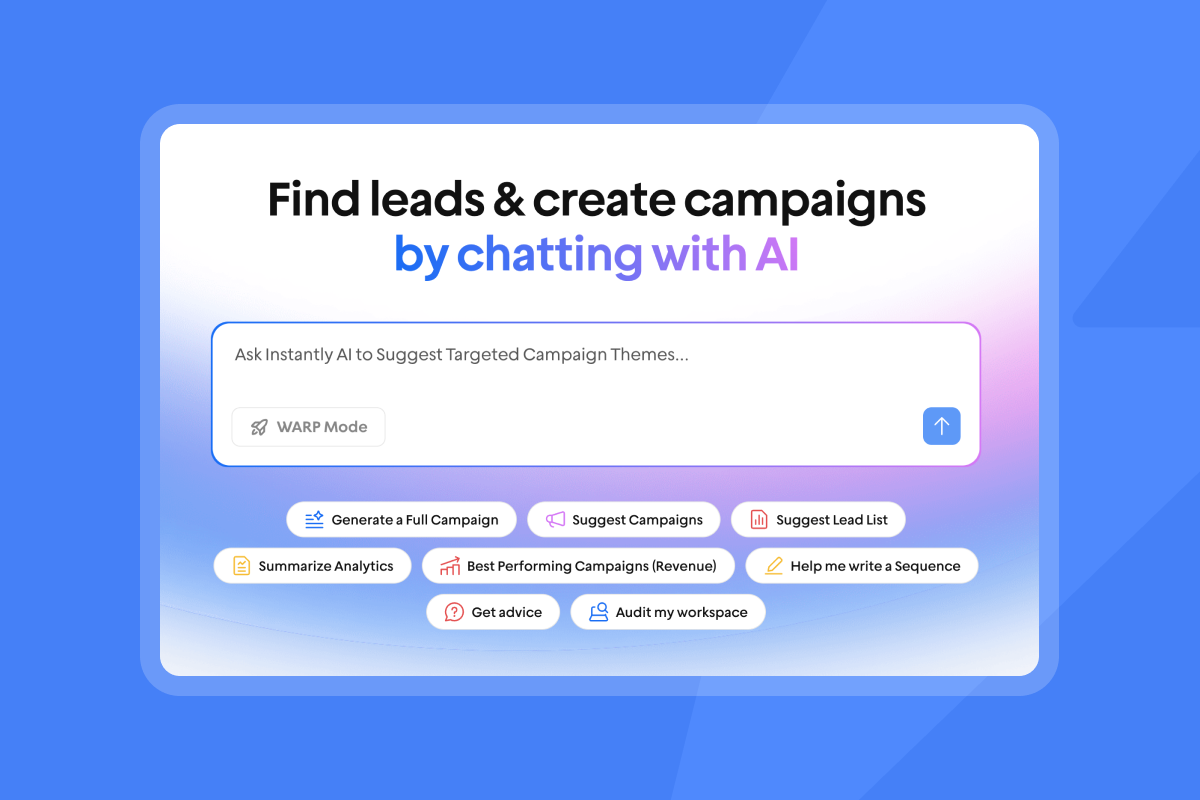
Manual reply triage is the biggest time sink for a solo founder running outbound. Unibox NLP auto-classifies replies across 50+ languages so you see only the warm leads that need action. The AI Reply Agent handles replies in under 5 minutes at 5 Instantly Credits per reply.
Interest reply handler
Use when: lead replied with soft interest, no commitment
A lead replied: "[Exact reply text]". They seem interested but have not committed. Write a reply that moves them to a 15-minute call. Under 80 words. One clear ask at the end.
Positive-signal qualification
Use when: lead replied positively and you need to qualify
Write a qualification email for a lead who replied positively about [topic]. Uncover budget range, timeline, decision process, and current solution. Frame as 2-3 natural questions. Under 80 words.
Meeting-booking reply
Use when: lead confirmed interest and needs a time slot
A lead said they are interested. Write a reply offering 2 specific time slots [Day 1 at Time / Day 2 at Time] and a Calendly link placeholder. Under 50 words. Plain and direct.
Price-objection reply
Use when: lead pushed back on price
A lead said: "This seems expensive." Write a reply that reframes value without discounting. Reference [specific ROI metric or time saved]. Under 70 words. No desperation.
"Not the right time" reply
Use when: lead asked to be followed up later
A lead said: "Not the right time." Write a reply that respects this, plants a seed, and sets a specific follow-up date 60 days out. Under 60 words.
Lead-scoring brief
Use when: you need to prioritize a batch of replies
A lead replied: "[Exact reply text]". Score this reply 1-5 on buying intent based on: timeline language, budget signals, and question specificity. Explain your score in one sentence. Under 50 words.
Priority-tier sorting
Use when: you have 10+ replies and need triage
I have 10 replies this week: [paste reply summaries]. Sort them into three buckets: Book now, Nurture, and Close. List each lead by name and bucket. Under 100 words.
Final breakup email
Use when: lead has not replied after 5 touchpoints
Write a final breakup email for a lead who has not replied after 5 touchpoints. No guilt. Give them a clear way to re-engage if the timing changes. Under 50 words. Plain text.
Instantly's Out-of-Office Resume feature detects out-of-office auto-replies, extracts the return date, and resumes sending automatically on all plans, so you never need a prompt for this step.
Mastering client discovery with LLM sales scripts
Discovery is where most founders lose deals they should close. Use these prompts to build call agendas, identify buying personas, and surface the needs that turn a curious reply into a signed contract.
"I love using Instantly for email outreach as it significantly saves me time by simplifying the process of finding leads and sending emails efficiently." - Azan on G2
Pre-call research brief
Use when: 24 hours before a discovery call
I have a discovery call with [First Name], [Title] at [Company]. Research their company using: [paste LinkedIn about, website copy, or news]. Give me a 5-bullet brief on their business, goals, likely objections, and 2 smart questions to ask. Under 150 words.
Pre-call objection prep
Use when: you know the likely objections and want scripted responses
I am meeting with [Title] at [Company]. My offer is [offer]. List the 3 most likely objections they will raise and a one-sentence response to each. Under 120 words.
Stakeholder map
Use when: selling into a company with multiple buyers
[Company Name] is a [size] [industry] company. Map the likely stakeholders involved in purchasing [product category]: economic buyer, technical evaluator, and end user. For each, list their primary concern. Under 100 words.
BANT qualifier
Use when: converting discovery questions into natural conversation
Turn these into natural conversation for a [Industry] [Title]: Budget ("Is this funded or exploratory?"), Authority ("Who else weighs in?"), Need ("What's the cost of doing nothing?"), Timeline ("When do you need this live?"). Conversational tone. Under 100 words.
Discovery call agenda
Use when: standardizing your call structure across all reps
Write a 20-minute discovery call agenda for a [Title] at a [Industry] company who responded to an email about [topic]. Include: intro (2 min), their goals (8 min), our fit (5 min), next steps (5 min). Under 150 words.
Post-call summary email
Use when: sending a follow-up within an hour of the call
Write a post-call summary for a call with [First Name]. We discussed: [3 bullet notes]. Agreed next steps: [next steps]. Under 80 words. Professional and warm. Subject line included.
Multi-stakeholder variants
Use when: adapting one pitch for three different buyers
Write 3 versions of the same cold email pitch for: the CFO (focused on cost and ROI), the VP of Sales (pipeline and speed), and the Operations Manager (process and reliability). Each under 70 words. Same offer, different angle.
Closing techniques for high-intent replies
For setup and campaign launch guidance, watch the Instantly AI Sales Agent setup guide for a walkthrough of the full configuration from ICP to first send.
Outcome-led proposal opener
Use when: opening a proposal document or email
Write a 3-sentence proposal introduction for [Company Name]. Lead with the outcome we promise: [outcome]. Follow with the timeline: [timeline]. Close with the investment: [price]. Under 70 words.
Case study bridge
Use when: connecting a past win to the prospect's situation
We helped [Similar Company] achieve [outcome] in [timeframe]. Write a 2-sentence bridge connecting this result to [Prospect Company]'s situation. Under 40 words. Direct and specific.
Board-ready summary
Use when: prospect needs to share your proposal internally
Condense this proposal into 5 bullet points a non-technical executive can share with their board: [paste proposal]. Each bullet under 20 words. Focus on business outcomes, not features.
Risk-mitigation summary
Use when: prospect raised 3 specific objections
Write a 3-bullet "why now, why us, why this price" summary for [Company Name]. Each bullet addresses one stated objection: [objection 1], [objection 2], [objection 3]. Under 80 words.
ROI calculator narrative
Use when: prospect wants to see the numbers
[Company Name] currently spends [X hours/month] on [manual process]. Our product reduces this by [percentage]. At [their hourly cost], this saves [$amount] per month. Write a 3-sentence ROI narrative for a proposal. Under 70 words.
Flat-fee vs per-seat rebuttal
Use when: prospect is comparing you to a per-seat competitor
A prospect compares us to a per-seat competitor at [Competitor price per seat]. We charge [your flat fee] for unlimited users. Write a 3-sentence rebuttal that shows the math for a [team size]-person team without attacking the competitor. Under 70 words.
Value-over-price redirect
Use when: prospect says your price is higher
A lead said our price is 20% higher than a competitor. Write a reply that redirects from price to outcome: [specific outcome]. Under 60 words. No discounting.
Deal-revival email
Use when: a deal has been stalled for weeks
A deal stalled for [Duration]. Last communication was about [topic]. Write a 3-sentence re-engagement email that references something new: [feature / case study / industry news]. Under 70 words.
Champion-coaching email
Use when: your internal champion needs to sell this upward
My champion at [Company] needs sign-off from [Stakeholder Title]. Write a 5-bullet email they can forward internally to make the case. Each bullet under 15 words. Business-outcome focused.
AI scripts for churn prevention and renewals
These prompts help you build onboarding sequences, renewal emails, and upsell conversations that keep clients without hiring a customer success manager.
Day-1 welcome email
Use when: customer just signed up
Write a day-1 onboarding email for [Customer Name] who just signed up for [product]. Their goal is [stated goal]. Include: 3 first steps, one helpful resource link, and a check-in invite for day 7. Under 100 words.
Milestone celebration
Use when: customer just hit a key milestone
[Customer Name] just reached [milestone]. Write a 3-sentence congratulations email that reinforces the value of the milestone and suggests the next step. Under 60 words.
At-risk re-engagement
Use when: customer hasn't logged in for 21+ days
[Customer Name] has not logged in for 21 days. Write a re-engagement email that asks one question about what blocked them and offers one specific help resource. Under 60 words. Warm, not alarming.
QBR preparation brief
Use when: preparing for a quarterly business review
Write a QBR brief for [Customer Name]. Include: results vs. goals, top 3 wins, one gap to address, and 2 goals for next quarter. Under 150 words. Bullet format.
60-day-out renewal email
Use when: contract renews in 60 days
[Customer Name]'s contract renews in 60 days. Write a renewal email that opens with their top result from the past year: [result]. Offer to set up a review call before renewal. Under 80 words.
Champion-led renewal ask
Use when: champion needs to build internal support for renewal
Write a renewal email for my champion at [Company] to share with [Approver Title]. 5 bullets summarizing value delivered. One clear ask. Under 100 words.
Usage-based upsell trigger
Use when: customer is near their plan limit
[Customer Name] has used [X%] of their [plan limit] this month. Write a 3-sentence upsell email that connects their usage to the next plan's benefit. No pressure. Under 60 words.
Referral ask after renewal
Use when: customer just renewed and is happy
[Customer Name] just renewed. Write a referral request email that thanks them, summarizes their result, and asks if they know one person who would benefit. Under 60 words. Low pressure.
Essential rules for AI sales prompt success
A sales prompt library is only as strong as the discipline you apply to it. The AI Spam Words Checker flags language that triggers spam filters before you send, which removes the most common failure mode for AI-generated copy. Instantly's 2026 benchmark report found that consistent senders see higher replies (15-20% more) than sporadic ones, so your prompt output needs to sound like one consistent brand voice.
Feed your LLM relevant lead details. Every prompt should include the lead's title, company, trigger event, and your one-sentence offer. A prompt with no context is the fastest way to robotic AI copy, because the LLM fills information gaps with averages, not specifics.
Context injection template
Before running any sales prompt, paste this context block: "Lead: [First Name], [Title] at [Company]. Company: [Industry], [Employee Count], [Revenue Range]. Trigger: [Trigger event]. My offer: [One sentence]. Proof: [One customer outcome]. Word limit: [X words]. Tone: [Direct/conversational/formal]." Then run the prompt.
Train LLMs to mirror your company voice. Provide 2-3 examples of your best-performing emails as few-shot examples in the system prompt. This trains the model on your sentence length, formality level, and how you handle objections.
Voice calibration system prompt
System prompt: "You write cold sales emails for [Company Name]. Our voice is [adjective 1], [adjective 2], [adjective 3]. We never use [banned phrases]. We always [positive constraint]. Here are 3 examples of our best emails: [Paste emails]. Match this style exactly."
Improve reply rates with A/Z tests. All Instantly Outreach plans include A/Z testing. Hypergrowth ($97/mo) and above support up to 26 variants per step. Use the prompts below to generate test variants, then measure results in the Account Analytics dashboard.
Subject line A/Z generator
Use when: you have one subject line and need variants
I want to A/Z test my subject line. Current: "[Subject]". Write 5 variants that each test: length, personalization, benefit, curiosity, and pattern interrupt. Each under 8 words.
Prompt performance audit
Use when: monthly review of sequence results
I ran 3 email variants last month: Variant A [rate], Variant B [rate], Variant C [rate]. Analyze what drove the difference based on subject line, opening line, and CTA. Recommend 3 changes to test next month. Under 150 words.
Deliverability red-flag check
Use when: before activating any AI-generated sequence
Review this email: "[Paste email]". Flag any phrases that could trigger spam filters, sound AI-generated, or reduce inbox placement. List each flag and suggest a replacement. Under 100 words.
Full sequence audit
Use when: quarterly review of your active sequences
Review this 4-step sequence: [Paste sequence]. Score each step 1-5 on: personalization, clarity, call to action strength, and length appropriateness. Recommend one change per step. Under 150 words total.
Brand-voice stress test
Use when: before scaling a new prompt to 1,000+ sends
Read these 3 AI-generated emails: [Paste emails]. Identify any phrases that sound unlike a human founder writing to a peer. List them and suggest replacements. Under 100 words.
Per-seat platforms offer strong outreach tooling with broader social touchpoints, but costs scale linearly as your team grows. Instantly's Outreach Growth plan at $47/month includes unlimited email accounts and warmup, which means a 5-person team pays the same as a solo founder and margins stay intact as you scale pipeline.
| Cost item | Typical per-seat platform | Instantly flat-fee |
|---|---|---|
| Platform (5-person team) | Varies by team size (per-seat pricing scales with headcount) | Outreach Growth ($47/mo, unlimited accounts) |
| Lead data | Separate tool required (cost varies by provider) | $47/mo (Instantly Credits Growth, powers SuperSearch) |
| AI agents | Add-on or unavailable | $9-197/mo+ (Instantly Credits: Nano to Hyper Credits) |
| CRM | Separate add-on (cost varies by provider) | $47/mo (Growth CRM) |
| Total monthly (starter stack) | Varies (platform + separate lead data + CRM add-ons stack quickly with per-seat pricing) | From $141/mo (monthly billing: Outreach Growth + Instantly Credits Growth + Growth CRM) |
Start your free 14-day trial at Instantly, paste any prompt from this library into the AI Sequence Writer, and generate a 4-step sequence from your offer and audience inputs. No credit card required. The trial includes 250 uploaded contacts and 1,000 emails so you can test the full motion before committing.
FAQs: AI prompts for sales teams
What are the best AI prompts for sales teams?
The best AI prompts for sales teams combine role, lead context, and a word count ceiling in one input. Instantly's 2026 benchmark report shows top senders keep emails under 80 words and run 4-7 step sequences, so every prompt here includes those constraints.
Do these prompts work with any LLM?
Yes, these prompts work with ChatGPT, Claude, Gemini, and any LLM that accepts system prompts. Instantly's AI Sequence Writer runs prompt-to-sequence generation inside the platform, removing the copy-paste step.
How do you prevent AI-generated emails from sounding robotic?
Provide 2-3 examples of your best emails in the system prompt, cap output at 80 words, and run it through the AI Spam Words Checker before sending. Adding lead title, trigger event, and one proof point prevents generic output.
Does AI-generated copy hurt deliverability?
AI-generated copy does not hurt deliverability if you warm for 4-6 weeks, keep bounces below 2%, and avoid spam-flagged language. BounceShield skips high-risk recipients automatically, and high-bounce auto-pause stops campaigns at 5% bounce rate.
How often should you update your prompt library?
Audit prompt performance monthly and update your ICP prompts quarterly. Replace any prompt producing below 3% reply rates after 1,000+ sends, because your ICP and market shift faster than the annual benchmark report cycle.
Key terms glossary
Warmup: A process that gradually increases send volume on a new or inactive email account to build sender reputation before running campaigns. Instantly's warmup network uses shared pool mechanics and takes 4-6 weeks before accounts reach full sending volume.
Spintax: A technique that rotates words or phrases across emails using {{RANDOM | option1 | option2}} syntax to maintain uniqueness and reduce spam filter triggers. The AI Spintax Writer generates Spintax variants from your existing copy automatically.
Primary inbox: The main inbox folder where business emails land, as opposed to Promotions, Spam, or other filtered tabs. Consistently landing there requires clean list hygiene, low bounce rates, and a warmed sending account.
BounceShield: Instantly's automated feature that skips known high-risk recipients before sending, based on real-time and historical bounce data. The high-bounce auto-pause triggers at a configurable threshold (default 5% after 200 sends) to protect your domain.
Unibox: Instantly's centralized reply inbox that aggregates all incoming replies across unlimited email accounts into one view. Unibox NLP auto-classifies replies by interest level across 50+ languages so you see only the leads that need action.
SuperSearch: Instantly's B2B lead database with 450M+ B2B leads and waterfall enrichment through seven providers. Leads exported from SuperSearch arrive pre-verified, which means no separate verification credit is needed before sending.
Instantly Credits: A separate subscription pool that powers four of Instantly's five AI agents (Copilot, AI Sales Agent at 5 credits per lead, AI Reply Agent at 5 credits per reply, and Lead Finder Agent). The fifth agent, the Deliverability AI Agent, is included on Hypergrowth and above Outreach plans at no credit cost. Credits plans start at $9/month for 150 credits.
Reply rate: The percentage of sent cold emails that receive a response, calculated as (replies / delivered emails) x 100. The platform average is 3.43%, with top-quartile senders reaching 5.5%+ through tight list hygiene and context-dense messaging, per Instantly's 2026 benchmark report.
A/Z testing: Instantly's variant-testing feature that supports up to 26 copy variants per sequence step, with the full 26-variant capability gated to Hypergrowth ($97/mo) and above, allowing you to test subject lines, openers, CTAs, and email length simultaneously against a live sending audience.
Read next
- How to Scale Outbound Sales With Automation Tools: A practical breakdown of the automation stack that lets lean teams run high-volume outbound without adding headcount.
- AI sales agents for B2B company research: the complete guide for outbound teams: How to use AI agents to surface trigger events, map decision-makers, and build contact lists before you write a single email.
- How to Automate Prospecting: A Step-by-Step Guide: A step-by-step walkthrough of building a prospecting system that finds, verifies, and sequences leads with minimal manual input.


