.svg)
%20(1).svg)


Updated October 16, 2026
Hundreds of billions of emails are sent and received daily across the globe. It's no wonder inboxes today feel like a sales pitch parade.
But despite this wearisome state of affairs, B2B cold emailing remains surprisingly effective. Why? Because it combines the personal touch of a phone call with the speed of social media while staying professional and non-intrusive. That said, getting it right is no cakewalk.
While most cold emails today prioritize catchy subject lines and (basic) personalization, truly successful B2B cold emails are built on deeper foundations. Things like understanding prospect pain points, creating meaningful value propositions, and establishing relevance within seconds.
To help you skip the trial and error, this guide breaks down:
- How to write B2B cold emails that prompt responses rather than eye-rolls
- Psychology-backed practices that boost replies and conversions
- Battle-tested templates you can customize immediately
What is B2B Cold Emailing?
B2B cold emailing is when your business reaches out to another company for the first time, usually to start a conversation, pitch an offer, or explore a partnership. It’s a direct way to introduce your product or service to potential clients or collaborators.
But sending a cold email that actually gets noticed takes more than dropping names into a template and hitting send. The days of bulk blasts and generic pitches are over, and rightly so.
Today’s winning approach is all about precision and relevance. It’s sending thoughtfully written cold emails to carefully selected prospects who actually need what you’re offering. The most successful cold emails feel almost uncannily timely, arriving just when a company is wrestling with the exact problem you solve.
What is B2B Email Outreach?
B2B email outreach is the process of using email to start conversations with potential business customers, partners, or decision-makers. It typically involves identifying relevant prospects, finding and verifying their contact information, sending personalized emails and following up over time.
Cold emailing is one of the most common forms of B2B email outreach. Unlike email marketing to an existing subscriber list, cold outreach focuses on reaching relevant prospects who may not already know your business.
Effective B2B email outreach starts with reaching the right people and giving them a relevant reason to respond. Consistent follow-up then helps keep the conversation moving.
How to Do B2B Cold Emailing Right: 5 Expert Tips to Write Stellar Emails
There are countless ways to succeed with cold email outreach, but starting with the basics will help you improve your B2B campaigns and see what works.
Know Your Audience
If you’re sending cold emails to “anyone who might be interested,” you’re doing it wrong. B2B buyers don’t respond to vague pitches. They respond to relevance. And that means narrowing your focus.
So before writing anything, learn who your audience is and what they care about. Dig into their business, their role, the tools they use, and what challenges they’re likely facing.
The more you know, the more you can connect the dots between their goals and your solution. Even exceptional emails fall short if they land in the wrong inbox.
Need help tracking down the right prospects? Instantly.ai can help thanks to its built-in lead database that features over 450 million verified B2B contacts.
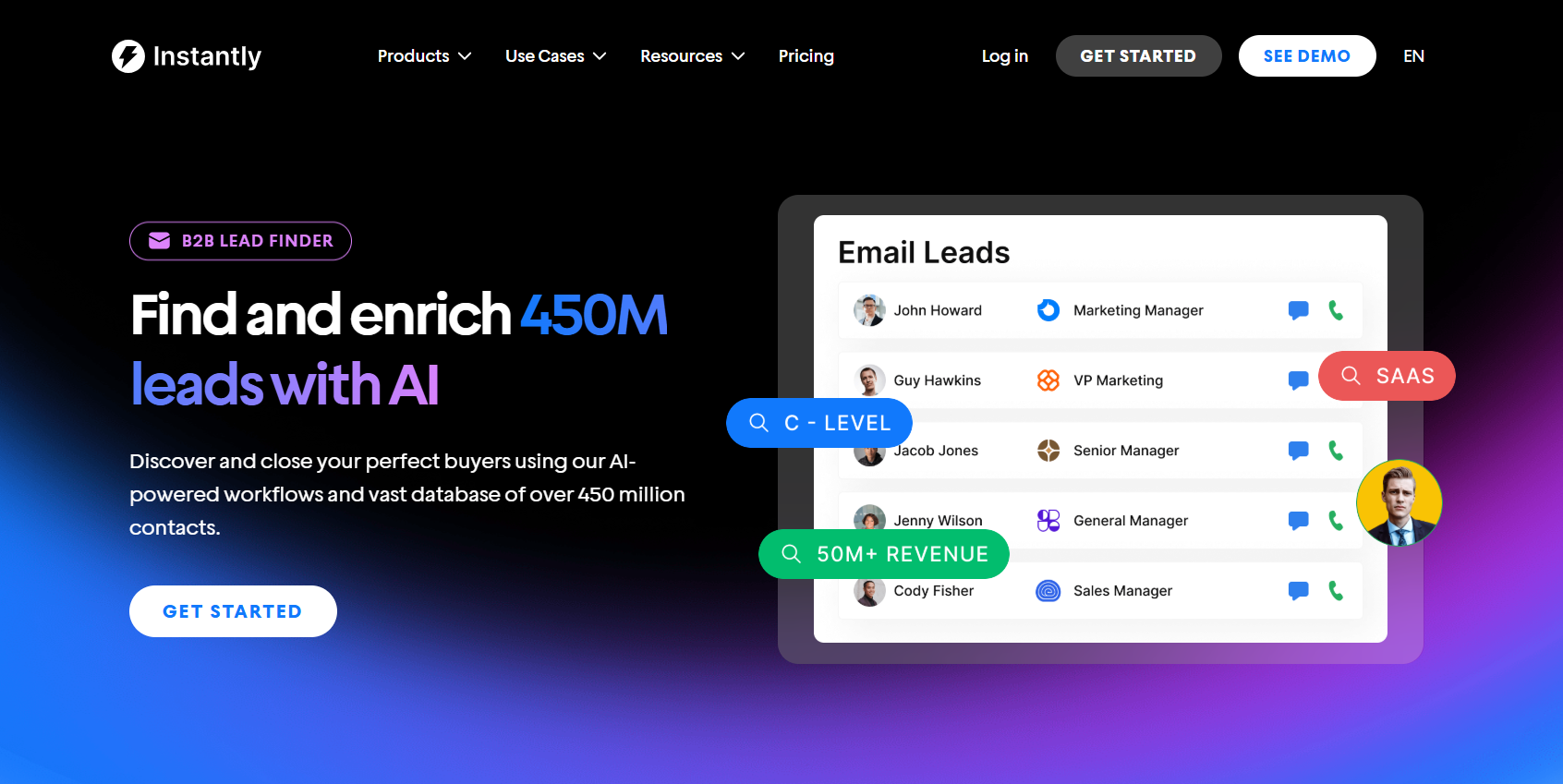
How does it work? You can use any number of advanced filters and combinations to pin down your ideal prospects, including location, title, industry, tech stack, company size, revenue, keywords, and so much more.
With Instantly, you get a faster way to build smarter, tighter lists without wasting hours scraping data. Try Instantly today at zero cost!
Write Engaging Subject Lines
In B2B cold emailing, your subject line is the first impression that decides if your email gets opened or ignored. The perfect subject line needs to grab attention, address a problem, and offer value, all while staying clear and credible.
Avoid being overly flashy or sales-driven. Instead, aim for a subject line that feels authentic and personal. A personalized subject line shows you care and increases the chance it will grab attention.
Keep it short: four to seven words is the sweet spot. Long subject lines risk being cut off in the inbox, and your email might never get opened. Word choice matters too. Avoid terms like “click here” or “make money,” which can trigger spam filters. Your subject line should feel natural, not stuffed with buzzwords.
Share Your Offer and Back It Up
Give prospects a reason to respond to your cold email by focusing on the value your offer provides. If you’ve done your research on your audience and their pain points, use that information to highlight the benefits of your services.
If, for example, a prospect struggles with customer retention, you can point out how your sales CRM software drastically improves retention rates by consolidating customer interactions to help users stay in tune with the buying journey.
That said, it’s important to always back your claims with data or evidence. B2B buying cycles are long (6-12 months on average), and decision-makers do their homework. Include a link to your product or service page so they can easily verify your claims and learn more.
The point is to show, not just tell. You can also use social proof to demonstrate how your services have helped similar companies succeed. Sharing real results builds credibility and proves your value.
Personalize Beyond the Basics
Personalizing B2B cold emails goes beyond adding a name or company. It’s about using deeper insights to make your message relevant and impactful.
Next-level personalization means referencing professional milestones or shared interests. For example, if you’re reaching out to a VP of Marketing, you could say: “As someone leading marketing strategy, balancing brand growth and ROI can be tough. We’ve helped companies like yours achieve both with {{your solution}}.”
You can also use past interactions to add context. For instance, if a prospect attends your webinar, your follow-up email could say: “I saw you joined our webinar on {{topic}} last week. Here’s a report we just published that dives deeper into {{related topic}}. Thought it might help your team.”

Another approach is bringing up industry trends or company news. For example, you could mention: “I read about {{prospect company}}’s new expansion plans. It’s exciting to see growth in your industry! We’d love to share how our solution supports scaling efficiently.”
The best part? Once you've done your research, crafting personalized emails gets easier. Most marketers still don't personalize their cold emails, which leaves you a real opportunity to stand out.
End with a Clear CTA
The call to action in a cold email is often overlooked. Most people focus on subject lines to boost open rates or spend time perfecting the email body. But failing to provide a strong, persuasive call to action can undermine your efforts.
When crafting your CTA, keep these three points in mind:
- Focus on one action: When you give recipients too many choices at the end of an email, they’re less likely to act. Whether it’s booking a meeting, scheduling a call, or replying to your email, stick to a single, clear ask.
- Make it easy to say yes: Asking for a detailed demo might feel overwhelming, but sending over a short case study? That’s low commitment and easy for them to review.
- Align with the buying journey: Your CTA should match where your prospect is in their decision-making process. If they’re ready to buy, send them to the purchase page. If they’re ready for a call, offer a few time slots.
B2B Cold Email Best Practices for Better Outreach
Beyond the structure and design of your email, keep these best practices in mind when sending cold emails to ensure you always hit the mark.
Keep Your Email Short and Concise
The best practice for concise B2B outreach emails is one idea per email, a body under 80 words, paragraphs of two to three sentences, and a single call to action. Instantly's 2026 benchmark report, built on billions of cold email sends, found emails under 80 words earn the best reply rates.
Use two- to three-sentence paragraphs and simple sentences to make your email easy to scan. Most people skim, focusing only on what feels useful to them. Keep it concise, keep it engaging, and make it worth their time.
Test Your Emails for Better Results
Consider A/B testing your B2B cold emails to see what works best. Test two subject lines with the same content to find out which gets more opens. Or experiment with different email layouts or calls to action to see what drives more clicks and responses.
Stay Compliant with Email and Outreach Laws
B2B cold email campaigns need to play by the rules. Make sure you follow laws like CAN-SPAM, CASL, and GDPR. Always include a clear unsubscribe option, your company’s physical address, and accurate contact details.
Avoid misleading subject lines or content. When required, get explicit consent and track opt-ins. Update your privacy policy regularly to reflect how you're handling data. Staying on top of these regulations not only protects your business but also builds trust with your audience.
Don't Forget to Follow Up
Prospects are busy and often forget to respond, even if they plan to. Failing to follow up can mean losing almost every opportunity. Instantly's 2026 benchmark report found first-touch emails generate 58 percent of replies and follow-ups the remaining 42 percent, so skipping follow-ups forfeits close to half your pipeline. Two to three follow-ups, spaced out and each adding something new, is the reliable starting cadence.
Automate Your Email Outreach
Cold email tools save you time by automating outbound campaigns. Instead of sending 100 emails manually, the right software does it all for you. To succeed with cold email marketing, you need a tool that handles every part of the process.
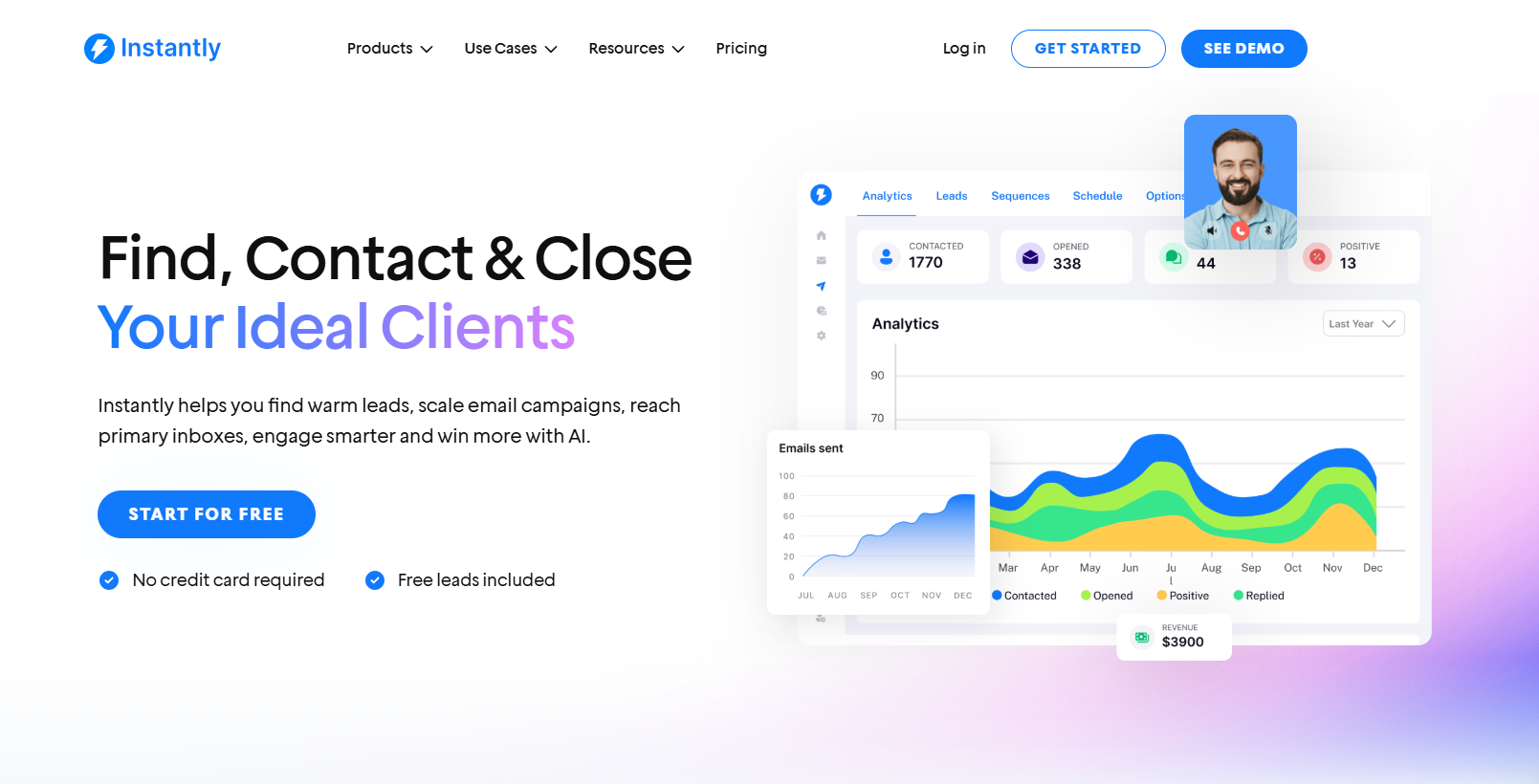
Instantly.ai simplifies it with one dashboard: automating lead generation, scaling personalization, and managing leads across channels.
How to Build a B2B Email Outreach Campaign
A successful B2B email outreach campaign starts well before the first email is written. You need to know who you want to reach, why they are a good fit and whether you have accurate contact information for the right decision-makers.
Build your prospect list around your ICP rather than simply trying to maximize its size. Company size, industry, role, location and buying signals can all help narrow the field. Once you have a list, verify email addresses before sending. Poor quality data can quickly increase bounce rates and undermine deliverability.
Your sending setup matters too. Domains should be properly authenticated, and new inboxes need time to establish a sending history before you increase campaign volume. Scaling gradually gives you a much better foundation than pushing a large campaign through newly configured accounts.
From there, build a sequence around the conversation you want to start. The first email should make the reason for reaching out clear, while follow-ups give you opportunities to approach the same problem from a different angle, add useful context, or reinforce why the conversation is relevant.
Once campaigns are running, look beyond open rates. Replies, positive responses, bounce rates, and deliverability trends give you a clearer picture of what’s working. If performance starts to move, you can then investigate whether the issue sits with the audience, offer, messaging or sending setup.
What Makes a Good B2B Sales Cold Email?
A good B2B sales cold email makes it immediately clear why you’re reaching out and why the conversation is relevant to the recipient. It doesn’t need to explain your entire product or push for a sale in the first message.
Instead, connect your offer to something the prospect is likely to care about and give them enough context to understand why you’re reaching out. Support your message with relevant proof where possible and finish with a simple next step.
The strongest sales emails also sound like they were written for the person receiving them. Personalization should add relevance rather than simply inserting details into a generic template.
5 Proven B2B Cold Emailing Templates
Now that you know how to craft effective B2B emails, let’s talk templates. These templates are simple, proven frameworks designed to help you stand out and get more replies.
However, you still need to personalize them. Research and customization are key to making these templates work. Use them as part of a strategic approach to improve your outbound efforts and drive better results.
Appealing to Pain Points
Hi {{first name}},
Managing {{pain point}} can be a challenge, especially for teams like yours that {{specific characteristic, e.g., oversee multiple projects/sites/domains}}.
That’s why I'm thrilled to offer {{your product}}. It’s designed to {{specific solution}} so you can focus on what matters most without the bottlenecks.
For example, {{customer/competitor/company}} saw {{specific benefit or result}} after adopting our solution, leading to {{specific measurable outcome, e.g., X% growth, improved efficiency in Y area}}.
If you’d like to explore how {{your product}} can help your team, I’d love to set up a quick 10-minute chat to walk you through it. Let me know what works for you, and I’ll handle the rest.
Looking forward to connecting,
Best wishes
{{your name}}
Finding the Company’s Decision-Maker
Hi {{first name}},
I’m curious. Who oversees growth initiatives at {{prospect’s company}}? They’ll want to check out this tool before the end of the quarter. It’s helping teams hit their lead goals faster and save money in the process.
I know your time is valuable, so I’ll keep it short. Here’s what our clients are consistently seeing:
{{benefit 1}}
{{benefit 2}}
{{benefit 3}}
We’re already working with companies like {{client 1, client 2, client 3}}, and I’d love for {{prospect's company}} to see these results too.
If you’re the right person to chat with, what does your availability look like this week? If not, could you point me in the right direction?
Thanks and best regards,
{{your name}}
Providing a Free Offer
Hi {{first name}},
I wanted to share a free tool I think you’ll find super valuable. It’s a quick survey I built specifically for you that helps identify what sets your business apart in {{your city}}.
You can start the survey here: {{insert link}}
Once we connect, I’ll compare your responses to industry leaders nationwide so you can see exactly where you stand and how you can grow.
If, you're open to a quick chat to discuss this, here’s a link to my calendar {{insert link}} so you can pick a time that works best for you.
Looking forward to your thoughts!
Best,
{{your name}}
Establishing Value After Interest Signals
Hi {{first name}},
I noticed you recently showed interest in {{specific resource or topic}}, and I wanted to reach out. I’ve worked with businesses in {{industry/field}} and thought your team at {{company name}} could benefit from what we do.
We help businesses like yours achieve {{specific goal}} through:
{{solution 1}}
{{solution 2}}
{{solution 3}}
If hitting {{specific goal/outcome}} is a priority for you this year, let’s chat. You can grab time on my calendar here: {{meeting link}}.
Looking forward to connecting,
Best regards,
{{your name}}
Re-engaging an Unresponsive Prospect
Hi {{first name}},
I’ve been trying to connect with you to share some ideas on improving {{business needs}} but haven’t heard back yet. That usually means one of three things:
You’ve already got everything covered and don’t need any help.
You’re interested but haven’t had the time to reply.
Something urgent came up, and this just isn’t the right time.
Let me know where things stand. I’m happy to adjust or step back if needed.
Looking forward to hearing from you!
{{your name}}
Why Use Instantly for B2B Email Outreach?
Running B2B email outreach at scale means managing more than the emails themselves. You need a reliable way to find the right prospects, verify their contact details, prepare sending accounts, automate follow-ups and keep track of replies without stitching together several different tools.
Instantly brings that workflow into one platform. You can use B2B Lead Finder to build targeted prospect lists from verified contact data, then move those leads directly into personalized outreach campaigns. Email accounts can be warmed up and rotated as you scale, helping you spread sending volume across your outreach infrastructure rather than relying heavily on individual inboxes.
Once a campaign is live, automated cold email sequences handle follow-ups at scale. From there, you can track campaign performance and use response data to refine your targeting and messaging over time.
For teams running B2B sales cold email regularly, this means less time moving prospect data between tools and more control over the process from prospecting through to reply.
Start your 14 day free trial and see how Instantly makes it easier to run and scale B2B email outreach.
Key Takeaways
Cold emailing still works, but only if your emails are relevant and well-written. Every word matters when reaching out to someone new. Here’s a quick recap of how to do it right:
- Write Emails That Get Replies: Know your audience, craft a strong subject line, and focus on their needs. Add personal details that matter and end with a clear call to action.
- Follow Best Practices: Keep it short, experiment with different versions, stick to email laws, and send follow-ups. These steps boost your chances of hearing back.
- Use Templates Wisely: Templates save time, but they need a personal touch. The ones shared here are proven to work and can be adapted to fit your message.
Ready to improve your cold outreach? For more on this, see our proven cold email templates to book meetings guide. Instantly helps you personalize, automate, and manage your B2B email campaigns—all in one place. Try it for free today!

FAQs About B2B Email Outreach and Cold Emailing
What is B2B email outreach?
B2B email outreach is the process of contacting potential business customers by email to start conversations and create sales opportunities. It typically involves identifying relevant prospects, finding and verifying their contact details, sending personalized emails, and following up with people who fit your ideal customer profile.
Does B2B cold emailing still work?
Yes. B2B cold emailing can still generate replies, meetings, and sales opportunities when the outreach is relevant to the recipient. Results depend on factors such as prospect targeting, contact data quality, deliverability, personalization, and the strength of your offer. Sending generic emails to large lists is far less likely to work than targeted outreach built around a clear ICP.
What are the best practices for B2B cold email?
B2B cold email best practices start with reaching the right prospects and verifying their email addresses before sending. Keep your message concise, explain why you’re reaching out, personalize it around something relevant to the recipient, and finish with a clear call to action. Follow-ups should add something to the conversation rather than simply repeating the first email.
How do you write a B2B sales cold email?
A B2B sales cold email should quickly give the prospect a reason to keep reading. Open with relevant context, connect your product or service to a problem or goal they recognize, and support your offer with credible proof where appropriate. Finish with a simple next step that makes it easy for the prospect to reply without asking for too much commitment upfront.
How many follow-ups should you send?
Two to three follow-ups is a reliable starting point for most B2B campaigns, inside an overall sequence of 4 to 7 steps per Instantly's 2026 benchmark report. Space them out and vary the message so each follow-up provides a new reason to respond rather than sending the same pitch again.
Read Next
- Cold Email Strategy: Go beyond individual emails and learn how to build a cold outreach strategy around your audience, offer, and campaign goals.
- B2B Cold Email Templates: Browse cold email examples you can adapt for different prospects, offers, and stages of your outreach.
- Sales Follow-Up Emails: Learn how to follow up with prospects without simply repeating your original message.


