.svg)
%20(1).svg)


Updated September 22, 2026
TL;DR: AI sales agents for sales enablement programs are process infrastructure, not rep replacements. They add measurable value in three zones: onboarding acceleration, cadence standardization, and auditable process compliance. Instantly.ai's 2026 benchmark report found consistent senders produce 15-20% higher reply rates than inconsistent ones, with a platform average of 3.43% while top-quartile senders reach 5.5% or higher. The difference between average and top-quartile performance isn't the AI itself, it's the governance controls and process discipline around it. This guide gives you a framework for deploying AI sales agents inside your enablement program, setting the right guardrails, and measuring impact without breaking trust in your analytics or deliverability.
AI sales agents for sales enablement programs are the top question in sales leader conversations right now, and most advice in this space tells you to automate everything. The teams who get results automate less, but govern more.
Your reps need faster ramp and consistent cadence. Your CFO needs auditable numbers. AI sales agents can deliver both, but only when you deploy them as governed systems with clear approval workflows and audit trails. This guide gives you the mental model, the evaluation checklist, and the phased rollout plan to evaluate the leading AI sales agents for sales enablement and deploy them well.
What are AI sales agents for sales enablement programs?
AI sales agents execute multi-step sales tasks that static automation can't handle. A traditional sequence fires pre-written messages on a timer. An agentic workflow goes further because the AI reasons across steps, interacts with external tools, and adapts based on outcomes. That means the agent can source leads, write personalized copy, send the sequence, and handle early replies without a rep touching each step manually.
What separates the leading AI sales agents for sales enablement from risky guesswork is whether the agent has memory, planning, and access to the right external systems before it acts. Applied to sales, this means an agent that grounds its actions in CRM data and verified ICP profiles behaves very differently from one running on generic inputs.
Instantly's agent suite covers the full outbound motion. The AI Sales Agent finds qualified leads from 450M+ B2B contacts, writes personalized cold emails, builds multi-step campaigns, and optimizes messaging based on replies (verify current credit cost per generated lead). Copilot acts as your in-app AI assistant, analyzing campaigns, summarizing analytics, and building Automations from natural-language requests. The AI Reply Agent handles inbound replies in under five minutes in human-in-the-loop or Autopilot mode.
The Deliverability AI Agent runs every 24 hours, monitoring DNS health, bounce rates, and blacklist status, then surfaces one-click fixes before a problem reaches your campaign. It is available on Hypergrowth ($97/mo) and above Outreach plans. See all agents in Instantly's AI Agents hub.
Static automation vs. AI sales agents
| Feature | Static automation | AI sales agents |
|---|---|---|
| Lead qualification | Typically rule-based filters | Dynamic ICP matching across 450M+ contacts |
| Sequence writing | Usually pre-written templates | AI-generated, persona-specific copy |
| Reply handling | No built-in reply triage. Replies queue for manual rep action | Classified, drafted, and sent in under 5 minutes |
| Multi-step execution | Linear, fixed schedule | Adapts based on engagement signals |
| Human oversight | No adaptive oversight built in | Human-in-the-loop and Autopilot modes configurable per workspace |
Where AI agents add real value
Three zones consistently deliver reliable results when governed well:
- Onboarding acceleration: New reps run AI-generated sequences while learning the playbook, instead of sending nothing during the first weeks of ramp.
- Cadence standardization: AI enforces sequence structure, timing, and copy rules across every rep, not just top performers.
- Auditable process compliance: Approval workflows and audit logs create a defensible record for CFO review and compliance checks.
AI agents don't close deals or build relationships. While the AI Reply Agent classifies and drafts responses to incoming replies, when a prospect raises a legal concern, asks about enterprise pricing, or signals high intent through a nuanced reply, the rep must step in. Define those handoff points before rollout, not after your first deliverability problem.

Why sales leaders must adopt AI sales enablement tools
The business case for AI sales enablement isn't about replacing SDRs, it's about three measurable outcomes: faster ramp, consistent cadence, and a process that holds up under scrutiny.
Instantly's 2026 benchmark report analyzed billions of cold email interactions across thousands of active workspaces from January 1 to December 18, 2025. Consistent, stable sending patterns produce 15 to 20% higher reply rates than inconsistent patterns. The gap between the 3.43% platform average and the 5.5%+ top-quartile result doesn't come from better AI. It comes from more disciplined process execution.
| Metric | Platform average | Top quartile | Top 10% |
|---|---|---|---|
| Reply rate | 3.43% | 5.5%+ | 10.7%+ |
| Bounce rate threshold | Below 2% | Below 2% | Below 2% |
| Optimal sequence length | 4-7 steps | 4-7 steps | 4-7 steps |
| Email length | Under 80 words | Under 80 words | Under 80 words |
Source:Instantly's 2026 Cold Email Benchmark Report, data covering January 1 to December 18, 2025.
Rapid skill deployment for new hires
Hyperbound's case study with Vanta showed a 60% ramp-time reduction (210 days to 72 days, a cut of roughly 4 months) using AI roleplay certification, well above Hyperbound's cited 6-9 month industry average, though this is one company's result, not a general benchmark. Results depend on program design and guidance rule quality. The AI Sales Agent setup guide walks through configuring supervised modes step by step so new reps build judgment while the agent does the heavy lifting.
How AI agents accelerate rep onboarding
The AI Reply Agent's human-in-the-loop mode functions as a training tool. New reps shadow the AI's draft responses before approving them, which builds reply judgment faster than reading a playbook. The AI Reply Agent's Slack integration sends real-time alerts with reply text and an AI-drafted response preview, so reps can approve or edit from Slack before anything sends. Managers review AI drafts alongside rep decisions, spot pattern errors, and coach to the behavior rather than just the outcome.
Standardizing sales cadences at scale
Inconsistent cadence is a leading cause of reply-rate variance across teams. When each rep builds their own sequence, individual skill determines quality, not team process. The AI Sales Agent supports up to 10 guidance rules that encode your playbook logic directly into agent behavior. Rules like "prioritize leads with funding signals" or "keep emails under 80 words" are custom instructions that direct how the AI Sales Agent writes emails, which means your weakest rep runs the same structure as your strongest.
"I love that Instantly solves one of my biggest problems with outbound sales by integrating multiple tools into one... The AI features, like the AI sales agent for prospecting and the AI reply agent that handles replies automatically, greatly reducing my manual work." - Jonathan R. on G2
For a practical walkthrough of AI agent configuration, watch the Instantly AI Sales Agent webinar which covers setup and approval workflow options in detail.
Risks of AI in sensitive outreach tasks
Unmanaged AI can hurt deliverability and brand trust faster than it builds pipeline. Instantly's 2026 benchmark report sets a clear threshold: keep bounce rates below 2%. Cross that line and your sending reputation degrades regardless of copy quality.
Don't automate enterprise renewals, legal-sensitive outreach, or high-touch negotiations. The failure mode isn't a bad email. It's a damaged relationship that can take weeks to repair and a sending reputation that may take even longer to recover. The boundary is this: AI handles outbound prospecting and early-stage reply triage. Humans handle anything where a mistake costs a deal.
An AI agent that operates without grounding can produce copy that misses account-specific context and hurts your sender reputation over time. Grounding means connecting the agent to CRM context, rep history, and verified ICP data before it writes a word. Connect agents to verified lead data and CRM records before activating any automated sends.
The Out-of-Office Resume feature illustrates the right kind of AI automation: NLP detects out-of-office replies, extracts the stated return date, pauses the sequence, and resumes on that date automatically. Instantly includes it on all plans at no extra cost, making it a low-risk starting point for teams building confidence with AI-driven decisions.
Establishing guardrails for AI sales workflows
Guardrails are what make AI safe to adopt. The governance-first approach means setting rules before you activate automation, not after a deliverability spike.
Sales leader's evaluation framework
Use this checklist to evaluate the leading AI sales agents for sales enablement before approving any deployment:
| Category | What to check | Why it matters |
|---|---|---|
| Audit logs | Does every send, edit, and approval get logged? | Defensible record for CFO and compliance review |
| CRM integration | Do AI actions sync to HubSpot contact records on reply? | Keeps outreach data and pipeline in sync |
| Data privacy and governance | Are contacts verified? Is consent posture documented? | Protects domain and brand reputation |
| Approval workflows | Can you require manual approval before first sends? | Prevents rep-by-rep autopilot drift |
| Deliverability protections | Is BounceShield active? Is warmup complete (4-6 weeks)? | Keeps bounce rate below the 2% threshold |
Role-based governance for AI agents
Define access levels before rollout to prevent two failure modes: over-automation, where reps run Autopilot without oversight, and under-adoption, where reps bypass AI because it feels unsafe.
- Admins: Set guidance rules, configure daily sending limits (recommended at 30 campaign emails per day per email account), and choose Autopilot vs. manual-approval mode at the workspace level.
- Managers: Review AI drafts in Slack before they send and monitor involvement rate and resolution rate data from the AI Reply Agent dashboard.
- Reps: Approve or edit individual replies and review sequence performance at the campaign level. Disable Autopilot mode for new reps until they demonstrate consistent judgment on AI drafts. AI Blocklist Triggers add another layer by automatically blocklisting leads across the entire workspace.
Unsubscribe-based blocklisting is available on all plans. Status- and reply-content-based triggers require Hypergrowth ($97/mo) or above. BounceShield runs by default to skip known high-risk recipients. The Global Blocklist prevents re-importing unsubscribed or bounced contacts. Together, these two features protect your domain reputation without manual oversight.
Before any AI-generated sequence goes live at scale, run two checks. The AI Spam Words Checker evaluates copy for spam-triggering language using contextual AI analysis, not keyword matching. A/Z testing is available starting on the Growth plan, with the full 26-variant capability gated to Hypergrowth ($97/mo) and above, letting you compare AI-generated copy against rep-written alternatives before committing to a sequence.
A sequence that clears both checks and reaches a 5% reply rate in a 200-send pilot is ready to scale. One that doesn't goes back to guidance rule refinement first.
How Instantly compares on governance
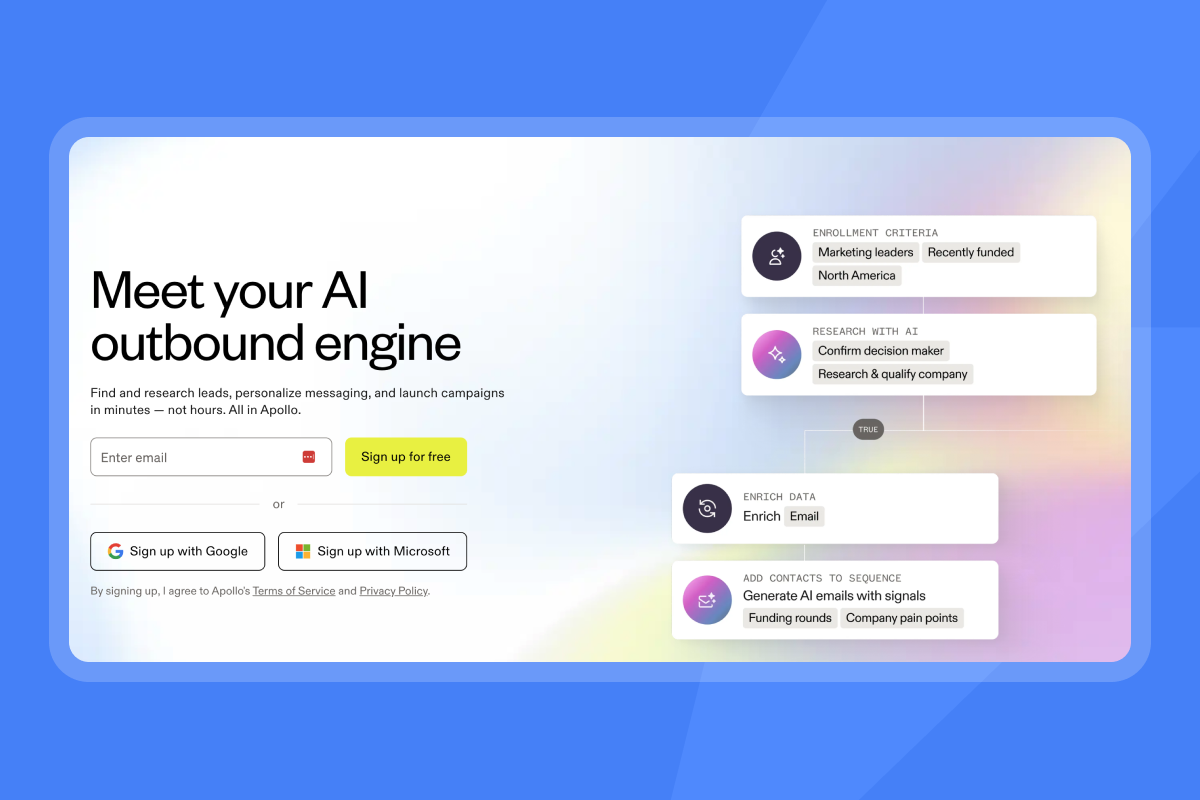
Apollo's strength is in data breadth and all-in-one consolidation. Instantly's approval workflows, human-in-the-loop reply controls, and flat-fee model give you the governance controls you need without per-seat pricing that scales against you as you add reps. Outreach and Salesloft offer deep CRM-native integrations and enterprise-grade sequence controls. Instantly gives you the same human-in-the-loop controls without annual lock-ins or per-seat pricing that compounds with headcount.
| Platform | Human-in-the-loop controls | Approval workflows | Pricing model | Lock-in terms |
|---|---|---|---|---|
| Apollo | Not a primary feature | Rule-based filters | Per-seat | Typically annual |
| Outreach & Salesloft | Available at enterprise tier | Enterprise-grade sequence controls | Per-seat | Annual contracts standard |
| Instantly | Human-in-the-loop and Autopilot modes, configurable per workspace | Manual-approval mode available on all plans | Flat-fee, unlimited accounts | No lock-in, monthly available |
"Their refined SuperSearch feature along with AI Sales agent are the best. Purchased Instantly credits solely for this. Love the experience as of now." - Chinmay on Trustpilot
How to audit AI agent impact on pipeline ROI
Measure process compliance and rep velocity, not just reply rates. A reply rate number that doesn't reconcile with CRM pipeline is a trust problem, not a reporting win.
Cost-per-meeting ROI model
Cost-per-meeting (CPM) is the total cost to generate one held, qualified meeting divided by meetings completed. Use this variable-based model to make AI ROI tangible before presenting to leadership:
| Variable | Example value | Notes |
|---|---|---|
| Outreach plan (Growth) | $47/mo | Unlimited email accounts and warmup (verify current pricing) |
| Instantly Credits (Growth) | $47/mo | Credits for leads and AI agents (verify current pricing) |
| CRM plan (Growth) | $47/mo | Unibox, pipeline, reporting (verify current pricing) |
| Total monthly AI cost | $141/mo | Starter stack illustrative example |
| Meetings set per month | 12 | Based on team performance data |
| Cost per meeting | $11.75 | $141 / 12 |
Use your actual numbers. This model illustrates the formula, not a guaranteed outcome.
Track meetings set, SQLs generated, pipeline coverage, and reply rate at the rep level. Use Instantly's 2026 benchmark figures (3.43% average, 5.5%+ top quartile) as targets, not guarantees.
Reconcile AI outreach data with HubSpot contact records weekly. If Instantly logs a reply but HubSpot doesn't show a contact update, you have a sync gap that will produce reporting errors the moment a CFO runs a pipeline review.
Step-by-step rollout for sales automation
The phased approach reduces risk and creates early evidence of value before you commit the full team.
Phase 1: Validating AI in key sales plays
Pick one outbound play targeting a specific ICP with a defined offer. Run the AI Sales Agent in manual-approval mode, then send enough volume to generate a statistically meaningful sample before you evaluate results. Instantly's BounceShield auto-pauses at a minimum threshold, so let that cycle complete before drawing conclusions.
Success threshold: Reply rate at or above 5%. If AI-generated copy meets that benchmark, move to Phase 2. If it doesn't, refine the guidance rules and rerun before scaling.
Phase 2: Institutionalizing AI sales agents
Roll out to the full team with role-based access configured and document guidance rules in a shared playbook. Run onboarding sessions on human-in-the-loop workflows for reps who haven't used AI Reply Agent before.
Success threshold: Majority of reps using AI-generated sequences while maintaining bounce rates below 2%, per the threshold in Instantly's 2026 benchmark report.
Phase 3: Monitoring for ROI and results
Run a weekly review covering reply rate, meetings set, bounce rate, and credit consumption, then adjust guidance rules based on performance data. If reply rate drops below the platform average of 3.43%, check sequence adherence and bounce rate before changing copy.
Success threshold: Cost-per-meeting trending down quarter over quarter with a metrics chain from AI action to closed revenue that a CFO can verify.
Syncing AI agents with CRM workflows
Connect AI agents to HubSpot using Instantly's native HubSpot Automations. Use bidirectional triggers: HubSpot deal stage changes can initiate Instantly sequences, and Instantly reply events or campaign completions can create HubSpot contacts, tasks, or notes. For Pipedrive, the Pipedrive in Automations connector follows the same bidirectional logic. For other CRMs, the HTTP Request action in Instantly's Automations supports any REST API. This CRM sync keeps outreach data and pipeline data in agreement, which is the foundation of analytics your team can trust.
Try Instantly free and run the Phase 1 validation play with AI Sales Agent in manual-approval mode. Test governance controls and measure reply rate against your current process before you roll it out to your full team. Start your 14-day trial, no credit card required.
FAQs: AI sales agents for sales enablement programs
How do AI sales agents reduce ramp time for new sales reps?
AI agents let new reps run verified sequences from day one while learning the playbook, and Hyperbound's case study with Vanta showed a 60% ramp-time reduction (210 days to 72 days) using AI roleplay certification, though this is one company's result, not a general benchmark. Measure the delta between your pre-AI and post-AI cohorts to validate the gain, because results depend on program design and starting skill level.
What governance controls should sales leaders require before deploying sales enablement AI tools?
Require at minimum: manual-approval mode for all first sends, audit logs of every AI action, role-based access that separates admin, manager, and rep permissions, and CRM sync that updates contact records on every reply event. These four controls create a defensible record and prevent the configuration drift that causes deliverability problems at scale.
How can sales leaders prevent analytics trust issues when using AI sales agents?
Reconcile AI outreach data with your CRM on a weekly basis using Instantly's HubSpot Automations to trigger contact and activity updates on reply. If reply rates in Instantly don't match SQL creation in HubSpot, fix the sync gap before you present numbers to leadership.
Can AI agents replace human coaching in a sales enablement program?
No. AI agents handle repeatable tasks like lead sourcing and early reply triage, but you still need human coaching for complex objections, high-touch negotiations, and judgment calls that determine deal outcomes. The AI Reply Agent's involvement rate and resolution rate metrics surface coaching opportunities, but the coaching itself stays human.
What's a realistic ROI timeline for AI in a sales enablement program?
Most teams see measurable cost-per-meeting improvement within the first quarter of a governed Phase 1 pilot, with full team rollout data available as you scale. Set expectations before launch with a variable-based model (total AI cost divided by meetings set), and apply conservative attribution when presenting to a CFO to avoid overstating AI's contribution.
Key terms glossary
Agentic workflows: Automated processes where AI agents reason across steps, interact with external APIs, and adapt based on outcomes rather than following a fixed rule set. Agentic research distinguishes these from traditional automation by their multi-step decision-making and tool-use capabilities.
Grounding: Connecting AI outputs to real business data such as CRM records, ICP profiles, and rep performance history. Agents that operate without grounding generate generic copy that misses account-specific context and hurts your sender reputation over time.
Human-in-the-loop (HITL): An approval workflow where a human reviews and approves AI-generated actions before they execute. In Instantly, HITL mode on the AI Reply Agent requires rep approval before any AI draft sends, making it a training tool as well as a safety control.
Sequence governance: The set of rules, approval workflows, and audit controls that ensure every rep's outreach meets program standards. This is the mechanism that makes AI output consistent with your playbook across the full team.
Deliverability: The ability of an email to reach the primary inbox rather than spam or promotions folders. This depends on domain health, warmup progress, bounce rate, and sender reputation. The Deliverability AI Agent monitors all four factors every 24 hours.
Ramp time: The period from a new rep's start date to consistent quota attainment. AI agents reduce ramp time by giving new reps live, supervised sequences to run while they learn the playbook.
Cost-per-meeting: The total cost to generate one held, qualified sales meeting, calculated as total investment (tools, data, management) divided by meetings completed. CFOs trust this metric because it connects spending directly to pipeline creation.
Read next
- AI sales agent benchmarks 2026: the complete performance report: How reply rates, sequence length, and bounce thresholds compare across performance tiers, based on data from billions of cold email interactions.
- AI sales agents for B2B company research: the complete guide for outbound teams: How outbound teams use AI agents to pull verified company signals, enrich contact records, and ground sequences in account-specific data before a rep touches a single reply.
- Best AI sales prospecting tools for B2B teams in 2026: A side-by-side comparison of prospecting tools covering lead quality, pricing structure, and deliverability controls so you can choose the right fit for your team size and outbound volume.


