


Updated November 6, 2026
TL;DR: AI sales agents book meetings at low single-digit rates in cold outbound. In inbound-assisted flows, warm replies should convert at higher rates than cold outbound. A practical planning target for an AI SDR is 12 to 15 meetings per month with verified data, 4-7 step sequences, and reply handling that protects deliverability. This is a planning assumption, not a published benchmark, and results vary with reply rate and setup. Reply-to-meeting conversion depends on response speed and lead temperature, so track your own rate to set a baseline. A functional Growth stack (Growth Outreach plus Growth Credits plus Growth CRM) runs about $112.80 per month on annual billing ($47 + $47 + $47 = $141 per month on monthly billing), so at 3 to 10 booked meetings per month the real cost per meeting is roughly $11 to $38 on annual billing.
Sales leaders often ask for a single industry average for AI sales agent meeting booking rates. The rate you should plan around depends on which motion you run. Cold outbound flows, where the agent contacts prospects who have never engaged with your brand, book meetings at low single-digit percentages of contacts reached. Inbound-assisted flows, where the agent handles replies from warm prospects, should convert at higher rates than cold outbound, so track your own rate to set a baseline. This article breaks down benchmarks by motion type, shows how to forecast SQLs from reply data, and gives you the math to report pipeline coverage with confidence.
Targeting ideal AI booking rates for 2026
The AI sales agent meeting booking rate you target depends on lead source quality and sequence design, not agent capability alone.
Cold outbound motions, where the AI agent sources leads and sends initial outreach to contacts who have not engaged with your brand, convert a small percentage of total contacts reached into booked meetings. Instantly.ai's 2026 benchmark report found the platform average reply rate is 3.43%, which means even strong performers see modest booking rates on cold volume.
Inbound-assisted flows, where the AI agent handles replies to inbound leads, demo requests, or warm prospects who have already engaged with your content, should convert at higher rates than cold outbound. The gap versus cold outbound comes from lead temperature. Warm prospects already understand your offer and have signaled intent, so they tend to convert at much higher rates.
Conversion targets for AI sales agents
Set conversion targets based on motion type, not a blended average.
For cold outbound, Instantly's 2026 benchmark report shows top quartile senders reach 5.5% reply rates or higher, and top 10% reach 10.7% or higher. If your AI agent achieves the platform average reply rate of 3.43% on 1,000 sends (34 replies) and converts 15% to 20% of those replies into booked meetings, expect about 5 to 7 meetings per 1,000 sends.
For inbound-assisted flows, track your own rate of qualified replies converting to booked meetings. AI agents handling warm replies with sub-five-minute response times keep intent high and should convert better than slower handling.
Predicting SQL yields from AI leads
AI-booked meetings typically convert to SQL at lower rates than human-booked meetings because AI agents optimize for meeting volume rather than relationship depth. Sales leaders should expect conversion in the lower end of typical B2B ranges and apply conservative assumptions when forecasting pipeline from AI agent output.
To forecast SQLs from AI leads, multiply booked meetings by your meeting-to-SQL conversion rate. If your AI agent books 15 meetings in a month and your conversion rate is 20%, expect 3 SQLs.
Performance gap: AI agents vs. human SDRs
Human SDR output varies by team and segment. Martal cites 12 to 15 qualified meetings per month as the common 2026 benchmark for a fully ramped outbound SDR. An AI sales agent configured with verified data and deliverability monitoring can plan for the same 12 to 15 meetings per month, though that is a planning assumption, not a published benchmark. The meeting volume is comparable, but the cost structure differs sharply.
A human SDR with a realistic total annual cost of $154,800, per Remote Growth Partners' 2026 cost breakdown, is modeled at roughly 80 to 100 meetings per year (the article's scenario estimate, built on a target of 10 qualified meetings per month). That works out to $1,548 to $1,935 per meeting. The total includes salary, taxes, benefits, recruiting, ramp time, tools, management, and turnover. An AI agent on Instantly's Growth plan ($47 Outreach + $47 Credits = $94/month) booking 12 meetings per month costs roughly $8 per meeting in platform fees, though total cost of coordination, AE time, and CRM management must also be factored.
The AI agent handles more volume at lower cost per touch, but the human SDR converts a higher percentage of meetings to qualified opportunities. Most sales leaders run a hybrid motion where the AI agent handles initial outreach and reply triage, and human SDRs handle high-value accounts and complex discovery.
Scaling AI SDR output to hit meeting targets
How many meetings should an AI sales agent book per month? The answer depends on your lead source, sequence design, and deliverability health. A realistically configured AI sales agent paired with verified data, 4-7 step sequences, and reply handling that protects sender reputation books 12 to 15 meetings per month.
Baseline AI meeting performance
A practical planning baseline for a cold outbound AI sales agent is roughly 12 to 15 meetings per month on about 1,800 to 2,200 contacts reached, assuming a 3.43% reply rate and 20% reply-to-meeting conversion (1,800 contacts yield about 62 replies and 12 meetings, and 2,200 contacts yield about 75 replies and 15 meetings). Treat this as a working target rather than a guaranteed floor. Results depend on warmup, list hygiene, and ongoing optimization, so expect them to build gradually. Instantly's 2026 benchmark report cites a 4 to 6 week warmup timeline.
Teams that follow warmup protocols and maintain list hygiene can move reply rates from the platform average toward the top quartile. Instantly's 2026 benchmark report found that consistent, stable sending patterns produce 15% to 20% higher replies. The report does not give a timeline for that progression, so track your own reply rate week over week.
Divide booked meetings by qualified replies over a few weeks to get your rate (for the full method, see how to benchmark your AI sales agent). For example, if your AI agent handles 100 qualified inbound replies in a month and books 30 meetings, your rate is 30%.
Top-tier AI agent booking performance
Track your own numbers for monthly meetings booked and for the share of qualified replies that convert in inbound-assisted flows. What top senders share, per Instantly's 2026 benchmark report, is 4-7 step sequences and bounce rates below 2%. Verified contact data, sub-five-minute reply handling, and deliverability monitoring help you hold those standards.
Top performers combine hyper-relevant subject lines, emails under 80 words, a single call-to-action, and problem-first positioning, per Instantly's 2026 benchmark report. Elite senders (top 10%) achieve reply rates of 10.7% or higher, translating to 20+ meetings per 1,000 sends at 20% conversion.
Instantly's AI Reply Agent responds to lead replies in under five minutes, 24/7. Faster response times keep intent high and improve conversion compared to manual SDR handling at typical multi-hour response windows.
Optimizing sequence length for meetings
Sequence length directly affects meeting booking rate. Four to seven emails is the sweet spot, per Instantly's 2026 Cold Email Benchmark Report, which analyzed billions of cold email interactions across thousands of active workspaces.
The report found that 58% of all replies arrive on Step 1, with Steps 2-4 contributing another 42%. This is why most high-performing sequences stop at 4-7 emails. Beyond that, marginal reply gains do not offset the deliverability risk from increased send volume.
Causes of AI meeting rate fluctuation
AI meeting rates fluctuate because of lead source quality, deliverability health, and reply handling speed. An AI SDR scales whatever offer and buyer list you give it. A weak offer or a loose list turns into more wrong emails, worse deliverability, and meetings that never show.
Poor email deliverability silently kills reply rates, meeting bookings, and revenue. Google's sender guidelines say to target a spam complaint rate below 0.1% and never exceed 0.3%. Instantly's 2026 benchmark report sets the bounce-rate threshold below 2%, and hard bounces above that signal list quality issues and damage domain reputation quickly. Instantly's Deliverability AI Agent monitors DNS health, blocklists, warmup scores, bounce rates, and provider balance, surfacing issues before they tank your booking rate.

Measuring the ROI of automated sales outreach
Cost per meeting exposes whether your AI sales agent motion is working. AI agents deliver meetings at a fraction of the cost of human SDRs, but only if you account for platform fees, credit consumption, and coordination time.
Cost per meeting booked
Instantly's AI Sales Agent costs 5 Instantly Credits per generated lead, and the AI Reply Agent costs 5 credits per reply generated. Instantly Credits start at $9/month for 150 credits and scale to $47/month for 1,500 to 2,000 credits.
On the Growth plan ($47/month Outreach + $47/month Credits for 1,500-2,000 credits), an AI agent sourcing 300 leads and handling 40 replies per month consumes roughly 1,700 credits. Total cost: $94/month. At 12 meetings booked, that is $7.83 per meeting in platform fees.
Compare that to a human SDR. Remote Growth Partners' 2026 cost breakdown puts the realistic total annual cost of an in-house SDR at $154,800 and calculates $1,548 to $1,935 per meeting, based on its scenario estimate of 80 to 100 meetings per year. The AI agent still delivers meetings at a small fraction of that cost. At $7.83 per meeting in platform fees (12 meetings per month), that is about 0.4% to 0.5% of the human SDR figure. The exact ratio shifts with monthly meeting volume, and meeting quality and SQL conversion rates differ.
How much does each SQL cost?
Cost per SQL is cost per meeting divided by meeting-to-SQL conversion rate. If your AI agent delivers meetings at $8 per meeting in platform fees and your meeting-to-SQL conversion is 20%, your cost per SQL is $40 in platform costs. For a human SDR at $1,548 to $1,935 per meeting and 25% meeting-to-SQL conversion, cost per SQL is $6,192 to $7,740.
The AI agent delivers SQLs at dramatically lower cost, even accounting for lower conversion rates. This math holds only if your AI agent books qualified meetings. Sales leaders should apply conservative meeting-to-SQL conversion assumptions when forecasting pipeline from AI agent output.
AI agent vs. human SDR performance
| Metric | AI Sales Agent | Human SDR |
|---|---|---|
| Meetings per month | 12-15 (planning assumption, varies with reply rate and setup) | 12-15 (fully ramped, per Martal) |
| Cost per meeting | $8 (platform fees) | $1,548-$1,935 (scenario estimate of 80-100 meetings per year, per Remote Growth Partners) |
| Reply rate (cold outbound) | 3.43%-5.5% (platform average to top quartile, per Instantly's 2026 benchmark report) | 3%-5% (general cold email benchmark, not specific to human-sent outreach) |
| Meeting-to-SQL conversion | 15%-25% (conservative planning assumption, not a published benchmark) | 25%-40% (planning assumption, not a published benchmark) |
| Ramp time to full productivity | 30-60 days (planning assumption, varies with warmup and setup) | 3-5 months |
Table note: Martal's 12-15 meetings per month is a target benchmark for a fully ramped SDR. Remote Growth Partners' 80-100 meetings per year is a scenario estimate built on a target of 10 qualified meetings per month, not a measured average. The cost-per-meeting row uses it for that calculation only.
The AI agent wins on volume, cost, and speed to ramp. The human SDR wins on meeting quality and conversion to qualified opportunities.
Forecast SQL targets using agent response data
You forecast SQLs from AI agent response data by multiplying reply volume by reply-to-meeting conversion, then multiplying meetings by meeting-to-SQL conversion.
Converting AI replies into booked meetings
Reply-to-meeting conversion depends on response speed. Instantly's AI Reply Agent responds to lead replies in under five minutes, 24/7, keeping intent high while it is still fresh. Manual SDR handling at multi-hour response times lets that intent fade. Track your own reply-to-meeting rate to set a baseline.
To forecast meetings from replies: monthly replies × your reply-to-meeting conversion rate = booked meetings. For example, if your AI agent generates 100 replies in a month and your rate is 20%, expect 20 booked meetings.
Forecasting SQLs from AI meeting rates
Meeting-to-SQL conversion for AI-booked meetings typically runs lower than for human-booked meetings. Sales leaders should plan for conservative conversion assumptions in the 15% to 25% range for cold outbound motions.
A common explanation for the gap is that AI agents focus on getting the meeting booked, while human SDRs build more context before the call. This is a working hypothesis, not a measured finding, so treat the 15% to 25% range as a planning assumption and track your own meeting-to-SQL rate.
Mapping AI booking rates to pipeline goals
Pipeline coverage is the ratio of pipeline value to quota. 3x to 4x pipeline coverage is a common benchmark cited by SaaS investors and boards.
To map AI booking rates to pipeline goals, work backward from your SQL target using conversion rates at each stage. Example funnel for 10 SQLs per month:
- Contacts reached: 7,288
- Replies (3.43% rate): 250
- Booked meetings (20% conversion): 50
- SQLs (20% conversion): 10
- Opportunities (70% of SQLs): 7
- Closed-won (25% of opportunities): 1.75
If your CFO asks how many meetings the AI agent needs to book to hit quota, you have the math.
Optimizing sequences for higher meeting conversion
Sequence optimization is the most effective activity for improving AI meeting booking rates. Small changes in reply handling, ICP filters, and CRM sync compound into meaningful gains.
Improve AI agent response precision
Instantly's AI Reply Agent operates in Autopilot or Human-in-the-Loop modes. Autopilot sends replies automatically. Human-in-the-Loop queues replies for approval before sending.
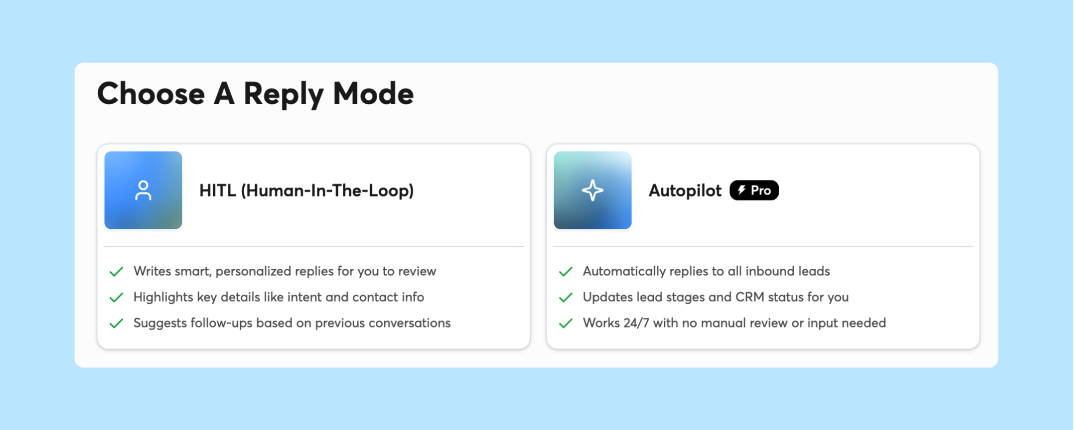
For cold outbound, start with Human-in-the-Loop mode. Review the first 50 AI-generated replies to ensure they match your qualification criteria, then switch to Autopilot for scale.
The AI Reply Agent tracks Involvement Rate and Resolution Rate as named metrics. Involvement Rate measures how often the agent engages with replies. Resolution Rate measures how often the agent's drafted reply is sent without any edits, so it reflects draft quality and sendability, not whether a reply was escalated (see the AI Reply Agent help article). Monitor both metrics in the AI Reply Agent dashboard and optimize guidance rules to keep them high.
Refine ideal customer profile filters
ICP filters determine which leads enter your sequence. Loose filters generate volume but tank conversion rates. Start with firmographic filters (company size, industry, revenue, geography), layer in technographic filters if relevant, and add behavioral filters like recent funding, hiring signals, and leadership changes.
Instantly's Lead Finder includes 450M+ B2B leads with waterfall enrichment across seven providers. The Signals filter surfaces buyer-intent data across social activity, buying intent, growth signals, and company activity, with new signals added weekly.
Test filter combinations in small batches before scaling spend. Compare each batch against the platform average reply rate of 3.43% and the top quartile benchmark of 5.5%+ from Instantly's 2026 benchmark report, and track reply-to-meeting conversion for each batch. Keep scaling the filters that beat the platform average and convert replies to meetings at or above your running average, and cut the ones that lag. Treat these figures as reference points, not guarantees.
Sync AI booking flows with CRM
Instantly's CRM includes Unibox for centralized replies, opportunities/pipeline, tasks and follow-ups, and reporting. Unibox reply capability is plan-gated. Hypergrowth and Light Speed get full in-app reply, while the Growth plan is preview-only, so you must reply from the original email provider. Instantly connects with HubSpot in two ways. The HubSpot lead-import integration is one-way, pulling HubSpot leads into Instantly. Automations covers the two-way flow. HubSpot contact, deal, and task changes can trigger Instantly actions, and Instantly replies and campaign completions can create HubSpot contacts, tasks, and notes.
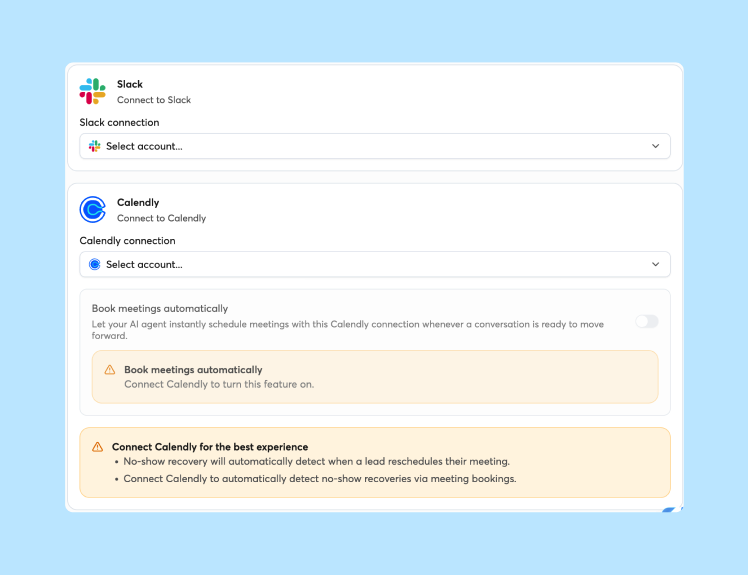
This matters for CFO-level reporting. If your AI agent dashboard shows 50 booked meetings but HubSpot shows 35, you have a data integrity problem. Sync your AI booking flows with your CRM to ensure every meeting, reply, and SQL is tracked in one system of record.
Resolve drop-offs in booking flow
Drop-offs happen at three points: reply to meeting booked, meeting booked to meeting held, and meeting held to SQL.
For reply-to-meeting drop-offs, improve response speed and calendar link friction. Instantly's AI Reply Agent responds in under five minutes. Use a one-click calendar link instead of a multi-step booking form.
For meeting-to-held drop-offs, send calendar invites immediately and include a reminder sequence. Add a confirmation email 24 hours before the meeting with a personal note from the AE.
For held-to-SQL drop-offs, tighten qualification criteria in the AI agent's guidance rules. Instantly's AI Sales Agent supports up to 10 Guidance Rules. Use these to enforce BANT or MEDDIC criteria before booking.
Benchmarks by industry and deal size
AI booking rates vary by industry and deal size because buying cycles, decision-making units, and budget authority differ.
AI booking performance by deal size
Deal size changes the buying process, which is likely to affect meeting-to-SQL conversion more than reply-to-meeting conversion. Smaller deals usually have shorter sales cycles and fewer stakeholders, so the buying process is more transactional. Commonly cited benchmarks put enterprise deals ($100K to $500K ACV) at 6 to 9 months, with more stakeholders involved. Track meeting-to-SQL conversion by ACV tier in your own CRM before you set targets.
For cold outbound, expect similar booking rates regardless of deal size. The variance shows up in SQL conversion. Larger deals require more relationship context, which is where human SDRs outperform AI agents.
Performance metrics for software sales
B2B SaaS companies see the highest AI booking rates because the buying process is transactional and decision-makers are reachable by email. Software buyers respond to product-led messaging, free trial offers, and ROI calculators.
Well-targeted software sequences can aim for the top quartile reply rate of 5.5% or higher, per Instantly's 2026 benchmark report. Track your own reply-to-meeting conversion for this segment to set a baseline. AI SDRs in software sales perform well because the offer is clear, the ICP is defined, and the buying process is repeatable.
Benchmarking service-based AI sales
Service-based sales (agencies, consulting, professional services) see lower AI booking rates because the buying process is relationship-driven. Track your own reply rate and reply-to-meeting conversion for this segment to set a baseline.
The variance is wider in services because offer clarity matters more. A vague offer like "helps companies grow" generates low reply rates. A specific offer like "builds outbound systems that book 20 meetings per month" generates higher reply rates. AI agents work in services when the ICP is narrow and the offer is concrete (see these agency use cases for AI sales agents).
Ready to test these benchmarks with your own ICP and sequences? Start a free Instantly trial. The Outreach trial includes 250 uploaded contacts and 1,000 emails. The Deliverability AI Agent is included in Hypergrowth ($107/month) and above Outreach plans, not in the trial. No credit card required.
FAQs: AI sales agent meeting booking rate
How many meetings should an AI sales agent book per month?
A realistically configured AI sales agent books 12 to 15 meetings per month in cold outbound motions when paired with verified data, 4-7 step sequences, and deliverability monitoring. The 12 to 15 meetings figure is a planning assumption, not a published benchmark. For inbound-assisted AI agents, track your own rate of qualified replies converting into booked meetings.
What is a realistic reply-to-meeting conversion rate for AI agents?
Reply-to-meeting conversion for AI agents depends on lead temperature and response speed. AI reply agents with sub-five-minute response times keep intent high and should convert better than slower handling. Track your own rate to set a baseline.
How do you calculate pipeline coverage from AI agent replies?
Multiply monthly replies by your own reply-to-meeting conversion rate to get meetings. Multiply meetings by your meeting-to-SQL conversion rate (15%-25%) to get SQLs. Multiply SQLs by your average deal size and win rate to get pipeline value, then divide by quota for coverage ratio.
What causes low meeting booking rates for AI SDRs?
Low meeting booking rates come from poor lead quality, weak offers, deliverability issues, and slow reply handling. An AI SDR scales whatever offer and buyer list you give it. Bounce rates above 2% and spam complaints above 0.1% kill booking rates before your copy gets a chance.
Key terms glossary
Reply-to-meeting conversion: Reply-to-meeting conversion is the percentage of email replies that convert to booked meetings. For both cold outbound and inbound-assisted flows, track your own rate to set a baseline.
Meeting-to-SQL rate: Meeting-to-SQL rate is the percentage of held meetings (meetings that actually took place) that convert to sales-qualified leads. It is separate from the booked-to-held rate, which tracks how many booked meetings are attended. Plan for 15% to 25% on AI-booked meetings and 25% to 40% on human-booked meetings (both are planning assumptions, not published benchmarks).
Pipeline coverage: Pipeline coverage is the ratio of qualified pipeline value to quota. 3x to 4x coverage is a common benchmark cited by SaaS investors and boards, meaning $3 to $4 in pipeline for every $1 of quota.
AI sales agent: An AI sales agent is software that sources leads, writes and sends sequences, handles replies, and books meetings without human intervention. Instantly's AI Sales Agent costs 5 credits per generated lead and supports manual-approval or full Autopilot modes with configurable daily sending limits from 10 to 10,000 emails per day.
Read next
- AI sales agent use cases for lead generation agencies: See how agencies use AI sales agents to generate leads and book meetings for their clients.
- What is an AI sales agent? Definition, capabilities, and limits: Learn what an AI sales agent does, what it can handle, and where human reps still need to step in.
- AI sales agents vs traditional sales training software: what's actually different?: Compare how AI sales agents and training software differ in purpose, workflow, and the results you can expect.


