.svg)
%20(1).svg)


Updated July 13, 2026
TL;DR: The best AI BDR tools combine unlimited sending accounts, built-in warmup, and human-in-the-loop approval to protect domain health while scaling volume. Instantly.ai's 2026 benchmark report puts the platform average reply rate at 3.43%, while top-quartile senders reach 5.5%+ through consistent, disciplined sending patterns. Per-seat pricing compounds fast. At 15 reps, Apollo's Professional tier runs approximately $14,220 per year at annual billing ($79 per seat per month) versus Instantly's Hypergrowth plan at approximately $931.20 per year at annual billing ($77.60 per month). Never send more than 30 emails per single inbox per day. Add warmed inboxes to increase total volume safely. Instantly's AI Sales Agent, AI Reply Agent, and Copilot run on a separate Instantly Credits subscription starting at $8.10/month on annual billing, giving you usage-based control over AI spend.
Most sales leaders focus on how fast an AI BDR tool writes copy. The real bottleneck is whether that copy ever reaches the primary inbox. Our complete guide to AI BDR covers the fundamentals before you compare vendors. Fully autonomous AI agents that send unapproved emails are a liability for B2B brands, and the benchmark data points to human-in-the-loop systems as the safer path to scaling outreach without burning domain reputation.
This guide compares the five leading AI BDR platforms, breaks down their pricing models, and helps you choose a deliverability-first system that protects your domains while booking consistent meetings. This guide is written for heads of sales and RevOps managers at 20 to 200-person B2B companies who are evaluating AI BDR platforms for a team of 3 to 15 reps.
Core capabilities of modern AI BDR software
The term "AI BDR" covers a wide range, from fully autonomous agents that prospect, write, and send without human review, to AI-assisted platforms that augment your existing SDR workflow. The distinction matters more than most vendors admit.
Fully autonomous systems promise zero manual effort. The trade-off is that you hand over brand voice, compliance decisions, and domain reputation to a system you cannot audit. In cold outreach, this means an AI agent could send a fabricated case study to a high-value prospect and you would not know until the reply arrived.
Human-in-the-loop (HITL) systems keep a rep or manager in the approval chain before high-stakes sends. They trade some speed for brand safety and auditability, one of the key differences between AI BDR and human BDR workflows. For B2B teams where a single reply from a target account can open a six-figure deal, that trade-off is worth it.
Essential AI BDR functional features
Modern AI BDR platforms must handle four jobs: lead sourcing, copy personalization, reply management, and CRM handoff. Any tool that misses one requires you to patch it with a separate product, adding cost and data silos.
Key features to require from any platform:
- Lead database: Verified contacts with multi-provider enrichment to keep bounce rates below 1%.
- AI copy agents: Sequence writing, subject line testing, and reply drafting with human approval options.
- Warmup network: Automated inbox warming tied to a private deliverability network, included in the base price, not sold as an add-on.
- Reply classification: Intent detection that separates "interested," "OOO," "not the right person," and "unsubscribe" automatically.
- CRM sync: Native integration with your existing stack so qualified replies do not sit waiting for manual export.
The AI Sales Agent help documentation covers how autonomous lead sourcing, messaging, follow-up, and meeting booking work inside a single platform at 5 Instantly Credits per generated lead, giving you a direct cost-per-lead line item for reporting.
Measuring cost per meeting outcomes
Vanity metrics like "emails sent" do not survive CFO scrutiny. The metric that matters is cost per meeting booked. Here is the calculation using Instantly's starter stack:
Cost-per-meeting calculation:
- Annual billing software cost: $112.80/month (Outreach Growth + Credits Growth + CRM Growth, each at $37.60/month on annual billing)
- Reply rate at 3.43% across 500 contacts: approximately 17 replies
- Meeting booked rate at 1.5% of 500 contacts (illustrative assumption for this calculation): approximately 7 to 8 meetings
- Cost per meeting: $112.80 divided by 7.5 = approximately $15.04, using the illustrative 1.5% meeting rate assumed above
Top-quartile teams hitting 5.5%+ reply rates per the 2026 benchmark data would generate approximately 27 replies from 500 contacts (5.5% x 500 = 27.5). That is 10 more reply conversations from the same 500 contacts and the same $112.80/month stack. If meetings book at roughly the same rate relative to replies, approximately 44% based on the baseline figures above (7.5 meetings from 17 replies), top-quartile senders convert approximately 12 of those 27 replies into meetings. At the same $112.80/month, cost per meeting drops from approximately $15.04 to approximately $9.40. That is the financial case for investing in deliverability infrastructure: better inbox placement produces more replies, more replies produce more meetings, and cost per meeting falls without adding headcount or increasing contact volume.
Methodology for testing BDR solutions
The four criteria below define what a defensible AI BDR stack looks like. Each one maps to a failure mode that causes teams to miss pipeline targets.
Five platforms were evaluated across four criteria: deliverability infrastructure, pricing transparency, data accuracy, and integration depth. Priority was given to platforms that publish their warmup mechanics, display inbox placement metrics in-product, and offer pricing structures that do not penalize you for adding reps or inboxes.
Email warmup and inbox placement
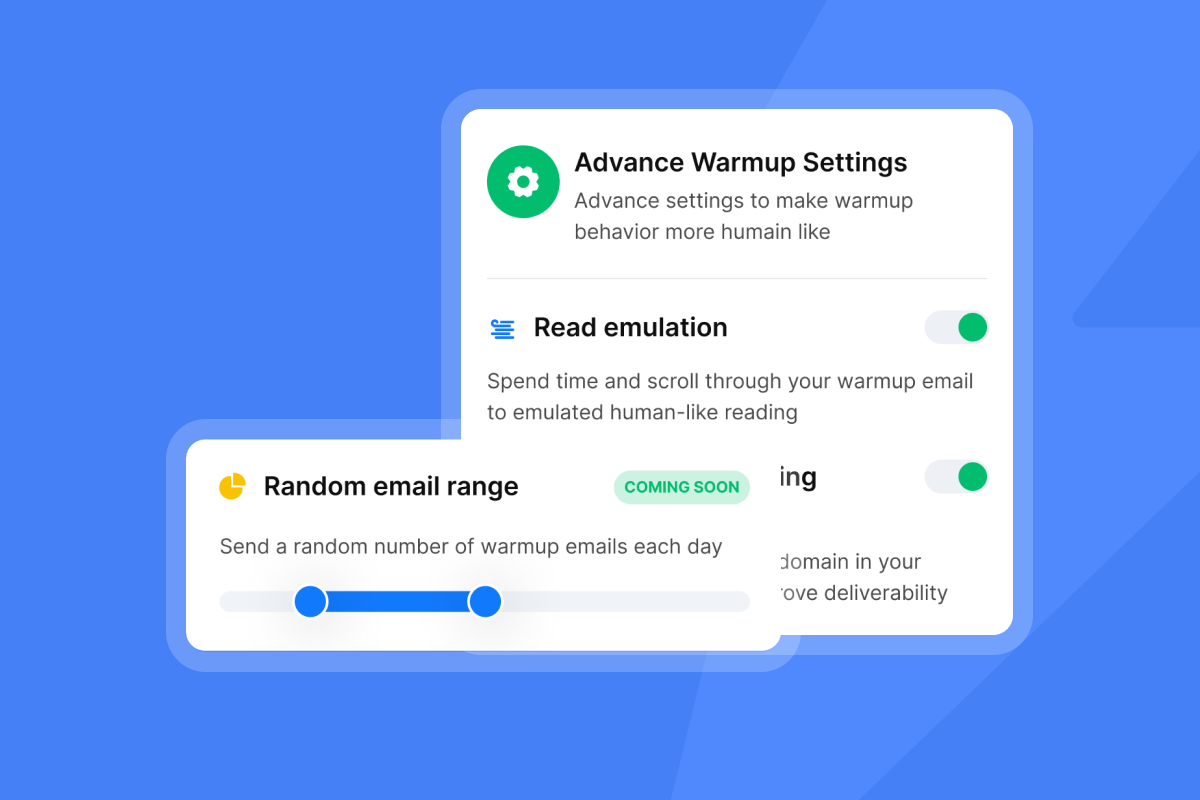
Native warmup must be included in the base price, not sold as an add-on. Instantly uses a private deliverability network of 4.2 million+ accounts for warmup and engagement, which means new inboxes build authentic sending history before your first campaign send.
Automated Inbox Placement tests confirm where an email lands (primary, promotions, or spam) before you commit a full campaign. This catches authentication or content issues before they damage your sender reputation at scale.
Subscription costs and contract terms
Per-seat pricing is a growth tax. Every new rep and every new inbox triggers another line item. At 3 reps on Apollo's Professional tier, you pay approximately $2,844 per year at annual billing rates ($79 per seat per month). At 15 reps, that climbs to $14,220 per year for outreach alone, with no warmup included.
Flat-fee platforms let you add unlimited email accounts across all plans without per-seat charges. The email outreach plans comparison shows how one Growth plan at $37.60/month on annual billing covers unlimited accounts and warmup for your entire team.
Ensuring pipeline data accuracy
Bad data poisons AI personalization at every step. If your AI agent personalizes a message using a stale job title or a defunct company, you waste credits and damage your sender reputation with a bounce. Keep bounce rates below 1% to protect sender reputation with Gmail and Outlook.
How Instantly verifies lead data accuracy
Waterfall enrichment solves the match rate problem by querying multiple data providers in sequence. If provider one lacks a verified email, the system checks provider two, and so on. Waterfall enrichment queries multiple providers in sequence, which increases the likelihood of returning a verified email compared to relying on a single data source.
Instantly built SuperSearch with five-provider waterfall enrichment across 450 million+ B2B leads. Leads are auto-tagged as Verified, Risky, or Invalid, and Risky and Invalid leads are excluded from sending by default so you do not need to manually filter your list before each campaign.

The best AI BDR tools for 2026 compared
Each platform below solves a different infrastructure problem. Match the tool to your team size and operational requirements before evaluating pricing or feature lists.
Comparing top AI BDR software
The five platforms below represent the main architectural choices in 2026. Each solves a different problem, which means the best tool depends on your team size, infrastructure needs, and tolerance for setup complexity.
Platform | Pricing model | Key deliverability feature | Key limitation |
|---|---|---|---|
Instantly | Flat-fee, unlimited accounts | Warmup + Inbox Placement + SISR | AI agents billed separately via Instantly Credits subscription |
Apollo | Per-seat | Warmup and mailbox limits vary by plan | Per-seat costs compound at scale |
Lemlist | Per-seat | Partner warmup network | No flat-fee unlimited account structure |
Smartlead | Usage-tiered | Warmup, rotating IPs | No native lead database or CRM |
Clay | Usage-based | None native | Steep learning curve, no native sending |
1. Instantly: deliverability-first outbound engine
Instantly.ai is a deliverability-first outbound engine with three native AI agents: Copilot (in-app research and campaign creation), AI Sales Agent (autonomous lead sourcing), and AI Reply Agent (inbox management with HITL approval). Unlimited email accounts and warmup are included on every plan.
On annual billing, pricing starts at $37.60/month for Outreach Growth, $77.60/month for Hypergrowth, and $286.30/month for Light Speed (which adds SISR). AI agents and SuperSearch run on a separate Instantly Credits subscription starting at $8.10/month on annual billing. The starter stack covering Outreach (Growth), Credits (Growth), and CRM (Growth) runs $112.80/month on annual billing.
Platform 2: Apollo
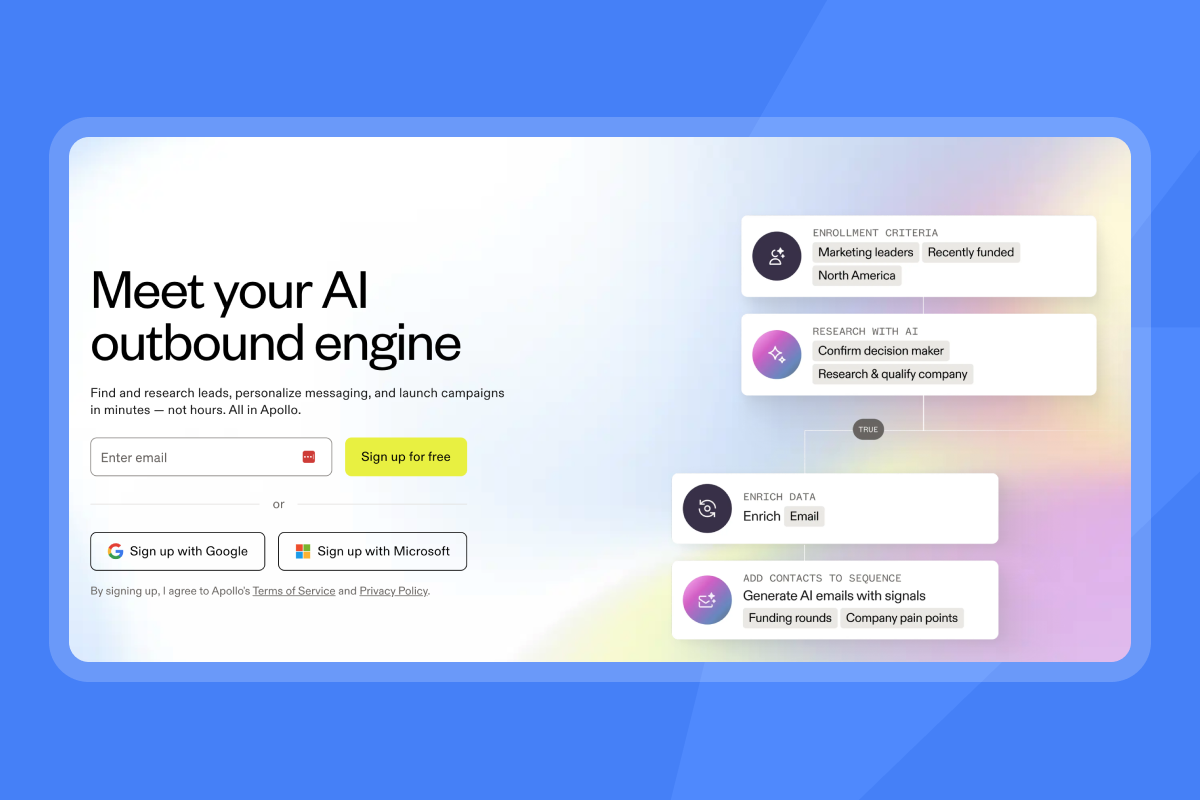
Apollo combines a large B2B database with built-in outreach sequences. Database coverage is wide and CRM integrations are strong. The limiting factor is per-seat pricing.
Apollo's Basic plan is $65 per seat per month (monthly) or $49 per seat per month (annual). Professional is $99 per seat per month (monthly) or $79 per seat per month (annual). At a 10-rep team on Professional with annual billing, that is $9,480 per year for outreach only ($79 x 10 x 12), with no flat-fee warmup infrastructure included. Mailbox caps also limit your ability to spread throughput across multiple inboxes safely. See the Apollo vs Instantly comparison page for a direct feature breakdown.
Platform 3: Lemlist
Lemlist offers strong personalization features including image personalization and video thumbnails, which can improve reply rates on targeted campaigns. Multichannel sequences covering email, LinkedIn, and voice are available on higher tiers.
Lemlist offers two core plans. The Email plan is $55/month on annual billing ($69/month monthly) and covers unlimited users and email senders, a 650M+ leads database, lemAgent AI agents, Deliverability Hub and Lemwarm, and HubSpot, Salesforce, and Pipedrive CRM integrations. It is best suited for founders and small teams running email-only outreach.
The Multichannel plan is $87/user/month on annual billing ($109/user/month monthly) and adds LinkedIn automation (visits, follows, invites, and voice messages), SMS and WhatsApp, a built-in call dialer, and unlimited emails per month. This plan switches to per-user pricing, so cost compounds with team size.
Warmup runs through Lemwarm rather than a private proprietary network. The Email plan's unlimited user structure is a cost advantage for small teams, but the Multichannel plan's per-user pricing model closes that gap quickly as your SDR headcount grows.
4. Smartlead
Smartlead is a strong infrastructure peer with rotating IP support and multi-workspace isolation for agencies. Its Basic plan starts at $32/month on annual billing ($39/month on monthly billing), making it one of the more affordable pure-infrastructure options.
Smartlead lacks a native lead database, so you need a third-party prospecting tool such as Apollo or Clay to source contacts. CRM functionality is limited to inbox and pipeline views rather than a full CRM workflow, so most teams route data to a dedicated CRM via Zapier or API for closed-loop reporting. You are assembling a stack rather than running a single system.
Platform 5: Clay
Clay is the most powerful data enrichment tool in this comparison. It pulls from 150+ data providers, supports conditional logic, and integrates with virtually every outbound platform. For RevOps engineers who want complete control over data pipelines, Clay is hard to match.
Clay does not include native sending infrastructure, so you need a separate email platform to actually send campaigns. Clay's March 2026 repricing moved new buyers to a Launch plan at $167/month on annual billing ($185/month monthly), with Growth at $446/month on annual billing ($495/month monthly). The setup curve is steep, and you need to budget for both Clay and your sending platform.
Key integration and deliverability features
The sections below cover the four integration layers that determine whether pipeline data moves cleanly from first send to closed-won, without leaking into manual handoffs.
Inbox placement and domain health
The single biggest operational risk in AI BDR is burning a primary sending domain through overvolume or poor authentication. The rule is non-negotiable: never exceed 30 emails per inbox per day. To scale total daily volume, add more warmed inboxes and distribute throughput across them.
Use secondary sending domains to protect your primary domain. Set up SPF, DKIM, and DMARC on each secondary domain before warming. Instantly sells pre-warmed domains at $15/year, which shortens the ramp-up timeline. See the analysis of rotating IP algorithms for the technical rationale behind this limit.
"The deliverability tools actually work... We're able to scale our outreach without sacrificing personalization or risking our sender reputation." - Natalie on Trustpilot
Precision in lead intent detection
AI agents must classify at minimum four reply categories: interested, out of office, not the right person, and unsubscribe request. Tools that only detect "positive reply" versus "everything else" create compliance risk. Our AI BDR lead qualification guide covers the full classification framework. Misclassifying an unsubscribe as "interested" and triggering a follow-up damages brand trust and violates CAN-SPAM.
Instantly's AI Reply Agent classifies and handles reply types automatically, including OOO detection, objection handling, and meeting scheduling. The AI Reply Agent help documentation details the Human-in-the-Loop vs. Autopilot configuration, and how the Slack integration lets reps approve, edit, or escalate AI-drafted replies without opening the platform.
CRM and calendar sync capabilities
Data silos between your outreach platform and CRM leak pipeline. A rep marks a lead as "Interested" in the outreach platform, but without a live CRM sync, the AE never sees it, and the opportunity dies in a queue. Native integrations prevent this.
Instantly's native HubSpot integration handles bidirectional sync, with broader connectivity via Clay, Zapier, Make, and Pabbly covered in the integrations hub.
Admin controls and user permissions
Team-level standardization depends on admin controls that prevent reps from going rogue with sequences, send windows, or contact lists. Look for workspace-level settings, campaign approval workflows, and audit logs that show you exactly what sent, when, and from which inbox.
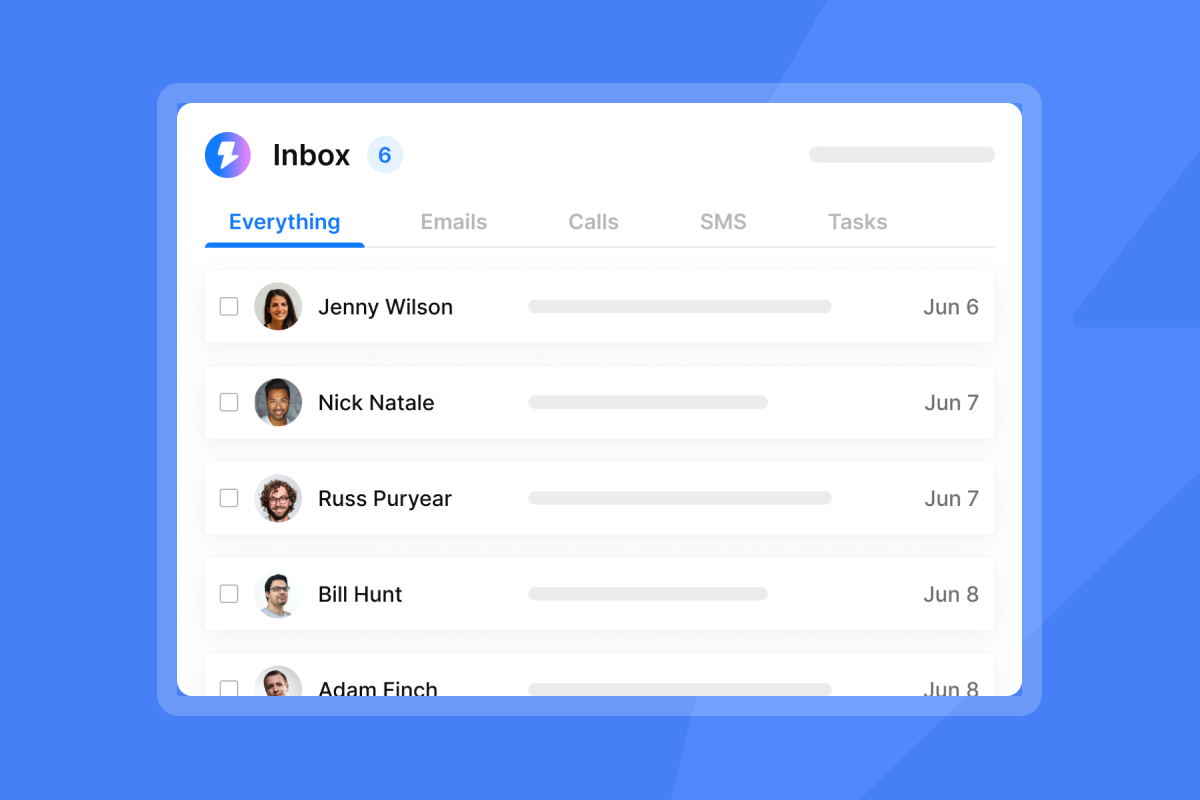
Unibox centralizes all reply management across every inbox your team runs, giving RevOps a single view of pipeline activity without relying on individual reps to keep their own inboxes tidy.
Budgeting for AI sales tools
Pricing models in this category vary enough to change the total annual cost by five figures at 15 reps. The breakdowns below show where the gaps appear.
Licensing models: seat vs. usage
The practical difference between per-seat and flat-fee pricing compounds fast. Here is the annual cost comparison at 15 reps using Apollo's Professional tier at $79 per seat per month on annual billing (or $99 per seat per month on monthly billing) versus Instantly's plans:
Team size | Apollo Professional (annual) | Instantly Hypergrowth (annual billing) | Savings |
|---|---|---|---|
3 reps ($79 x 3 x 12) | $2,844 | $931.20 ($77.60 x 12, flat-fee, unlimited accounts) | $1,912.80 |
15 reps ($79 x 15 x 12) | $14,220 | $931.20 ($77.60 x 12, flat-fee, unlimited accounts) | $13,288.80 |
Hypergrowth covers unlimited accounts at any team size, so the annual cost stays at $931.20 whether you run 3 reps or 15. Teams sending 10,000+ emails daily may want to upgrade to Light Speed at $286.30/month on annual billing for SISR dedicated IP infrastructure, but that is a volume decision, not a headcount one.
At 15 reps, Instantly costs over 93% less than Apollo for outreach alone on annual billing, because the flat-fee does not move when you add reps or inboxes. That gap funds additional SDR headcount or drops directly to the bottom line.
Identifying unpredictable add-on fees
Many platforms charge separately for email warming as a paid add-on, which does not apply to Instantly since warmup is included in every plan at no extra cost. When evaluating other platforms, check whether warmup is bundled or billed per inbox.
Enrichment markups are the second trap to watch for. Some tools charge per row of enrichment at rates that climb quickly on large lists. Instantly bundles lead access and enrichment into the Instantly Credits subscription, so the cost-per-lead is predictable and does not change when you add inboxes.
Contract terms and exit flexibility
Annual lock-ins with auto-renewal clauses are the most common source of billing complaints in this category. Instantly offers a 14-day free trial with no credit card required, and monthly billing is available across all plans. When your trial ends, campaigns and warmup pause automatically rather than triggering an auto-charge, giving you a clear opt-out path.
What top-performing teams achieve with AI BDR tools
Instantly's 2026 Cold Email Benchmark Report covers billions of cold email interactions across thousands of active workspaces from January 1 to December 18, 2025. The data shows a platform average reply rate of 3.43%, a top-quartile rate of 5.5%+, and a top 10% rate of 10.7%+. Consistent, stable sending patterns produce 15 to 20% higher replies compared to erratic volume, which validates the case for disciplined daily send caps.
Wednesday produces the highest reply rates. Monday is the optimal launch day. The best-performing sequences run 4 to 7 steps, and emails under 80 words outperform longer copy.
To filter for meeting quality rather than raw reply volume, set qualification criteria in the AI Reply Agent to automatically tag replies by company size, job title, and buying intent before a rep invests time in follow-up. The AI Reply Agent can include a Calendly booking link when leads express interest, and autonomously book meetings when prospects confirm availability.
Standardized sequence templates, send windows, and follow-up logic across all reps reduce variance and make it easier to diagnose what is working. Start with proven cold email frameworks, then lock your best-performing variants at the workspace level so reps cannot deviate from proven copy.
Vetting AI tools for reliability and scale
Reliability means different things at different team sizes. The three sections below address the specific risk profile for small SDR teams, high-volume senders, and compliance-sensitive buyers.
Prioritizing tooling for small SDR teams
If you manage a team of 3 to 15 reps, you do not need an enterprise suite with a six-month implementation timeline. It needs a platform that ramps fast, standardizes process across reps, and reports at the rep level without requiring a BI team to interpret the data.
The fastest path to first meetings is to set up secondary sending domains, connect warmed inboxes, upload a verified contact list from SuperSearch, and launch a 4 to 7 step sequence with A/Z subject line testing. The Growth Outreach plan includes A/Z testing from the $37.60/month annual billing tier following the January 2026 plan update. The full 26-variant capability is available on Hypergrowth at $77.60/month on annual billing.
Ensuring deliverability at scale
As your team scales send volume toward 10,000+ emails daily, shared IP pools create "bad neighbor" risk that affects your whole team's results, not just one rep's inbox. One poor sender on the same IP degrades your deliverability with no warning. Instantly's SISR technology (Server and IP Sharding and Rotation) on the Light Speed plan at $286.30/month on annual billing addresses this by assigning dedicated, private server and IP pools that rotate automatically. SISR substantially improves inbox placement for high-volume senders compared to shared infrastructure by isolating each IP's reputation so a single throttled IP does not impact your full campaign.
Identifying high-risk vendor traits
Research on AI accountability shows that black-box AI systems create direct compliance exposure: unlike traditional software that logs every decision step, opaque AI cannot produce a clear audit trail, and regulations such as GDPR require businesses to explain automated decisions clearly. As the person accountable for your team's outbound process, GDPR requires you to be able to explain automated decisions. If your AI BDR cannot produce an audit trail, your team carries the regulatory exposure.
Avoid platforms with any of these patterns:
- No manual approval step before AI sends a reply to a prospect
- Hidden token or credit consumption that appears only on the invoice
- No audit log showing which rep sent which email from which inbox
- AI that handles unsubscribe requests by continuing to follow up
- No blacklist monitoring or domain health alerts
- "Guaranteed inboxing" claims without explaining the underlying deliverability system
Key considerations for buying AI BDR software
The decisions that matter most happen before the first send. The sections below cover ramp planning, mid-cycle migration, and ongoing domain monitoring in that order.
Time to value for new sales teams
Use this 30-60-90 day plan to move from manual to AI-augmented outreach without disrupting your active pipeline:
- Days 1-30 (Infrastructure): Set up secondary sending domains with SPF, DKIM, and DMARC. Connect 2 to 5 Google Workspace or Microsoft 365 inboxes. Warm for a minimum of 14 days (30 days is the safer target). Import a verified contact list from SuperSearch. Cap daily sends at 20 to 30 emails per inbox during warmup.
- Days 31-60 (Testing and calibration): Run multiple subject line variants with a minimum of 250 contacts per variant. Below that threshold you cannot distinguish signal from noise. Push toward 500+ contacts per variant when you want high-confidence results before locking a winning subject line as your team-wide default. Test email length (under 80 words vs. longer copy). Configure the AI Reply Agent in Human-in-the-Loop mode so your team reviews AI-drafted replies before send. Monitor bounce rate weekly and pause if it approaches 1%.
- Days 61-90 (Scale and ROI measurement): Ramp to your target daily volume by adding more warmed inboxes rather than increasing per-inbox send counts. Activate automated Inbox Placement tests to catch deliverability issues before they affect live campaigns. Calculate cost per meeting and tie it back to reply rates. Document your winning sequences and lock them as team-wide templates.
Mid-quarter platform migration strategy
Migrating during an active sales cycle carries risk. The safest approach is to run parallel infrastructure for 2 to 3 weeks: keep your existing tool active for campaigns already in-flight while warming new inboxes on Instantly. Once warmup is complete and Inbox Placement tests confirm primary inbox landing, cut over new campaigns to Instantly and let existing sequences on the old platform complete their final steps.
Do not export contacts from your old platform and immediately upload them to a new one without re-verifying. List hygiene deteriorates during any platform transition. Run the full SuperSearch verification pass on any imported list before your first send.
Managing domain health and inbox placement
Domain health requires ongoing monitoring, not just setup-and-forget configuration. Check inbox placement scores weekly during your first 90 days. If placement drops below 80% in primary inbox, pause new sends, run the deliverability audit checklist, and re-verify your contact list before resuming at a lower daily cap.
The AI Deliverability Agent continuously reviews your workspace, campaigns, and sending accounts across DNS health, blocklists, warmup scores, bounce rates, provider balance, campaign copy, and abuse complaints. When it finds a risk, it shows what is affected, why it matters, and what to fix first. You can take supported actions directly inside Instantly, including pausing campaigns, replacing risky accounts, balancing providers, and improving campaign copy. Available on Hypergrowth and above. For the detailed mechanics of scaling safely with secondary domains, the secondary sending domains guide covers domain naming, authentication setup, and ramp schedules.
Ready to test this infrastructure? Start your free trial with no credit card required, then download the 2026 benchmark report to set realistic reply rate targets for your first 90 days.
FAQs
What is the average reply rate for cold email outreach in 2026?
According to Instantly's 2026 benchmark report, the platform average reply rate is 3.43%, while top-quartile senders achieve 5.5% or higher and the top 10% reach 10.7%+. Consistent sending patterns and strict list hygiene are required to reach these benchmarks.
How many emails should an AI BDR send per inbox daily?
Never scale past 30 emails per single inbox per day to protect your domain reputation with Gmail and Outlook. If you need higher total daily volume, add more warmed inboxes and distribute throughput across them rather than pushing any single inbox past the 30-email ceiling.
How long does inbox warmup take before running a cold outreach campaign?
A minimum of 14 days is required, but 30 days is the safer target for cold outreach domains. During warmup, cap daily sends at 20 to 30 emails per inbox. Instantly's private deliverability network of 4.2 million+ accounts builds authentic sending history automatically, so new inboxes earn sender reputation before your first campaign goes live.
What is the difference between Instantly's AI agents?
Instantly offers three distinct agents: Copilot handles in-app research and campaign creation, the AI Sales Agent autonomously sources leads and executes outbound, and the AI Reply Agent manages inbox replies in under 5 minutes with Human-in-the-Loop or Autopilot modes. All three run on the Instantly Credits subscription starting at $9/month, which is separate from Outreach plan fees. For a deeper breakdown of how the agentic sales agent fits into a full-funnel workflow, see our dedicated overview.
How much does a full Instantly stack cost per month?
On annual billing, the starter stack (Outreach Growth + Instantly Credits Growth + CRM Growth) runs $37.60 + $37.60 + $37.60 = $112.80/month. A power-sender stack (Light Speed + Hyper Credits) runs $286.30 + $177.30 = $463.60/month on annual billing.
Key terms glossary
SISR (Server and IP Sharding and Rotation): A deliverability technology on Instantly's Light Speed plan that uses dedicated, private servers and IP rotation to protect sender reputation at scale. It isolates each IP's reputation so that one throttled IP does not impact your full campaign.
SuperSearch: Instantly's native lead generation database containing over 450 million verified B2B contacts with multi-provider waterfall enrichment across five providers. Leads are auto-tagged as Verified, Risky, or Invalid, with Risky and Invalid contacts excluded from sending by default.
AI Reply Agent: An Instantly agent that automatically drafts and sends email replies in under 5 minutes, featuring configurable Human-in-the-Loop approval via Slack or a fully autonomous Autopilot mode. Each reply costs 5 Instantly Credits.
Warmup: The process of gradually increasing daily send volume from a new inbox to build sender reputation with email providers before running full campaigns. A minimum of 14 days of warmup is recommended, with 30 days being the safer target for cold outreach domains.
Instantly Credits: A separate usage-based subscription starting at $9/month that powers SuperSearch lead lookups, Copilot, AI Sales Agent (5 credits per lead), and AI Reply Agent (5 credits per reply). Credits are distinct from the Outreach, CRM, and Website Visitors subscriptions.
Read next
- Cold email subject lines: frameworks and testing: How to write, test, and select subject line variants that improve open rates without triggering spam filters.
- How to write follow-ups for cold leads, warm leads, proposals, and objections: How to structure follow-up sequences across 4 to 7 steps, with guidance on send timing, copy variation, and when to stop.
- How to improve your cold email reply rate: a complete guide: Practical techniques covering list segmentation, personalization, and send-window selection to move reply rates above the platform average.



