.svg)
%20(1).svg)


Updated July 13, 2026
TL;DR: An AI BDR is an autonomous software agent that automates top-of-funnel tasks like prospecting, signal monitoring, and initial outreach. Reps using AI BDRs shift time from list building and manual follow-up to live conversations and pipeline conversion. Scaling that output safely depends on a strict focus on deliverability and multi-inbox infrastructure to protect domain health. Getting this right depends on your deliverability infrastructure: unlimited sending accounts, a large warmup network, and AI reply handling that keeps up with inbound responses at scale.
An AI BDR is an autonomous AI sales agent that automates top-of-funnel sales tasks like prospecting, signal monitoring, and initial outreach. This guide explains how AI BDRs work, what they require to operate safely at scale, and where they fit in a well-governed outbound stack. This guide is written for sales leaders evaluating AI BDR software, with hands-on setup detail included so you can assess deliverability requirements, team governance, and operational fit before committing.
The role of AI in modern pipeline generation
This section covers what an AI BDR prospecting agent actually does, how it differs from a human rep, and why scaling it changes your team's capacity model.
How AI BDR software works
An AI BDR is an AI sales automation agent that executes the core functions of a human business development representative: prospecting, outreach, qualification, and meeting scheduling. The critical distinction is autonomy. An AI BDR personalizes messaging based on prospect data, company news, technographic signals, and prior engagement history without requiring a human to trigger each step.
AI BDRs differ from rule-based sequences because they make real-time decisions about who to contact, what to say, and when to follow up, using machine learning and natural language processing, the same intelligence behind Instantly's AI agents.
The term "AI BDR" describes two different things depending on context, which matters in any 2026 AI BDR tools comparison. The table below clarifies the distinction:
Dimension | Human BDR role | AI BDR software |
|---|---|---|
Definition | Professional who prospects outbound for new business | Autonomous agent automating top-of-funnel prospecting |
Cost | Annual base + commission (varies by market and experience) | Outreach from $47/mo. AI agents run on a separate Instantly Credits subscription from $9/mo |
Daily capacity | ~50-100 activities per day | Scales across unlimited accounts |
Work pattern | Office hours | 24/7 operation |
Scalability | Linear (add reps = add cost) | Flat-fee (scale without per-seat penalties) |
This guide focuses on AI BDR software: the autonomous agents that handle prospecting and initial outreach inside your sales stack.
Scaling sales through AI automation
The core AI BDR automation benefit is productivity recovery, not headcount reduction. Most reps spend the majority of their day on tasks that do not directly generate pipeline: researching accounts, building lists, writing outreach, and logging activity. AI BDR tools are designed to take on the repetitive, top-of-funnel work, which means your reps stop spending mornings on list building and start spending them in qualified conversations.
The shift changes how you think about team capacity. The bottleneck moves from "how many reps can we afford" to "how cleanly can we scale our sending infrastructure." That infrastructure question is what this guide addresses.
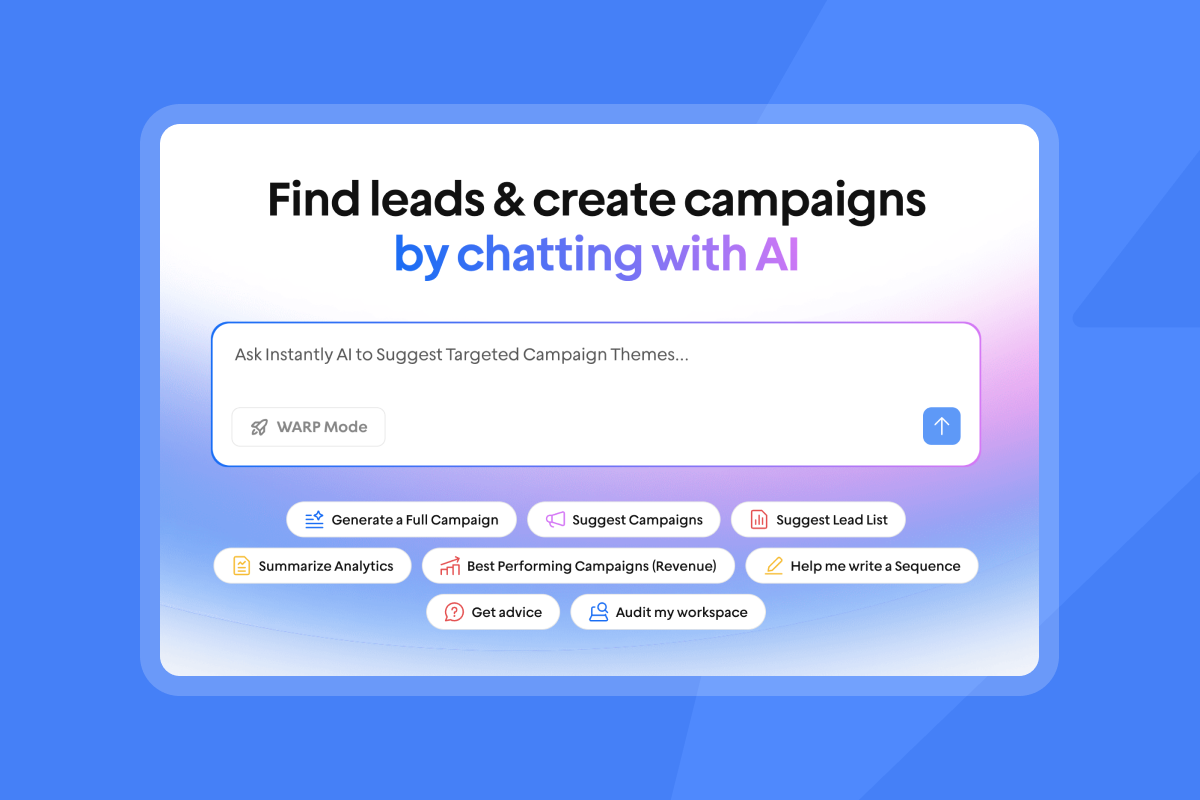
Behind the scenes: how AI BDRs automate outreach
Each stage of the AI BDR workflow relies on a different system. Here is how AI BDRs work at each layer, from list building to reply triage.
Building high-quality lead lists
AI BDRs identify prospects based on signal data: real-time behavioral or market triggers that indicate buying intent. Signal-based selling monitors dozens of signal categories across hundreds of millions of contacts, detecting events like funding announcements, leadership changes, technology adoptions, and job postings.
How AI crafts relevant sales emails
AI copy generation works by combining prospect-level context (role, company, recent signals) with your sequence structure and brand voice guidelines to produce personalized first drafts.
The copy quality ceiling is determined by your sequence structure and email length. Instantly's 2026 Cold Email Benchmark Report, which analyzed billions of interactions from January 1 to December 18, 2025, found that the best-performing campaigns keep emails under 80 words and run sequences of 4-7 touchpoints. A well-structured sequence matters more than any single perfectly written email.
Scaling outreach with delivery health
Most AI outreach deployments fail at the deliverability layer, not the copy layer. Instantly's AI sales agent deliverability system is built to close that gap. You can have the best-written emails in your category, but if they land in spam, reply rates will be zero.
The critical constraint is the per-inbox sending limit. According to Instantly's warmup guidance, you must not scale past 30 emails per single inbox per day to protect sender reputation. Mailbox providers like Gmail and Microsoft judge sender behavior patterns, and sudden volume spikes on a single inbox trigger spam classification.
Distribute sending volume across multiple inboxes, each running its own warmup.
Using secondary sending domains is non-negotiable. Your primary business domain stays protected. Outreach goes out through secondary domains, each warmed separately and each capped at 30 emails per inbox per day.
Automating inbox reply triage
Speed matters once a lead replies. A well-configured AI reply agent should respond within minutes, before the prospect's context has cooled. It operates in two modes:
- Human-in-the-Loop (HITL): The agent drafts a reply. A Slack notification pushes the draft to your team for one-click approval or editing before it sends.
- Autopilot: The agent sends replies automatically once you've validated its accuracy on your messaging and tone.
Start with HITL to calibrate the agent's tone and response logic, then move to Autopilot once you trust the output.
Automating calendar sync and handoffs
The handoff from AI-qualified lead to human AE is where many deployments lose data integrity. A reply classified as "interested" needs to carry full context: the sequence it came from, the signal that triggered outreach, and the conversation thread to date.
Native integrations to your CRM can handle this by syncing lead status, classification notes, and activity history automatically when a positive reply is detected. Direct enrichment platform integrations connect data directly to campaign triggers.

Can AI replace human SDRs in your sales pipeline?
The honest answer depends on use case and infrastructure. These sections cover the real constraints, hidden costs, and the tasks that still need a human, and our AI BDR vs human SDR comparison goes deeper.
Throughput limits for AI outreach
The 30-email-per-inbox limit is your primary scaling constraint. When all sending activity runs through a single IP, mailbox providers flag the pattern as suspicious. If that IP gets flagged, every campaign stops.
Spreading volume across many IPs means a single flag does not bring down your entire outreach operation. See this IP sharding guide for how the architecture works in practice. Scale by adding more inboxes, never by pushing individual inboxes past the 30-email daily threshold.
Hidden costs of AI SDR automation
Software costs for sales teams add up quickly. According to Predictable Revenue, the annual true cost of the SDR tech stack for a 10-person team is approximately $36,120, or about $3,010 per month, before accounting for additional data tools.
Instantly's pricing structure works differently. Outreach plans are priced by volume tier, not headcount:
- Growth: $47/mo (or $37.60/mo annual)
- Hypergrowth: $97/mo (or $77.60/mo annual)
- Light Speed: $358/mo (or $286.30/mo annual), includes SISR
Instantly vs. legacy per-seat platforms
Feature | Instantly | Legacy per-seat tools |
|---|---|---|
Pricing model | Flat monthly fee by tier | Variable per-seat monthly fee (cost scales with headcount) |
Email accounts | Unlimited on all plans | Typically 1-5 per seat |
10-person team cost | $47-$358/mo (same as 1-person) | Typically $3,000-$5,000+/mo estimated |
Warmup network | 4.2M+ private network included | Often requires third-party tool |
Deliverability infrastructure | SISR on Light Speed plan | Varies by vendor |
AI agents, including Instantly's AI Sales Agent Software, run on Instantly Credits, a separate subscription starting at $9/mo. A 10-person team pays the same outreach infrastructure cost as a 1-person team at the same sending volume. A typical starter stack (Outreach Growth + SuperSearch Growth + Growth CRM) runs approximately $141/mo.
Maintaining brand voice at scale
The biggest risk of automated outreach is copy that drifts off-brand or targets the wrong segment. HITL controls are not just a safety net. They are the governance mechanism that keeps your AI agent aligned with your messaging strategy as context changes.
AI BDRs work best on high-volume, signal-based, event-driven campaigns where the prospect population is large and the use case is well-defined. A funding-round trigger campaign targeting 500 recently funded Series B companies is a strong fit. A nuanced sequence targeting your top 20 enterprise accounts typically benefits from human oversight on research, qualification, and relationship-building steps, an area where AI BDRs still fall short.
Use case | Typical approach |
|---|---|
High-volume signal-based outreach | AI BDR |
Low-volume, high-context account outreach | Often benefits from human oversight |
Complex multi-stakeholder deals | Often benefits from human involvement |
Negotiation and objection handling | Can be handled by AI Reply Agent or HITL mode |
Operational requirements for AI-driven prospecting
Running AI-driven outreach safely means getting four operational layers right. Miss any one of them and deliverability, data quality, or compliance will stall the campaign.
Automated prospect data verification
High bounce rates are the fastest way to damage sender reputation.
Keep bounces at or below 1%. If you're consistently above that threshold, the fix is list hygiene, not lower send volume.
Ensuring primary inbox placement
Inbox placement tests run automated checks against a panel of real inboxes to show you where your emails land (primary inbox, spam, or promotions) before your campaign reaches real prospects. Automating these checks as part of your pre-launch checklist removes a manual step that teams routinely skip.
For high-volume senders, infrastructure that distributes sending across dedicated private servers and IPs prevents a single blocklist event from stopping your entire outreach operation.
Tracking performance and audit trails
Syncing your outreach platform to CRM requires mapping reply classifications, bounce events, and campaign stage changes to the correct contact properties. Build a validation step into your workflow that reconciles reply counts against CRM contact activity logs weekly. Discrepancies almost always trace back to a mapping error or a timing issue in the webhook trigger.
Every AI-generated reply, every sequence step, and every lead status change should be logged with a timestamp and the triggering event, the raw material for AI sales agent reporting and analytics. A centralized reply inbox and strong CRM integration carry that activity into your audit trail.
Protecting sensitive prospect data and pricing
Instantly operates under a publicly available DPA through Foo Monk LLC. Sub-processors are listed publicly, with AWS (USA) as the primary infrastructure provider. The DPA specifies categories of data you must not upload, including PHI, payment card data, and biometric data.
For EU operations, the lawful basis for B2B cold email prospecting under GDPR is typically legitimate interest under Article 6(1)(f), provided each email contains a clear opt-out mechanism and your data source is transparent.
High-ROI use cases for AI BDRs
Three campaign types consistently produce the highest return from AI BDR deployment:
- Signal-triggered outreach: Build lists filtered by funding events, leadership hires, or technology changes using SuperSearch, and route each segment into a dedicated sequence referencing the specific trigger. Personalization anchored to a real buying signal outperforms generic cold email.
- Event follow-up sequences: Export your event attendee list, run it through SuperSearch enrichment to validate contact data, load the verified list into a 4-step sequence with the event as the personalization anchor, and launch within 24 hours. The AI Reply Agent handles inbound responses and routes positive replies to the AE booking workflow.
- Re-engagement campaigns: Prospects who engaged with a prior sequence but did not convert are high-value targets for signal-based re-engagement. Use updated firmographic data and a new trigger event to restart the conversation with fresh context rather than a generic "just following up" message.
Evaluating AI BDR reliability and performance
Before scaling, you need a clear view of governance modes, expected reply rates, and what a real deployment looks like when the setup is done correctly.
How human-in-the-loop control works in practice
In a governed AI outreach setup, the AI produces structured output at each stage and the human decides whether to approve, edit, or escalate before the action is taken.
HITL is not a limitation of the technology. It is the governance layer that keeps your outreach on-brand and operationally safe during calibration. Instantly's AI Reply Agent supports both HITL and Autopilot modes, giving you full control over when and how much autonomy the agent operates with.
Average reply rates for AI sequences
Campaign type | Average reply rate | Source |
|---|---|---|
Platform average (all senders) | 3.43% | Instantly 2026 Benchmark Report |
Top quartile senders | 5.5%+ | Instantly 2026 Benchmark Report |
Top 10% senders | 10.7%+ | Instantly 2026 Benchmark Report |
These figures represent what structured, well-governed campaigns achieve, based on data from billions of cold email interactions analyzed in Instantly's 2026 Cold Email Benchmark Report. Consistent sending patterns produce 15-20% higher reply rates than irregular campaigns. The difference between average and top-quartile performance almost always comes down to list quality, sequence structure, and deliverability, not copy quality.
How Instantly fits into your AI BDR stack
Instantly is the email growth engine for sales teams that want to scale outbound without per-seat penalties or deliverability risk.
List building and enrichment
Instantly's SuperSearch connects to a database of 450M+ B2B leads with waterfall enrichment across 5+ data providers and LLM-assisted filtering. You can build a targeted list of companies that just posted a "VP of Sales" role, raised a Series A, or recently adopted a competing tool, and push those leads directly into a campaign in minutes.
Copy generation
Instantly's built-in AI Sequence Writer is available on the Growth plan ($47/mo) and above. Copilot, which handles copy variation and rewriting, is accessible on paid Outreach plans but running it consumes Instantly Credits from a separate subscription (from $9/mo).
Deliverability infrastructure
Instantly includes unlimited email accounts and warmup on all plans, with a private deliverability network of 4.2M+ accounts to build inbox trust before campaigns go live. This removes the need for a separate warmup tool and keeps deliverability infrastructure inside a single platform.
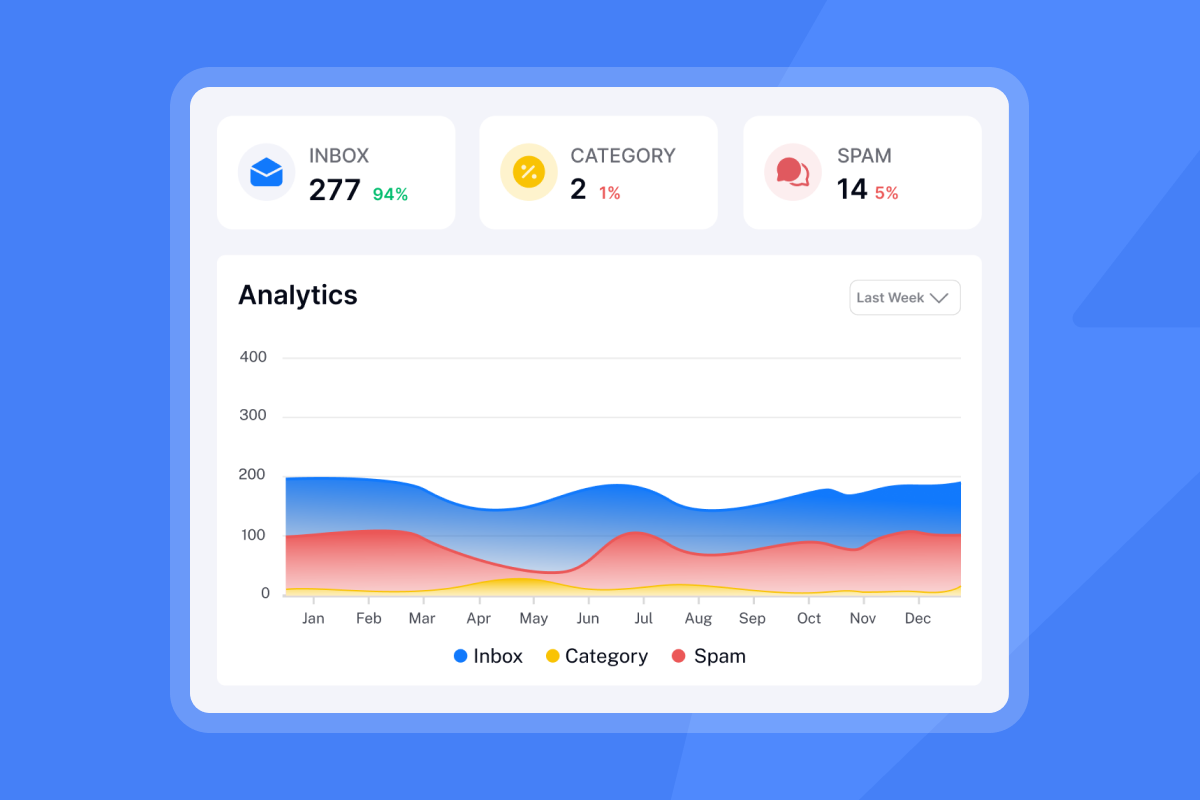
Inbox Placement tests in Instantly run automated checks against a panel of real inboxes to show you where your emails land (primary inbox, spam, or promotions folder) before your campaign reaches real prospects. The automated Inbox Placement test lets you run these checks programmatically as part of your pre-launch checklist.
For high-volume senders, Instantly's Light Speed plan ($358/mo) includes SISR (Server and IP Sharding and Rotation). Per Instantly's IP sharding guide, SISR splits sending volume across dedicated private servers and IPs. If one IP faces throttling or a blocklist event, the remaining IPs continue delivering. This architecture keeps your outreach running even when individual IPs face throttling or blocklist events.
Reply automation and CRM handoff
The AI Reply Agent responds to lead replies in under 5 minutes at 5 credits per reply. The AI Sales Agent handles autonomous lead sourcing and outbound execution at 5 credits per generated lead. Both run on Instantly Credits, a separate subscription starting at $9/mo, so your AI spend scales with activity rather than team size.
Instantly's Unibox centralizes all reply history. The native HubSpot integration connects your outreach activity to CRM, keeping lead data and reply history in sync across both platforms. The native Clay integration connects your enrichment workflow to Instantly campaigns. HubSpot is now the primary native CRM integration.
Instantly's built-in bounce detection and reputation protection monitors list health in real time and pauses sending when bounces approach the 1% threshold.
Compliance and pricing
Instantly operates under a publicly available DPA through Foo Monk LLC. Sub-processors are listed publicly, with AWS (USA) as the primary infrastructure provider. The DPA specifies categories of data you must not upload, including PHI, payment card data, and biometric data.
Instantly offers a 14-day free trial. Paid plans run month-to-month or annually (20% discount on annual) with no per-seat taxes and no annual lock-ins on standard plans.
Quick start checklist:
- Connect 2-3 secondary domain inboxes and start warmup (4-6 weeks before full campaigns)
- Build a signal-based list in SuperSearch (funding events, job postings, or tech stack changes)
- Use the AI Sequence Writer to create a 4-7 step sequence under 80 words per email
- Launch with HITL mode on the AI Reply Agent to calibrate tone and response logic
- Track reply rate (target 5.5%+) and inbox placement weekly
- Scale by adding inboxes, never by exceeding 30 emails per inbox per day
For performance benchmarks, download Instantly's 2026 Cold Email Benchmark Report to optimize sequence steps and email length based on data from billions of interactions.
Start your 14-day free trial to set up unlimited sending accounts and test the AI Reply Agent on real campaigns.
FAQs
What is the difference between an AI SDR and an AI BDR?
While human SDRs traditionally qualify inbound leads and human BDRs focus on outbound prospecting, AI agents in sales typically handle both top-of-funnel roles by automating list building, signal monitoring, and initial outreach. In practice, the terms are used interchangeably when referring to AI software. For a full breakdown, see AI BDR vs AI SDR differences.
How much does AI BDR software cost?
Outreach infrastructure plans range from $47/mo (Growth) to $358/mo (Light Speed with SISR), with AI agents powered by a separate Instantly Credits subscription starting at $9/mo for 150 credits, the same structure we break down in AI sales agent pricing models. A typical starter stack combining Outreach, SuperSearch, and CRM runs approximately $141/mo.
Can AI BDRs send emails from my primary domain?
No. Always use secondary domains for cold outreach to protect your primary domain's reputation. Each secondary domain inbox should be capped at 30 emails per day and warmed for at least 4-6 weeks before sending at full volume.
What metrics should I track to validate AI BDR ROI?
Track reply rate (target 5.5%+), meetings set per month, cost per meeting, and SQL conversion rate from AI-qualified leads, benchmarked against your AI BDR implementation timeline. Cost per meeting = (Monthly outreach software cost + Credits used for AI agents) / Meetings booked per month.
What happens if my AI agent sends an off-brand reply?
Use HITL mode during the calibration period. Instantly's AI Reply Agent lets you review and edit every draft before it sends. Once you've validated the agent's accuracy and tone, you can switch to Autopilot mode.
Key terms glossary
Primary inbox: The main folder where legitimate emails land, separate from spam or promotions folders. Landing here is the operational goal of all deliverability work.
Sender reputation: A score assigned by inbox providers based on sending history, bounce rates, and spam complaints. A damaged sender reputation causes emails to be filtered or blocked before they reach the prospect.
Warmup: The process of gradually increasing email volume on a new account over 4-6 weeks to build trust with mailbox providers before running full campaigns.
List hygiene: The practice of regularly removing invalid, inactive, or bounced email addresses from your prospect list to maintain low bounce rates and protect sender reputation.
SISR: Server and IP Sharding and Rotation. A deliverability technology that distributes email sending across multiple private servers and IPs, so a single flagged IP does not stop all outreach. Available on Instantly's Light Speed plan ($358/mo).
Signal data: Real-time behavioral or market triggers (funding announcements, job postings, leadership changes, technology adoptions) that indicate a prospect may be in a buying moment.
Human-in-the-loop (HITL): A governance mode where a human reviews and approves AI-generated outputs before they are sent, providing oversight during the calibration period of an AI agent deployment.
Read next
- Cold email deliverability guide: how to protect sender reputation and land in the primary inbox: A step-by-step breakdown of warmup, bounce thresholds, and inbox placement checks to keep your campaigns out of spam.
- The 30-day AI reply management playbook: book more meetings: A practical, month-by-month framework for using the AI Reply Agent to triage replies, qualify interest, and route leads to booked meetings.
- How to write a cold email sequence: steps, length, and copy that gets replies: Covers sequence structure, optimal step count, and copy patterns that top-quartile senders use to hit 5.5%+ reply rates.



