.svg)
%20(1).svg)


Updated August 26, 2026
TL;DR: Outbound sales automation is a four-layer infrastructure (Data, Orchestration, Execution, and Agents) that replaces manual sales tasks with systematic outreach. To scale without damaging your domain reputation, you must treat deliverability as a system, using multi-inbox rotation, automated warmup, and verified data. While legacy platforms charge per seat, Instantly.ai offers unlimited sending accounts on a flat fee, allowing you to distribute sending volume safely and keep bounce rates below 2%. According to Instantly's 2026 benchmark report, top-quartile senders reach 5.5%+ reply rates and the top 10% clear 10.7%+ using 4-7 step sequences.
Most sales leaders focus on writing better email copy while ignoring the technical infrastructure that determines whether their outbound sales automation ever reaches the primary inbox. Outbound sales automation is not a copywriting tool. It is a coordinated four-layer GTM infrastructure (Data, Orchestration, Execution, and Agents) that must prioritize deliverability and system-level governance to generate predictable pipeline. This guide breaks down every component so you can map each capability directly to your team's workflow. Platforms like the Instantly AI Agent combine several of these roles into one connected system.
What outbound sales automation actually does
Here is what each layer of the system does, how they connect, and why treating this as infrastructure rather than a tool set changes what you can build. See this breakdown of the different types of AI agents for how these roles typically divide across a stack.
Defining outbound sales automation
Outbound sales automation is the systematic coordination of data sourcing, sending infrastructure, follow-up logic, and AI-driven triage. It generates a consistent, measurable flow of qualified pipeline without requiring reps to execute each step manually. For more, see our guide to what AI sales automation is.
The four layers work as follows:
| Layer | Function | How Instantly handles it |
|---|---|---|
| Data | Source and verify target contacts | SuperSearch (450M+ verified B2B contacts) |
| Orchestration | Build sequences and route leads automatically | Automations and campaign builder |
| Execution | Distribute sending volume across inboxes safely | Inbox Rotation and SISR |
| Agents | Handle replies, top up leads, and monitor health | AI Reply Agent, Lead Finder Agent, Deliverability AI Agent |
This is not just email sequencing. It is a complete system for managing pipeline health, protecting sender reputation, and giving you full visibility across every rep's outreach activity.
Replacing repetitive manual outreach
Manual outreach means one rep sending emails from a single primary inbox, then manually checking replies, categorizing responses, and hunting for new contact data when lists run dry. Bounces accumulate on a single domain, reps forget follow-ups, and you lose your audit trail.
Automated multi-inbox campaigns distribute that same volume across dozens of warmed-up accounts, rotate sends to protect each domain, and handle follow-up timing automatically. Here is how the two approaches compare:
| Metric | Manual outreach | Automated multi-inbox |
|---|---|---|
| Setup time | Manual per rep: domain config, list prep, and copy built separately each campaign | Minutes via campaign builder |
| Deliverability risk | High (single domain absorbs all bounces) | Low (risk spread across multiple accounts) |
| Personalization | Deep but not scalable | Scalable via Spintax and AI copy tools |
| Cost per send | Scales with rep headcount | Flat fee, unlimited accounts |
| Reply triage | Manual, reactive, inconsistent | Automated via NLP and AI agents |
Limitations of sales automation
Your offer, product-market fit, and contact-list quality determine results. Automation scales execution, but it cannot fix weak fundamentals. Feed bad data into an automated system and it fails faster than manual outreach because the volume compounds the damage.
The "set-and-forget" mentality is the most common reason automated campaigns collapse. Domain health scores, bounce rates, reply classification accuracy, and CRM data reconciliation all need regular human review. For high-value deal triage, human judgment remains essential. Automation handles the repetitive steps so your reps can focus entirely on live conversations and active pipeline.
Five structural elements of scalable outreach
Each element addresses a specific failure point in the outbound pipeline. Get any one wrong and it compounds damage across the rest of the system.
Building verified outbound prospect lists
List hygiene forms the foundation of any outbound system because sending to unverified addresses pushes bounce rates above the critical 2% threshold, which triggers campaign pauses and damages your sender reputation with ESPs.
SuperSearch gives you access to 450M+ verified B2B contacts with a seven-provider waterfall enrichment model that checks its own database first, then sequences through BetterContact, ContactOut, Findymail, IcyPeas, LeadMagic, Prospeo, and Wiza until it finds a verified result. The waterfall enrichment process runs automatically in the background, yielding higher contact discovery rates than any single-provider approach.
Every lead imported from an external CSV or CRM must go through lead verification (0.25 credits per lead) before entering a campaign. SuperSearch-sourced leads are pre-verified automatically.
Managing domain warmup and deliverability
Warmup is not optional. Think of it as pre-race stretching: skip it and you risk a spam block or blacklisting event on your primary sending domain.
The warmup mechanics at Instantly operate through a shared-pool model where accounts send to and receive from other accounts in the pool, building authentic engagement signals with ESPs before any campaign email goes out. When you enable warmup, Instantly activates it at the next 12:00 AM UTC. The minimum warmup period is 2 weeks, but 4-6 weeks is recommended to reach full campaign volume safely.
Optimizing cadence and send logic
Cap each inbox at 30 campaign emails and 10 warmup emails per day. Staying within these limits protects sender reputation as you add accounts and scale total volume.
Spintax handles copy variation at scale. Using the {{RANDOM | option1 | option2}} syntax, each send receives a slightly different version of the email, which reduces the pattern-matching spam filters use to flag bulk sends. The AI Spintax Writer inside the Sequence Editor generates variants automatically from your existing copy, so you skip manual rewriting entirely. The AI Spam Words Checker flags triggering language using contextual AI evaluation rather than a keyword blocklist and updates continuously as spam filter behavior changes.
Automated lead routing and triage
Every inbound reply needs to be handled fast. Delayed triage kills momentum and lets deals slip out of pipeline before a rep even sees them. The solution is a unified inbox that centralizes replies across all sending domains into one view.
Unibox v2 surfaces replies from every connected account in a single interface, with bulk actions, team-visible notes, auto-refresh, and an "Others Folder" for non-lead replies. The built-in Unibox NLP classifies incoming replies by sentiment automatically across 50+ languages and categories like "interested," "out of office," and "unsubscribe," so your team knows exactly where to focus attention.
Measuring campaign ROI and outcomes
You need reporting that holds up to CFO scrutiny, not dashboards that look good but don't reconcile with CRM data. Key metrics to track at the campaign level are open rates, reply rates, bounce rates, and booked meetings.
Instantly's 2026 benchmark report (covering Jan 1 to Dec 18, 2025) puts the platform average reply rate at 3.43%, top-quartile senders at 5.5%+, and the top 10% at 10.7%+. Consistent, stable sending patterns produce 15-20% higher reply rates than erratic, high-volume sends. These are performance targets that come from disciplined execution, not from sending more emails.

Mechanics of automated outreach sequences
Follow these six steps in order. Each builds on the previous one, and skipping ahead, especially past domain setup and warmup, creates compounding deliverability risk.
Step 1: Setting up domains for deliverability
Before sending a single campaign email, you need secondary domains configured with the correct DNS records: MX, SPF, DKIM, and DMARC. DKIM and SPF must authenticate for a minimum of 48 hours before you enable DMARC, because ESPs verify these records in sequence during the 24-48 hour propagation window.
Instantly's Done-For-You Google setup buys the domain, configures DNS, and creates inboxes automatically (domains $15/yr, inboxes $5/mo each). Pre-warmed accounts skip the waiting period entirely. A Custom Tracking Domain (CTD) replaces the shared tracking URL with your own domain, isolating your sender reputation from shared infrastructure.
Step 2: Source and verify target contacts
SuperSearch's Signals filter identifies leads showing active buying intent such as recent social activity, competitor mentions, funding news, and leadership changes, matching approximately 5.8 million new signals per week against the 450M+ verified B2B contact database.
After selecting your leads, run verification before importing into a campaign. SuperSearch-sourced leads are pre-verified automatically. For imported CSV lists, the 0.25-credit-per-lead verification step classifies each address as valid, invalid, or risky, and Instantly keeps risky addresses out of campaigns automatically. The Lead Finder Agent automates prospecting by searching the 450M+ contact database for fresh leads that match your criteria.
Step 3: Structure multi-touch sales sequences
According to Instantly's 2026 benchmark report, the optimal sequence length is 4-7 steps. The first-touch email generates 58% of all replies, but follow-ups from steps 2-7 drive the remaining 42%, making the full sequence critical for pipeline coverage. Keep emails under 80 words.
The AI Sequence Writer generates a complete multi-step sequence from your offer and audience inputs. Use it as a starting point, then apply Spintax across variants to avoid pattern-matching.
Step 4: Audit health and bounce rates
Your account health score must stay above 90% before you launch campaign sends. The health score tracks the percentage of warmup emails landing in the primary inbox versus spam over a trailing 7-day window. If a score dips below 90%, pause campaign sends on that account until it recovers.
BounceShield filters high-risk recipients before a send goes out, using real-time and historical bounce data to protect your domain automatically. The high bounce auto-pause feature adds a second layer: campaigns pause automatically when bounce rate exceeds 5% (configurable) after a minimum of 200 sends. To disable BounceShield intentionally, toggle off BounceProtect in Settings under "Allow risky emails." In normal operations, leave it enabled.
Step 5: Automate lead triage and booking
Inbound replies need to be handled fast. Delayed triage kills momentum and lets deals slip out of pipeline before a rep even sees them. The solution is a unified inbox that centralizes replies across all sending domains into one view.
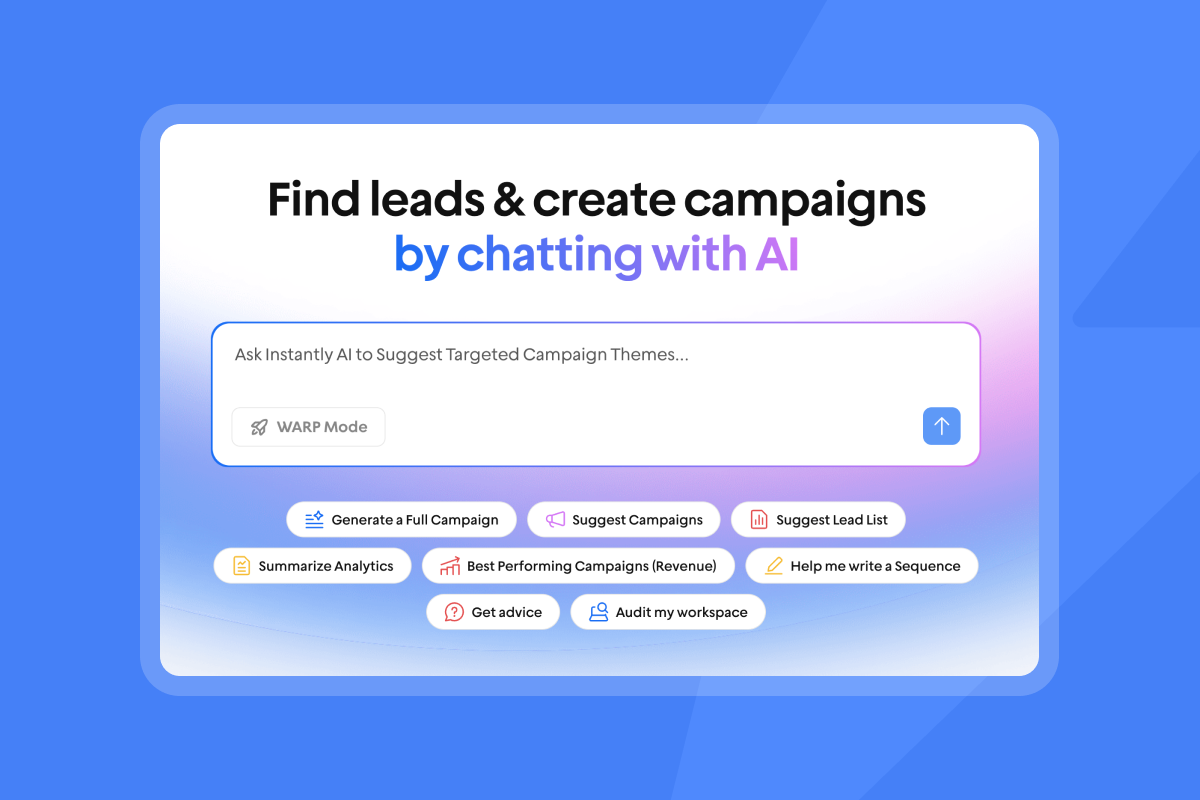
The AI Reply Agent does exactly that, operating in either Autopilot mode (fully autonomous) or Human-in-the-Loop mode (AI drafts, human approves before send). Each generated reply costs 5 Instantly Credits. The AI Reply Agent also supports Slack integration, sending real-time alerts when a reply needs review or a conversation is routed to your team. The agent tracks Involvement Rate and Resolution Rate as its primary performance metrics.
The Out-of-Office Resume feature (AI Smart Pause) detects OOO auto-replies via NLP, extracts the stated return date, pauses the lead, and auto-resumes sending on that date. It is available on all plans at no extra cost and requires two campaign settings: "Stop on Auto-reply" disabled and "Automatically tag interest status in replies" enabled. When a lead's status updates to interested, the Automation Builder can trigger a HubSpot contact or task creation automatically, keeping your CRM in sync without manual exports.
Step 6: Scale success via A/B testing
You can isolate high-performing subject lines and body copy without running separate campaigns using A/Z testing, included on the Growth plan ($47/mo) and above. The full 26-variant capability per sequence step is gated to Hypergrowth ($97/mo) and Light Speed ($358/mo) and above.
When you find a winning variant, scale it by adding more warmed-up inboxes to the campaign via Inbox Rotation, not by increasing the daily send volume on existing accounts. Each new inbox you add increases your total throughput by up to 30 emails per day while keeping every individual account within the safe sending limit.
The ROI of automated outbound sales
The return shows up in two places: fewer hours lost to manual tasks and lower deliverability risk across the team. Here is how each works.
Enforce uniform playbooks and prevent blacklisting
Automation lets you standardize templates, send windows, follow-up timing, and blocklist rules across every rep from a single workspace. This prevents reps from using unapproved copy, running unsafe browser extensions, or bypassing your DNS setup on personal inboxes.
Inbox Rotation distributes your total volume across multiple accounts, so any single deliverability event affects a small fraction of your total sending capacity rather than putting your entire domain at risk.
For teams sending at high volume, SISR on the Light Speed plan ($358/mo) adds another isolation layer, routing campaigns through private, dedicated server and IP blocks rather than a shared public pool. It applies automatically for eligible workspaces.
Ensure predictable lead flow and eliminate manual tasks
Consistent, stable sending patterns produce 15-20% higher reply rates compared to erratic high-volume sends, according to Instantly's 2026 benchmark report. The Lead Finder Agent prevents pipeline dry spells by automatically searching the 450M+ verified B2B contact database for fresh leads that match your criteria, so your team always has verified contacts ready to enter the next campaign.
Manual list building, follow-up scheduling, domain health checks, and reply categorization each take major time daily across a team of 5-15 reps. Automating these tasks at the system level frees your SDRs to spend their time on live conversations and meeting bookings, which is the only activity that directly generates pipeline.
Assessing platform security and compliance
Before committing to any outbound platform, verify how it handles domain health, rep oversight, and data compliance. These four areas determine your audit and legal exposure.
Inbox health and sender reputation
The Deliverability AI Agent runs a full workspace audit every 24 hours, monitoring DNS health, blocklist status, warmup scores, bounce rates, provider balance, campaign copy quality, and reply-rate benchmarks, with account health scores above 90% indicating strong inbox placement before you scale campaign volume. When it identifies an issue, it surfaces exactly what is affected, why it matters, and a one-click fix such as pausing campaigns, replacing risky accounts, or rebalancing providers. This feature is included in the Hypergrowth plan ($97/mo) and above, with no separate Credits cost.
Centralized controls for rep visibility
Workspace-wide settings let you set Global Blocklists, manage all billing from one place, and review account-level analytics for every rep without logging into individual accounts. With team-visible notes in Unibox v2, you see the same conversation context your reps do, which keeps handoffs to AEs clean and auditable.
Standardized data for sales audits and compliance
Account Analytics reporting in Instantly is fixed to UTC timezone, so all time-based reporting is consistent across a distributed team, eliminating the discrepancies that result from reps in different time zones pulling data with different local offsets.
On data privacy, Instantly's Data Processing Agreement covers processing terms under Foo Monk LLC, sub-processor listings including AWS USA, and data category restrictions on what you may not upload (including PHI/HIPAA and biometric data). Instantly's DPA, sub-processor transparency, and data category restrictions cover the operational practices most GDPR reviews ask about. The Unibox surfaces unsubscribe replies immediately across all connected accounts, so your team can act on opt-out requests without logging into multiple inboxes. Enterprise buyers should request any available attestations directly under NDA.
Automating lead handoff workflows
The Automation Builder uses a visual, node-based trigger-action interface to push leads to your CRM without manual exports. The HubSpot integration in Automations enables syncing in both directions: when a lead replies in Instantly, the system creates a contact, task, or note in HubSpot automatically, and HubSpot contact or deal changes can trigger Instantly campaign actions in return. Copilot can also build Automations from natural-language requests, converting a plain-text description like "When a lead replies, create a contact in HubSpot" into a workflow you then refine.
Avoiding vendor lock-in and hidden fees
Instantly's Outreach plans are flat-fee with unlimited email accounts across all tiers: Growth at $47/mo, Hypergrowth at $97/mo, and Light Speed at $358/mo. There are no per-seat charges. A typical starter stack combines Outreach Growth ($47/mo), a Credits plan starting at $9/mo, and CRM Growth ($47/mo).
The 14-day free trial requires no credit card. After 14 days without an upgrade, dashboard access ends and warmup and campaigns pause automatically. Free trial workspaces without an active subscription will then expire. There are no post-cancellation charges.
Instantly Credits (starting at $9/mo for 150 credits) are a separate subscription that powers SuperSearch, the Copilot AI assistant, and three AI agents: AI Sales Agent, AI Reply Agent, and Lead Finder Agent. The Deliverability AI Agent is included in the Outreach subscription on Hypergrowth and above and does not consume Credits. Monthly Credits expire two months after purchase if unused. Each subscription type cancels separately in Settings under Billing.
Preventing common pipeline leakage points
Most pipeline losses in automated outreach trace back to four fixable process gaps. Address them before scaling volume and they stop compounding against you. For more, see our guide to common outbound automation mistakes.
Standardizing your outbound ramp phase
New inboxes need a structured ramp before they carry campaign volume. Enable warmup on day one, then hold for a minimum of 2 weeks (3 weeks for DFY Airmail accounts) before sending any campaign email. Start at 5-10 emails per day and raise daily sends gradually, checking that the health score stays above 90% before each increase. Reach the 30-campaign-emails-per-day limit only after 4-6 weeks of consistent warmup performance.
The warmup health score documentation explains how the 7-day trailing inbox-placement rate is calculated so you can monitor progress objectively. The enabling warmup guide covers account connection and activation steps for Google, Microsoft, and IMAP/SMTP providers.
Risks of using purchased contact lists
Raw purchased lists without verification often push bounce rates above 5%, which triggers Instantly's high bounce auto-pause and stops your campaign automatically. Beyond the pause, high bounces damage your domain's reputation with ESPs over time, meaning future sends from that domain are more likely to land in spam even after the bounce rate recovers. The 0.25-credit-per-lead verification step filters out invalid and risky addresses before they enter your campaign.
Why you must track bounce patterns
Hard bounces indicate permanently invalid addresses. Soft bounces indicate temporary delivery failures like a full mailbox or server issue. If you see a spike in bounces concentrated on a specific domain, that points to a blocklisted IP or a domain-level filtering rule rather than a bad list, and it needs a different remediation approach than list hygiene alone. Bounced leads in Instantly can be exported as a CSV for analysis and imported to the Global Blocklist in bulk.
Reconciling dashboards with CRM
Instantly's account-level analytics report in UTC. If your CRM uses a different timezone offset for reporting, standardize your CRM reporting timezone to UTC before building pipeline attribution reports. The Automation Builder's HubSpot and Pipedrive integrations automatically sync reply events, interest status changes, and unsubscribes from Instantly to your CRM. This eliminates the manual export-and-import step that causes data lag and attribution gaps between your outbound dashboard and your pipeline source of truth.
Ready to build a deliverability-first outbound system that protects your domain while scaling pipeline? Start a 14-day free trial of Instantly Outreach with no credit card required, then benchmark your team against real-world data from Instantly's 2026 Cold Email Benchmark Report.
FAQs: Outbound sales automation
Does outbound scale damage inboxing?
No, provided you scale by adding more email accounts and using Inbox Rotation rather than increasing the volume on a single account past 30 campaign emails per day. Pushing more volume through a single account concentrates bounce and spam risk on one domain. Adding more warmed-up accounts and distributing the load across them keeps each inbox within safe limits and protects your sender reputation as you grow.
What are the typical timelines for email warmup?
You must warm new domains for a minimum of 2 weeks before sending campaign emails (3 weeks for DFY Airmail accounts), though 4-6 weeks is recommended to reach full campaign volume safely with a health score above 90%.
What performance data exists for sales sequences?
According to Instantly's 2026 benchmark report (data: Jan 1 to Dec 18, 2025), the platform average reply rate is 3.43%, top-quartile senders achieve 5.5%+, and the top 10% reach 10.7%+ using 4-7 step sequences with emails under 80 words.
How does syncing outbound data with a CRM work?
Using Instantly's Automation Builder, you can sync reply events, interest status changes, and unsubscribes to HubSpot or Pipedrive automatically. When a lead replies in Instantly, a contact, task, or note is created in HubSpot without manual intervention.
What are the recommended daily email send limits?
Cap each individual email account at 30 campaign emails and 10 warmup emails per day to protect sender reputation. Scale total daily volume by adding more warmed-up accounts via Inbox Rotation, not by raising the per-account limit.
Key terms glossary
Inbox Rotation: The practice of distributing campaign sends across multiple email accounts so no single account exceeds its daily limit, reducing deliverability risk at scale.
BounceShield: Instantly's automated system that skips known high-risk recipient addresses before a send goes out, using real-time and historical bounce data.
Spintax: A syntax ({{RANDOM | option1 | option2}}) that generates copy variation across sends to reduce spam filter pattern-matching at scale.
SISR: Advanced deliverability infrastructure on the Light Speed plan that routes sends through dedicated, private server and IP blocks rather than shared public pools.
Waterfall enrichment: A multi-provider email discovery process that queries data providers in sequence until a verified contact result is found or all sources are exhausted.
Sender reputation: The trust score that ESPs assign to a sending domain and IP based on engagement signals, bounce rates, spam complaints, and historical sending behavior.
Health score: The percentage of warmup emails landing in the primary inbox versus spam over the trailing 7 days. Accounts must stay above 90% before running campaign sends.
Unibox NLP: Instantly's natural language processing system inside Unibox that automatically classifies incoming replies by sentiment across 50+ languages.
Read next
Outbound sales software features that actually matter (and the ones that don't): A breakdown of which platform capabilities drive pipeline and which are table stakes that vendors use to justify higher price points.
Best outbound sales software for growing sales teams in 2026: A compared shortlist of outbound platforms evaluated on deliverability, pricing structure, team controls, and CRM integrations.
How to choose outbound sales software: the ultimate evaluation checklist: A step-by-step checklist covering the questions to ask vendors on domain health, data privacy, billing terms, and rep-level controls before you sign.


