.svg)
%20(1).svg)


Updated October 11, 2026
TL;DR: Your AI SDR meeting booking rate depends on inbox health, list quality, and sequence discipline, not the AI layer alone. Instantly's 2026 benchmark report puts the platform average reply rate at 3.43%, with top-quartile senders reaching 5.5%+ and the top 10% hitting 10.7%+. Cost-per-qualified-meeting, not feature count, is the right comparison metric for agency operators. Flat-fee unlimited accounts change the margin math entirely when you manage 10-150+ inboxes: Apollo starts at $65 per seat per month, Lemlist starts at $69/month for the Email plan (unlimited users) and $109/month per user for the Multichannel plan, while Instantly.ai charges a flat $47 per month for unlimited accounts. Run a 14-day pilot with a structured ramp plan before you commit.
The features that determine meeting-booking reliability live outside the demo: bounce handling, calendar sync failure recovery, and domain health monitoring. This guide gives agency operators a numbers-driven framework to compare vendors on rate, reliability, and cost-per-meeting, using published benchmarks and failure-mode testing rather than vendor claims.
What drives reliable meeting booking
Reliable AI SDR meeting booking depends on inbox health, list quality, and sequence discipline. The AI layer converts replies into booked meetings. It does not create them. You cannot fix a low booking rate by adding more AI if the underlying email infrastructure is unhealthy.
Core metrics for inbox health
Three numbers determine whether your outreach reaches a primary inbox:
- Bounce rate: Keep it at or below 2%. Instantly's 2026 benchmark report identifies 2% as the maximum acceptable threshold, with top performers targeting hard bounces under 1%.
- Health score: Instantly marks accounts as campaign-ready when the warmup health score clears 90%, measured as the percentage of warmup emails landing in the inbox over the trailing seven days.
- Inbox placement rate: Run Inbox Placement tests before and during campaigns. Set an alert to pause automatically if placement drops below 80%.
Scaling outreach without burning leads
The physics of sender reputation are simple: ramp slowly, cap daily volume, and never push past 30 campaign emails plus 10 warmup emails per account per day. Scale horizontally by adding more inboxes, not vertically by pushing higher volume from fewer accounts.
The ramp plan below gives you a copy-paste schedule for any new client domain:
| Week | Daily sends per inbox | Warmup emails | Health check |
|---|---|---|---|
| 1 | 5-10 | 10 | Bounce rate below 1%, open rate above 40% |
| 2 | 10-15 | 10 | Continue only if bounce rate stays below 1% |
| 3 | 15-20 | 10 | Inbox placement at or above 80% before scaling further |
| 4+ | Up to 30 (combined campaign + warmup) | 10 | Monitor weekly, pause if inbox placement drops below 80% |
A full 4-6 week warmup timeline is required before reaching full sending volume.
How AI agents secure qualified demos
An AI SDR handles prospect research, draft personalization, objection responses, and calendar scheduling. This differs from scripted chatbots, which follow fixed decision trees and break on any response outside their script.
The conversion lever is reply speed. Instantly's AI Reply Agent responds to lead replies in under five minutes, 24/7, keeping intent high while it is still fresh. It costs 5 Instantly Credits per reply generated. You can configure it in Human-in-the-Loop mode for review before sending, or Autopilot mode once you are confident in response quality.
How to measure AI SDR performance gains
Measure reply rate, meeting-booking rate, and cost-per-meeting against published benchmarks. Vendor case studies are marketing. Your own pilot data, measured against the 2026 benchmark report, is evidence.
Optimizing volume for meeting booking
Four variables determine how much volume you need to hit a meeting-booking target:
- Sequence length: 4-7 steps produce optimal results, per Instantly's 2026 benchmark report. Shorter sequences under-follow-up. Longer ones create fatigue.
- Email length: Under 80 words per email. Longer emails reduce reply rates.
- Launch and reply timing: Tuesday-Wednesday see peak reply rates, with Wednesday highest across the week. Launch new sequences on Monday for best results.
- First-touch weight: 58% of all replies come from step one. Do not sacrifice the first email for follow-up volume.
Maintaining deliverability at scale
Consistent senders see 15-20% higher replies than inconsistent senders, according to Instantly's benchmark data. Maintaining that consistency requires dedicated IP infrastructure at scale. Server and IP Sharding and Rotation (SISR), available on Instantly's Light Speed plan at $358/month, assigns dedicated IP pools to your campaigns and isolates your sending infrastructure from shared-pool reputation bleed.
Scaling ROI on AI meeting bookings
ROI formula: cost-per-meeting = total monthly tool cost divided by qualified meetings booked. The table below shows how the math changes at different reply rates and meeting conversion rates for a single client running 1,000 contacts per month at a flat $47 Instantly Outreach plan.
| Reply rate | Replies | Meeting conversion | Meetings | Cost per meeting |
|---|---|---|---|---|
| 3.43% (platform avg) | 34 | 10% | 3 | ~$16 |
| 5.5% (top quartile) | 55 | 20% | 11 | ~$4 |
| 10.7% (top 10%) | 107 | 30% | 32 | ~$1.50 |
Per-seat pricing breaks this math as you scale inboxes. Apollo's per-seat model starts at $65/month per user billed monthly, and Apollo's broader data network and multichannel capabilities (calling, email) are real advantages for teams that need them, but Instantly's flat-fee unlimited accounts mean every client you add costs sending capacity rather than seats.
Lemlist offers two main plans: the Email plan at $69/month (unlimited users, 50,000 emails/month) and the Multichannel plan at $109/month per user (unlimited emails and messages, plus LinkedIn, SMS, and calling). Lemlist's social-channel integrations are strong for blending LinkedIn and email, but Instantly's deliverability tooling covers the inbox-health foundation that social-channel-first tools often under-invest in.
Outreach does not publish pricing publicly (contact Outreach directly for a quote), and Outreach's enterprise compliance depth is real, but Instantly's DPA and sub-processor transparency cover the same operational requirements without per-seat pricing that compounds against agency margins.

Essential benchmarks for choosing AI agents
Use the 2026 benchmark report numbers as your baseline, then test vendors against your own pilot data. Vendor-quoted numbers from case studies are not a substitute for a controlled pilot with your lists, your sequences, and your ICP.
Predictable AI SDR meeting performance
The benchmark targets for a disciplined agency are:
- Average reply rate: 3.43% (platform average, Instantly 2026 benchmark report)
- Top-quartile target: 5.5%+ with list hygiene, warmup discipline, and A/Z tested sequences (Growth includes A/Z testing, full 26-variant capability on Hypergrowth at $97/month and above)
- Top 10% benchmark: 10.7%+ with all of the above plus signal-based targeting Frame 5.5%+ as your achievable goal with the right controls. No vendor can guarantee 10.7% because mailbox provider algorithms shift. Any vendor that makes that guarantee is selling you fiction.
Ensuring CRM data accuracy at scale
Low-quality data is a direct cause of high bounce rates, which kill sender reputation and reduce meeting-booking rates. Instantly's SuperSearch database holds 450M+ B2B leads with waterfall enrichment across five or more providers, checking each lead sequentially until a verified email is found.
SuperSearch-sourced leads ship pre-verified. Leads imported from CSV, HubSpot, or Pipedrive require a separate lead verification step at 0.25 credits per lead. Run verification before any campaign launch.
Managing multiple client setups at scale
Managing 10-150+ inboxes across multiple client domains requires workspace isolation, per-client domain health monitoring, and a flat-fee pricing model. Unlimited accounts on every Instantly Outreach plan means you add inboxes for new clients without a per-seat cost increase. Inbox Rotation automatically distributes sends across all accounts assigned to a campaign.
Compliance checklist for agency operators:
- Maintain a Data Processing Agreement (DPA) with your email platform
- Verify sub-processor transparency for data enrichment and warmup
- Confirm GDPR Article 28 processor obligations in your vendor contract
- Document lawful basis (legitimate interest or consent) for cold outreach per jurisdiction
- Provide opt-out mechanisms in every email footer
Review Instantly's DPA for full details on data processing terms, sub-processor transparency, and compliance coverage relevant to your client contracts.
Unit economics: mapping AI SDR spend to ROI
Cost-per-qualified-meeting is the only number that protects agency margins. Feature count is noise.
Calculating total AI SDR overhead and typical booking metrics
A typical agency stack has four cost buckets:
- Outreach plan: Instantly Growth at $47/month (flat fee, unlimited accounts and warmup)
- Lead data: Instantly Credits Growth at $47/month (1,500-2,000 credits for SuperSearch)
- Domain and inbox costs: $15/year per domain, $10/month per pre-warmed account
- AI agents: 5 Instantly Credits per AI Reply Agent reply, 5 credits per AI Sales Agent lead generated
A starter stack (Outreach + Credits + CRM) runs approximately $141/month. See the Instantly pricing page for current plan details.
At the platform average reply rate of 3.43% and a 10% reply-to-meeting conversion rate, 1,000 contacts produce roughly 3 qualified meetings per month on the starter stack. Reaching the top-quartile reply rate of 5.5%+ with a 20% conversion rate pushes that to 11 meetings from the same contact volume, which is where the cost-per-meeting math becomes compelling for agency retainers.
Defining your minimum booking volume
Set your break-even meeting volume per client by dividing your monthly tool cost allocation for that client by your revenue-per-meeting-booked. The real margin risk is not tool cost. It is a deliverability failure that takes a client domain offline for two weeks. That is the failure mode that ends retainers, so test for it before you commit to a vendor.
Common AI SDR failure modes and red flags
The failures that end agency relationships are calendar sync errors, low-intent meetings, spam placement, and API outages. Test for all four before you commit to a vendor.
Fixing automated calendar sync errors
Calendly integration with Instantly's AI Reply Agent handles no-show recovery: the first follow-up sends immediately when a lead is marked "No Show," with additional follow-ups spaced out thereafter. Review the Calendly integration documentation for setup steps. Test timezone handling before launch by booking a test meeting across a timezone boundary. If the AI Reply Agent is not sending replies as expected, the troubleshooting guide covers the most common configuration issues.
Identifying low-intent AI SDR meetings
AI SDRs can book meetings with leads who have no buying intent if qualification criteria are not set. Use the AI Reply Agent's label-based filtering to restrict which interest labels trigger an automated reply. Configure Human-in-the-Loop mode during onboarding and review the first 50-100 replies before switching to Autopilot, per the AI Reply Agent setup guidance.
Preventing spam-related booking loss
Spam placement kills meeting-booking rates before the AI gets a chance to work. Three tools address this directly:
- AI Spam Words Checker: Scans language and structure in the sequence editor and flags context-dependent spam triggers, not just keyword lists.
- BounceShield: Automatically skips high-risk recipients based on real-time and historical bounce data, as documented in the BounceShield help article.
- Deliverability AI Agent: Available on Hypergrowth and above, this agent monitors DNS health, blocklists, warmup scores, bounce rates, and campaign copy every 24 hours, surfacing one-click remediation actions per the Deliverability AI Agent documentation.
Solving API failures during live runs
Ask every vendor for their public status page, incident response SLA, webhook availability by plan tier, and campaign auto-pause protocol after outages. Instantly's public status page is at instantlyai.instatus.com, and webhooks require Hypergrowth or above. The high bounce auto-pause feature pauses campaigns automatically when bounce rate exceeds 5% (configurable) after a minimum 200 sends, with a 7-day exemption from re-triggering after a resume. This is a default protection on all plans, not a paid add-on.
Enforcing agency SLAs for AI meeting booking
Write SLAs around reply rate, meeting-booking rate, and deliverability health, then track them per client workspace. A verbal commitment to "great results" is not an SLA. Measurable thresholds are.
Defining AI SDR meeting performance SLAs
Example SLA targets for a mid-market B2B client:
- Reply rate: 5%+ (top-quartile benchmark, achievable with clean data and warmed inboxes)
- Meeting-booking rate: 1%+ of contacts contacted per month
- Bounce rate: At or below 2% at all times
- Inbox placement rate: Above 80% on weekly placement tests
If reply rate drops significantly below your baseline, treat it as a trigger for immediate review: re-verify the list, check domain health scores, and run a deliverability test from the sequence preview window before resuming.
Tracking AI SDR meeting performance
Instantly's Account Analytics "Combined Score" (weighted open rate plus reply rate) gives a quick health check per sending account. A score above 30 is healthy once 100+ contacts have been reached. Use this alongside per-client campaign analytics to run a weekly review cadence.
Managing multi-domain AI SDR workflows
For each client, assign dedicated sending domains, rotate sends using Inbox Rotation, and set per-domain send caps to protect domain health. The slow ramp warmup guide covers the exact progression from initial warmup through full campaign volume.
Syncing AI SDRs with client CRMs
Instantly's Automations builder supports bidirectional flows between Instantly and HubSpot: HubSpot contact or deal changes can trigger Instantly actions, and Instantly replies or campaign completions can trigger HubSpot contact, task, or note creation. Full activity sync (opens, clicks, replies) back to HubSpot in real time requires a third-party connector. Webhooks for real-time event triggers require Hypergrowth or above.
Vendor comparison: AI SDR for meeting booking
| Feature | Instantly | Apollo | Lemlist | Outreach |
|---|---|---|---|---|
| Pricing model | Flat fee per workspace | Per seat | Per user | Per seat (quote-only) |
| Entry price | $47/month | $65/user/month (monthly) | $69/month (Email, unlimited users) | Not Published |
| Unlimited sending accounts | Yes, all plans | No (seat-based limits) | Unlimited (Email) / 5 per user (Multichannel) | No (seat-based) |
| Built-in warmup | Yes, all plans | Contact vendor | Yes, all plans | Contact vendor |
| AI reply handling | AI Reply Agent (under 5 min) | No (manual only) | Configurable (default pause, AI classifies interest) | AI-powered reply management |
| Deliverability monitoring | Deliverability AI Agent (Hypergrowth+) | Third-party/limited | Yes (Deliverability Hub) | Contact vendor |
| HubSpot integration | Native import; bidirectional via Automations | Native | Native | Native (frequent sync issues reported) |
| Calendar sync (no-show recovery) | Yes, via Calendly | Yes, via integrations | Yes, via integrations | Yes, via integrations |
Apollo's Deliverability and Lemlist's Deliverability Hub are real strengths, and Instantly's Deliverability AI Agent on Hypergrowth adds always-on automated remediation that flags issues before they reach your clients. Outreach's enterprise compliance depth is real for large procurement teams, and Instantly's DPA covers the same core operational requirements without per-seat pricing that compounds against agency margins as inbox count grows.
Try Instantly free for 14 days (no credit card required) and run a structured pilot with the ramp plan and benchmark targets from this article.
FAQs: AI SDR meeting booking
What booking rate should an AI SDR deliver?
At the platform average reply rate of 3.43% and a 10% reply-to-meeting conversion, 1,000 contacts produce roughly 3 qualified meetings per month, per Instantly's 2026 benchmark report. Top-quartile senders reaching 5.5%+ reply rate with a 20% conversion rate push that to 11 meetings from the same contact volume.
How long does it take to see reliable meeting bookings?
Allow 4-6 weeks for warmup before reaching full sending volume, per Instantly's warmup guidance. After 2-3 weeks of warming with 5-30 emails per day and maintaining bounce rates below 1% and inbox placement above 80%, you can gradually scale volume.
Can AI SDRs handle complex calendar scheduling?
AI SDRs with Calendly integration handle timezone-aware scheduling, alternate time proposals, and no-show recovery automatically. Complex or high-value prospects benefit from Human-in-the-Loop review before any reply is sent.
What's the difference between AI SDR meeting booking and traditional outreach?
Traditional outreach relies on manual reply handling, which delays response by hours or days and lets buying intent drop. An AI SDR handles replies in under five minutes, 24/7, and routes to a calendar link or human review based on qualification criteria you set.
How do agency operators prevent AI SDR tools from burning client domains?
Keep your bounce rate at or below 2%, run Inbox Placement tests weekly, use BounceShield on all campaigns, and cap daily sends at 30 campaign emails plus 10 warmup emails per account per day. Follow the 30-day warmup and hygiene system before any campaign launch.
Key terms glossary
Deliverability: The ability of an email to reach a recipient's primary inbox rather than spam or promotions folders, measured via Inbox Placement tests.
Sender reputation: A score assigned by mailbox providers based on bounce rates, spam complaints, and engagement signals. Low reputation routes emails to spam.
Warmup: The process of gradually increasing send volume from a new inbox over 4-6 weeks to build sender reputation before running campaigns.
List hygiene: The practice of verifying and cleaning contact lists to remove invalid, risky, or unresponsive addresses before sending.
Reply rate: The percentage of sent emails that receive a response, with a platform average of 3.43% and top-quartile benchmark of 5.5%+ per Instantly's 2026 benchmark report.
Booked meetings: Qualified calendar appointments resulting from a reply-to-meeting conversion. The primary output metric for agency operators evaluating AI SDR performance.
Cost-per-meeting: Total monthly tool cost divided by qualified meetings booked. The primary ROI metric for agency operators evaluating AI SDR platforms for meeting booking.
Spintax: A syntax format using the {{RANDOM | option1 | option2}} structure that generates per-lead email copy variations, reducing template fatigue and improving deliverability.
SISR: Server and IP Sharding and Rotation. A deliverability feature on Instantly's Light Speed plan that assigns dedicated IP pools to campaigns, isolating sender reputation from shared infrastructure.
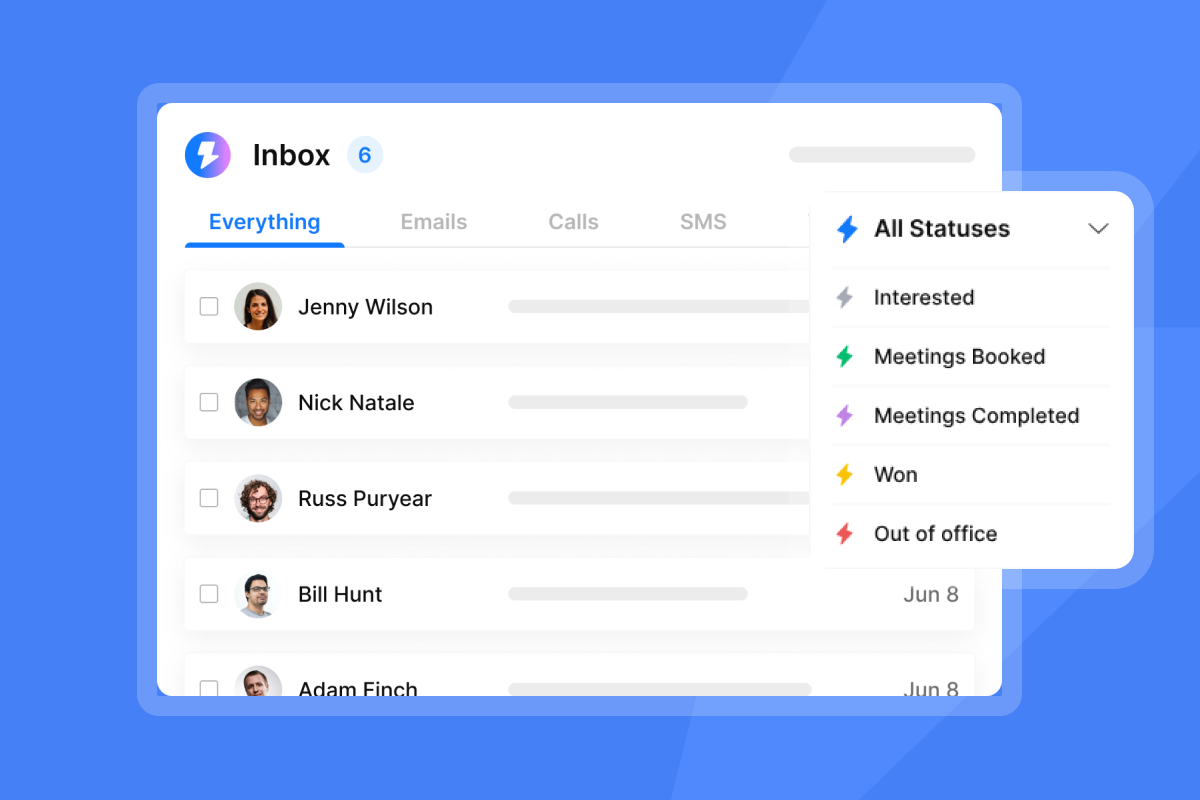
Unified inbox: A single view aggregating replies from all sending accounts. Instantly's Unibox centralizes replies with AI sentiment analysis, auto-tagging, and bulk actions.
Read next
- AI sales agents for sales enablement programs: the complete guide for sales leaders: A practical framework for sales leaders integrating AI agents into enablement programs to drive consistent pipeline at scale.
- AI sales agent vs AI SDR: what's the difference? (2026 category guide for sales leaders): A clear breakdown of how AI sales agents and AI SDRs differ in function, use case, and ROI so you can choose the right tool for your team.
- Best AI SDR tools for agencies: the 2026 complete guide: A side-by-side comparison of the top AI SDR platforms for agency operators, ranked by deliverability, pricing model, and meeting-booking reliability.


