.svg)
%20(1).svg)


Updated October 10, 2026
TL;DR: Never input PII, PHI, financial data, or confidential deal details into any public LLM. This is the first rule of AI enablement, not an afterthought. ChatGPT prompts for sales enablement can generate battlecards, onboarding playbooks, objection scripts, and email sequences at scale, but only when RevOps installs governance first. A structured prompt framework built around Persona, Context, Goal, Format, and Verification fields helps produce consistent outputs across every rep and deliverable type. Governance means versioned prompt libraries, mandatory review gates, and adoption metrics, not just a shared folder. AI-generated outreach must pass deliverability checks before it ships. Instantly.ai's 2026 benchmark report shows top-quartile senders reach 5.5%+ reply rates with disciplined, process-driven sending.
Your reps are already using ChatGPT prompts for sales enablement. You need to know whether you can audit, standardize, and trust how they use it.
ChatGPT can produce battlecards, objection scripts, and outreach sequences at scale, but only if you install a repeatable prompt framework, governance policies, and human-in-the-loop review first. This guide gives you the exact prompts, templates, and audit checkpoints to roll out AI-assisted enablement without brand drift or deliverability risk. You will also see how to connect AI-generated content to a reliable outbound engine so your team can measure what works.
Why ChatGPT for sales enablement content matters now
ChatGPT lets RevOps leaders produce standardized enablement assets without adding headcount, but only when you build process controls before you scale output.
Writing ability is no longer the bottleneck. Consistency is. One rep drafts a crisp battlecard, another produces something that contradicts your pricing, and neither version is auditable. ChatGPT removes the manual content bottleneck for onboarding decks, battlecards, and scripts, but only if every rep pulls from the same governed prompt library. Cirrus Insight reports that, as cited in their coverage of a HubSpot survey, 43% of sales reps actively use AI tools, up from 24% in 2023, which means informal AI use is already happening on your team. RevOps can either own that workflow or inherit the cleanup.
The compliance risk is real and immediate. Reps feeding CRM records, deal names, or contact details into a public LLM expose your company to data liability. Strac's guidance confirms that PII, PHI, PCI data, API keys, and confidential business information should be redacted or masked before they enter any AI workflow. The governance sections below give you specific guardrails to prevent this, including a data policy every rep should acknowledge before using any AI sales tool.
How do you use ChatGPT for sales enablement?
Use a repeatable prompt framework and install governance before you scale. A structured approach with Persona, Context, Goal, Format, and Verification fields is the foundation for every ChatGPT prompt for sales enablement in this guide.
Building modular sales prompt systems
The PCGFV framework turns a vague request into a structured, repeatable instruction set. OpenAI's prompt engineering documentation confirms that structured approaches produce more consistent outputs than open-ended requests. Replace each bracketed placeholder with your specific inputs:
Persona: [Role of the person this content is for, e.g., "SDR at a SaaS company targeting HR leaders"]
Context: [Relevant background, e.g., "Our product automates employee onboarding. The prospect is a 200-person company on Workday."]
Goal: [What the output should achieve, e.g., "Write a 3-sentence opening line that references a recent hiring announcement."]
Format: [Output structure, e.g., "Plain text, under 30 words, no jargon."]
Verification: [What to check before using, e.g., "Confirm company name and announcement date match CRM data."]
Setting rules for AI-generated sales content
Before any rep uses ChatGPT for outreach, define your brand voice rules in writing. These rules feed directly into the Context and Format fields of every PCGFV prompt. Include approved tone descriptors (direct, confident, plain), banned terms from your style guide, and required compliance reminders. Store this as a one-page reference that lives alongside your prompt library so every ChatGPT sales enablement template starts from the same baseline.
Establishing prompt governance policies
Prompt engineering best practices recommend treating prompts like code with versioning and structured review workflows. Use a folder structure with semantic versioning and require peer review before any prompt enters the approved library. In practice, assign one accountable owner per template responsible for keeping it current and compliant. This is what separates a scalable AI enablement program from an unmaintained shared document.
Mandatory review steps for AI output
Most AI-generated content benefits from human review before publication. Atom Writer's 2026 analysis found human revision rates of 25 to 40% of the original AI draft, meaning most drafts need meaningful human editing before they are production-ready. Build review into your publishing workflow as a hard gate for external-facing assets, not a recommendation.
Building scalable onboarding workflows via ChatGPT
ChatGPT can draft onboarding playbooks, ICP definitions, discovery frameworks, and readiness audits, but each asset needs a verification step before it reaches a rep.
Drafting sales playbooks with AI
Use this prompt to generate a 30-60-90 day rep playbook structure:
Persona: New SDR joining a B2B SaaS company selling to operations directors.
Context: Example deal size and sales cycle will vary by team. Competitive alternatives depend on your market segment.
Goal: Create a 30-60-90 day structure covering key activities, learning priorities, and measurable outcomes for each phase.
Format: Three sections with daily activity targets and learning milestones for each phase.
Verification: Review with your enablement manager to confirm activities and targets align with current team goals before distributing.
Pair the outreach section of this playbook with Instantly's cold email copywriting framework to align reps with proven message structures from day one.
Drafting accurate ICP and persona data
ICP definitions fail when they come from assumptions rather than closed-won data. Use ChatGPT to structure the definition, then verify every attribute against your CRM and revenue data before the document goes live:
Persona: RevOps analyst building ICP documentation for the sales team.
Context: We sell project management software to engineering managers at 50-500 person tech companies. Closed-won data shows average ARR will vary by team.
Goal: Define the ICP with firmographic attributes, key pain points, and disqualifying signals relevant to your market.
Format: Bullet list under each heading, plain language, concise structure.
Verification: Cross-check all attributes against the last 50 to 100 closed-won deals in your CRM and revenue data.
Question frameworks for discovery calls and readiness audits
Discovery frameworks built with ChatGPT give every rep the same starting structure while leaving room for live adaptation. The AI Prompts & Enrichment feature inside Instantly.ai also lets you enrich lead records with pre-call research at scale, so reps arrive with context rather than guesswork.
For readiness audits, use ChatGPT to draft a checklist covering ICP knowledge, objection handling accuracy, sequence governance compliance, and CRM hygiene. Assign a pass threshold for each category and tie results to rep coaching cycles.

ChatGPT sales enablement templates for battlecards
Build battlecards with market positioning, feature-to-benefit translation, and quantified loss reasons. ChatGPT can draft all three with the right prompts.
AI prompts for market positioning and feature translation
Start with positioning, then convert features into benefits in the same workflow:
Persona: Enablement manager building a competitive battlecard.
Context: We compete against [Tool A] in deals where the buyer cares about pricing transparency and sending volume.
Goal: Write a positioning statement that highlights our flat-fee model and built-in deliverability tooling, then convert the key points into buyer benefits.
Format: One positioning sentence, followed by benefit bullets, no superlatives.
Verification: Confirm all pricing figures match the current pricing page before publishing.
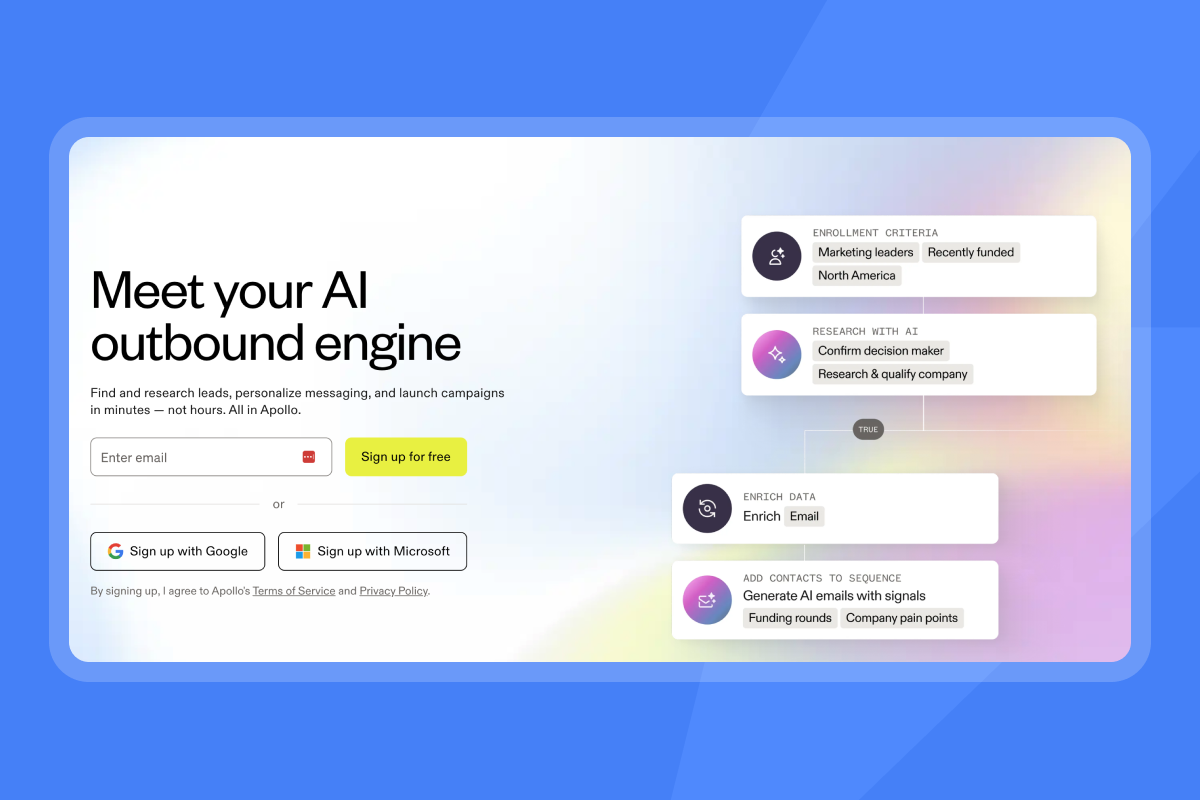
Apollo offers compliance tooling backed by SOC 2, ISO, GDPR, CCPA, and CPRA certifications for enterprise buyers. On data coverage, the published numbers favor Instantly: SuperSearch covers 450M+ B2B leads compared to Apollo's 240M+ verified contacts. Instantly's flat-fee unlimited accounts give the same standardization at scale without per-seat costs that compound as your team grows.
| Feature | Instantly | Apollo |
|---|---|---|
| Pricing model | Flat-fee unlimited accounts | Per-seat pricing |
| Primary strength | Deliverability and unlimited sending | Compliance certifications and CRM integrations |
| Best for | Outbound-focused teams scaling accounts | Multichannel sales intelligence |
| Account limits | Unlimited on flat fee | Per-seat costs compound |
Quantifying why prospects walk away and the battlecard structure
Loss reasons are a valuable battlecard intelligence source. Use ChatGPT to structure a loss-reason analysis from aggregated deal data to surface objection patterns by category and frequency. Instantly's 600 email templates also include message structures you can adapt for post-loss re-engagement.
Battlecard structure (copy-paste ready):
- Positioning statement: One sentence explaining why we win this comparison.
- Key proof points: Two to three data points or customer outcomes with sources.
- Objection map: Three common objections with pre-approved responses.
- Disqualifying signals: Scenarios where this deal is unlikely to close, based on deal size, technical fit, or buyer profile.
- Next action: Recommended follow-up steps for the rep based on deal stage and context.
Turning common sales pushback into winning replies
ChatGPT can classify objections, define brand-aligned response rules, and validate claims, but every script needs a human review for tone and accuracy before it reaches a prospect.
Classifying and responding to buyer objections
Start by categorizing objections before writing responses. Feed 30 to 40 objections from recent lost deals into this prompt:
Persona: RevOps manager building an objection handling library.
Context: We collected objections from lost deals and stalled opportunities across recent sales activity.
Goal: Classify each objection into common categories such as price, timing, trust, need, or competitive alternatives. Then draft a response for the most frequently occurring objections in each category.
Format: Structured table with columns for objection text, category, and a concise response.
Verification: Have senior AEs review the classification and responses before finalizing.
Define five response rules that every script must follow:
- No guarantees: Never promise a specific outcome.
- No negative comps: Never name a competitor in a negative comparison.
- One question: Always end with a single question.
- 60-word cap: Stay under 60 words.
- Pricing check: Confirm any pricing figure against the live pricing page.
OpenAI's prompt engineering best practices recommend reviewing and refining outputs iteratively, which applies directly to objection scripts where a single inaccurate stat creates more damage than no script at all. Use the structured prompt approach to generate scenario-specific variants: one for early-stage discovery, one for procurement pushback, and one for "we already have a tool." Store each in your approved library with clear ownership and keep deprecated versions archived rather than deleted.
Building reliable sales sequences with ChatGPT
AI-generated copy should pass spam checks before it ships. Optimal email length varies by audience and offer, so calibrate accordingly rather than applying a fixed word count to every sequence. The framework below covers formula, deliverability, angle, and follow-up in sequence.
Building consistent sales email formulas and outreach angles
Use the formula that produces the most replies: one relevant hook, one piece of proof, one easy ask. Instantly's 2026 benchmark report found the best email length is under 80 words, the best launch day is Monday, and first-touch emails generate 58% of replies. Use this prompt to generate a formula-based first touch:
Persona: SDR targeting operations directors at 100-300 person manufacturing companies.
Context: We help ops teams cut manual reporting time. The prospect recently posted about Q3 planning challenges.
Goal: Write a cold email under 80 words with a personalized opener relevant to the prospect's context and a clear, single call to action.
Format: Plain text, no HTML, no attachments.
Verification: Run through Instantly's AI Spam Words Checker or a comparable spam-trigger scanning tool before sending.
Optimizing copy for high deliverability
AI-generated content can introduce spam trigger patterns even in well-written drafts. Google's sender guidelines require keeping your spam rate below 0.1% and avoiding reaching 0.3% or higher. For cold email, keep your overall bounce rate under 2%. Instantly's BounceShield auto-pauses sending at a 5% bounce threshold, so treat that as a hard ceiling you should never approach. Any hard bounce should be removed from your list immediately, and a pattern of hard bounces across your whole list usually points to an authentication problem. Instantly's AI Spam Words Checker scans your copy for trigger language and surfaces replacement suggestions directly in the sequence editor. Cap daily sends at 30 per inbox to protect sender reputation.
"The smart AI features and campaign management stand out, and the ability to automate email generation really helps us come up with ideas. I also like how we don't miss emails anymore as we can track our sequences in one place, which helps with optimizing spam, bounce rates, and open rates, thus enhancing our sequences." - Sohaib on G2
Defining standard follow-up workflows
Instantly's benchmark data puts the optimal sequence length at 4 to 7 steps. Fewer than four give up too early, and more than seven produce diminishing returns unless each step adds new value. Use the AI Sequence Writer to generate a full multi-step sequence from your offer and ICP inputs, then review each step for accuracy and brand compliance before launch.
Ensuring brand compliance in AI sales assets
Compliance requires auditable prompt libraries, review gates, and adoption metrics.
Building auditable prompt libraries and review gates
Every prompt in your library needs key metadata covering details such as asset type, version number, owner name, and approval date. PromptQuorum's team library management guide covers using a structured folder system with sequential versioning (for example, battlecard/competitor-positioning-v2) so reps know which version is current. Archive deprecated prompts rather than deleting them so you can trace any output back to the prompt that produced it.
Define three review gate levels based on risk:
A common approach is to define review gate levels based on asset risk, with lighter review for internal drafts and stricter sign-off requirements for external-facing or compliance-sensitive content:
- Low-risk assets (internal playbook drafts): one rep review required.
- Medium-risk assets (outbound email copy): enablement manager sign-off required.
- High-risk assets (pricing-adjacent scripts, competitive claims): RevOps or legal approval required.
Keep a record of each approval so you can trace any published asset back to who reviewed it and when. Instantly's AI Reply Agent Slack integration uses the same Human-in-the-Loop pattern for live replies, which you can reference as a workflow template for your asset review process.
Audit metrics for rep adoption and content optimization
Track key adoption signals: the percentage of reps using approved assets, off-script messages flagged in quality reviews, and time from prompt request to approved asset. A rep who consistently goes off-script is a coaching opportunity, not a technology problem.
Reply rate data is your feedback loop for prompt quality. Instantly's 2026 benchmark report found that consistent, stable sending patterns produce 15 to 20% higher replies than erratic sending. The platform average reply rate is 3.43%, the top quartile reaches 5.5%+, and the top 10% reaches 10.7%+. When a sequence underperforms the 3.43% baseline, pull the prompt that generated it, identify the gap between the PCGFV inputs and the output, and update the prompt library with a revised version.
KPIs for your ChatGPT sales playbooks
Measure ROI by asset type, track rep insights against win rates, and quantify time saved per asset.
Tracking ROI by asset type
Different asset types connect to different outcomes. Battlecards tie to win rate in competitive deals. Outreach sequences tie to reply rate and meetings set. Objection scripts tie to deal stage advancement and stall rate reduction. Define one primary KPI per asset type at launch so you can attribute performance to specific prompt changes rather than general team trends.
| Asset type | Primary KPI | Secondary KPI |
|---|---|---|
| Battlecard | Competitive win rate | Deal progression metrics |
| Email sequence | Reply rate vs. 3.43% baseline | Meetings booked |
| Objection script | Objection resolution rate | Stall rate reduction |
| Onboarding playbook | Ramp time to first deal | Milestone completion rate |
How rep insights predict win rates and quantifying efficiency gains
Rep feedback from won and lost deals helps refine prompt libraries over time. Collect rep input on which assets helped or failed at the deal level and use that feedback to identify patterns across your prompt library. Over time, this data shows which prompts correlate with positive pipeline movement. Pair this with Unibox NLP reply classification to see how prospects respond to AI-generated messages at scale, giving you signal beyond anecdote. The AI Sales Agent documentation covers how Instantly's AI Sales Agent handles autonomous outbound execution, while the AI Reply Agent auto-handles inbound lead replies in under five minutes.
To quantify efficiency: subtract average AI-assisted creation time (including review) from average manual creation time to get minutes saved per asset. Multiply by monthly asset volume to get total hours saved. Report this alongside pipeline metrics so productivity and revenue data appear in the same review. The outreach plans comparison shows how Instantly's flat-fee model keeps cost per asset predictable as volume scales.
Apply these prompt frameworks inside a real outbound workflow. Start a free Instantly trial and use the AI Sequence Writer and AI Spam Words Checker to validate your first AI-generated sequence. No credit card required, and your first 14 days include full access to test the complete workflow.
FAQs: ChatGPT prompts for sales enablement
How can ChatGPT outputs stay on-brand?
Feed your brand voice rules, banned terms, and tone descriptors directly into the Context and Format fields of every structured prompt, then require a human review pass before any asset goes live. Version your prompt library so every rep pulls from the same approved baseline.
Can ChatGPT replace an enablement team?
No. It cannot verify claims against your CRM, judge tone in a live deal context, or catch compliance gaps without human review. Atom Writer's 2026 analysis found human revision rates of 25 to 40%, meaning most AI drafts need a human pass to be production-ready.
What's the best way to store and share prompts?
Use a folder structure with semantic versioning (for example, /prompts/objection-scripts/price-v3, organizing by asset type and version number), assign one owner per prompt, and archive rather than delete deprecated versions so you can trace outputs back to the prompt that produced them.
How can reps be prevented from going rogue with AI?
Publish a written AI usage policy before any rep uses ChatGPT for sales content, track which assets reps deploy in outreach, and flag off-script messages in weekly quality reviews. Governance is a process, not a platform setting.
What data should never be fed into ChatGPT?
Never input unredacted PII, PHI, financial data, API keys, confidential deal details, or customer records. Strac's analysis confirms the primary risk is what employees paste into a public LLM, not the platform's stated policy. Use anonymized or synthetic data in prompts and verify outputs against real data in a separate, controlled step.
Key terms glossary
Sales enablement: The process of giving sales reps the content, tools, and information they need to engage buyers and close deals. In the context of this guide, it covers battlecards, onboarding playbooks, objection scripts, and email sequences.
Battlecard: A short reference document that gives reps positioning statements, competitive differentiators, and objection responses for a specific competitor or deal scenario. Battlecards are designed for use in live conversations.
Prompt engineering: The practice of writing structured instructions for a large language model to produce a specific, consistent output. In sales enablement, it means defining Persona, Context, Goal, Format, and Verification for every asset.
RevOps: Revenue Operations. The function that aligns sales, marketing, and customer success processes, data, and tools to improve pipeline consistency and forecast accuracy. RevOps owns governance for AI-assisted sales workflows.
Objection handling: The practice of preparing structured responses to common reasons prospects delay or decline a purchase. Effective objection handling is categorized by objection type, fact-checked, and reviewed for brand compliance before reps use it in the field.
Read next
- AI prompts for sales prospecting: 10 best prompts to try: Ten ready-to-use ChatGPT prompts that help reps find, qualify, and engage high-fit prospects faster.
- AI agents for sales calls: what actually works in 2026: a sales leader's capability map: A practical breakdown of which AI call capabilities deliver real results and which are still hype.
- AI sales agent vs AI SDR: what's the difference? (2026 category guide for sales leaders): A clear comparison of two distinct AI roles so sales leaders can decide which fits their outbound motion.


