


Updated October 24, 2026
TL;DR: Artificial intelligence (AI) sales agents save agencies the most hours in research, list building, and reply triage. Instantly.ai's 2026 benchmark report shows average reply rates of 3.43%, with top-quartile senders hitting 5.5% or higher, a gap driven by data quality rather than copy volume. Instantly's deliverability network of 4.2M+ accounts keeps warmup and sender reputation signals current at agency scale. Deploy AI agents in Human-in-the-Loop mode first, and track your own cost per meeting to measure the reduction.
AI sales agents can support lead generation agencies across five workflow stages: market discovery, list building, copy personalization, lead scoring, and follow-up enrichment. The highest return on investment (ROI) applications are not the flashy autonomous campaign managers that some vendors promote. They are the repetitive tasks that take up a large share of the manual work in every client campaign. Agencies deploying AI agents for research and data hygiene protect their margins and their clients' sender reputations, while those handing full control to autopilot systems often burn domains within weeks. Keep first-touch email review manual until you validate deliverability across multiple campaigns.
How AI agents boost agency lead gen margins
Instantly's guide to AI sales agents for startups notes that manual research and list building eat up a large share of the hours behind every client campaign. Instantly's workflow documentation shows that AI agents shorten that timeline through waterfall enrichment, which checks multiple providers in sequence until it finds a match.
The margin impact depends on your own numbers. To estimate your gain, multiply the research hours AI agents save per client by your fully loaded hourly cost. You can then put those hours toward additional client work or keep them as net margin.
Instantly's 2026 benchmark report shows that the difference between average and top-quartile performers rarely comes from better copy. It comes from cleaner data and tighter targeting, which is exactly where AI agents deliver value.
Pricing model comparison
| Model | 10 inboxes | 25 inboxes | 50 inboxes |
|---|---|---|---|
| Illustrative per-seat tool at $50/inbox (example rate, not a quoted vendor price) | $500/mo | $1,250/mo | $2,500/mo |
| Instantly Growth (unlimited accounts) | $47/mo | $47/mo | $47/mo |
| Instantly Hypergrowth (unlimited accounts) | $97/mo | $97/mo | $97/mo |
AI agent credit consumption (5-client agency estimate)
| Agent | Credit cost per action | Typical monthly usage | Monthly credit cost |
|---|---|---|---|
| AI Sales Agent | 5 credits/lead | 500 leads | 2,500 credits |
| AI Reply Agent | 5 credits/reply | 200 replies | 1,000 credits |
| Lead Finder Agent | Not yet published | Varies by agency | Not yet published |
| Copilot | Not yet published | Varies by agency | Not yet published |
Instantly's pricing page lists the Instantly Credits Growth plan ($47/mo) with 1,500 to 2,000 credits. The AI Sales Agent and AI Reply Agent usage in the table above totals 3,500 credits per month. Growth's 2,000-credit cap falls short of this volume, so Supersonic ($97/mo, 5,000 to 7,500 credits) is the next available tier, with room to spare.
Scaling lead research with AI agents
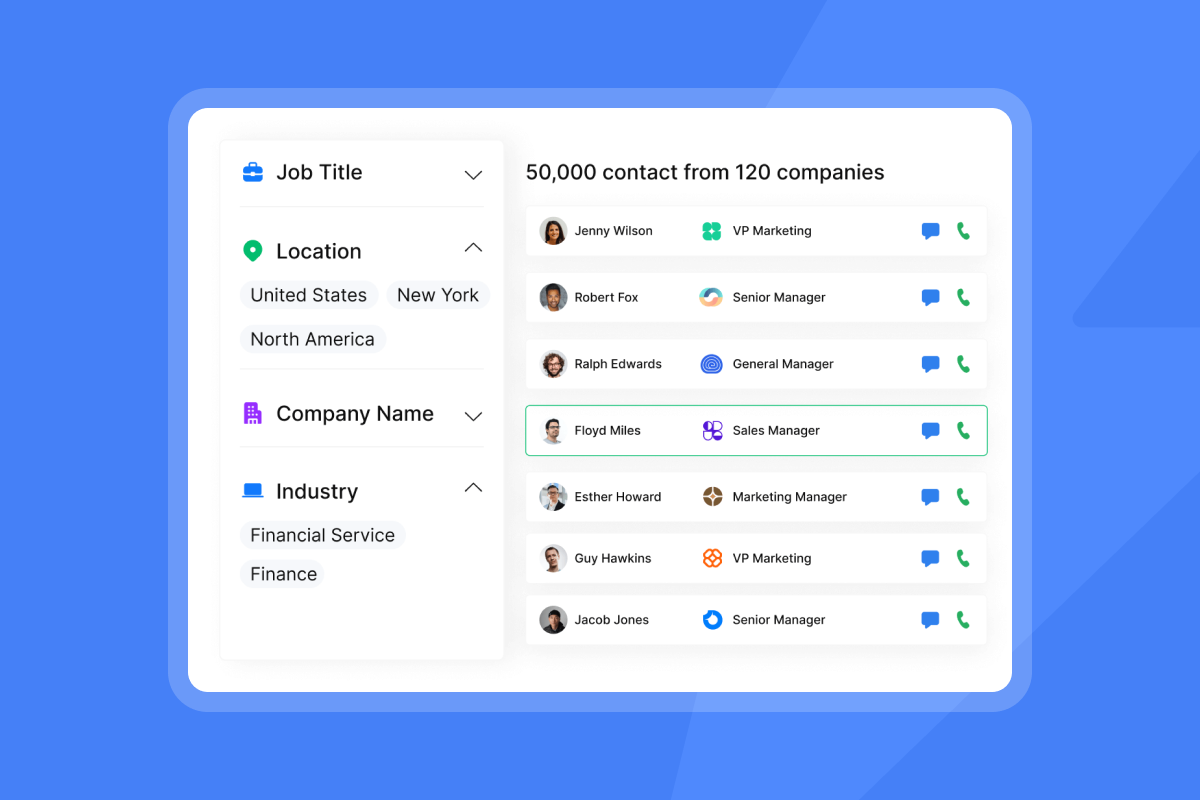
AI agents parallelize lead research across multiple data dimensions simultaneously. A human researcher checks firmographic fit, then intent signals, then technographics in sequence. An AI agent queries all three layers at once. Instantly's SuperSearch database contains over 450M+ business-to-business (B2B) leads, and the signals filter pulls buyer intent from social activity, funding announcements, and leadership changes.
This capability supports specific AI sales agent b2b use cases like monitoring technographic changes or tracking competitor mentions across Reddit and LinkedIn simultaneously.
Fixing data accuracy at scale
Agency operators fear bad data because bounced emails kill sender reputation. AI agents address this through waterfall enrichment, checking multiple data providers in sequence until finding a verified result. Instantly's Waterfall Enrichment help article explains that SuperSearch applies the same approach, querying multiple providers in sequence until it finds a verified email. Lead verification costs 0.25 credits per lead and classifies addresses as valid, invalid, or risky before sending.
Personalizing outreach at volume
AI agents generate baseline templates and Spintax variants without sacrificing deliverability. The AI Sequence Writer creates multi-step sequences from offer and audience inputs, capped at 100 generations per workspace monthly. The AI Spintax Writer generates per-lead variations from existing copy, helping you stay under the 80-word threshold that correlates with higher reply rates.
Qualifying prospects at scale
AI-driven lead scoring classifies replies by intent and routes qualified leads to your team. The AI Reply Agent drafts responses in under 5 minutes, tracks involvement rate and resolution rate metrics, and costs 5 credits per reply.
Use case 1: AI-powered market discovery
Before: A researcher spends hours building a contact list by hand. They query LinkedIn Sales Navigator, export comma-separated values (CSV) files, clean duplicates, and verify emails one by one. Manual handling introduces errors at every step, and by the time the list is ready, some intent signals (funding announcements, hiring sprees) may have lost value. Signals decay at different rates, so the longer the build takes, the more likely it is that some of them are out of date.
After: An AI agent monitors the same ideal customer profile (ICP) parameters continuously. When a target account announces a Series B or posts a relevant job opening, the agent pulls the contact data, verifies the email through waterfall enrichment, and adds the lead to the campaign while the signal is still fresh. The researcher reviews the output rather than building it from scratch.
The hidden costs of human research
Manual research costs more than hourly wages. It introduces data decay, human error, and opportunity cost. A researcher building a list manually might miss that a prospect changed jobs last week or that the company just adopted a new technology stack.
AI agent tactics for lead insights
AI agents pull firmographic data (company size, revenue, industry), technographic data (current tech stack), and intent signals (funding, hiring, expansion) simultaneously. Instantly's AI outbound guide explains that Copilot analyzes your ideal customer profile and surfaces targeting insights, pain points, and messaging angles based on industry and role.
How AI shrinks your research timeline
AI agents shorten the research timeline by handling data gathering and verification, so your team reviews finished lists instead of building them. The time saved varies by research type and workflow. This consolidation matters because context switching between research tools and sending platforms introduces errors.
"The AI sales agent that helps with responses is impressive, and the integration with Pipedrive is quite beneficial. I also use their Super Search leader database and the email verification system which helps save time in preparing new campaigns and keeps my lead list clean. Instantly's ability to connect multiple sending accounts without additional costs was a major draw for us, as it made scaling campaigns much easier." - Martin K. on G2
AI-assisted research checklist:
- Define ICP parameters: Input firmographic filters (industry, headcount, revenue) into the AI agent.
- Set signal triggers: Configure alerts for funding events, leadership changes, or technology adoption.
- Run waterfall enrichment: Verify contact data across multiple providers before export.
- Verify emails: Run the 0.25-credit verification step to classify addresses as valid or risky.
- Human review: Spot-check a sample of the list for tone and targeting accuracy.
- Import to campaign: Push verified leads directly to the sending sequence.

Use case 2: building targeted prospect lists
Before: Your team imports CSVs from three different data providers. They deduplicate in Excel, verify emails through a separate tool, and manually check for leads that have gone stale. The process takes time on every client, and bounce rates can still climb above the 2% threshold from Instantly's 2026 benchmark report, which puts sender reputation at risk.
After: The Lead Finder Agent monitors your campaign's active lead count and automatically tops up fresh leads when the count drops below your set threshold. The system proposes three audience strategies (Same Profile, Broader Search, Peer Companies) and falls back automatically if the primary audience is exhausted.
Consolidating fragmented lead data
Agencies often juggle Apollo for data, a separate verification tool, and a CSV importer. This tool sprawl creates gaps where leads decay. Instantly's lead import supports CSV import with auto-mapping for up to 50 variables, plus native imports from HubSpot and Pipedrive. Paired with SuperSearch for data, it consolidates three tools into one while maintaining a single source of truth for lead status.
Automating lead research at scale
The Lead Finder Agent runs continuously in the background. You set the threshold (minimum 10, maximum 10,000 active leads), and the agent tops up the campaign without manual re-searching.
Fixing lead decay with AI agents
Lead decay happens when prospects change jobs or companies pivot. AI agents monitor bounce rates and refresh stale leads automatically. BounceShield automatically skips known high-risk recipients based on real-time and historical bounce data. The high bounce auto-pause triggers when bounce rate exceeds 5% after 200 sends, pausing the campaign before further reputation damage occurs.
Use case 3: building hyper-relevant email copy
Before: A copywriter writes email variants for a client by hand. They research each prospect individually, write custom openings, and A/B test subject lines manually. By the time the sequence launches, the market conditions have shifted.
After: AI Sequence Writer generates a 4 to 7 step sequence from your offer and audience inputs. The AI Spintax Writer creates per-lead variations using {{RANDOM | option1 | option2}} syntax. The copywriter reviews and refines rather than writes from scratch, which cuts production time while maintaining quality control.
Scaling campaigns via baseline templates
AI Sequence Writer generates full multi-step sequences from basic inputs about your offer and audience. The system is capped at 100 sequence generations per workspace per month, which encourages strategic use rather than spamming generic templates. Each generation includes follow-up logic based on the optimal sequence length of 4 to 7 steps identified in Instantly's benchmark data.
How AI agents adapt client outreach
AI Spintax Writer creates variations that help you keep first-touch emails short. Instantly's 2026 benchmark report found that the best email length is under 80 words. This matters because Instantly's cold email guide reports that shorter emails get 2.4x higher reply rates than emails over 200 words.
Boosting reply rates with AI
Reply rate optimization requires connecting personalization to benchmark data. Instantly's 2026 benchmark report found that 58% of replies come from the first touch, while 42% come from follow-ups. AI agents optimize for this by ensuring follow-ups reference specific prospect attributes rather than generic "bumping this up" messages. The goal is reaching the top-quartile threshold of 5.5% reply rates through disciplined testing and data hygiene, not through volume.
Use case 4: intelligent lead scoring
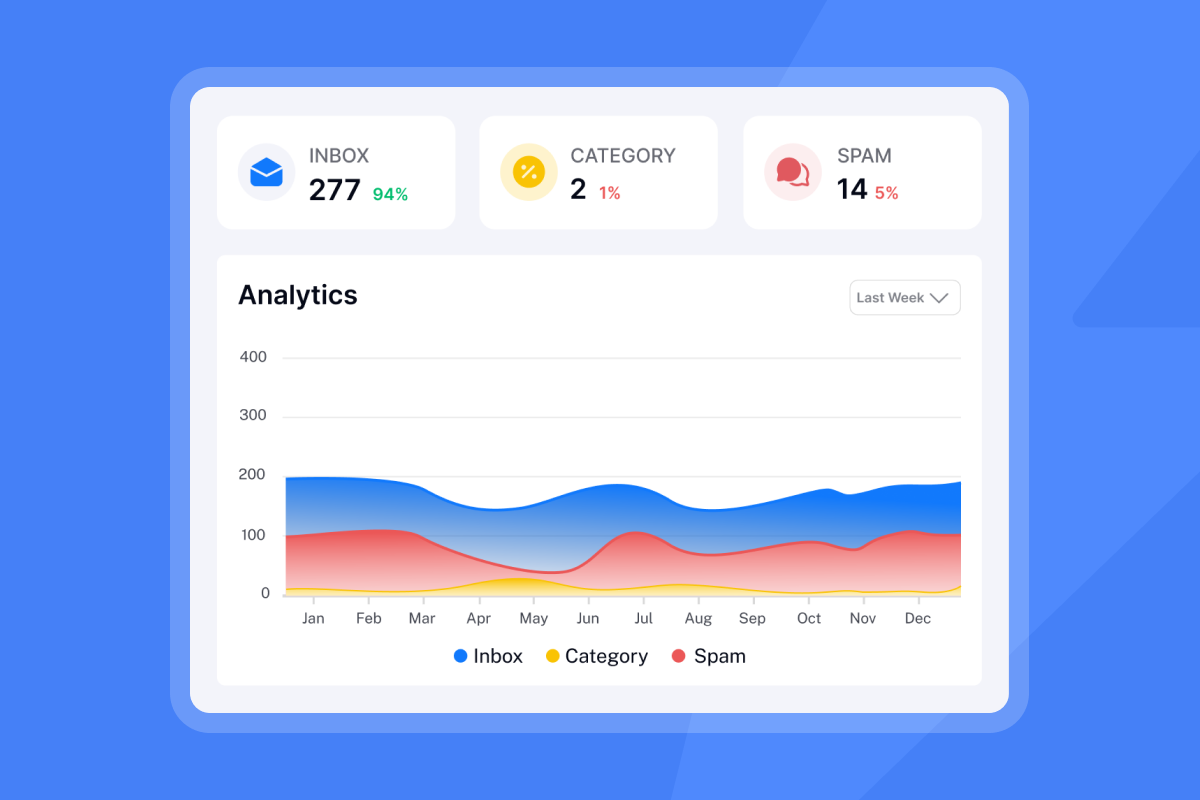
Before: Sales development reps manually sort hundreds of replies per day across multiple client inboxes. They copy-paste responses into a customer relationship management (CRM) system, tag leads as hot or cold, and often miss buying signals because they are overwhelmed by volume. Response times slow as the inbox fills, and qualified leads can go cold.
After: Unibox NLP (natural language processing) auto-classifies incoming replies by sentiment and intent. The AI Reply Agent drafts responses in under 5 minutes. Human operators review the drafts in a unified inbox before sending, so replies go out faster while you maintain quality control.
Scaling lead sorting with AI
Instantly's agency lead qualification guide shows that manual reply management does not scale past 5 to 10 inboxes. Unibox NLP solves this by auto-classifying replies into custom labels using sentiment and context detection across 50+ languages.
Automating lead qualification flows
Instantly's agency lead qualification guide shows that the AI Reply Agent reads incoming replies, classifies them by intent (interested, not interested, out of office, objection, question), and routes qualified leads to your team in under 5 minutes. This automated triage ensures no hot lead sits unread while your reps handle low-priority messages.
Automating granular lead segmentation
AI-driven segmentation routes leads to different sequence paths based on engagement signals. The Automations builder supports conditional branching (AND/OR logic) and delay nodes, allowing you to create sophisticated workflows like "If lead opens three times but does not reply, send case study variant B." This level of segmentation was previously only available through enterprise sales engagement platforms costing thousands per month.
Use case 5: streamlining lead follow-up
Before: After a prospect replies, a rep manually updates the CRM, creates a task for the account executive (AE), and schedules a follow-up email. Each reply adds admin work per lead. AskElephant's CRM automation guide says manual data entry takes 5 to 10 minutes per call, which is why reps often skip updates. Data entry error rate research shows that manual data entry also carries an average error rate of 1% to 4% at the field level. By the time the next touchpoint happens, the CRM record may no longer reflect the actual conversation.
After: AI agents enrich lead profiles with firmographic and intent data after the first reply. The Automations builder pushes enriched data to HubSpot or Pipedrive. When a lead replies, the system can create a contact, update the deal stage, and create a task for the owning AE without manual entry.
AI driven lead profile building
Post-reply enrichment adds context that helps close deals. In SuperSearch, the Enrich & AI button on your lead list lets you toggle on a fully enriched profile (company description, headcount, contact details), job listings, technologies, news, and funding type. Each of these options costs 0.5 credits per row, so your rep has that context before the conversation.
Automating CRM data enrichment
Instantly's native HubSpot integration handles workflow automation through the Automations builder. The connection works in both directions. Actions in HubSpot, such as contact creation, property updates, or deal stage changes, can initiate Instantly workflows. Outreach outcomes such as replies and campaign completions can push back to HubSpot natively. If you need a custom sync beyond the native actions, you can build on the HubSpot application programming interface (API) and Instantly's API v2, or use custom webhooks. Custom variables in Instantly campaigns map to HubSpot fields, and when Unibox NLP classifies a reply as "Interested," that label can drive a HubSpot contact update, a task creation for the owning AE, and a deal stage movement.
Automating data sync for sales
Copilot can build Automations from a plain-language description. In the Agents tab, click Create New, open the Instantly AI widget at the bottom right, and type a request such as "When a lead replies, create a contact in HubSpot." Instantly AI drafts the workflow, and you then set up the trigger, connect your HubSpot account, map the lead fields, and run a test before switching it on. Once the workflow is live, replies can update HubSpot natively, so your CRM reflects engagement status without manual entry.
Operationalizing AI sales agents for your agency
Rolling out AI agents requires a phased approach that protects client domains while proving ROI. Follow this four-step playbook to implement agency workflows with AI research safely.
Identify high friction manual tasks
Audit your current workflows to find bottlenecks. Track where your team spends the most hours per client campaign. Common high-friction areas include list building, reply triage, and CRM updates. List the top three time-consuming tasks and calculate the fully-loaded cost of each.
Test AI on your lowest-risk client
Start with one client campaign that has a proven offer and established sender reputation. Configure the AI Sales Agent in manual-approval mode. Set the AI Reply Agent to Human-in-the-Loop mode so it drafts replies within 5 minutes but routes them through a Slack approval workflow before sending. Run the pilot long enough to gather meaningful deliverability and reply data before expanding to other clients.
Measure AI agent ROI per client
Track three numbers per client per month: total campaign cost, replies generated, and meetings booked. Derive cost per meeting from these figures and compare your results against the 3.43% average reply rate benchmark to ensure you are meeting baseline performance.
Roll out AI agents to all campaigns
Scale gradually across your client base. Keep Human-in-the-Loop review on first-touch emails until you validate deliverability across multiple campaigns. Monitor the Deliverability AI Agent dashboard for Domain Name System (DNS) health, blocklist status, and bounce rate trends. As your Resolution Rate improves, shift low-complexity reply types to Autopilot while keeping human review for interest-positive replies that need a human close.
Ready to test these workflows? Try Instantly free and run AI agents on one client campaign for 14 days. The free trial includes 100 Instantly Credits to test SuperSearch and AI agents without upfront cost.
FAQs: AI sales agent use cases for agencies
Do AI sales agents replace human researchers?
No, AI agents augment human researchers rather than replace them. The highest-performing agencies use AI for data gathering and initial classification while keeping humans in charge of strategy and final quality control. Human oversight remains essential for maintaining brand voice and catching edge cases that algorithms miss.
How accurate is AI-generated lead data?
Accuracy depends on the verification layer. SuperSearch uses a waterfall enrichment model that checks multiple providers in sequence until finding verified contact information, which helps reduce bounce rates compared to single-source databases. Lead verification costs 0.25 credits per lead and classifies addresses as valid, invalid, or risky before sending.
Which use case saves agencies the most time?
Lead research and list building save the most time, because AI agents handle data gathering and verification while your team reviews the output. Reply triage follows closely, with the AI Reply Agent drafting responses in under 5 minutes while maintaining quality control through Human-in-the-Loop checkpoints.
Can AI agents maintain data compliance?
Yes, when configured correctly. Instantly's data processing addendum (DPA) outlines prohibited data categories like protected health information (PHI) and payment card data. The platform supports General Data Protection Regulation (GDPR) and Controlling the Assault of Non-Solicited Pornography and Marketing (CAN-SPAM) Act compliance through opt-out management and unsubscribe handling, though agencies remain responsible for their own data sourcing practices.
How do AI agents improve reply rates?
AI agents improve reply rates by ensuring data quality and personalization at scale. By verifying leads through waterfall enrichment and generating Spintax variants that keep emails under 80 words, AI agents help agencies reach the top-quartile benchmark of 5.5% or higher reply rates identified in Instantly's 2026 benchmark report.
Key terms glossary
AI sales agent: Software that autonomously executes sales tasks such as lead sourcing, email writing, and reply handling, typically operating in either Human-in-the-Loop or Autopilot modes.
Waterfall enrichment: A data verification method that queries multiple providers in sequence until finding accurate contact information, reducing bounce rates by cross-referencing sources.
Firmographic fit: The alignment between a prospect's company attributes (industry, size, revenue) and your ideal customer profile criteria.
Human-in-the-loop: A workflow where AI generates outputs but requires human approval before execution, ensuring quality control and brand safety.
Sender reputation: A score assigned by email service providers based on bounce rates, spam complaints, and engagement metrics, determining whether emails land in the primary inbox or spam folder.
Spintax: A formatting method using {{RANDOM | option1 | option2}} syntax to create multiple email variations from a single template, helping maintain deliverability at scale.
Unified inbox: A centralized interface that aggregates replies from multiple email accounts into one view, eliminating the need to check individual inboxes.
Cost per meeting: The total campaign cost divided by the number of meetings booked, used to measure the efficiency of outbound campaigns and AI agent ROI.
Read next
- Best AI SDR for lead generation: a data-driven comparison for growth marketers: Compares AI SDR options so you can choose one that fits your lead generation workflow.
- AI sales agents for sales enablement programs: the complete guide for sales leaders: Explains how AI sales agents fit into sales enablement programs and what sales leaders should plan for.
- AI agents for sales calls: what actually works in 2026: a sales leader's capability map: Maps which AI agent capabilities apply to sales calls so you can plan your rollout.


