



Updated 27 November, 2026
TLDR: AI prompts can handle drafting, qualification, and ad-hoc research, while sales intelligence tools are built for verification, enrichment, compliance, and CRM sync. A hybrid approach often delivers the highest ROI: prompts for reasoning and routine cleanup, a verified database for data integrity. Instantly.ai's 2026 benchmark report found the platform average reply rate is 3.43%, with top-quartile senders reaching 5.5%+. Data quality and deliverability are levers you control, and they sit outside the prompt itself.
The "AI vs tools" debate misses the point. AI prompts are an instructional layer that writes and reasons; sales intelligence platforms are an infrastructure layer that verifies, enriches, and syncs data. A prompt can draft a cold email in seconds, but it cannot tell you if the address is valid, the contact still works there, or the domain is a spam trap. Using prompts in place of a verified database can mean higher bounce rates, compliance gaps, and extra manual cleanup. Any AI-written email still has to meet CAN-SPAM requirements, including an opt-out mechanism and a physical postal address. Combining both delivers predictable spend, cleaner lists, and faster iteration.
Core functions of sales intelligence platforms
Sales intelligence platforms are systems of record for contact data. They verify, enrich, deduplicate, and sync information to your CRM and outreach tools. Prompts cannot do this on their own, because a standalone large language model is a text-trained model. By design, it has no integrated B2B contact database, built-in verification mechanism, or compliance layer unless it is connected to external tools or data sources.
If your reply rate falls below the benchmark baselines in the TLDR above, check data quality and deliverability hygiene first. Those are platform functions, not prompt functions.
Ensuring lead data accuracy
Verified data matters because bounce rates directly damage sender reputation. Instantly's 2026 benchmark report puts the bounce-rate threshold at below 2%. Verifying a list before you send is the most direct way to stay under that line, which keeps your domain healthy.
The verification hit rate is the percentage of contacts in a list that pass email verification. Instantly's lead verification process costs 0.25 credits per lead and classifies addresses as valid, invalid, or risky before sending. A separate catch-all verification pass also costs 0.25 credits per lead and helps you sort addresses that standard verification would otherwise mark as risky, catch-all, or unknown.
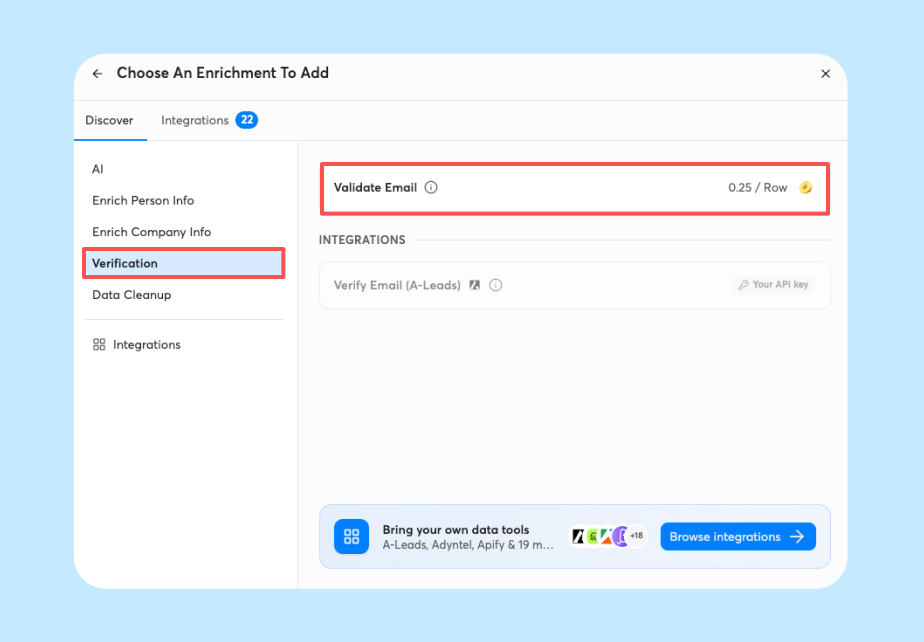
Validating contact accuracy at scale
Waterfall enrichment validates contact accuracy at scale by checking seven data providers in sequence until a verified email is found. Stacking sources this way raises coverage because a contact missed by one provider can still be found by the next.
Instantly's Lead Finder checks its own database first at 1 credit per verified email. If no match exists, it sequences through seven data partners: BetterContact, ContactOut, Findymail, IcyPeas, LeadMagic, Prospeo, and Wiza. A verified email from a data partner costs 2 credits per row, with no API key or partner account required. Instantly charges only when a verified email is found, so a row with no match costs 0 credits.
Compliance and opt-out handling
Sales intelligence platforms handle opt-out suppression and data provenance, while raw prompts do not. GDPR requires documented legitimate interest and easy withdrawal, CAN-SPAM requires opt-out links and a physical address, and CASL is the strictest, requiring implied or express consent for Canadian recipients. CAN-SPAM requires opt-outs to be honored within 10 business days, with civil penalties reaching $53,088 per email as of January 2025.
Instantly maintains opt-out suppression lists and supports CCPA and GDPR opt-out handling, covering opt-out-of-sale and objection-to-processing requests. Prompts have no mechanism to track or enforce these requirements.
Setting realistic expectations for generative prompts
Prompts are strong at reasoning and drafting, weak at data. They have no system of record, no live verification, and no compliance layer. GPT-4 achieved near-perfect factual accuracy with a hallucination rate below 5%, while LLaMA 2 and DeepSeek exhibited much higher factual hallucination rates around 20% to 25%.
LLM hallucination rates vary widely by model, task, and prompting method, and no single universal rate exists. That variance is why an unverified prompt-generated contact list can carry accuracy risk, especially when the model lacks access to current, verified B2B data. The size of that risk for prompt-generated lists specifically isn't well quantified.
Prospecting accuracy and list enrichment
The accuracy gap is structural. LLMs hallucinate contacts, use stale training data, and cannot verify email addresses. A prompt can generate a plausible-sounding email pattern, but it cannot confirm the contact still works at the company, the email is active, or the domain is not a spam trap. Sending to unverified addresses raises your bounce rate, and Instantly's 2026 benchmark report puts the bounce-rate threshold at below 2%. Bounces above that line can damage your sender reputation over time.
Contrast this with a verified database. Instantly's Lead Finder ships pre-verified leads from its database of 450M+ B2B leads. The verification step is built into the data sourcing process, not bolted on afterward.
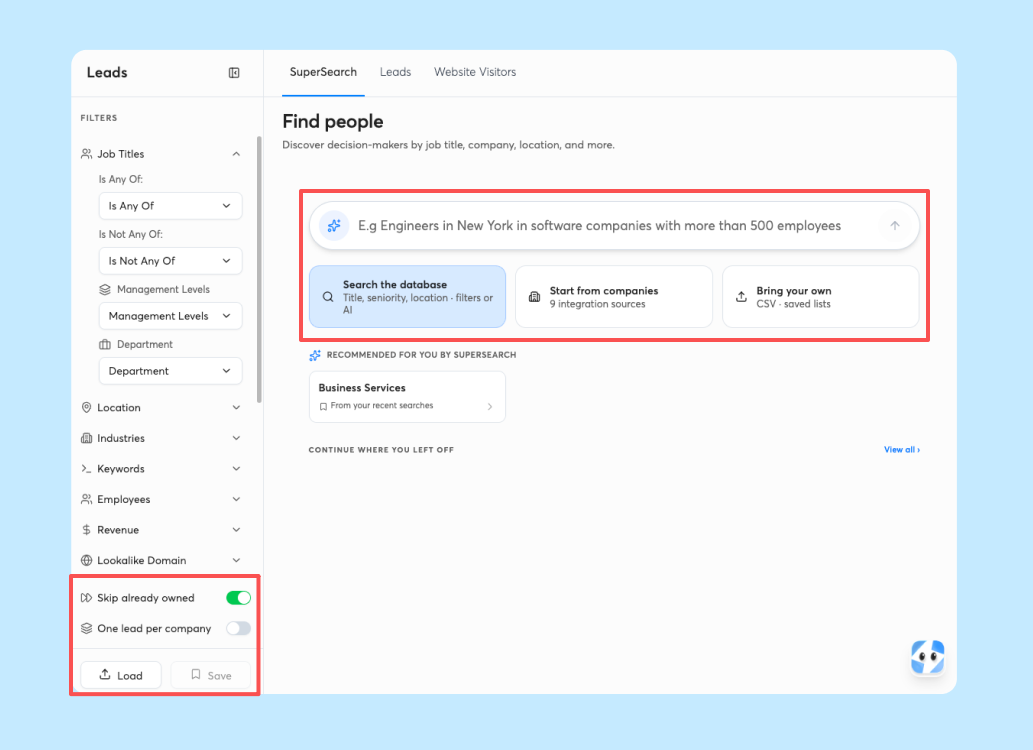
Enriching and deduplicating lead sets
The manual work prompts create falls to the marketer. Deduplication, normalization, and enrichment all require manual intervention when you start from a prompt-generated list. Run the math on a typical cleanup. As an illustrative assumption, say it takes about three minutes to clean up a single contact by hand. At that rate, 1,000 invalid contacts works out to roughly 50 hours. Time your own team on a small sample to check that estimate. Remote Growth Partners' 2026 SDR cost breakdown puts the fully loaded annual cost of a U.S. in-house SDR at $102,000 to $210,000. That figure includes payroll taxes, benefits, recruiting, ramp time, tools, management, and turnover on top of salary. Assuming a standard 2,080-hour work year (40 hours a week for 52 weeks), that works out to about $49 to $101 per hour on a fully loaded basis. The hourly rate is this article's own calculation, not a figure from the source, and it runs higher than a salary-only hourly rate. Using the $49 low end as an illustration, 50 hours is roughly $2,450 in fully loaded labor cost. Swap in your own team's hourly rate to check the math. Verifying the list upfront costs a small fraction of that.
Verifying a list upfront with Instantly costs 0.25 credits per lead. The prompt is cheap, but the cleanup is not.
Accuracy gaps in prompt outputs
Concrete failure modes of AI prospecting prompts include fabricated emails, outdated job titles, and missing opt-out flags. A fabricated email bounces, damaging sender reputation. An outdated job title wastes a send and a follow-up. A missing opt-out flag creates a compliance violation. Prompts have no mechanism to detect or prevent these failures because they lack access to live, verified data.

Calculating ROI for prompts and sales software
Compare total cost per verified lead, not sticker price. The real cost comparison is not prompt tokens vs. platform seats. It is the hidden OpEx of manual verification, deduplication, and CRM cleanup that prompts create when used alone.
| Approach | Data Accuracy | Verification | Compliance | Cost Model |
|---|---|---|---|---|
| AI prompts only | Variable (hallucination rates differ widely by model and task) | No built-in verification, often manual unless connected to a verification tool | Prompts can flag issues in drafts, but opt-out handling and data provenance are typically manual | LLM token costs, plus manual cleanup labor and other costs that vary by setup |
| Sales intelligence platform | High (verified database) | Built-in | Typically built in | Per-seat or credits |
| Hybrid (prompts + platform) | Higher when prompts run on verified data (accuracy depends on the data source and setup) | Built-in | Built-in | Credits, plus any LLM provider costs if you bring your own API key |
Calculating variable AI generation costs
Instantly's AI Prompts & Enrichment spans email copywriting, research and analysis, data operations, and outreach prompt templates, with differentiated per-task credit costs. Most tasks cost approximately 0.5 credits per row, company research costs 1 credit per row, and work-email enrichment costs approximately 1.5 credits per row. Basic data cleanup, such as normalizing first names, last names, company names, and company domains, is free. You can run prompts on the shared Instantly AI account or connect your own API key from six LLM providers: OpenAI, Anthropic, DeepSeek, xAI, Perplexity, and Google.
Lead Finder's waterfall enrichment costs 1 credit for an own-database match and 2 credits for a waterfall-partner match. The cost is predictable and transparent, with no hidden fees.
Hidden pricing in data licensing
ZoomInfo and Apollo price differently. ZoomInfo is positioned for enterprise sales teams that need premium direct dials and intent data. Apollo publishes its per-seat pricing openly and offers a free tier. Check each vendor's pricing page for current numbers before you compare.
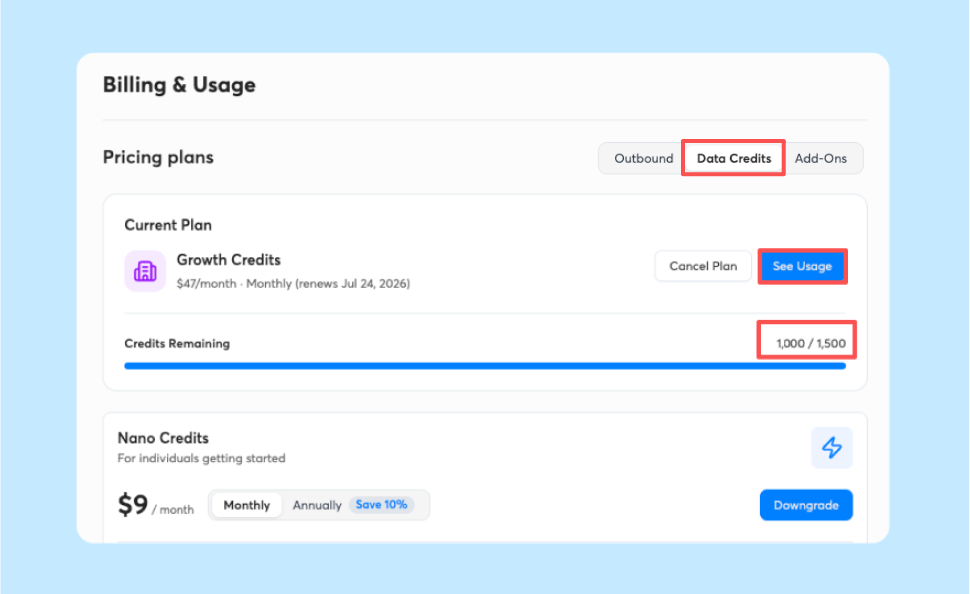
Instantly's model differs. Outreach plans include unlimited email accounts on all tiers, starting at $47 per month for Growth, $107 for Hypergrowth, and $358 for Light Speed on monthly billing. Hypergrowth and Light Speed also include Instantly CRM at no extra cost. Instantly Credits, a separate subscription, powers Lead Finder lookups and eight of Instantly's nine AI agents at transparent per-task costs. The Deliverability AI Agent is included in Hypergrowth and above Outreach plans at no extra Credits cost. You can start on a free trial ($0) with 1,000 welcome credits, and paid plans start at $9 per month for 150 credits.
Hidden OpEx in manual workflows
The hidden OpEx of prompt-only workflows includes the labor cost of cleaning lists, the deliverability cost of high bounce rates, and the compliance risk of unverified data. The cleanup math above tells the story: 1,000 invalid contacts at an assumed three minutes of research each takes roughly 50 hours. At the low end of Remote Growth Partners' fully loaded SDR cost estimate, that is roughly $2,450 in labor cost, and your own team's time and rate may differ. The real cost of prompt-only workflows is not the token cost. It is the manual work required to make the output usable, deliverable, and compliant.
Optimizing AI prompts for better conversion
Prompts convert best when they run on verified, enriched data. Instantly's AI Prompts & Enrichment provides access to multiple LLM providers, dozens of community AI templates, and per-task credit costs that make spend predictable.
Batch processing for lead hygiene
Prompts can classify, score, and clean lists in batch. Data operations in Instantly's AI Prompts & Enrichment include cleaning or reformatting data, classifying or labeling leads, and scoring leads by ICP fit. Cleaning or reformatting data costs approximately 0.5 credits per row, and basic data cleanup (normalizing first names, last names, company names, and company domains) is free. That makes it practical to run hygiene operations on large lists without manual intervention.
Ad-hoc research and lead qualification
Use prompts for account research, pain-point discovery, and qualification before sending. The reply-rate baselines from Instantly's 2026 benchmark report are covered in "Verifying data accuracy for experiments" below. Targeting and personalization are levers you control, and industry-specific outreach prompts can help with both when they run on verified data.
Prompts excel at synthesizing information from multiple sources, identifying pain points, and drafting personalized opening lines. They fail at verifying contact data, which is why the hybrid approach works.
Enriching CRM data via AI prompts
Prompts can fill missing fields, clean or reformat data, and score leads by ICP fit. The Score leads (ICP fit) task in Instantly's AI Prompts & Enrichment lets you prioritize follow-ups and segment lists by how closely each lead matches your ideal customer profile. Preview the output on one contact before you run it on the full list. Running it on verified data from Lead Finder keeps the inputs accurate while AI handles the reasoning and classification.
Scaling outbound with verified lead databases
Verified databases are the only safe way to scale volume. Prompts scale reasoning, not data. Instantly's Lead Finder provides access to 450M+ B2B leads with waterfall enrichment across seven data partners. Leads ship pre-verified, eliminating the manual verification step.
Automating high volume lead validation
Instantly's lead verification costs 0.25 credits per lead and classifies addresses as valid, invalid, or risky before sending. A separate catch-all verification pass also costs 0.25 credits per lead and helps you sort addresses that standard verification would otherwise mark as risky, catch-all, or unknown.
BounceShield automatically skips known high-risk recipients based on real-time and historical bounce data. High bounce auto-pause campaigns auto-pause once bounce rate exceeds 5% (default, configurable) after a minimum 200 sends. These are platform-level protections that prompts cannot provide.
Automating lead enrichment pipelines
Waterfall enrichment is an automated pipeline. Lead Finder checks Instantly's own database first at 1 credit per verified email, then sequences through seven data partners (BetterContact, ContactOut, Findymail, IcyPeas, LeadMagic, Prospeo, and Wiza) at 2 credits per verified email from a data partner, with no API key or partner account required. Instantly charges only when a verified email is found.
The process runs automatically in the background when you click "Find email > Work email" in Lead Finder, or "Enrich & AI > Enrich Person Info > Work email" in a list or campaign.
Ensuring GDPR and CCPA data compliance
Instantly maintains a self-service CCPA/GDPR opt-out flow covering CCPA opt-out-of-sale and GDPR/UK/Swiss objection-to-processing requests. The DPA details processing terms, sub-processor listing, audit rights, and data categories that customers must not upload.
Prompt-generated lists lack provenance and opt-out handling. A prompt cannot track which contacts have opted out, enforce suppression lists, or provide audit trails for compliance reviews.
Optimizing outbound sequence handoffs
Verified data feeds sequences, Spintax, and A/Z testing. The Growth plan ($47/mo) includes A/Z testing, but the full 26-variant capability is gated to Hypergrowth ($107/mo) and above. Instantly's AI Sequence Writer generates a full multi-step email sequence from business details and customer profile. AI Spintax Writer auto-generates Spintax variants from existing copy. AI Spam Words Checker flags spam-triggering language using an AI model that evaluates context, not just keyword-matching. These tools run on verified data from Lead Finder, ensuring deliverability and compliance while using AI for copy generation and optimization.
Optimizing output by combining AI and data
The hybrid pattern often delivers the strongest ROI. Prompts reason, databases verify, and the combination compounds. The workflow is: import list, run waterfall enrichment, apply AI prompts for personalization, send sequence, triage sales replies.
Automating lead enrichment workflows
The workflow starts with Lead Finder's waterfall enrichment, which checks seven data partners in sequence and charges only when a verified email is found. Once you have verified emails, apply AI prompts for personalization, research, and classification. The Enrich & AI flow runs in the background, combining data verification with AI-powered enrichment.
Refining prospect lists using AI prompts
Use prompts to score, segment, and prioritize lists after enrichment. Instantly's 2026 benchmark report found the best launch day is Monday, and the highest reply day is Wednesday. Instantly's 2026 benchmark report found that consistent, stable sending patterns correlate with 15 to 20% higher replies. Classifying leads by ICP fit and routing them to optimized send windows supports that consistency. Use prompts to classify leads by ICP fit, industry, and pain points, then route high-priority segments to optimized send windows.
Predictable spend for ramp sequences
Credit-based pricing makes spend predictable. Instantly Credits tiers start at $9 per month for 150 credits, $47 for 1,500 credits, $97 for 5,000 credits, and scale to $1,700 per month for 200,000 credits. Waterfall enrichment costs 1 to 2 credits per match, most AI Prompts & Enrichment tasks cost approximately 0.5 credits per row, and verification costs 0.25 credits per lead. This transparency allows you to forecast costs based on volume.
Building a winning tech decision matrix
Route each task to the layer that handles it best.
| Task | Best Tool | Why |
|---|---|---|
| Drafting emails | AI prompts | Fast, cheap, high-quality copy |
| List building | Sales intelligence platform | Verified data, compliance, scale |
| CRM hygiene | Hybrid | Prompts can classify, platform verifies |
| Ad-hoc research | AI prompts | Flexible reasoning, synthesis |
| Compliance handling | Sales intelligence platform | Opt-out suppression, provenance |
Evaluating vendor data integrity
Verification hit rate, data freshness, and provenance are evaluation criteria. Run a bake-off by importing the same list into multiple platforms and comparing verification hit rates, bounce rates, and reply rates. Instantly's Lead Finder ships pre-verified leads from its database of 450M+ B2B leads.
Validating AI against sales data
Test prompt outputs against a verified database. Run a 100-lead bake-off by generating a list with prompts, then verifying it against Lead Finder's database. Compare verification hit rates, bounce rates, and reply rates. A prompt-generated list is likely to show higher bounce rates and lower reply rates if it contains fabricated or outdated contacts.
Verifying data accuracy for experiments
Use bounce rate and reply rate as experiment validity checks. Instantly's 2026 benchmark report found the platform average reply rate is 3.43%, and top-quartile senders reach 5.5% or higher. If your campaigns fall below the average, check your data quality first. If bounce rates exceed 2%, pause sends, re-verify the list, and restart at a lower cap.
Verify your list first, then run prompts only on the contacts that pass. That keeps the data accurate and lets AI handle the personalization.
Try Instantly free and run a 100-lead bake-off between prompt-generated lists and Lead Finder's verified waterfall enrichment.
FAQs: AI prompts vs sales intelligence tools
Are AI prompts a replacement for sales intelligence tools?
No. Prompts draft and reason, but they cannot verify emails, enrich data, or handle compliance. Use prompts on top of a verified database.
Can ChatGPT replace ZoomInfo or Apollo?
No. ChatGPT has no live B2B database, no verification, and no opt-out handling. It can draft copy, but it cannot build a compliant, verified list.
How do you test data quality between approaches?
Run a 100-lead bake-off. Compare bounce rates, verification hit rates, and reply rates between prompt-generated and database-sourced lists.
What's the minimum volume where tools make sense?
There is no single volume threshold that applies to every team. The breakeven varies with your labor rate, tool costs, and accuracy requirements. If you sell to a small, defined set of accounts, manual verification is often feasible and a premium data tool can be hard to justify. As volume grows, manual OpEx tends to rise faster than tool cost. Test your own numbers: multiply the minutes of manual research per contact by your hourly labor cost, then compare it with the per-lead verification cost. Run that comparison alongside your bounce rate and verification hit rate so the decision rests on your own data.
Can you use AI prompts for GDPR-compliant prospecting?
Only if the underlying data is compliant. Prompts do not provide provenance or opt-out suppression. Use a verified database with compliance handling.
Key terms glossary
Sales intelligence platform: A software system that maintains a verified B2B contact database, enriches records, and syncs data to CRM and outreach tools.
Waterfall enrichment: A process that checks seven data providers in sequence until a verified email is found, improving match rates.
Verification hit rate: The percentage of contacts in a list that pass email verification. Higher hit rates mean lower bounce rates and better sender reputation.
Contact data freshness: How recently a contact record was updated. Fresh data reduces bounces from job changes and company moves.
Read next
- AI prompts for SaaS founders: outbound campaigns that don't sound robotic: Shows SaaS founders how to write AI prompts that produce outbound emails that read as human.
- AI prompts for sales rep onboarding: the complete guide to faster ramp times: Explains how to use prompts to help new reps learn your messaging and start selling sooner.
- The essential AI and LLM prompt library for sales teams (60 templates, 2026): Gives sales teams a library of 60 prompt templates they can copy and adapt for outreach.


