


Updated November 10, 2026
TL;DR: AI sales agents remove the three blockers that kill traditional role-play: scheduling friction, manager bias, and rep anxiety. The system works when you build scenario libraries from actual prospect pushback, score practice with rubrics tied to observable behaviors, and make drills a weekly requirement. Review objection-labeled replies in Instantly's Unibox NLP to train scenarios on buyer friction captured from live cold email conversations, not hypothetical scripts.
Yes, AI sales agents can deliver effective role-play training, but only when you feed them real buyer objections instead of generic scripts. If you lead a sales team and want repeatable practice without adding coaching headcount, this guide is for you. Most sales leaders know role-play matters. The problem is execution: scheduling live practice takes more time than the practice itself, reps feel awkward performing in front of peers, and scoring varies wildly depending on who runs the session. AI sales agents solve the logistics problem, but only if you treat the system like an operational process, not a one-time training event.
AI sales agents train reps through on-demand practice conversations that remove scheduling friction, manager bias, and rep anxiety. The system works when sales leaders build scenario libraries from actual buyer objections captured in CRM and email data, score practice with competency rubrics tied to pipeline stages, and require two to three sessions per rep each week, typically 15 to 20 minutes each.
This guide shows how to configure AI agents for realistic objection handling, design scenario libraries reps actually use, score practice with rubrics that map to pipeline stages, and make AI drills a weekly habit without adding coaching headcount.
Why AI sales agents beat traditional role-play
Traditional role-play fails because it depends on scarce resources: manager time, rep availability, and consistent scoring. AI sales agents remove those dependencies while capturing practice data manual sessions never could.
| Factor | Traditional role-play | AI sales simulation |
|---|---|---|
| Scheduling friction | Requires manager and rep availability | On-demand between calls |
| Manager time required | Manager must attend, run, and score every live session | Light weekly review |
| Scoring consistency | Varies by manager and mood | Standardized rubric every time |
| Practice frequency | Caps out at a few sessions per quarter | 2-3 sessions per week |
| Data capture | Manual notes, often lost | Automatic logging and trends |
| Rep anxiety | High (peer judgment) | Low (private practice) |
Live role-play attendance is often sporadic because sessions depend on manager calendars. Reps practice more frequently when sessions are self-directed and scored consistently.
Real skill gains over compliance
Role-play run only to meet a training requirement tends to produce little lasting change. Skill-building role-play changes behavior, and the difference comes down to practice frequency and feedback quality.
When reps practice two to three times per week with immediate scoring, they apply feedback in the next session instead of the next quarter. Repetition volume and consistent feedback drive the improvement, and the technology simply makes both easier to deliver.
Flexible training for busy teams
Manager calendars are the bottleneck in traditional role-play. A sales leader managing 10 reps cannot run weekly live practice for everyone without sacrificing pipeline reviews and deal coaching.
AI simulation removes the scheduling constraint. Reps practice between calls, before high-value meetings, or during slow periods, and practice stops feeling like an interruption. Removing the coordination tax drives adoption and makes practice a habit instead of an event.
Eliminating bias in role-play data
Manager scoring is subjective. One manager rewards aggressive closing, another penalizes it, and the inconsistency makes practice data unreliable for coaching decisions or performance reviews.
AI scoring applies the same rubric to every session. Clear rubrics that grade observable behaviors such as question depth, objection reframes, and next-step clarity produce consistent skill measurement. That consistency gives you documented evidence when people decisions get questioned. When a CFO asks why one rep got promoted over another, you can point to proficiency trends across weeks of scored practice, not a manager's gut feel.
Fine-tuning AI agents for authentic sales scenarios
Generic scripts produce generic practice. Reps disengage when scenarios feel artificial because the pushback does not match what they hear on real calls. The fix is building scenarios from actual buyer objections captured in your CRM and email engagement data.
If your team runs cold email through Instantly.ai, you can pull this material straight from your own reply data. Unibox NLP auto-classifies incoming replies into labels like "Interested," "Not interested," and "Out of Office," according to Instantly's product documentation. Custom label selection requires Hypergrowth ($107/mo) or Light Speed ($358/mo). These classifications represent real friction from live cold email conversations, which means you can review actual buyer pushback in Unibox and use it to train AI role-play scenarios.
Mapping logic for tough buyer pushback
Objection-handling scenarios work when they mirror real buyer behavior. Start by reviewing objection-labeled replies in Unibox and aggregating them by category: price, timing, authority, competitor, need.
For each category, build a logic tree mapping the buyer's initial objection, likely follow-up pushback, and resolution paths. A price objection might branch into "too expensive versus competitor," "no budget this quarter," or "need to justify ROI to leadership." Each branch requires a different rep response.
Evaluate each role-play turn by turn against your competency framework: discovery depth, objection handling, value articulation, and next step. This structure ensures practice maps to the skills that actually move deals.
Designing effective discovery drills
Discovery practice often falls short when reps stay with broad, general questions and accept vague answers. Effective discovery drills push reps to ask follow-up questions about the impact of the problem, who is involved in the buying decision, and how the problem connects to a business goal.
Build discovery scenarios around your qualification framework. If you use MEDDICC, create scenarios where the AI buyer withholds metrics, economic buyer access, or decision criteria until the rep asks the right follow-up questions. If you use SPIN, build scenarios that reward situation, problem, implication, and need-payoff questioning.
Build the rubric around the actual sales methodology your team runs rather than generic talk-ratio scores. If you use MEDDICC, score how well the rep uncovers each component of the framework: metrics, economic buyer, decision criteria, decision process, identify pain, champion, and competition, according to Nutshell's MEDDICC overview. If you use SPIN, score situation, problem, implication, and need-payoff question quality.
Building effective sales pitch scripts
Pitch drills fail when they reward feature recitation instead of outcome articulation. Keep pitch scenarios focused on one clear ask: connect the solution to the buyer's stated business problem with proof.
Instantly's 2026 benchmark report found that emails under 80 words generate the highest reply rates. That finding is about email, not spoken pitches, but the same instinct for brevity is worth applying to verbal pitches, even though it's a different medium. Practice scenarios should penalize rambling and reward concise value articulation. The benchmark data also shows that top-quartile senders, at 5.5%+ reply rates, keep messaging tight and focused. For segmented benchmarks by industry and sequence type, see AI sales agent benchmarks.
Build pitch scenarios that require reps to deliver the core value prop in under 60 seconds, then handle one clarifying question. This constraint forces clarity and prevents the feature dump that kills most pitches.
Customizing simulation scenarios
Reps ignore generic scenarios because they do not reflect their territory, industry, or deal stage. Adapt scenarios by industry vertical, buyer persona, and deal stage. A discovery call with a CFO at a 500-person manufacturing company requires different questions than one with a VP of Sales at a 50-person SaaS startup. Build separate scenario tracks for each major persona and industry you target.
Avoid building 50 scenarios upfront. A practical starting point is three to five core scenarios covering your most common objections and deal stages, such as price, timing, and competitor pushback. Practice each one several times before adding more. Then review the library on a regular schedule (quarterly works for many teams) and add scenarios based on rep feedback and lost deal analysis.

Building asset libraries reps actually adopt
Scenario libraries fail when they live in a wiki nobody reads or when they reflect what leadership thinks buyers say instead of what buyers actually say. Adoption requires sourcing scenarios from real conversations and making the library easy to access during practice.
Scripting responses to primary prospect pushback
Every rep needs practiced responses to five common objections that can derail deals. Pull these from your Unibox objection labels and lost deal reviews.
- Price objection: "Your solution costs more than we budgeted."
- Timing objection: "This is not a priority right now."
- Authority objection: "I need to run this by my boss."
- Competitor objection: "We already use [competitor]."
- Need objection: "We do not have this problem."
For each objection, script three response paths: a clarification question, a reframe, and a proof point. Load these into your AI simulation platform so reps practice the same objection multiple times with slight variations in buyer context.
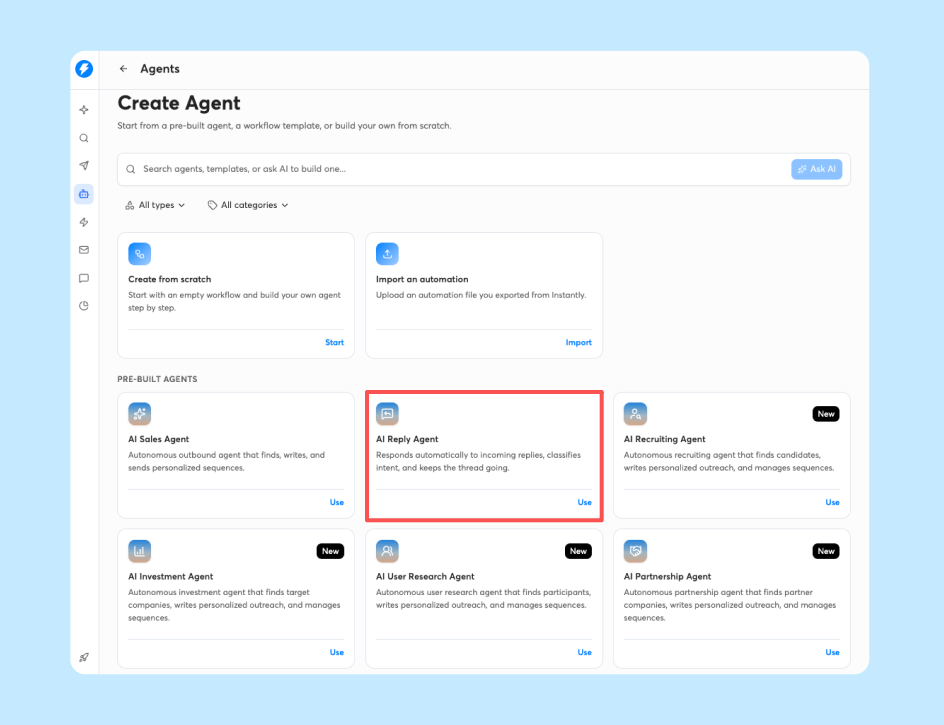
The AI Reply Agent handles lead replies automatically, which means you can see how Instantly's AI responds to common objections in live conversations. Use those responses as a starting point for your role-play scripts, then refine based on what your top performers say. To see how reply classification and CRM handoff work under the hood, read about AI sales agent architecture.
Aligning AI simulations with pipeline stages
Practice connects to revenue when scenarios map to pipeline stages. A prospecting-stage scenario focuses on earning the meeting. A discovery-stage scenario focuses on qualifying budget and authority. A negotiation-stage scenario focuses on protecting margin while advancing the deal.
Map each scenario to a CRM stage and track how practice scores correlate with stage conversion rates. If reps score high on discovery practice but discovery-stage deals stall, your scenario does not reflect real buyer behavior.
Instantly's HubSpot integration in Automations allows you to sync reply data and campaign activity to CRM fields. This gives you the pipeline side of the picture, such as which replies and deals move forward. Practice proficiency scores come from your simulation platform, so they need their own import step into your CRM before you can compare them with pipeline outcomes (see the steps in "Mapping role-play results to CRM" below).
Collecting custom training requests from reps
Reps hear objections you do not. Create a feedback loop where reps can log new objections as they come up, using a simple form or Slack workflow. Start with a few basic fields, such as the objection wording, the buyer context, and what the rep said in response. Add more fields (like the deal outcome) only if your team needs them.
Aggregate submissions on a regular schedule (monthly works for many teams) and prioritize objections that surface repeatedly or attach to lost deals. Convert high-impact objections into new AI scenarios by adding buyer persona, deal context, and success criteria. This keeps the scenario library fresh and signals to reps that their input shapes training, which can improve adoption.
Refining skills using past deal failures
Lost deals are practice gold. Every lost deal contains a moment where the rep could have changed the outcome with a better response. Review closed-lost deals monthly, identify the objection or stall point where the deal went sideways, and build a scenario that puts the rep back in that moment with a chance to try a different approach.
Frame failure analysis as coaching input, not blame. The goal is to identify skill gaps and build practice around them, not to punish reps for losing deals.
Quantifying rep performance through AI rubrics
Rubrics turn subjective feedback into objective data. When you score practice consistently, you can track proficiency trends, identify skill gaps, and make coaching decisions based on evidence instead of anecdotes.
Standardizing KPIs by practice type
Each practice type needs its own scoring criteria. Objection handling measures resolution quality. Discovery measures question depth. Pitch measures clarity and brevity. Follow-up ask measures how clearly the rep proposes a next step.
Here is an example objection-handling rubric. Adapt the levels to your team. Each level describes observable behaviors:
- 1 (Developing): Becomes defensive, debates the buyer, or drops price.
- 2 (Emerging): Acknowledges the concern but offers a generic answer, and does not confirm whether it was resolved.
- 3 (Proficient): Clarifies the concern, reframes it, and confirms resolution.
- 4 (Strong): Reframes the concern with relevant proof and checks that the buyer agrees before moving on.
- 5 (Advanced): Addresses the concern before the buyer pushes on it, connects the answer to what the buyer cares about, and keeps the conversation moving toward a next step.
Here is an example follow-up ask rubric. It scores how clearly the rep proposes a next step. Adapt the levels to your team:
- 1 (Developing): Ends with a vague next step, such as "let's circle back," or pushes for a hard close.
- 2 (Emerging): Suggests a next step but gives no date, owner, or purpose.
- 3 (Proficient): Proposes a specific next step with a date and a clear purpose.
- 4 (Strong): Confirms the next step with the buyer and agrees on who will attend or prepare.
- 5 (Advanced): Ties the next step to the buyer's stated goal and identifies other stakeholders to involve.
Rubrics that grade observable behaviors produce consistent skill measurement.
When you weight competencies, prioritize the skills your pipeline data ties most closely to closed deals, such as discovery depth and objection handling, rather than delivery polish alone.
Prioritizing immediate feedback by rep experience
Real-time feedback works best for new reps building foundational skills because immediate correction prevents bad habits from forming. Post-session review works better for experienced reps refining advanced techniques because it allows them to complete the full scenario before deconstructing what worked.
Prioritize immediate feedback during onboarding and when introducing new scenarios, then shift to post-session review once reps demonstrate baseline proficiency. Faster feedback loops compress the time between practice and correction.
Benchmarking rep performance over time
Proficiency trends matter more than single-session scores. Compare each rep's average rubric score week over week so you can spot improvement and plateaus. Pick a tracking window that fits how often your team practices.
Judge growth by trend rather than by a single score. A rep whose average climbs steadily over the quarter is improving, while a rep whose scores stay flat for several weeks likely needs targeted coaching instead of more generic practice. Set realistic proficiency targets based on your team's current performance. For example, review where your strongest reps score today on objection handling, then set a team benchmark that most reps can reach within a quarter. Avoid arbitrary targets that do not connect to actual deal outcomes.
Using simulation metrics to refine rep workflows
Practice data becomes valuable when it changes coaching decisions. Use rubric scores to identify skill gaps, assign targeted practice, and connect proficiency to pipeline outcomes.
Pinpointing individual performance gaps and scheduling targeted role-play
Aggregate rubric scores hide actionable insights. A rep with a 3.5 average might score 4.5 on discovery but 2.5 on objection handling, and that gap tells you exactly where to focus coaching.
Review individual competency scores monthly, identify the lowest-scoring competency for each rep, assign practice scenarios that target that skill, and track whether focused practice improves the gap over the next four weeks. This beats generic "practice more" advice because it directs effort toward the skills that improve results fastest.
Build a practice calendar that rotates scenario focus across the four competencies in your framework: discovery depth, objection handling, value articulation, and next step. Monday: discovery depth drills. Wednesday: objection handling sprints. Friday: alternate between value articulation (pitch) drills and next-step practice, switching every other week. This structure builds habitual practice and covers all four competencies within two weeks, so every rep addresses each one at least monthly. Allow reps to add extra sessions targeting their identified gaps so high performers can focus on advanced scenarios while newer reps build foundational skills.
Mapping role-play results to CRM
Practice data gains credibility when it correlates with pipeline outcomes. In your CRM (HubSpot or another system of record), create custom fields for practice proficiency scores and track how they correlate with stage conversion rates and win rates. If you want outreach and pipeline activity in one place, Instantly's CRM combines email, calls, SMS, tasks, and pipeline management in a single place. CRM access is included with Hypergrowth ($107/mo) and Light Speed ($358/mo) Outreach plans, but not with Growth ($47/mo).
Map Instantly reply data to HubSpot contact properties so you can track how reps with high objection-handling scores perform on deals with pricing pushback.
Practice scores need an extra step. Automations triggers and actions cover Instantly events (such as email sent, opened, replied, or bounced) and HubSpot events (such as contact or deal changes). They don't pull rubric scores from a separate role-play platform. First, get the scores into HubSpot contact properties using your simulation platform's own export or integration, or a connector such as Zapier or Make. Once the scores sit in HubSpot, use the HubSpot integration in Automations to react to those HubSpot-side changes, such as starting a coaching workflow when a score field drops below your threshold.
A practice-to-pipeline flow looks like this: AI simulation generates rubric scores, your team loads those scores into CRM custom fields (through the simulation platform's export or integration, or a connector such as Zapier or Make), managers review proficiency trends in weekly one-on-ones, coaching focuses on the lowest-scoring competency, and you track whether improved practice scores correlate with better stage conversion over the next quarter.
Visualizing rep proficiency trends
Dashboards make practice data actionable. Build a simple proficiency trend chart showing average rubric score per rep over a consistent multi-week window, with a team average line so individual reps can see their performance relative to peers without public rankings.
Update the dashboard weekly and review it in team meetings. Highlight reps showing strong improvement trends, and use declining trends as a coaching trigger, not a performance management issue.
Establishing routine AI drills for sales reps
Practice sticks when it becomes a habit. Habits form when expectations are clear, participation is tracked, and results connect to outcomes reps care about.
Encouraging AI simulations for call prep
Encourage a short practice session before high-value calls. Pre-call preparation of about 10 minutes (research, objective, and a short rehearsal) is a common recommendation. For a rep preparing for a pricing negotiation, a quick warm-up works best: spend a couple of minutes rehearsing one price objection response, not running a full scenario. Save full 15 to 20 minute sessions for scheduled practice. A short rehearsal makes practice immediately relevant and reinforces the connection between simulation and live performance.
Track completion in your CRM or the system of record your team already uses. Instantly's CRM is included with Hypergrowth and Light Speed Outreach plans, but not Growth. Reps who complete pre-call practice should show higher confidence and better outcomes on those calls. Use that correlation to reinforce the habit.
Standardizing weekly AI simulation goals
Set a minimum of two to three practice sessions per rep per week. A good baseline is three sessions of 15 to 20 minutes each, roughly 45 to 60 minutes of focused practice weekly. This cadence fits between calls and does not require blocking large chunks of calendar time.
Track weekly completion rates and address participation gaps in one-on-ones before they become patterns.
Measuring proficiency, not leaderboards
Leaderboards create perverse incentives. Reps game the system by running easy scenarios repeatedly or rushing through practice to hit session counts. Proficiency thresholds focus on skill development instead of competition.
Set individual proficiency targets based on each rep's current performance and growth trajectory. Targets vary by competency and rep experience, so avoid one number for everyone. A newer rep might aim for a solid baseline across core competencies by the end of their ramp period (a typical industry planning range is roughly 8 to 12 weeks for entry-level reps, though it varies with how structured your onboarding is), while an experienced rep might push for a higher score on one advanced competency such as objection handling. Share anonymized team benchmarks quarterly to provide context without public rankings.
Auditing rep participation in AI drills
Track completion rates weekly. A rep who completes zero sessions for two consecutive weeks needs a coaching conversation, not a warning. Low participation usually signals that practice feels irrelevant, too time-consuming, or disconnected from current deals.
Review participation data in weekly one-on-ones, ask reps which scenarios they found useful and which felt like a waste of time, and use that feedback to refine the library. Tie participation to development plans, not compensation, so practice stays a skill-building tool rather than a quota.
Consistent, focused practice that targets individual skill gaps is what builds skill over time.
"I'm also a fan of their AI reply agent, which helps manage a high volume of responses by categorizing replies, understanding the conversation context, and preparing responses based on my instructions." - Riley T. on G2
Start your 14-day free trial of Instantly to review real buyer objections in Unibox and build your first AI role-play scenario library. Run live cold email campaigns during the trial, capture the pushback that comes back, and feed it straight into your scenarios.
FAQs: AI sales agents for role-play training
Can AI sales agents do role-play training effectively?
Yes, when you build scenarios from real buyer objections instead of generic scripts. The system supports faster ramp and more frequent practice during onboarding because reps can drill on demand instead of waiting for quarterly live role-play sessions.
How long should each AI practice conversation last?
Keep sessions short. A practical starting point is about 15 to 20 minutes, since sessions under 10 minutes rarely leave time to complete a full scenario. Adjust the length to your team and the scenario. Short sessions fit between calls and keep focus on one skill at a time, which helps retention and reduces practice fatigue.
Will reps actually use AI role-play between calls?
Adoption depends on scenario relevance and scoring consistency. Reps engage when scenarios reflect the objections they hear on live calls and when practice scores connect to visible skill improvement and coaching decisions.
How do you prevent reps from gaming the scoring system?
Focus rubrics on conversational depth and observable behaviors rather than keyword matching. A rep gaming the system produces flat scores with no improvement trend, which becomes obvious in weekly manager reviews comparing practice scores against live call performance.
Can AI replace live manager coaching sessions?
No. AI handles repetitive practice and skill tracking, which frees managers to focus on high-value coaching conversations about deal strategy and career development. Use AI for practice volume and managers for judgment and context. The same hybrid approach applies to research work, as covered in replacing VAs with AI.
Key terms glossary
AI sales simulation: AI sales simulation uses conversational AI to replicate buyer interactions, allowing reps to practice objection handling, discovery, and pitch delivery on demand. The system scores each session against a rubric and tracks proficiency trends over time.
Objection handling: Objection handling is the skill of addressing buyer concerns about price, timing, authority, need, or competitors in a way that advances the deal. Effective objection handling clarifies the concern, reframes the issue, and confirms resolution before moving to the next step.
Discovery practice: Discovery practice trains reps to ask questions that quantify pain, identify the buying committee, and link the problem to a business outcome. The goal is to uncover the information needed to qualify the opportunity and position the solution effectively.
Scenario library: A scenario library is a collection of practice conversations built from real buyer objections, organized by competency and deal stage. Sales leaders keep the library current by reviewing it on a regular schedule (quarterly works for many teams) and adding or retiring scenarios based on rep feedback and lost deal analysis.
Scoring rubric: A scoring rubric defines observable behaviors for each competency and assigns point values to different performance levels. Rubrics remove subjectivity from practice feedback and allow sales leaders to track proficiency trends across weeks and months.
Read next
- Why your AI voice agent has low connect rates (and how to fix it): Find out why AI voice agents get low connect rates and which fixes help you reach more prospects.
- What is an AI sales agent? Definition, capabilities, and limits: Learn what an AI sales agent does, where it works well, and where it still needs human oversight.
- AI sales agents vs traditional sales training software: what's actually different?: See how AI sales agents differ from traditional sales training software in cost, practice frequency, and feedback quality.


