


Updated November 10, 2026
TL;DR: AI sales agents help account executives (AEs) close complex deals faster when deployed as a deal coach that handles pre-call research, objection support, and post-call action plans. Consistency matters too, since Instantly.ai's 2026 benchmark report found that consistent senders see 15-20% higher reply rates than erratic senders. This guide shows sales leaders how to implement AI for AE calls to cut admin time, standardize playbooks, and improve pipeline health without sacrificing human judgment. You'll learn specific workflows for discovery, demos, and closing calls, plus ROI metrics and governance steps.
If you lead a team of AEs, this guide shows how AI sales agents for account executives support each call stage, from pre-call research to post-call follow-up, while your reps stay in control of every conversation.
Why AEs need AI as a deal coach, not a replacement
Deploying AI that tries to replace discovery is a common mistake sales leaders make. The better move is AI that makes discovery sharper.
One useful way to group AI sales agents for account executives is by call stage. Some agents handle post-call work like CRM updates and follow-up scheduling, while others prepare AEs before calls with account research and account mapping. A third group can support live calls with guidance and objection-handling suggestions.
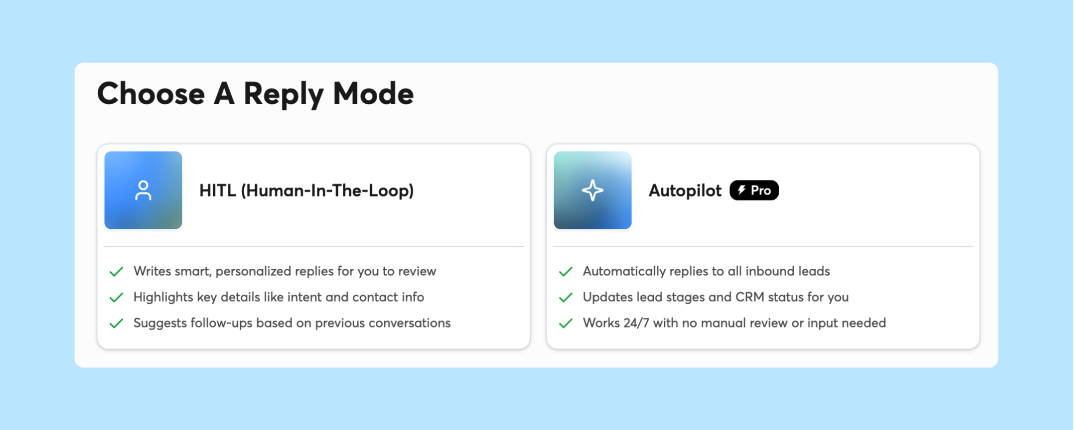
The key differentiator is human-in-the-loop control. Your AE stays in charge of the conversation while the AI supplies context, competitive intelligence, and suggested next steps drawn from email replies and CRM history. This prevents the trust erosion that happens when AI misclassifies replies or suggests wrong competitive responses during live calls.
Here is how the three stages break down:
| Call Stage | Primary Use Case | Example Tasks | Instantly Features |
|---|---|---|---|
| Post-call | Follow-up automation | Logging call notes in the CRM, drafting follow-up emails | AI Reply Agent |
| Pre-call | Account research | Mapping the buying committee, reviewing buyer-intent signals | Lead Finder, Copilot for account research |
| During-call | Live-call guidance | Objection context from recent replies, follow-up drafts | Unibox NLP, AI Reply Agent for reply drafts |
Solving visibility gaps in complex deals
Complex deals fail when AEs miss critical stakeholder context. AI agents surface hidden decision-makers and account history before your AE picks up the phone.
Instantly's Lead Finder identifies high-intent B2B prospects using buyer-intent signals across four categories: social activity, buying intent, growth signals, and company activity. The database holds 450M+ verified leads, with new buying signals added weekly. This means your AEs start discovery calls knowing which stakeholders changed roles, which competitors the prospect mentioned, and what pain points appeared on Reddit or industry forums. To reach C-suite buyers consistently, see how to build a repeatable executive outreach system with verified contact data.
The cost of manual call prep
Manual prep takes time away from selling. Cutting AI-assisted prep time per meeting could return selling hours to each AE every week, and the exact amount depends on your deal volume and how much research each account needs. Individual gains vary. That recovered time translates to more discovery calls, more demos, and more closed deals.
Driving pipeline health through AI
Pipeline health depends on consistent input. Instantly's 2026 benchmark report found that consistent senders see 15-20% higher reply rates than erratic senders. Consistency requires automation.
AI agents feed pipeline health by qualifying leads before they reach AEs. Instantly's Lead Finder Agent monitors campaign lead counts and automatically tops up fresh prospects when thresholds drop. This ensures AEs always have qualified conversations scheduled, rather than spending Monday morning hunting for new leads. To understand how deliverability impacts this pipeline, review the email warmup guide.
How AI agents accelerate pipeline readiness
Pre-call preparation determines call outcomes. AI agents cut prep time by automating account research, history review, and deal summaries.
Here is the workflow for AI-assisted pre-call readiness:
- Stakeholder identification: AI maps the buying committee using job titles, engagement history, and intent signals.
- History compilation: AI pulls past emails, call notes, and CRM activity into a single brief.
- Insight generation: AI analyzes buyer persona, pain points, and competitor usage.
- Deal summary creation: AI generates a one-page summary with next steps, risks, and stakeholder status.
This process reduces prep time compared with researching each account by hand. More importantly, it standardizes quality across your team so every AE enters calls with the same depth of context.
Mapping accounts for faster outreach
Account mapping identifies the buying committee before the first call. AI agents analyze organizational structure and buying signals to surface decision-makers.
Instantly's Lead Finder uses a Signals filter that surfaces funding events, leadership changes, and competitor mentions. The system tracks millions of new signals weekly against the contact database. Your AEs see which prospects just raised Series B funding, which companies changed CFOs, and which accounts mentioned your competitor in a Reddit thread last week. Learn more about Lead Finder capabilities for building targeted account lists, then route those lists into Instantly CRM so signals, deals, and follow-up tasks stay in one pipeline. Instantly CRM is bundled into the Hypergrowth ($107/mo) and Light Speed ($358/mo) Outreach plans. It is not included with Growth ($47/mo), so confirm your plan before you build CRM workflows.
Reviewing account history before calls
Context wins deals. AI agents compile every touchpoint into a digestible brief.
Instantly CRM (included with Hypergrowth and Light Speed) aggregates opportunities, tasks, and pipeline activity in one view. When an AE opens a deal, they see email threads from Unibox, task history, and deal activity without switching tabs. The Out-of-Office Resume feature automatically pauses sequences when prospects are away and resumes them on return dates, ensuring no context gets lost during gaps.
AI-driven insights for sales readiness
Raw data does not help AEs. Insights do. AI agents analyze buyer persona, pain points, and the competitive market to generate actionable intelligence.
Instantly Copilot researches accounts and surfaces relevant talking points. It runs on Instantly Credits, with the free trial including 1,000 credits to test the workflow.
Generating actionable deal summaries
Deal summaries prevent information loss between calls. AI creates standardized one-pagers that capture stakeholder status, next steps, and risk factors.
Instantly Automations trigger follow-up tasks when specific events occur, such as a lead replying, a campaign finishing for a lead, or a lead's interest status changing. For example, when a lead replies to a campaign, the automation can create a task for the AE to review the account history and email thread before the scheduled call. Automations don't write the deal summary itself, so pair them with a connected tool such as Zapier or Make if you want summaries generated automatically. This ensures no AE walks into a demo without knowing the full account context.

How AI agents support live sales calls
Live calls separate good AEs from great ones. AI demo assistants work when they are fast, accurate, and under AE control.
The critical requirement is human-in-the-loop operation. The AE decides what to say while the AI supplies supporting context. This prevents the latency and context-loss issues that plague fully automated systems, where delays or misclassifications cause prospects to disengage.
Defeating competitor claims mid-demo
Competitor mentions are common in complex deals. AI battle cards surface relevant responses in real time.
An effective battle card covers four areas: a competitor overview, key differentiators (yours versus theirs), trap questions to set for the competitor, and landmine questions to anticipate. When a prospect names a competitor in an email reply, the AI can flag the mention and link the relevant card on the deal record before the demo. Your AE chooses whether to address it immediately or note it for follow-up.
Instantly's Unibox plus CRM gives AEs a unified view of email, calls, and tasks in one place. This integration means your battle cards live alongside your email threads and deal notes.
AI guidance for complex deal objections
Objections follow patterns. AI agents suggest responses based on deal stage, persona, and past interactions.
For a pricing objection, an AE could draft a reply that acknowledges the budget constraint, confirms the decision timeline, and offers an ROI calculation from a similar customer. Instantly's AI Reply Agent can draft a contextual reply to an objection from email replies, and the AE reviews it before sending. For a security objection, the AE should answer only with security documentation and certifications your company can verify, such as a security overview, a call with your security team, or data residency options. Confirm which compliance claims your company can publicly support before referencing them. The AE selects the appropriate response and adapts it to the conversation flow.
Customizing AI guidance by buyer persona
Different stakeholders care about different outcomes. AI adjusts language and proof points accordingly.
| Persona | Key Concern | Proof Point to Bring |
|---|---|---|
| CFO | ROI and cost reduction | Your team's cost-per-meeting figure for the current quarter, pulled from your own CRM data |
| CTO | Integration and security | Your public API documentation and any security whitepaper your company publishes |
| End User | Ease of use and time savings | A walkthrough of the workflow steps and any time-tracking data your team has collected |
This ensures your AE speaks the right language to each stakeholder without memorizing separate scripts.
Managing live demo time allocation
Demos fail when AEs run out of time before covering value propositions. A preset agenda helps the AE keep the demo on the plan. A visible timer or a shared agenda lets the AE check whether feature walkthroughs are crowding out outcomes.
For a typical 30-minute demo, the AE can set an agenda across discovery confirmation, workflow demonstration, ROI discussion, and next steps, for example 5, 12, 8, and 5 minutes. The AE can then check time against that agenda during the demo. If the demo runs long on features, a simple agenda reminder helps the AE transition to business impact. This structure improves demo consistency across your team.
AI negotiation tactics for faster deal closure
Closing calls require precision. AI for closing calls helps AEs avoid discounting traps and spot red flags in buyer sentiment.
The goal is supporting negotiation without replacing AE judgment. AI provides guardrails and intelligence while the AE maintains relationship control.
Preventing rogue discounting tactics
Unauthorized discounting kills margins. A clear pricing playbook keeps reps within approved policy.
When a prospect requests a discount, the AE checks the request against your approved pricing policy. If the request falls outside those limits, the AE can offer alternatives that your team has already approved, such as extended payment terms or a reduced seat count at the same per-seat rate. These are standard negotiation options, not Instantly features. Instantly doesn't enforce discount rules automatically, so keep the approved limits and alternatives in a shared playbook or CRM field that every rep can see. This standardization prevents reps from making promises that finance cannot support.
Redline and term support
Contract negotiations stall over non-standard clauses. Your legal team and AEs need a clear way to spot deviations from standard agreements.
This is a process step, not legal advice. Instantly doesn't review contracts, so keep your standard MSA and a list of pre-approved alternative clauses in a shared playbook. The AE compares requested terms against that list and sends any deviations to your legal team for review. Your legal team makes final decisions, which keeps AEs from agreeing to problematic terms during a verbal negotiation.
Spotting red flags in call sentiment
Buyer disengagement predicts deal slippage. AI analyzes call sentiment to flag risks early.
Instantly's Unibox NLP performs sentiment analysis on email replies, classifying them by interest level. For live calls, separate conversation intelligence tools analyze vocal patterns. The key is connecting these signals to your CRM so AEs see engagement trends across all touchpoints.
Post-call: AI-generated mutual action plans
Automating the work after a call delivers measurable ROI from AI agents. Manual CRM updates and follow-up scheduling consume hours that AEs should spend selling.
Here is the post-call workflow:
- Action plan generation: AI creates a mutual action plan with owner, due date, and next step for each stakeholder.
- CRM updating: AI logs call notes and updates deal stage automatically.
- Follow-up scheduling: AI triggers appropriate email sequences based on call outcomes.
- Forecast updating: AI adjusts close date predictions based on engagement signals.
Automating post-call action plans
Mutual action plans (MAPs) keep deals moving. AI generates these documents immediately after calls.
A sample MAP structure includes: stakeholder name, their action item, due date, and dependency notes. For example: "Sarah (CFO) to review ROI calculation by Friday, depends on receiving Q3 usage data." The AI assigns tasks in your CRM and sends calendar invites to stakeholders, ensuring accountability without AE administrative work.
Predictive forecasting of close dates
Close date accuracy improves with engagement data. AI uses deal velocity and interaction frequency to predict timelines.
These predictions appear as ranges rather than guarantees. For example, AI might flag deals as high, medium, or low probability based on response time and stakeholder engagement patterns. This helps sales leaders allocate resources and identify at-risk deals before they slip.
Standardizing buyer committee sign-off
Multi-threaded deals require multiple yeses. AI tracks stakeholder engagement and flags missing sign-offs.
Instantly tracks email opens and clicks, and Instantly CRM holds tasks and deal activity (CRM requires Hypergrowth or above). Together, they show which stakeholders engaged by email and which action items are still open. Instantly doesn't track call attendance automatically, so the AE should log who joined each call in the CRM. If the technical evaluator has not engaged recently, the AE re-engages that persona before requesting final approval. This prevents deals from stalling due to overlooked stakeholders.
Automating CRM data entry and hygiene
Clean data enables accurate forecasting. AI logs call notes, updates deal stages, and flags stale information.
Instantly Automations trigger CRM updates when specific events occur. When a campaign finishes for a lead, the automation creates a task for the AE to log call notes. When a lead replies with positive sentiment, the automation updates the deal stage. This ensures your CRM reflects reality without requiring manual data entry.
Quantifying AI ROI on AE pipeline health
AI investment requires measurement. Sales leaders should track admin hours saved, deal velocity improvements, and pipeline coverage changes rather than just counting meetings booked.
Here is the ROI framework comparing manual versus AI-assisted workflows:
| Stage | Manual Workflow | AI-Assisted Workflow | Time Saved |
|---|---|---|---|
| Pre-call | Approx. 30-60 minutes of research per account | A brief generated automatically, ready for a quick review | Varies by account complexity |
| During-call | Looking up competitor details and taking notes by hand while on the call | Battle cards and objection context from recent email replies, linked on the deal record before the call | Varies by call length |
| Post-call | Manual CRM updates and follow-up scheduling | An AI-drafted mutual action plan ready for AE review and approval | Varies by deal size |
Quantifying AI impact on deal flow
Deal flow measures opportunities entering the pipeline. According to Remote Growth Partners' 2026 breakdown of in-house SDR costs, the realistic fully loaded cost of a U.S. in-house SDR is about $154,800 annually, within a range of $116,500 to $210,000 depending on market. That cost includes base salary, payroll taxes, benefits, recruiting, ramp time, tools, management, and turnover. The same source assumes an in-house SDR produces about 80 to 100 meetings per year, which puts cost per meeting at $1,548 to $1,935. Treat that range as a vendor-published estimate, and check it against your own meeting counts.
AI agents reduce this cost by improving SDR efficiency. When SDRs spend less time on manual research and follow-up, they book more meetings with the same effort. Frame this as a performance metric rather than a guarantee, since results depend on your specific market and execution. For a closer look at where AI SDRs end and AI sales agents begin, read this guide to AI sales agent vs AI SDR.
Reducing admin hours per deal cycle
Calculate hours saved using this formula: (hours saved per deal) × (deals per rep per month) × (number of reps). Multiply the result by your average hourly cost to get the dollar value.
As a hypothetical example, say a team of 5 AEs saves about 1 hour per deal across 20 deals per AE monthly: 1 × 20 × 5 = 100 hours recovered monthly. At $75 per hour fully loaded cost, that equals $7,500 in recovered selling capacity monthly. This capacity either reduces headcount needs or increases deal volume without adding staff.
Standardizing AI playbooks across reps
Variance between top and bottom performers creates forecasting headaches. AI playbooks reduce this variance by ensuring every rep follows proven processes.
When new AEs join, they access the same team-maintained competitor comparisons, answers to common objections, and demo flows as top performers. Keep these in a shared playbook, and use Instantly's campaign analytics to show which sequences and copy earned replies. New AEs can then read the replies in Unibox and see the related deals in your CRM. This standardization improves predictability and reduces ramp time for new hires.
Quantifying AI impact on revenue
Faster deal cycles and higher win rates compound into revenue growth. As a hypothetical example, if AI reduces your sales cycle by 15% and improves win rates by 10%, you can calculate the revenue impact based on your average deal size and pipeline coverage.
For a team closing $2 million quarterly with 90-day cycles, a 15% cycle reduction means closing the same deals in approximately 76 days. That creates capacity for additional deal cycles annually, effectively increasing revenue potential without adding headcount.
Ready to test AI agents for your AE team? Try Instantly free and try Lead Finder, Copilot, and CRM features for your pipeline, plus AI Reply Agent for drafting replies to inbound leads. The 14-day trial includes 1,000 Instantly Credits so you can test the full workflow without commitment. The CRM trial also runs 14 days on any plan, but keeping CRM afterward requires Hypergrowth or Light Speed.
FAQs: AI sales agents for account executives
Will AI agents slow down AEs during live calls?
No, when configured with human-in-the-loop controls. The AE maintains conversation control while the AI supplies context through a side interface. Latency issues that cause hang-ups in fully automated systems do not apply when AI augments rather than replaces human speech.
How does AI handle multi-threaded deals with multiple stakeholders?
AI maps the buying committee using organizational data and engagement signals. It tracks each stakeholder's interaction history, interests, and concerns, then suggests persona-specific talking points. The system flags missing sign-offs and identifies disengaged stakeholders before they stall the deal.
Can AI demo assistants integrate with an existing CRM and call recording tools?
Yes, Instantly integrates with major CRMs including HubSpot and Pipedrive. The Automations feature triggers actions across 140+ platforms. Instantly's CRM (Hypergrowth and above) handles calls alongside email, tasks, and SMS. For call recording, you can connect third-party conversation intelligence tools through Zapier or webhooks.
What happens if the AI suggests the wrong competitive response?
With human-in-the-loop mode, requiring AE approval before using AI suggestions reduces this risk. The AI displays recommendations, but the AE chooses whether to use them. For competitive intelligence, maintain updated battle cards with input from your sales and product teams. Review AI suggestions weekly to ensure accuracy and relevance.
How quickly can a team adopt AI sales agents without disrupting quota?
Start with post-call automation, which delivers immediate ROI without changing live call behavior. Implement pre-call research next, allowing AEs to review AI briefs before scheduled calls. Introduce live-call guidance last, after your team trusts the AI's accuracy. Industry guides commonly describe 60 to 90 day phased adoption timelines, so use that as a planning range, not a guarantee. Adjust the pace to how quickly your reps build trust in the AI's suggestions.
Key terms glossary
Multi-threaded deal: A complex sale requiring buy-in from multiple stakeholders across different departments or seniority levels, typically involving 3-7 decision-makers.
Mutual action plan (MAP): A shared document listing specific actions, owners, and due dates for both buyer and seller stakeholders, designed to maintain momentum toward contract signature.
Deal velocity: The speed at which opportunities move through your pipeline stages, typically measured using the formula: (qualified opportunities × win rate × average deal size) ÷ average sales cycle length.
Stakeholder mapping: The process of identifying all individuals involved in a purchasing decision, understanding their roles, concerns, and influence levels within the buying committee.
Battle card: A concise reference document containing competitor intelligence, objection responses, and proof points that AEs use during live calls to address competitive threats effectively.
Read next
- Replacing VAs with AI sales agents: what changes for agencies: See how agencies can shift repetitive virtual assistant tasks to AI sales agents and which responsibilities still need a human.
- AI sales agent reply rate benchmarks 2026: what's average vs. top quartile: Compare average and top-quartile reply rates so you can set realistic targets for your AI-assisted outreach.
- AI SDR best practices for maximum lead generation output: Learn the setup, governance, and deliverability habits that help AI SDRs generate more qualified leads.


