.svg)
%20(1).svg)


Updated June 22, 2026.
TL;DR: AI SDRs break the reply rate ceiling not by writing better copy, but by combining real-time buying signals with distributed, multi-mailbox sending infrastructure. Signal-triggered campaigns consistently achieve reply rates of 4% to 8%, compared to 1% to 3% for generic cold outreach, because they reach the right prospect at the right moment. The system combines verified data inputs with a maximum of 30 emails per inbox per day, rotated across 3 to 5 inboxes and 3 or more sending domains to safely reach 90 to 150 cold emails per day and automated warmup across multiple accounts. Without the deliverability layer, AI personalization at scale produces elevated spam-flag rates that destroy domain reputation.
Most sales teams assume cold email reply rates are falling because the copy is not good enough. The actual problem is simpler and harder to fix with a template: you are reaching the wrong people at the wrong time, and your messages are landing in spam before a human ever sees them.
This guide explains how an AI sales agent combines real-time buying signals with automated deliverability systems to improve reply rates. We analyze the performance benchmarks, detail the core data inputs required for personalization, and provide a playbook to scale outreach safely without risking your domain reputation.
How static messaging kills modern inbox engagement
Cold email volume has surged while average reply rates have fallen below 3% for generic campaigns, a gap even the leading AI SDR tools for sales teams are built to close. The decline does not stem from weak copywriting. Static lists go stale quickly, and when you send identical templates to thousands of prospects with no signal context instead of an autonomous AI SDR agent, you generate low engagement and high spam complaint rates.
You can measure the reply rate ceiling in your own campaigns. Campaigns built on purchased, unenriched lists regularly sit between 1% and 3%. Signal-triggered campaigns, built on real-time behavioral and event data, consistently reach 4% to 8% and sometimes higher on tight, high-intent segments.
The hidden costs of mass outreach
Sending the same template to thousands of contacts does more than produce low reply rates. It triggers spam filter heuristics. AI-generated email campaigns carry a higher spam-flag rate than human-written sends, because modern filters identify the statistical fingerprints of generated text.
Deliverability benchmarks document the volume-to-inbox correlation clearly. Organizations sending at aggressive 1-day intervals between sends achieve only 71% inbox placement, while teams using 3-day intervals achieve 93%. That 31-point lift in inbox placement dwarfs any gains from better subject lines or body copy. For organizations sending 1M+ emails monthly, inbox placement can drop below 28%, meaning more than 7 in 10 emails never reach the recipient at all.
The cost of unverified lead data and slow replies
Bad data compounds every problem above because bounce rates above 1% signal poor list hygiene to mailbox providers and accelerate domain reputation damage. Google and Yahoo now enforce a spam complaint threshold of 0.3% for bulk senders, and consistent violations result in blocks or severe throttling. Outdated lists waste sales capacity directly: every send to a dead address costs you a bounce event.
A high total reply rate also means little without a strong positive reply rate. A healthy campaign should achieve a strong positive reply rate as a share of total replies. Without fast, automated reply handling, positive responses cool quickly and booking rates fall. Manual triage across multiple inboxes compounds this problem further.
How AI SDR platforms personalize outreach at scale
Standard LLM tools draft text on command. Agentic AI executes entire workflows, from target identification through campaign analysis, without waiting for a human prompt at each step, according to IBM's research on agentic AI systems.
For cold email, this distinction matters because higher reply rates come from timing and intent matching, not from longer or more elaborate AI text.
How AI sourcing boosts response rates
An agentic AI SDR monitors real-time signals, identifies prospects showing active buying behavior, verifies contact data, and triggers outreach at the moment of highest intent. A standard LLM tool waits for a human to provide a list, then generates copy. The former produces signal-triggered reply rates of 4% to 8%. The latter, applied to a static list, stays at 1% to 3%.
How triggers lift reply rates
Signal-triggered outreach works by matching a verified prospect to a specific, observable event: a job change, a new funding round, a product review, or a competitor comparison page visit. Deterministic matching uses authenticated identifiers (email addresses, account IDs) rather than probabilistic device fingerprints to make those connections with higher accuracy, reducing noise in the signal feed.
Agentic search frameworks illustrate this principle at scale: the system scans for accounts displaying active evaluation behavior, such as searching for alternative vendors, and flags them for immediate, personalized outreach. The Instantly.ai team's signal-based cold email webinar shows exactly how this plays out in a live client campaign.
Automating consistent email personalization
Dynamic, context-aware personalization at scale requires a system that inserts accurate variables from verified data, not just a first-name merge tag. The Instantly AI Sequence Writer generates sequences from your verified contact and signal data, and A/Z testing lets you run up to 26 sequence variants simultaneously to identify which signal-based angles produce the highest reply rates.
Unified messaging for higher reply rates
Managing replies across ten or fifteen inboxes manually is where most teams lose the pipeline they just earned. Unibox aggregates all replies into a single dashboard, with the AI Reply Agent handling incoming responses in under five minutes on Human-in-the-Loop or Autopilot modes. This means a positive reply gets a qualified, accurate response before the prospect's attention moves on.
"I like the unified inbox because it allows me to manage conversations from multiple inboxes without the inefficiency and mess, and it helps me focus on high-intent, positive replies without the distraction of managing separate email clients for each sending account." - Jethu Ram P. on G2
The AI Reply Agent runs on Instantly Credits, which require a separate subscription starting at $9/month. Credits cover all three AI agents (Copilot, AI Sales Agent, and AI Reply Agent) at 5 credits per reply or per generated lead.
Fueling AI personalization with verified data
Personalization is only as good as the data feeding it. A system that inserts incorrect job titles, outdated company names, or mismatched technographic signals damages sender reputation and prospect trust faster than a generic template would. Four data layers power high-performing AI campaigns:
- Verified contact data sourced through waterfall enrichment across multiple providers
- CRM sync to prevent duplicate messaging and surface engagement history
- Intent enrichment to identify prospects actively researching solutions
- Behavioral signals from website visitors and third-party intent feeds
Syncing CRM and intent data for verified personalization
Syncing your outreach platform with CRM data prevents duplicate messaging, avoids contacting active opportunities through cold channels, and provides engagement history for deeper personalization. Instantly's native integrations cover HubSpot natively, Clay directly, and standard connectors through Zapier and Make. Correct field mapping between your CRM and outreach tool prevents merge tag errors from reaching live prospects.
The SuperSearch lead database gives you access to 450M+ B2B leads with waterfall enrichment across five-plus providers. This sequential verification approach queries multiple authoritative data sources in priority order, reducing bounce rates before a single email sends. LLM-assisted enrichment layers additional context on top of raw firmographic data to improve targeting precision.
Using company signals to boost replies
Breaking the 2% to 3% reply ceiling requires six specific data inputs working together. Most teams rely on firmographics alone. High-performing AI campaigns combine all six:
- Firmographics: Company size, industry, geography, and revenue range to define your addressable market.
- Intent signals: Digital behavioral indicators (content consumption, third-party data feeds) showing a company is actively researching or evaluating.
- Technographics: The tools and platforms a company currently uses, enabling competitive displacement messaging and integration angles.
- Engagement history: How actively a contact or account has interacted with your brand across sales and marketing touchpoints.
- Buying-group maps: Multi-stakeholder decision structures that let you adjust message framing based on who influences and who approves.
- Behavioral/trigger data: Observable actions (competitor page views, alternative searches) that warrant immediate, personalized outreach.
Mapping web activity to response rates
Website visitor data closes the gap between anonymous interest and named prospects. Instantly's Website Visitors pixel identifies US visitors and pushes them to your CRM with enriched contact data, enabling outreach to prospects who have already demonstrated intent by visiting your site. Combining Website Visitors data with a SuperSearch sequence creates a tight signal loop: identify the high-intent visitor, find their contact data, and send a triggered sequence before they evaluate a competitor.


Measuring AI SDR impact on reply rates
Reply rate benchmarks vary widely based on data quality, signal timing, and vertical. The tables below show 2026 industry averages for AI SDR performance compared to traditional cold outreach and human SDR baselines.
2026 AI SDR performance benchmarks
Outreach type | Average reply rate |
|---|---|
Cold generic | 1% to 3% |
Signal-triggered | 4% to 8% |
AI SDR average | 4.1% |
SaaS vertical average | 6.1% |
The deliverability penalty: AI vs. human performance
Metric | AI SDR | Human SDR |
|---|---|---|
Average reply rate | 4.1% | 5.2% |
Sending volume | 10x | 1x |
Spam-flag rate | 8% | 3% |
Meeting booking rate | 0.7% | 1.1% |
Human-written emails still achieve a slightly higher individual reply rate (5.2% vs. 4.1%) and booking rate (1.1% vs. 0.7%). AI wins on volume: AI SDRs send 10x more emails than human SDRs at a fraction of the cost, which means total meetings generated can exceed a human SDR's output provided deliverability is managed correctly.
Quantifying AI SDR lift over baselines
An AI SDR sending 10,000 emails per month at a 0.7% booking rate generates 70 meetings. At a 15% meeting-to-opportunity conversion rate, you produce approximately 10.5 opportunities per month. A human SDR generating 12 meetings per month at the same conversion rate produces 1.8 opportunities. The AI advantage is not per-email efficiency. It is volume multiplied by a defensible, if lower, conversion rate.
That math only holds when spam-flag rates stay controlled. Without distributed sending infrastructure, spam-flag rates climb as volume increases, reducing the share of emails that reach an inbox.
How AI replies fuel meeting volume
Positive reply rate is the real pipeline metric, not total reply rate. A healthy campaign achieves a strong positive reply rate as a share of total replies. A 4% total reply rate with 50% positive replies yields a 2% positive response rate, meaning 20 qualified conversations per 1,000 emails sent. Fast AI reply handling converts those conversations before interest cools.
How to implement AI personalization without sacrificing deliverability
Deliverability is not a feature. It is the infrastructure layer that determines whether any of the above performance numbers are achievable. Without it, AI personalization produces spam folder placement at scale.
Four non-negotiable deliverability controls:
- Automated warmup across a private network of 4.2M+ accounts
- Maximum of 30 emails per inbox per day, rotated across 3 to 5 inboxes and 3 or more sending domains
- Pre-send QA to catch broken merge tags and spam trigger words
- Continuous inbox placement monitoring with automated alerts
Protecting reputation during AI outreach
Instantly's private deliverability network uses 4.2M+ accounts for automated warmup, building inbox trust before a campaign launches. Warmup simulates genuine engagement patterns so your new sending domain earns a positive sending history gradually, rather than appearing cold and triggering filters on its first campaign. Treat the 30-day warmup ramp as a best-practice minimum and increase daily sends from 5 to 15 to 30 per inbox, pausing to run a hygiene check if domain health dips before scaling again.
The help doc on secondary sending domains covers the exact infrastructure setup for distributed domain architecture. Gmail accounts sending up to 30 cold emails per inbox per day, combined with proper warmup and authentication, consistently achieve high primary inbox placement rates. The cold email deliverability guide provides additional best practices for protecting sender reputation at scale.
Optimizing send velocity for deliverability
The recommended maximum is 30 emails per single inbox per day, distributed across 3 to 5 inboxes and 3 or more sending domains. Instantly's unlimited email accounts model on the Outreach Growth plan ($47/month) lets you distribute volume safely across as many inboxes as needed. Sending 300 emails per day requires at minimum 10 inboxes each operating at or below the 30-email maximum, spread across 3 or more sending domains, not one inbox sending 300. Instantly's IP rotation help article details how the system distributes sends to maintain high placement rates across providers.
Ensuring accuracy in AI token output and detecting spam signals
Before launching any AI-generated sequence, preview every email with a real contact record populated. Verify that every dynamic variable fills correctly, that no placeholder text appears as literal output, and that the AI Spam Words Checker (included on the Growth plan) flags any phrasing likely to trigger filters.
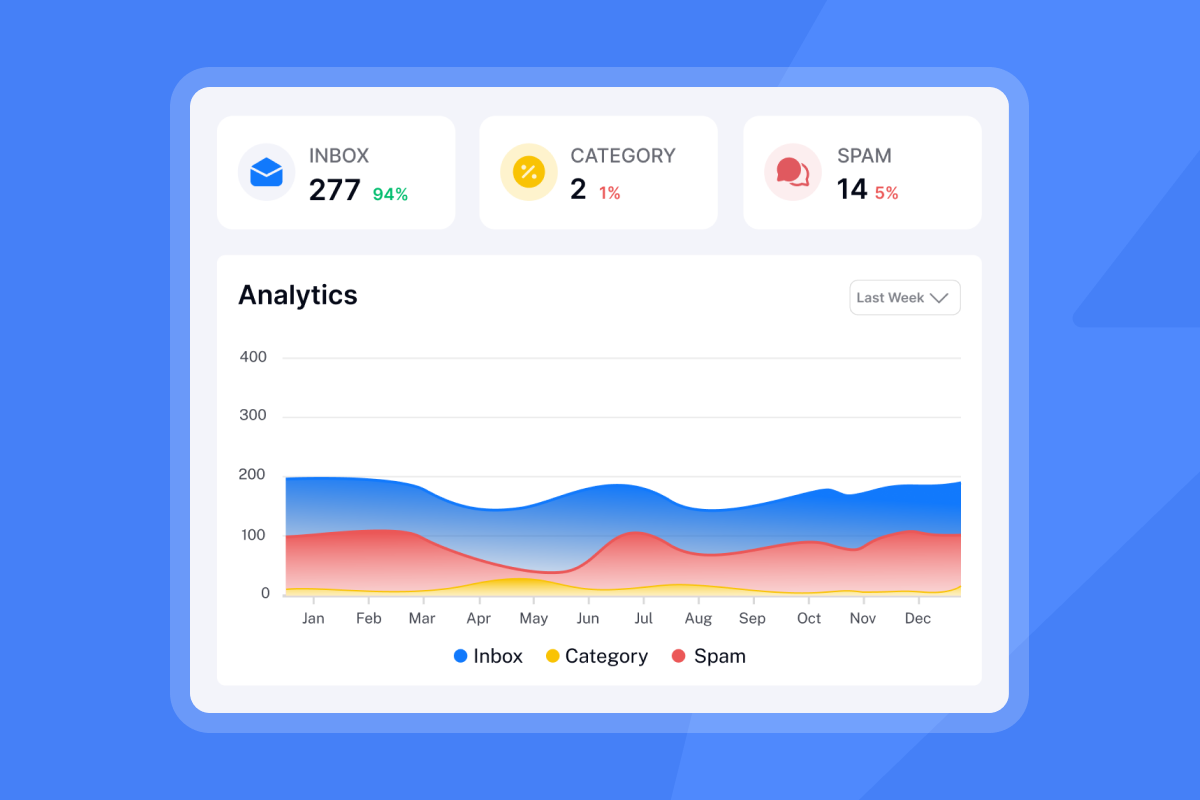
Instantly's automated Inbox Placement tests run continuous checks across major providers and alert you when placement drops. This is the early warning system that lets you pause a campaign before domain reputation suffers, rather than discovering the problem through declining reply rates two weeks in. The inbox placement help article covers how to configure alerts and interpret the results.
Standardizing processes to protect deliverability
Deliverability risks do not only come from the AI system. They come from reps who modify approved sequences, paste in unverified lists, or ignore bounce thresholds. Team-level governance turns individual discipline into a repeatable, enforceable process.
Preventing personalization and data errors
AI personalization should reference professional, observable signals: a recent funding announcement, a publicly stated company initiative, or a new product launch. It should not reference personal social media posts, location data, or anything that reads as surveillance. Keep personalization anchored to business context and verified firmographic or intent data, the same standard covered in Instantly's security and compliance guide for AI SDRs.
Field mapping errors cause a separate class of problem. Map every variable field between SuperSearch or your CRM and the sequence template before launch. A {{company_name}} token that pulls from an incorrectly named CRM field sends an email with no company name, or worse, the wrong one. Standardize field naming conventions across your CRM, enrichment provider, and Instantly to remove almost all of this class of error.
Fixing broken reply routing logic
Out-of-office replies, unsubscribes, and auto-responses all land in the same inbox as positive leads when reply routing is not configured correctly. Unibox combined with the AI Reply Agent's HITL mode automates lead qualification before a human reviews: positive leads route for SDR follow-up, unsubscribes drop from active campaigns immediately, and auto-responses filter out of your positive reply rate calculation so your metrics reflect actual qualified interest.
The reply rate discrepancy help doc explains how Instantly handles edge cases in reply counting, directly addressing the analytics trust concern that sales leaders raise most often during evaluations.
Assessing AI SDR ROI through downstream metrics
A 6% reply rate means nothing if it does not connect to qualified pipeline you can defend in a board or budget review. Build your ROI case on the metrics that matter downstream.
Tracking ROI from reply to SQL
Track from reply through to SQL using the CRM pipeline view in Instantly's Hyper CRM plan ($97/month), which connects reply activity to opportunities and reports on team-level conversion rates. If your positive reply rate is 50% of a 4% total reply rate, you have a 2% positive rate. At 15% meeting-to-SQL conversion, 10,000 emails per month produces roughly 30 SQLs. That is the number you can defend against CAC targets in any pipeline review.
Legacy sales engagement platforms charge per seat and cap the number of connected mailboxes, forcing reps to send too many emails from a single domain and triggering the spam blocks described above. Instantly's flat-fee model starts at $47/month on the Outreach Growth plan with unlimited email accounts and warmup. The fully loaded annual cost of a single human SDR, including base salary, variable compensation, benefits, tools, and management overhead, reaches $90,000 or more according to industry benchmarks. A three-module Instantly starter stack (Outreach + Credits + CRM) runs approximately $141/month total. That cost difference is the core AI SDR efficiency argument.
Measuring AI SDR tool utilization
The analytics dashboard in Instantly tracks open rates, reply rates, bounce rates, and campaign health at both the campaign and rep level. Use these as the source of truth for weekly performance reviews rather than relying on manually compiled spreadsheets. If a rep's campaigns produce a higher bounce rate than the team average, that surfaces in the dashboard before domain reputation suffers.
What AI SDR personalization actually delivers
AI SDR outperformance is not automatic. It requires the right data inputs, the right infrastructure, and the right governance. Teams that build this system, often with Instantly's AI agents, consistently beat the generic outreach baseline.
Realistic AI SDR response rate targets
Set your initial targets at 4% to 8% for signal-triggered campaigns on verified lists, and 1% to 3% as your baseline for campaigns still relying on firmographic-only targeting. Do not model pipeline around best-case numbers before you have deliverability data from your own domains. The Instantly cold email copywriting framework covers the structural elements that support these reply rates, and the Instantly prompt library provides tested starting points for AI sequence generation.
Can AI SDRs maintain primary inbox placement?
Yes, but only with the right infrastructure. Automated warmup, inbox placement monitoring, and distributed sending across multiple accounts are the minimum requirements. For high-volume operations, SISR (Server and IP Sharding and Rotation) on Instantly's Light Speed plan ($358/month) adds dedicated, private IP pools that rotate automatically when an IP shows declining placement. This sharply reduces the shared-IP risk that affects teams relying on standard sending infrastructure.
Time to value for AI SDR campaigns
A 14-day free trial (no credit card required) gives you access to test the infrastructure and benchmark your baseline reply rates. Most teams see enough data within two weeks to determine whether signal-triggered outreach is producing lift over their current campaigns. SuperSearch and AI agent testing are covered by the separate Instantly Credits free trial (100 credits, $0), which runs independently of the Outreach trial. After the trial, the Growth plan at $47/month is the entry point for unlimited accounts and warmup across your full sending infrastructure.
Try Instantly free for 14 days to test signal-triggered outreach across unlimited inboxes with built-in warmup. Add Instantly Credits starting at $9/month to run SuperSearch lead lookups and activate the AI Reply Agent for sub-five-minute reply handling.
FAQs
What is the average reply rate for an optimized AI SDR campaign?
The average reply rate for AI SDR campaigns sits at 4.1% per DigitalApplied's 100K email analysis, compared to 1% to 3% for generic cold outreach, as detailed in our complete guide to AI SDR. Signal-triggered campaigns targeting high-intent prospects reach 4% to 8% as a consistent operating range.
How many emails should an AI SDR send per mailbox per day?
The recommended maximum is 30 emails per single inbox per day to protect sender reputation, with volume distributed across 3 to 5 inboxes and 3 or more sending domains, a setup that safely handles 90 to 150 cold emails per day. Scaling past this threshold is the primary driver of spam-flag rate increases that reduce inbox placement.
What is the positive reply rate benchmark for AI outreach?
A successful campaign achieves a strong positive reply rate as a share of total replies, filtering out out-of-office messages, unsubscribes, and auto-responses. A 4% total reply rate with 50% positive replies yields 2% qualified conversations per 1,000 emails sent.
What does AI agent access cost?
The AI Reply Agent, AI Sales Agent, and Copilot all run on Instantly Credits, a separate subscription from the Outreach plan. Credits start at $9/month for 150 credits (Nano plan), and each AI agent action costs 5 credits per reply or per generated lead.
Do I need the Light Speed plan to maintain deliverability at scale?
Not necessarily. The Growth ($47/month) and Hypergrowth ($97/month) plans include unlimited accounts, automated warmup, and inbox placement testing. SISR on the Light Speed plan ($358/month) adds dedicated, private IP pools with automatic rotation, which is the right choice for teams where shared IP risk becomes a material concern at consistently high volumes.
Key terms glossary
Agentic AI: Autonomous AI systems that research, verify, and execute multi-step workflows rather than just generating text. Unlike a standard LLM that drafts copy on request, an agentic system identifies targets, sends outreach, and adjusts based on results without waiting for human input at each step.
SISR (Server and IP Sharding and Rotation): A deliverability technology on Instantly's Light Speed plan that uses dedicated, private IP pools and automatically rotates away from underperforming IPs to protect sender reputation at high sending volumes.
Deterministic matching: The process of linking prospect data to real-time buying signals using authenticated identifiers such as email addresses and account IDs, rather than probabilistic device fingerprinting, producing higher-accuracy signal matching with less noise.
Unibox: Instantly's centralized inbox that aggregates replies from all connected email accounts into a single dashboard, enabling consistent reply triage and AI-assisted classification across a distributed sending infrastructure.
Positive reply rate: The percentage of total replies representing genuine qualified interest, excluding out-of-office, unsubscribes, and auto-responses. Healthy campaigns achieve a strong positive share of total replies.
Waterfall enrichment: A data verification method that queries multiple providers in sequence until a confirmed, verified data field is found. SuperSearch uses waterfall enrichment across five-plus providers to reduce bounce rates before campaign launch.
Read next
Cold Email Subject Lines: A data-backed breakdown of subject line formulas that improve open rates across cold outreach campaigns.
15 Best Ways to Find B2B Sales Leads in 2026: A practical sourcing guide covering intent data, waterfall enrichment, and signal-based prospecting methods for B2B teams.
7 Best AI SDR Tools Worth Investing In: A comparative review of the top AI SDR platforms evaluated on deliverability infrastructure, personalization depth, and total cost of ownership.



