.svg)
%20(1).svg)


Updated June 26, 2026
TL;DR:
The best AI SDR tools for outbound B2B sales in 2026 win on deliverability infrastructure, not AI marketing copy. Instantly gives you unlimited sending accounts on a flat fee, a private deliverability network of 4.2M+ accounts, SISR on the Light Speed plan, and three distinct AI agents to automate sourcing, personalization, and reply handling. Apollo has strong data depth but per-seat pricing penalizes growth. Smartlead is a credible deliverability peer but adds costs for data and verification layers. Choose the platform where infrastructure comes first and billing scales with volume, not headcount.
Most sales leaders evaluating the best AI SDR tools for outbound B2B sales focus on how smart the AI copy sounds while ignoring the deliverability infrastructure that determines whether personalized emails ever reach the primary inbox. That infrastructure gap costs teams pipeline every month, and no amount of AI-generated personalization recovers it after the damage is done. Getting infrastructure right is what makes an AI sales agent actually work at scale.
Criteria for evaluating enterprise SDR stacks
Evaluating AI SDR platforms on feature lists leads to the wrong choice. The features that produce pipeline are the ones that keep your emails out of spam, protect your domain reputation, and hand clean data to your CRM. Four operational standards matter more than any individual feature.
Inbox placement infrastructure standards
Deliverability is a system, not a one-time configuration. It requires domain ramp-up, daily send pacing, warmup engagement, and active health monitoring working together continuously.
A correct ramp follows a predictable path: start at 10–20 emails per inbox per day in week one, then increase gradually over four to six weeks. For cold outreach, Instantly's own guidance recommends keeping sends at or below 30 emails per inbox per day as the safe sending threshold to protect sender reputation. Keep bounce rates at or below 1% as your operating target. Rates above 2% invite ISP penalties, and rates above 5% trigger active filtering.
Warmup infrastructure matters at scale. A private deliverability network uses real email accounts to simulate genuine engagement, building sender reputation before you send a single cold email. The underlying IP architecture also matters: rotating IP assignments across dedicated private pools prevents one flagged IP from contaminating your entire sending operation.
Secure AI settings for sales reps
The biggest governance risk in an AI SDR deployment is rogue output. If AI agents send off-brand or inaccurate messages to high-value prospects without a human review step, you face both pipeline damage and reputation risk.
Instantly built Human-in-the-Loop (HITL) mode into the AI Reply Agent to solve this directly. HITL queues AI-drafted replies for human approval before they send, giving you the speed benefit of AI drafting with the safety of human sign-off. You configure tone, response length, and product-specific guidance so the AI drafts within your brand voice, then a rep reviews and approves in Unibox or via Slack before delivery.
A global block list is a complementary safeguard, preventing any suppressed contact from receiving an email regardless of which campaign they appear in. Admin controls governing which reps can create campaigns, modify sequences, or change sending limits are also non-negotiable for teams managing three or more SDRs.
Automated CRM data hygiene standards
An AI-booked meeting is only useful if it flows into your CRM cleanly. Without bidirectional sync, you get duplicate leads, missing intent data, and handoff friction that slows AE follow-up.
Instantly's CRM handoff works like this: a lead replies positively, the AI Reply Agent flags or responds, the contact updates in your CRM with conversation history and intent signals, and an AE receives the meeting in their calendar with enriched data already attached. Teams running HubSpot should verify that their AI SDR platform supports contact deduplication, field-level mapping, and stage-progression triggers automatically.
Evaluating vendor billing structures
Per-seat pricing feels predictable until your team grows. Add five SDRs at $100 per seat and your monthly bill jumps $500 before you have sent a single additional email. Hidden costs compound further when platforms charge separately for credits, contact exports, and CRM integrations.
The alternative is volume-based or flat-fee pricing where costs are tied to what you send, not how many reps you have. A 20-person team and a 5-person team can operate on the same Instantly tier if they send similar volumes, which is structurally impossible with per-seat tools. Watch for annual lock-ins on enterprise plans: legacy platforms use multi-year contracts with renewal escalation clauses that make switching expensive even when performance is poor. Instantly publishes all plan pricing on the pricing page with no hidden seat multipliers.
Feature matrix: evaluating sales AI vendors
The table below maps each major platform to its primary strength, key differentiating feature, pricing model, and best-fit use case.
Platform suitability for sales teams
Tool | Primary Strength | Key Feature | Pricing Model | Starting Price | Best For |
|---|---|---|---|---|---|
Instantly | Infrastructure and Deliverability | Unlimited accounts, private warmup network, AI Reply Agent | Flat-fee + Credits | $47/mo | Scaling deliverability and multi-account outreach |
Smartlead | Infrastructure and Deliverability | Unlimited mailboxes, API access | Flat-fee per volume | $39/mo | Sales teams running high-volume email-only outbound without a built-in data layer |
Apollo.io | Data-Centric | 230M+ lead database | Per-seat + credits | $49/seat/mo | Teams needing built-in data prospecting |
Salesforge | Specialized (Forge Stack) | 500M+ contacts, Agent Frank AI | Subscription per AI agent | $499/mo (annual) | Teams adopting an autonomous AI SDR with built-in 500M+ contact data |
Landbase | Autonomous Agents | 300M+ contacts with real-time intent | Custom (enterprise) | Contact sales (est. $2,000+/mo) | Teams wanting fully autonomous pipeline generation |
Inbox placement and warmup protocols
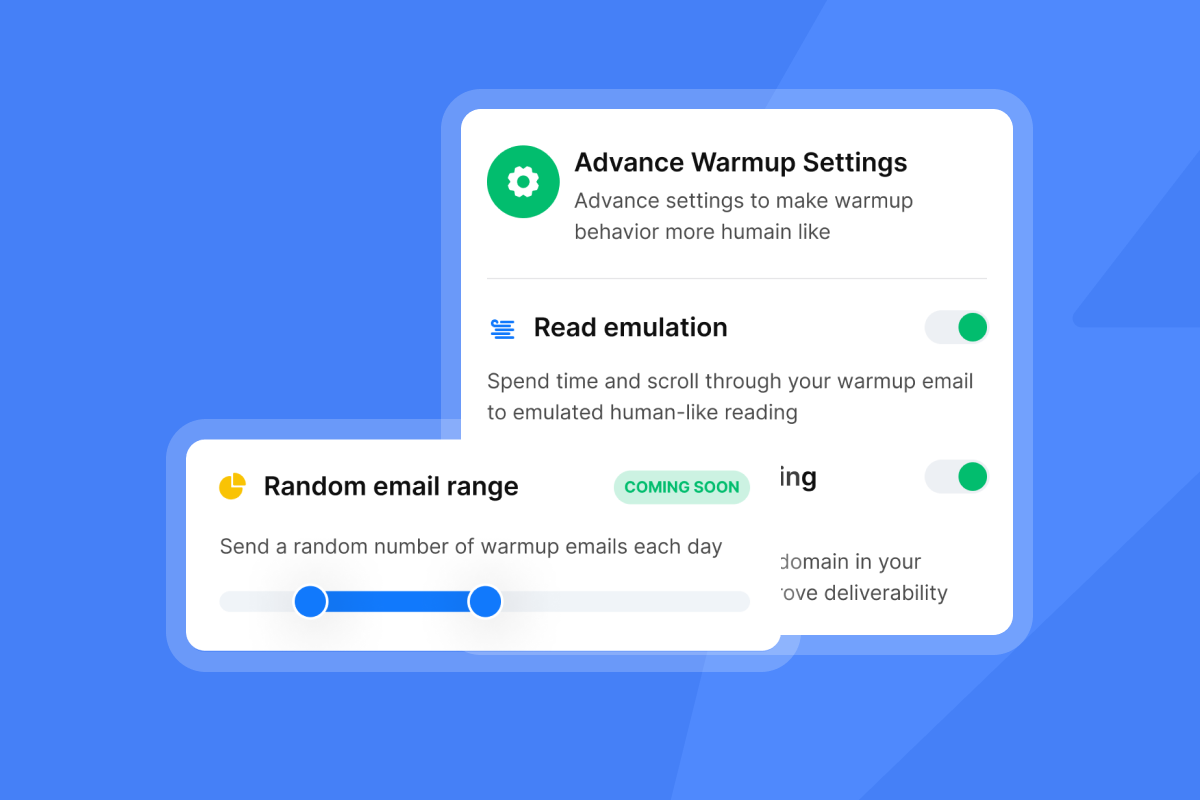
Warmup network quality is measured by two things: whether accounts are real (private vs. shared pools) and whether engagement signals are authentic enough to train ISP filters. A private deliverability network uses genuine accounts to simulate real engagement before a single cold email is sent, building sender trust at the infrastructure layer. Instantly operates a private network of 4.2M+ accounts and runs warmup automatically across all email plan tiers, including Growth at $47/month. You can configure advanced warmup options (weekday-only sending, read emulation, custom open and reply rates) to match the engagement patterns that look most natural to Gmail and Microsoft filters.
Smartlead also provides unlimited mailbox warmup on all plans. Neither Smartlead's standard warmup pool nor shared-IP configurations include the dedicated IP isolation that Instantly's SISR technology provides on the Light Speed plan.
AI context and intent personalization
Basic AI personalization pulls from firmographics: company name, title, industry. Advanced signal-based personalization pulls from buying intent indicators such as hiring trends, technology installs, SEC filings, and competitor activity to time outreach when a prospect is most likely to respond, which is exactly what the best AI sales prospecting tools are built to do.
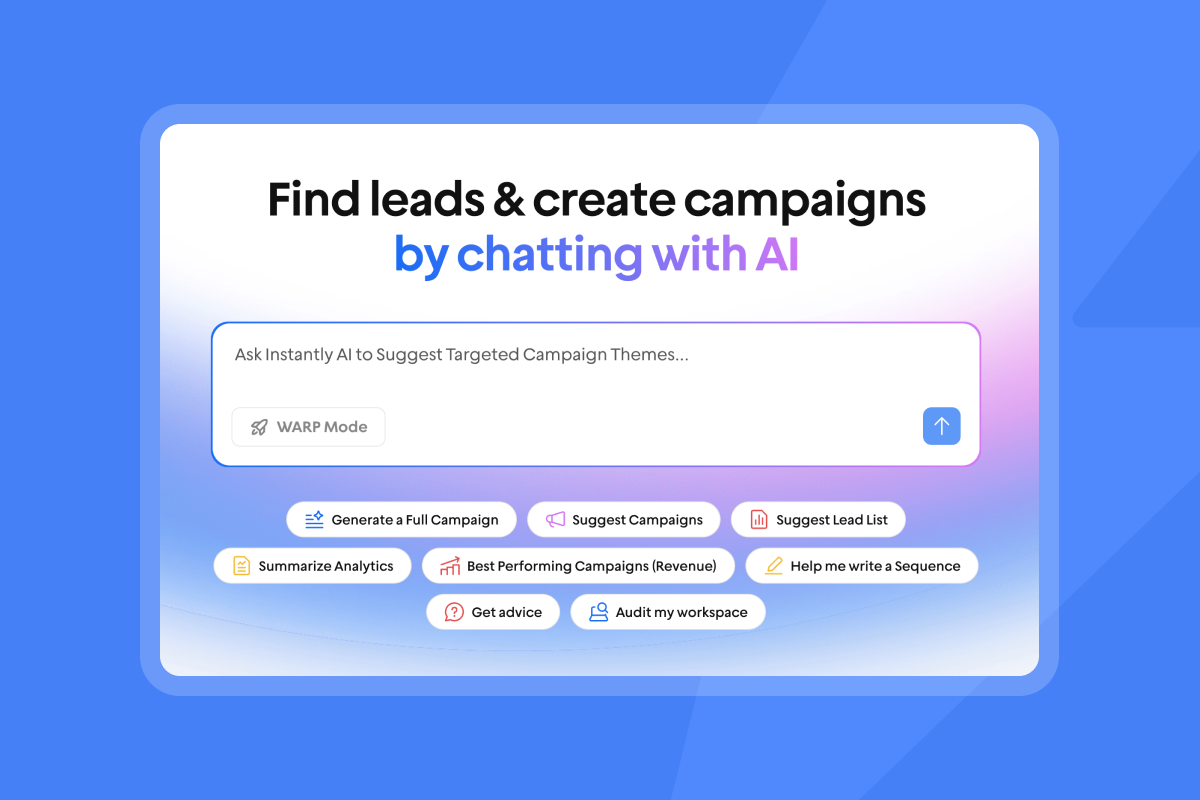
Instantly's AI Sales Agent handles autonomous lead sourcing and outbound execution at 5 Instantly Credits per generated lead. Copilot handles in-app research, lead targeting, campaign creation, and analytics summaries. All three AI agents run on Instantly Credits, a separate subscription from Instantly email plans, starting at $9/month. Landbase's GTM-1 Omni model works with its 300M+ contact database enriched with real-time intent data, positioning it as the most autonomous option for signal-based targeting. Apollo uses 230M+ contacts with waterfall enrichment, but data accuracy is notably weaker outside the US, creating bounce risk for European and APAC campaigns.
Native CRM integration capabilities
Instantly supports native HubSpot integration and a native Clay integration confirmed in 2026. Instantly's Unibox centralizes all replies across every connected sending account, preventing the scattered inbox problem that kills handoff quality on multi-rep teams.
Instantly does not support native LinkedIn automation, and that is by design. LinkedIn automations via browser extensions carry account suspension risk that can permanently damage a rep's professional profile. Smartlead offers native HubSpot, Pipedrive, and Zoho integrations alongside its core sending infrastructure (Clay connects via Zapier/API).
Transparent pricing and service agreements
Legacy enterprise platforms (Outreach, Salesloft) do not publish list prices. Custom quoting means you cannot evaluate true TCO without a multi-week procurement cycle, and renewal terms often include automatic annual increases. Instantly's 14-day free trial requires no credit card, and when the trial ends your account pauses automatically rather than auto-charging until you choose to upgrade.

Prioritize inbox placement for scalable outreach
The infrastructure thesis for outbound at scale is simple: if emails do not reach the primary inbox, personalization, sequence logic, and AI copy are irrelevant. The following standards define what inbox-first architecture looks like in practice, and how a platform either meets them or does not.
Protecting deliverability at scale
Shared-IP sending creates systemic reputation risk. One sender's poor practices can degrade inbox placement for every account on the same pool. The solution is dedicated IP pooling with automatic rotation: volume is split across isolated private IP pools, and when one shows degrading signals it is swapped out before it contaminates your campaigns. Instantly implements this through SISR (Server and IP Sharding and Rotation), available on the Light Speed plan at $358/month (or $286.30/month on annual billing). SISR splits your volume across multiple dedicated private IP pools, and when an IP shows degrading performance signals, Instantly rotates it out automatically so campaigns continue without interruption. This is a material difference from shared-IP warmup configurations, where another sender's poor practices can damage your reputation even when your own campaigns are clean. You can review the technical detail in Instantly's documentation on rotating IP algorithms.
Continuous inbox placement monitoring is a requirement, not a nice-to-have: delivery rates to specific mailbox providers can degrade days before bounce rates surface in campaign reports. Instantly's automated Inbox Placement testing runs continuously and alerts you when provider-level delivery starts to drop, giving you time to intervene before a deliverability problem becomes a pipeline problem.
Operational control for scaling teams
At scale, scattered inboxes across multiple sending accounts are an operational failure point: replies get missed, handoff context is lost, and AE follow-up slows. The correct architecture centralizes all replies into a single classified feed, routable to the right rep with full conversation context. Instantly's Unibox implements this across every connected sending account, so a three-rep team monitors one feed instead of 15. Every reply is classified, tagged, and routable to the right AE with context. Admin controls let you standardize sequences across reps, enforce global block lists, and audit campaign activity by account. For heads of sales managing rep onboarding cycles, this standardization means a new SDR follows the same ramp and hygiene protocols as a senior rep from day one, as our AI sales agent implementation guide lays out step by step.
"Instantly makes cold outreach operationally simple at scale. The interface is straightforward, setting up campaigns with multiple inboxes is fast, and the warm-up system helps maintain deliverability when sending higher volumes." - Ivar S. on G2
Predictable billing without annual contracts
Instantly's email plans run from $47/month (Growth) to $358/month (Light Speed). All tiers include unlimited email accounts and warmup, so you add inboxes to protect domain reputation without adding to your software bill. Instantly's three AI agents (Copilot, AI Sales Agent, and AI Reply Agent) run on Instantly Credits, a separate subscription starting at $9/month for 150 credits. The AI Sales Agent costs 5 credits per generated lead. The AI Reply Agent costs 5 credits per reply. You pay for actual AI usage rather than a flat seat fee that charges you for access you may not use.
A realistic starter stack: Growth email plan ($47) plus Credits Growth ($47) plus CRM Growth ($47) = $141/month total, with no annual commitment required.
Scaling email volume with Instantly
A practical scale-up sequence for a five-rep team:
- Warmup phase: Add sending accounts, ramp from 20 to 30 emails per inbox daily, monitor domain health in the Inbox Placement dashboard.
- Campaign launch: Upload verified contacts via SuperSearch or import from Clay, set up A/Z sequence variants, activate global block list.
- AI activation: Enable HITL mode so the AI Reply Agent drafts replies in under five minutes and queues them for rep approval in Unibox or via Slack before sending.
- Scale review: Analyze reply rates by variant, adjust send windows, evaluate upgrade to Hypergrowth if volume justifies it.
Watch the Instantly demo walkthrough by co-founder Raul Kaevand for a live view of this campaign setup flow.
"In my personal experience using Instantly extensively, it's always been very user-friendly, and the support is top-tier. You can hop on a live chat with a real person in minutes, and get the direct answers you need... They make it very simple to set up and warm new inboxes, manage your lists, test campaigns and adjust via results." - Evan T. on G2
Smartlead: scaling secure outbound with domain health
Smartlead is a credible peer in cold email infrastructure, built for sales teams that prioritize sending volume and deliverability stability over an all-in-one feature set. It offers unlimited mailboxes and warmup on all plans, custom variables and spintax for personalization, native HubSpot, Pipedrive, and Zoho integrations (Clay connects via Zapier/API), an optional email verification add-on, and a multi-client workspace designed for agency use cases. The platform's API access on higher tiers supports custom workflow automation, and its SmartDelivery system monitors sending patterns to flag engagement signals before bounce rates escalate. Higher tiers include dedicated private servers (SmartServers) that reduce shared-IP contamination risk. Pricing runs from $39/month (Basic) to $94/month (Pro) to $174-$379/month for Unlimited tiers.
Smartlead does not offer native LinkedIn automation. For cold email agencies with external data pipelines and straightforward email-only workflows, Smartlead is a functional choice. The platform's unlimited mailbox model and dedicated server options make it well-suited for sales teams where warmup automation and volume scaling are the primary requirements. The lack of integrated lead data means you will need to source contacts externally through Clay or other enrichment tools, then import them into Smartlead for sending.
For teams wanting data, deliverability, CRM, and AI agents in one platform without assembling a multi-tool stack, Instantly offers more integrated coverage at comparable or lower total cost.
Alternative AI solutions for enterprise sales
Apollo, Outreach, Salesloft, and Clay each serve a distinct role in the B2B outbound landscape. Understanding where each fits, and where it breaks down, helps you position Instantly's stack against the tools your buying committee will raise.
Apollo.io: verified data for SDR workflows
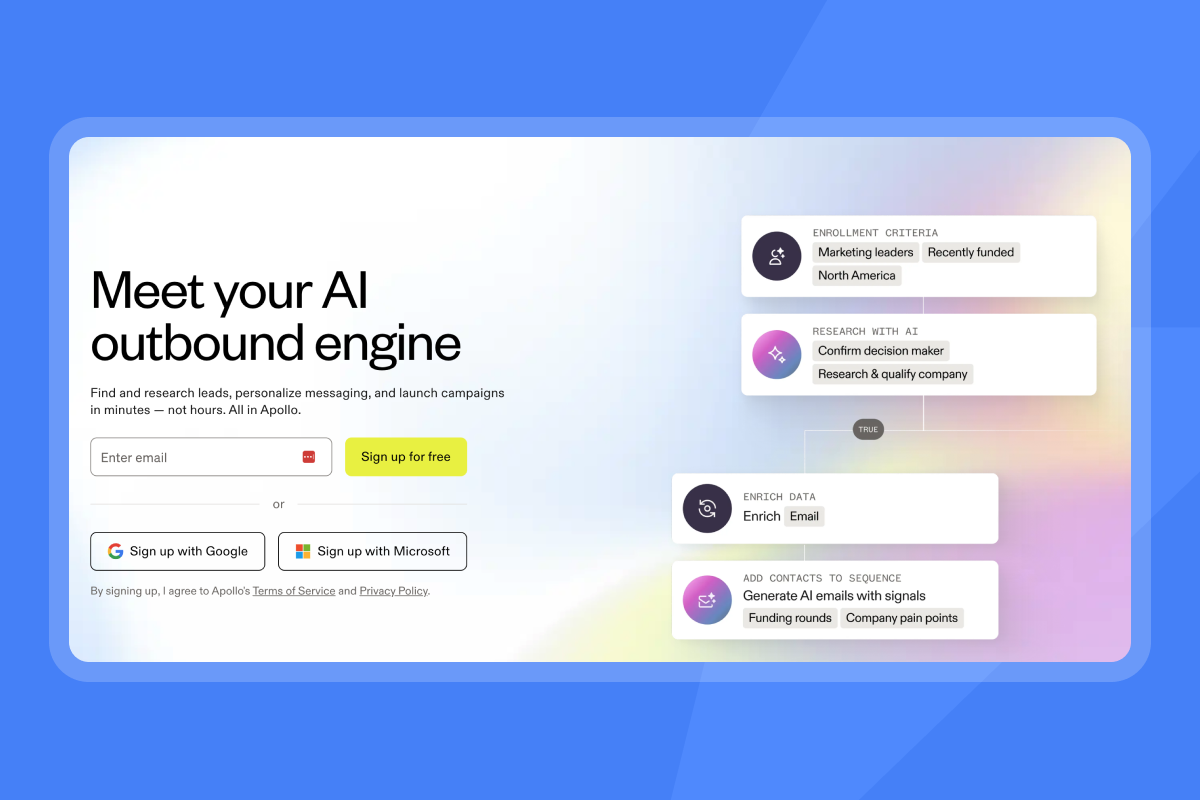
Apollo's core strength is its 230M+ contact database with multi-filter prospecting and multichannel sequences (email, LinkedIn tasks, calling). The per-seat cost structure penalizes scaling: the Basic plan runs $49 per user per month on annual billing, meaning a 10-rep team pays $490/month before mandatory credit purchases. The Professional plan runs approximately $790/month for 10 reps on annual billing before credit overages. Real expenses can triple the advertised base rate once credits are included. Data accuracy is notably weaker outside the US, creating bounce risk for European and APAC campaigns.
Outreach: reliable deliverability controls
Outreach is an enterprise sales execution platform built for large, structured organizations with mature sequence governance. Implementation fees run $5,000-$25,000+, annual platform fees add $2,000-$5,000, and per-seat pricing is custom-quoted and not publicly listed. For commercial-stage B2B companies (20-200 employees) without dedicated RevOps engineers, Outreach's complexity and cost are barriers rather than benefits.
Salesloft: standardized sequence governance
Salesloft excels at cadence frameworks, rep coaching, and call recording with AI analytics for enterprise organizations standardizing 50+ reps. Custom-quoted pricing is not publicly listed before add-ons, with annual contracts standard. The platform requires onboarding investment, and mid-contract exits are structurally difficult.
Automating data enrichment via Clay
Clay is a data enrichment and workflow engine that uses waterfall enrichment across multiple providers to build accurate, intent-enriched prospect lists. The native Clay-Instantly integration (confirmed in 2026) lets you build a Clay workflow that sources contacts, enriches them with intent signals (hiring data, technology installs, competitor follows), and pushes them directly into an active Instantly campaign via API key, creating signal-based prospecting without single-vendor lock-in. For teams with a dedicated RevOps resource, Clay plus Instantly is the modern stack for high-precision, high-volume outbound.
Choosing an AI platform for your sales workflow
Team Size | Recommended Stack | Monthly Cost | Key Reason |
|---|---|---|---|
3-10 reps | Growth email + Credits Growth + CRM Growth | $141/mo | Flat-fee scaling, unlimited accounts, no per-seat penalty |
10-50 reps | Hypergrowth email + Supersonic Credits + Hyper CRM | $291/mo | Multichannel (email, calling, SMS), HITL AI, HubSpot sync |
50+ reps | Light Speed email + Supersonic Credits + Hyper CRM | $552/mo | SISR IP isolation, enterprise governance, custom DPA support |
For lean teams (3-10 reps), the priority is volume and speed without compounding per-seat costs. At mid-market scale (10-50 reps), dedicated IP infrastructure and tighter CRM integration become critical. At 50+ reps, traditional sales automation platforms like Outreach and Salesloft have established track records in large, structured enterprise environments, but for buyers evaluating fresh, Instantly delivers the deliverability isolation and admin controls enterprise outbound requires.
Prioritizing inbox health over features
The most common mistake in AI SDR tools evaluation is treating AI personalization quality as the primary filter. Copy quality does not matter if the email lands in spam. Primary inbox placement depends on warmup history, domain age, bounce rates, and IP reputation, not on how well an AI paraphrases a LinkedIn profile.
Keep sends at or below 30 emails per single inbox per day for cold outreach. Run warmup for at least 30 days before scaling volume. Monitor bounce rates against a 1% operating target and stop sends immediately if you cross 2%. These constraints apply regardless of which platform you choose.
"Instantly has many good features. I personally like their warm-up system, which has improved the deliverability of my email accounts. The open rate of my campaigns has improved after switching to Instantly." - Verified User on G2
Critical metrics for your proof of concept
A POC without defined measurement criteria defaults to a subjective judgment call. The two sections below give you the specific numbers and tracking checkpoints to make the decision defensible.
Quantify ROI and monitor domain health during your POC
The cost-of-inaction case is straightforward. A fully loaded US SDR costs $102,000–$210,000 annually (base salary plus benefits, tools, recruiting, and management overhead). A functional Instantly stack runs approximately $112.80/month at annual billing (Growth Outreach $37.60 + Growth Credits $37.60 + Growth CRM $37.60), or $1,354/year. The more precise measure is cost per meeting booked: (monthly platform cost + domain and mailbox costs) divided by meetings set, the core metric behind any AI SDR vs human SDR comparison.
Metric | Human SDR | AI SDR Stack (Instantly) |
|---|---|---|
Annual cost (fully loaded) | $102,000 – $210,000 | $1,354 |
Time to first send | 4-8 weeks onboarding | 2-4 weeks setup |
Scalability | Linear cost per rep | Flat-fee volume-based |
Reply classification | Manual | AI Reply Agent (HITL or Autopilot) |
During your POC, monitor three indicators daily: bounce rate (target at or below 1%, pause above 2%), spam placement via Inbox Placement tests, and domain blacklist status. If bounces rise above 2%, pause sends, re-verify your list, and resume at a lower daily cap. Instantly's automated Inbox Placement testing alerts you when delivery rates to specific providers start degrading so you can intervene before a deliverability problem becomes a pipeline problem.
Track CRM handoffs and evaluate vendor support
Every meeting booked via AI SDR activity must map to a CRM opportunity with the originating sequence, contact source, and campaign name attached. Without this data, you cannot calculate true cost per SQL or defend the program to a CFO. Set up conversion tracking from day one: email sent, reply received, meeting booked, SQL created. Reconcile it against your CRM pipeline weekly to catch double-counted or missing contacts.
A deliverability crash during a live campaign requires root-cause answers within hours. During your POC, test support response time deliberately: submit a technical question and measure time to a substantive first response. Multiple users confirm Instantly's live chat resolves issues fast.
"Whenever I've had a problem its always solved quickly." - Verified user review of Instantly
If you're ready to apply this framework to your own stack, start your free 14-day trial with no credit card required. The trial includes 250 uploaded contacts, 1,000 emails, and access to Instantly's AI agents and SuperSearch via the Instantly Credits free tier (100 credits included). To test the AI Reply Agent and SuperSearch independently, explore Instantly Credits starting at $9/month.
The bottom line
The best AI SDR tool for outbound B2B sales in 2026 is the one that keeps your emails in the primary inbox, scales without per-seat penalties, and hands clean data to your CRM without manual intervention. Deliverability infrastructure, including warmup network quality, IP isolation, and bounce rate controls, determines pipeline outcome before a single line of AI copy is written. Teams that get that infrastructure right, and pair it with HITL governance and flat-fee billing, compound their outbound advantage every month without adding headcount cost.
FAQs
The questions below address the most common decision blockers that arise during platform evaluation and POC setup.
What is the maximum recommended sending volume per inbox?
Instantly's guidance is to keep cold outreach at or below 30 emails per single inbox per day to protect your sender reputation with Gmail and Microsoft. Running warmup for at least 30 days before scaling to that threshold further reduces deliverability risk.
Does Instantly support native LinkedIn automation?
No, Instantly does not support native LinkedIn automation. LinkedIn automations via browser extensions carry a genuine account suspension risk that can permanently remove a rep's professional profile, so Instantly does not build this into the platform.
How much does the Instantly AI Reply Agent cost?
The AI Reply Agent costs 5 Instantly Credits per reply, purchased through a separate Instantly Credits subscription starting at $9/month (or $0 on the free trial with 100 credits included). This subscription is separate from your Instantly email plan.
How does Instantly's pricing compare to Apollo for a 10-rep team?
Instantly's Hypergrowth email plan at $97/month covers all 10 reps on a flat fee. Apollo's Basic plan at $49 per user per month runs $490/month for 10 reps before mandatory credit purchases, and Apollo's Professional plan runs approximately $790/month for 10 reps on annual billing before credit overages, which can triple the effective monthly cost.
Can I use Clay with Instantly natively?
Yes. The Clay-Instantly integration (confirmed in 2026) lets you push Clay-enriched contacts directly into an active Instantly campaign using your Instantly API key, creating a signal-based prospecting workflow without manual data transfers between tools.
Key terms glossary
SISR (Server and IP Sharding and Rotation): A deliverability technology on Instantly's Light Speed plan that distributes sending volume across dedicated private IP pools, isolating sender reputation and automatically rotating out flagged IPs to maintain primary inbox placement.
Unibox: A centralized inbox inside Instantly CRM that aggregates replies from all connected sending accounts into a single feed, enabling rep-level reply triage and clean CRM handoffs without monitoring multiple individual inboxes.
HITL (Human-in-the-Loop): A configuration mode for Instantly's AI Reply Agent where AI-drafted replies are queued for human approval in Unibox or via Slack before sending, balancing reply speed with brand-voice control.
SuperSearch: Instantly's integrated B2B lead database with 450M+ verified contacts, AI-powered filtering, and waterfall enrichment, accessed via Instantly Credits and available directly within the platform without a separate data subscription.
Read next
- Cold email deliverability: how to land in the primary inbox every time: A step-by-step breakdown of warmup, domain setup, and send pacing to keep your emails out of spam at any volume.
- Cold email: ultimate guide to email outreach in 2026: Everything you need to run a cold email program from scratch, covering list building, copy, sequencing, and deliverability fundamentals.
- How to use secondary domains for cold email safety: Learn how to configure secondary sending domains to protect your primary domain reputation while scaling outreach volume.



