.svg)
%20(1).svg)


Updated June 22, 2026
TL;DR: An AI SDR is an autonomous software system that automates prospecting, outbound sequencing, reply classification, and CRM handoff. It is not a set-and-forget replacement for human reps. True success requires a hybrid model that combines agentic AI with strict deliverability governance. Instantly.ai provides the complete infrastructure for this motion, with unlimited sending accounts, a private warmup network of 4.2M+ accounts, SuperSearch with 450M+ B2B leads, and transparent credit-based AI agents so you can scale safely without per-seat penalties.
Most AI SDR platforms promise to replace your entire sales team, but they hide the technical reality: an AI agent is only as good as the inbox deliverability infrastructure supporting it, a lesson that applies to any sales automation agent you evaluate. Understanding what is an AI SDR, and how to evaluate one rigorously, is the difference between a reliable pipeline engine and a domain-reputation disaster, as this AI sales automation guide explains in more depth.
Defining the AI SDR: beyond simple automation
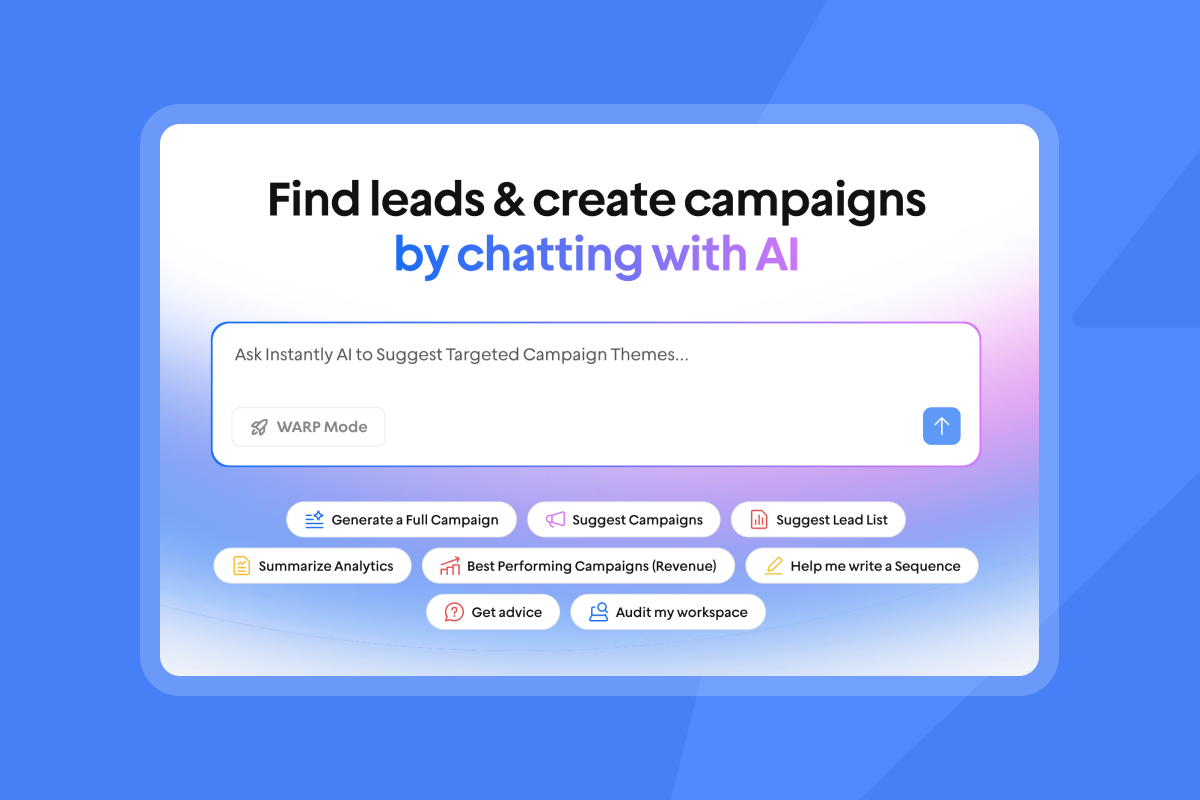
An AI SDR (Sales Development Representative), also called an AI sales agent, is a software system that autonomously executes the top-of-funnel sales workflow: sourcing leads, personalizing and sending outbound sequences, classifying prospect replies, and routing qualified responses to human account executives. At its core, the system uses large language models (LLMs) for natural language generation, NLP-based intent classification for reply triage, and conditional logic engines for sequence branching. Instantly offers an AI SDR platform built for outbound teams that combines these capabilities with deliverability infrastructure. For a breakdown of specific vendors, see this comparison of AI SDR tools worth evaluating in 2026.
The critical distinction sales leaders need to understand is the difference between agentic AI and simple automation:
- Agentic AI: The system perceives its environment (inbox signals, reply sentiment, prospect data), reasons about the appropriate next step, and acts autonomously across multi-step workflows without requiring human input at each stage. Advanced systems support conditional sequence branching based on engagement signals and AI-assisted send-time optimization through configurable send windows.
- Augmentation/automation: The system executes predefined, rule-based tasks. A sequence fires on a schedule. A template fills in variables. A human still decides what to do with the output. Platforms that call themselves "AI SDRs" while offering only mail-merge personalization are augmentation tools, not agents. True agentic AI requires dynamic path selection, meaning the system chooses the action, not just executes a pre-scripted one.
Sales leaders must treat AI SDR infrastructure as mandatory in the medium term, not optional. Gartner projects that by 2027, 95% of seller research workflows will begin with AI, compared to less than 20% in 2024. The complement vs. replacement tension is real but worth naming directly: agentic AI does not automate judgment. Human reps still decide how to handle objections, when to escalate to a demo, and how to build enterprise relationships. According to Salesforce's State of Sales, sales reps spend roughly 60% of their time on non-selling tasks. What AI eliminates is the repetitive, high-volume groundwork that falls into that category.
AI SDR model comparison
Feature | Pure replacement model | Augmentation model (Instantly approach) |
|---|---|---|
SDR task ownership | Full automation of all SDR tasks | AI handles volume and triage, humans handle judgment and relationships |
Deliverability risk | Higher (limited human oversight, single infrastructure) | Managed (HITL controls, warmup network, SISR, per-inbox caps) |
Cost structure | High per-seat fees, often $100-$500/seat/month | Flat-fee unlimited accounts from $47/month, credits billed by usage |
Human control | Minimal, "set and forget" framing | Configurable HITL approval modes, admin controls, sequence governance |
Core AI SDR capabilities explained
Three technical capabilities define a genuine AI SDR, part of a broader set of must-have AI SDR features:
- Natural language processing (NLP): The system reads and interprets prospect replies using probabilistic methods. By performing syntactic and semantic analysis, NLP extracts meaningful intent patterns from email text rather than relying on surface-level keyword triggers, as this AI SDR technical breakdown explains in more detail.
- Intent classification: The system categorizes replies by sentiment and intent, then routes each to the appropriate follow-up action automatically, whether that is a positive response, a time-based objection, or an unsubscribe request.
- Dynamic sequence adjustment: The system modifies its outreach path based on engagement data, so a prospect who opened three emails but never replied triggers a different branch than one who clicked a link.
How automated outreach works end to end
AI SDRs operate across three functional domains:
- Prospecting: The system sources leads from large databases (typically 300M-500M+ contacts), applies enrichment against multiple data providers to verify accuracy, and scores leads against intent signals. Instantly's SuperSearch covers 450M+ B2B leads with waterfall enrichment across 5+ providers and LLM-assisted enrichment for dynamic targeting.
- Engagement: Email is the primary channel for AI SDR outreach because deliverability infrastructure can be fully controlled. LinkedIn requires API or Zapier workarounds since no native integration exists. For email, AI SDRs manage sequencing, A/Z testing, and send windows. Reply handling is configured at the campaign level through the AI Reply Agent, which operates in either Autopilot or HITL mode depending on your team's oversight preferences.
- Conversion: On a positive reply, the AI SDR routes the lead to a human rep or, in advanced configurations, handles initial qualification questions before booking a calendar slot for the AE.
Key tasks AI agents can automate
- Lead enrichment: Verifying email validity and appending job title, company size, and technographic data from multiple sources in real time.
- Personalization: Generating variable-driven copy using LLMs, pulling in company news, job changes, or funding signals to make each message contextually relevant.
- Reply triage: Classifying every incoming reply by sentiment and intent, flagging positives for immediate human action, and handling auto-responders or unsubscribes without rep involvement.
- CRM logging: Pushing reply classifications, engagement events, and lead status updates to HubSpot automatically, maintaining a clean audit trail.
- Follow-up sequencing: Triggering the next step based on behavioral signals rather than calendar intervals alone.
How AI and human reps divide the outbound workflow
The case for AI SDRs is not that they outperform humans at sales. It is that they are structurally better at volume, consistency, and data processing, which frees human reps to focus on activities where human judgment creates the most value. If you're also evaluating BDR-focused tooling, this comparison of AI BDR vs AI SDR breaks down which role each is built to replace.
Scaling outreach without fatigue
A skilled human SDR sends 50-100 personalized emails per day when accounting for research, writing, and CRM logging time. AI does not get tired, discouraged by rejection, or distracted. It processes data and executes sends at a volume no human team can match without proportional headcount growth. Critically, AI SDRs do not require a per-seat license per sending account. Instantly's flat-fee Outreach plans include unlimited email accounts across all tiers, so scaling from 5 inboxes to 50 does not compound your costs.
How AI handles prospect intent
AI systems classify intent using NLP-based models trained on large volumes of labeled email data. Unlike basic keyword matching, NLP uses probabilistic methods to analyze the structure and context of language, which reduces classification errors and makes intent signals more actionable. The important constraint is nuance: AI handles clear signals well and struggles with ambiguous replies like "check back after our funding round." Those replies carry real pipeline intelligence that requires a human to interpret, and this is where Human-in-the-Loop (HITL) approval modes become operationally essential. Instantly's AI Reply Agent supports both Autopilot and HITL modes, so teams can configure where human judgment enters based on deal complexity and account value.
True cost of AI sales automation
For Instantly specifically, the baseline stack (Growth Outreach + SuperSearch Growth + Growth CRM) runs $141/month. Adding Instantly Credits for AI agents (starting at $9/month for 150 credits) scales alongside usage. Our AI sales agent pricing models guide covers how this compares to other billing structures. A Hypergrowth outreach stack with Credits Growth and CRM Growth runs $97 + $47 + $47, totaling $191/month on monthly billing.
Where AI SDRs outperform humans
AI and human SDRs show real performance gaps, but these gaps vary across metrics. AI SDRs excel at volume, consistency, and speed of initial outreach. Human SDRs outperform AI-only approaches at converting meetings to opportunities, making human judgment the deciding variable at the later stages of pipeline conversion. AI SDRs are 5.1x cheaper per meeting set, but 1.5x more expensive per closed-won deal on a pure AI configuration. Hybrid pods resolve this gap: research shows hybrid models generate approximately $278,000 in pipeline per seat per month, compared to $187,000 for human-only and $94,000 for AI-only approaches. The hybrid model captures both advantages.
What automated outreach actually delivers for pipeline
The operational value of a well-configured AI SDR spans multiple pipeline growth use cases, starting with pipeline predictability. When the system sources leads, verifies data, sends sequences, classifies replies, and logs outcomes consistently, your pipeline metrics become more reliable and your AEs spend more time in live conversations.
Verifying lead data accuracy
Keeping email bounce rates below 1% is the modern best practice for maintaining sender reputation with Gmail and Microsoft, both of which introduced stricter filtering in late 2025 that penalizes senders who consistently exceed this threshold. AI SDRs with real-time verification keep lists clean before any email is sent, not after bounces accumulate. Instantly's SuperSearch pulls from 450M+ B2B leads with waterfall enrichment across 5+ providers, cross-checking leads against multiple data sources before they enter your sequences. The LLM-assisted enrichment layer adds dynamic context (recent job changes, funding events, technology stack signals) to make personalization accurate rather than generic.
Scaling outreach with AI sequences
Instantly's AI Sequence Writer generates sequence copy and supports up to 26 A/Z email variants per step on the Hypergrowth plan. The Growth plan includes A/Z testing, AI Sequence Writer, and AI Spam Words Checker following the January 2026 update. Teams can run statistically meaningful variant tests across subject lines, CTAs, and body copy without manually building each version. Watch how to set up sequences end-to-end in this official AI Sales Agent setup guide from the Instantly team.
How AI SDRs interpret prospect replies
Reply classification is where the quality gap between basic automation and true AI agents is most visible. One of Instantly's AI agents, the AI Reply Agent, handles replies in under 5 minutes and routes each response based on classified intent. In Autopilot mode, it sends pre-approved responses directly. In HITL mode, it drafts the response and routes it via Slack for rep approval before sending. The Unibox centralizes all incoming replies across every sending account into a single interface, so a team managing 20+ inboxes does not need to monitor each one individually. For a real-world test of the AI Reply Agent in production, watch this 30-day AI Reply Agent field test to see exactly how the system performs before you deploy it.
"I use Instantly for the AI reply agent and finding leads. It saves a lot of time by automatically replying to all of my campaigns on autopilot mode. I especially like the email warm-up tool." - Lucky B. on G2
Streamlining meeting handoff to AEs
Research shows that lead conversion rates drop sharply when initial response times exceed five minutes, making the AI Reply Agent's sub-5-minute response window a meaningful operational advantage. The AI Reply Agent's HITL mode combines speed with accuracy: positive reply classified, draft generated, rep approval via Slack, AE notified with full reply history and lead record attached. The workflow turns a fragmented email thread into a clean, contextualized handoff.
CRM sync and data hygiene
Instantly supports one-way native HubSpot integration for importing leads and mapping fields into campaigns. For bidirectional sync of activity data including opens, clicks, and reply classifications back to HubSpot, use OutboundSync or a custom API connection.

What AI SDRs can't do (yet)
Setting realistic expectations before deployment protects your team from two failure modes: over-automation of high-value accounts and under-supervision of edge-case replies.
Resolving ambiguous sales signals
AI classifies replies accurately when the signal is clear. It struggles with ambiguous signals that carry strategic meaning. A reply like "we're mid-procurement freeze, check back in Q4" contains pipeline intelligence that belongs in your CRM as a note, a future task, and potentially a custom sequence, but extracting that correctly requires human judgment. Consider configuring the AI Reply Agent in HITL mode for replies the system classifies as objection categories, such as timing concerns, competitor preference, or lack of authority, so a human rep reviews the response before it sends. In Autopilot mode, the AI Reply Agent sends pre-approved responses directly without routing to a human rep first.
Manual oversight for account targets
High-value accounts in your ABM tier benefit from human-reviewed first-touch messages. AI-generated copy with tightly scoped prompts is a viable starting point, but a human review step before any message goes live is non-negotiable for validating accuracy and brand consistency. Use AI to manage follow-up sequencing and reply triage once the relationship is established.
Where AI struggles with tone
Current LLMs produce text that can read as overly formal or structurally repetitive at scale, particularly in industries with strong informal relationship norms. LLMs can also produce confident but inaccurate claims about a prospect's company or role, and in B2B workflows, a hallucinated detail in a personalized cold email reaches a real prospect and can damage your brand. A practical approach is to prioritize LLM enrichment for factual, verifiable personalization variables, such as company size, funding stage, or technology stack, because these are easier to validate and less likely to produce a hallucinated detail that reaches a prospect. Keep the relational, subjective elements of email copy under human editorial control. Pair the AI Prompt Library with team review of sequence copy before campaigns go live.
Key benchmarks for your AI SDR platform POC
A 30-day proof of concept tied to specific deliverability and pipeline targets is the right evaluation frame for comparing AI SDR tools. The warmup period is non-negotiable. Plan for at least 30 days of automated warmup before any campaign sends, with no exceptions for urgent pipeline needs.
Ensuring inbox placement and reputation
The deliverability stack is a risk mitigation system, not a feature:
- Authentication: Publish SPF, DKIM, and DMARC records on every sending domain before any campaign launches. Add List-Unsubscribe headers for marketing sequences and verify setup with Gmail Postmaster Tools.
- Warmup: Enable automated warmup on all new inboxes and allow at least 30 days before the first campaign send. Instantly's private warmup network includes 4.2M+ accounts that simulate authentic engagement to build ESP trust gradually.
- Per-inbox caps: Do not scale past 30 emails per single inbox per day. Start new inboxes at 5-10 sends per day and increase by 10-15 per day every few days, only when placement and bounce rates remain healthy.
- SISR on Light Speed: For high-throughput senders, Instantly's Light Speed plan at $358/month adds Server and IP Sharding and Rotation with dedicated private IP pools, separating your sending reputation from shared infrastructure.
Keep spam complaints under 0.3% and bounce rates below 1%. If either metric breaks threshold, pause campaigns, re-verify the list, and restart at a lower send cap. The Inbox Placement test in Instantly lets you run automated pre-send checks before any campaign goes live.
"I like that their email deliverability is on point, and they have an email warm-up tool with a strong reputation... The email deliverability is strong, which is crucial for email campaigns to reach recipients." - Daniel L. on G2
Verification and GDPR compliance
AI-driven B2B outreach requires strict compliance practices that carry real financial exposure when ignored. GDPR cumulative fines have reached 7.1 billion euros since enforcement began, according to DLA Piper's January 2026 GDPR survey. CCPA penalties for California residents start at $2,663 per unintentional violation and up to $7,988 per intentional violation, and the B2B exemption expired in January 2023, meaning business contact data for California residents is now fully protected.
Compliance checklist for AI SDR deployments:
- EU campaigns: Document a Legitimate Interest Assessment (LIA) for every campaign targeting EU residents.
- Data disclosure: Be transparent about where you obtained contact data in your privacy communications and provide clear opt-out mechanisms.
- Opt-out mechanism: Provide a clear opt-out link in every email.
- Response timelines: Honor CCPA opt-out requests within 15 business days and GDPR erasure requests within one month of receipt, as required under GDPR Article 12(3).
- Suppression sync: Maintain a global suppression list and ensure opted-out contacts are excluded from campaigns.
- Data minimization: Under GDPR Article 5, collect personal data that is adequate, relevant, and limited to what is necessary for your specified purposes. The regulation does not prescribe a fixed list of permitted fields. Collect only what is necessary for your stated outreach purpose. For most B2B campaigns, that means fields like name, work email, job title, and company, but the test is necessity relative to purpose, not a fixed field list.
- Restricted data: Review Instantly's DPA before upload and confirm you are not uploading restricted data categories (PHI, payment card data, biometric data).
How to audit AI performance metrics
For metrics to be trustworthy, they must reconcile with CRM records. Run this audit at the end of weeks one, two, and four during any POC:
- Compare primary-inbox placement rates from Instantly's Inbox Placement tests against CRM-logged open rates.
- Check that AI-classified positive replies in Unibox match "Meeting Booked" or "SQL" conversions in your CRM pipeline.
- Review HITL approval logs to identify patterns in replies the AI misclassified or escalated incorrectly.
- Verify that bounce data from campaigns matches the contact quality scores in SuperSearch.
If the numbers don't reconcile, the problem is usually in the CRM sync configuration, not the email performance itself.
Managing user access and permissions
Most AI SDR deployments fail at scale because teams skip governance controls. Sequence governance protects domain health and brand reputation: a single rep sending at unsafe volumes or using unapproved copy can crater the shared domain reputation across your entire team.
Admin controls to configure in Instantly before launch:
- Set campaign-level send caps and enforce them at the account level.
- Configure HITL mode for high-value accounts and complex sequence steps.
- Use the global block list to prevent re-enrollment of opted-out contacts.
How outreach platform pricing models work
The pricing model determines your total cost of ownership more than the feature list does, which is why a full AI SDR pricing and cost analysis matters before you commit. Many platforms charge per-seat fees that compound as your team grows. Instantly's model separates infrastructure from AI agent usage, giving you predictable base costs:
Module | Monthly (list) | Annual equivalent | Includes |
|---|---|---|---|
Outreach Growth | $47 | $37.60 | Unlimited accounts, warmup, A/Z testing, AI tools |
Outreach Hypergrowth | $97 | $77.60 | Priority support, higher throughput |
Outreach Light Speed | $358 | $286.30 | SISR, dedicated IP pools |
Instantly Credits (Nano) | $9 | $8.10 | 150 credits for AI agents and SuperSearch |
Instantly Credits (Growth) | $47 | $37.60 | 1,500-2,000 credits |
CRM Growth | $47 | $37.60 | Unibox, pipeline, reporting |
The AI Reply Agent and AI Sales Agent each consume 5 credits per action (per reply or per generated lead respectively), making AI agent costs directly proportional to usage volume rather than headcount. Watch the full platform walkthrough by Instantly's co-founder to understand the complete feature set before evaluating pricing tiers.
Technical setup and CRM integration
The integration layer determines whether your AI SDR output flows cleanly into pipeline management or creates a reconciliation problem. Key connections to configure:
- HubSpot: Native integration for one-way lead import from HubSpot lists into Instantly campaigns with field mapping. For bidirectional sync of activity data (opens, clicks, replies), use OutboundSync or custom API integration.
- Slack: Native integration for HITL reply approval notifications, so reps review and approve AI-drafted responses without switching contexts.
- Clay: Native integration for advanced enrichment workflows and multi-step lead scoring.
- Zapier and Make: For custom automation recipes connecting Instantly to tools not covered by native integrations.
Operational workflows for automated outreach
These are the repeatable, systems-first workflows that convert AI SDR infrastructure into consistent pipeline output. Watch the Instantly Scaling Sales guide for agency-level workflow setup in detail.
Standardizing outbound email cadences
Follow this ramp plan for every new domain and inbox:
- Domain setup (Days 1-2): Publish SPF, DKIM, and DMARC. Configure List-Unsubscribe headers. Verify DNS records.
- Warmup (Days 3-32): Enable automated warmup on all new inboxes. Send no campaign emails during this period.
- Ramp Week 1 (Day 33+): Start at 10-20 emails per inbox per day. If you are on a brand new domain with no prior sending history, begin at the lower end of that range. Monitor placement and bounce rates daily before increasing volume.
- Ramp Week 2: Increase to 20-30 emails per inbox per day if placement and bounce rates held steady in Week 1. Do not exceed 30 emails per inbox per day at any point during the ramp period.
- Ramp Week 3 and beyond: Hold at a maximum of 30 emails per inbox per day. This is Instantly's documented per-inbox ceiling. If you need higher total volume, add additional warmed inboxes rather than exceeding the per-inbox cap.
- Send windows: Restrict sending to 9:00-11:00 a.m. local time, where Salesforce's analysis shows the highest email open rates for B2B outreach.
Account-based outreach campaigns
For ABM campaigns targeting multiple contacts within a single account, use human-authored first-touch messages for decision-makers and AI-managed follow-up sequences for influencer-tier contacts. Map the buying committee (economic buyer, technical evaluator, champion) in the CRM before launching, and use separate sequences for each persona tier with distinct messaging angles. The global block list prevents any contact from being enrolled in multiple campaigns simultaneously, which protects your reputation within the account. For scaling volume across accounts without concentration risk, see the secondary sending domain strategy guide.
Essential safety guardrails for sales teams
AI SDR infrastructure scales fast. Without the right controls in place, that speed works against you. The following guardrails cover the two failure modes that most commonly derail AI SDR deployments: deliverability crashes and unreliable outcome tracking.
Governance and deliverability controls
Deliverability crashes stem from three preventable causes: missing SPF/DKIM/DMARC authentication, poor list hygiene (bounces above 1%), and skipped warmup periods. A crashed domain takes weeks to recover and can permanently damage your sending reputation. Pair authentication setup with the per-inbox caps above and run Inbox Placement tests before every new campaign to catch problems before they compound.
Document which campaign types use Autopilot vs. HITL mode, log every HITL approval decision, and review misclassification patterns monthly to refine the agent's configuration. The AI Reply Agent's HITL mode is the primary control mechanism for high-value accounts where speed matters less than precision.
Risk of inaccurate outcome tracking
Analytics that don't reconcile with CRM data produce strategic decisions based on false signals. If your AI SDR reports 50 positive replies in a month but your CRM shows only 12 meetings booked, the gap reveals either a classification error (the AI over-classified neutral replies as positive) or a handoff failure (positive replies were not routed to AEs effectively). Track the conversion rate from AI-classified positive replies to booked meetings as your primary quality metric, not just reply volume. This ratio tells you whether the AI's classification accuracy meets the standard required for autonomous operation, or whether HITL oversight needs to expand.
Build your AI SDR infrastructure on a reliable foundation with a 14-day free trial of Instantly Outreach and CRM, no credit card required.
FAQs
How do you divide tasks between an AI SDR and a human SDR?
AI SDRs handle high-volume prospecting, initial outreach, and reply classification, while human SDRs focus on handling objections, building relationships, and conducting live meetings. This split allows human reps to concentrate entirely on high-value, late-stage pipeline activities where judgment and relationship context create the most value.
How are AI SDR platforms typically priced?
Many platforms charge per-seat fees that compound as your team grows. Check current pricing on each vendor's pricing page before comparing options across the wider landscape of AI SDR and BDR tools. See our best AI SDR tools roundup for a side-by-side pricing comparison. Instantly offers flat-fee outreach plans starting at $47/month with unlimited accounts and a separate credit-based model for AI agents. The credit model charges 5 Instantly Credits per generated lead or automated reply, making AI agent costs directly proportional to usage volume rather than headcount.
How long does it take to set up and ramp an AI SDR?
Technical setup takes 1-2 days, but new email domains should undergo at least 30 days of automated warmup before launching campaigns. Once warmed up, start at 10-20 emails per inbox per day in Week 1, increase to 20-30 in Week 2 if placement and bounce rates hold steady, and cap at 30 emails per inbox per day from Week 3 onward. Never exceed 30 emails per single inbox per day. If you need higher total volume, add additional warmed inboxes.
Do AI SDRs integrate directly with HubSpot?
Yes, with an important distinction. Instantly's native HubSpot integration handles one-way lead import, pulling contacts from HubSpot lists into campaigns with field mapping. For bidirectional sync of activity data including opens, clicks, and reply classifications back to HubSpot, you need OutboundSync or a custom API connection.
What metrics should I track to measure AI SDR success?
Track primary-inbox placement (target 95%+), email bounce rates (keep below 1%), total reply rates (target 5%+ for tight ICP targeting with verified data), and meeting booked rates against your pipeline targets, then use our guide to AI SDR reply rate improvement to lift that number. The most critical quality metric is the conversion rate from AI-classified positive replies to booked meetings, which validates whether the AI's intent classification is accurate enough for your deployment configuration.
Glossary
AI SDR: A software system that autonomously executes top-of-funnel sales tasks including lead sourcing, outbound sequencing, reply classification, and CRM handoff. Unlike simple automation, a true AI SDR behaves like an agentic sales agent, using logic to choose the next action based on engagement signals, not just execute a pre-scripted path.
Agentic AI: An AI system that perceives its environment, reasons about the appropriate next step, and acts across multi-step workflows without requiring human input at each stage. The distinction from automation is dynamic path selection: the system decides, not just executes.
Human-in-the-Loop (HITL): A configuration mode in which an AI agent drafts a response or action and routes it to a human rep for review and approval before sending. HITL mode is the primary control mechanism for high-value accounts where precision matters more than speed.
Natural Language Processing (NLP): The computational method an AI uses to read, interpret, and extract meaning from prospect replies. NLP uses probabilistic syntactic and semantic analysis rather than surface-level keyword matching, which reduces classification errors on ambiguous signals.
Intent classification: The process by which an AI SDR categorizes incoming replies by sentiment and sales intent, such as positive, time-based objection, or unsubscribe, then routes each to the appropriate follow-up action automatically.
Email warmup: The process of gradually increasing send volume from a new inbox over 30 or more days to build sender reputation with email service providers before any campaign launches. Skipping warmup is the most common cause of deliverability crashes on new domains.
Sender reputation: A score that email service providers assign to your sending domain and IP based on engagement rates, bounce rates, spam complaints, and authentication signals. A damaged sender reputation causes emails to land in spam or be blocked entirely.
Bounce rate: The percentage of sent emails that are rejected by the recipient's mail server. Keep bounce rates at or below 1% to maintain sender reputation with Gmail and Microsoft, both of which tightened filtering standards in late 2025.
SISR (Server and IP Sharding and Rotation): A dedicated infrastructure configuration available on Instantly's Light Speed plan that assigns private IP pools to your sending accounts, separating your sender reputation from shared infrastructure. SISR reduces deliverability risk for high-throughput senders.
Unibox: Instantly's unified inbox that consolidates all incoming replies across every sending account into a single interface. Teams managing 20 or more inboxes use Unibox to monitor and triage replies without logging into each account individually.
SuperSearch: Instantly's B2B lead database covering 450M+ verified contacts with waterfall enrichment across 5 or more data providers and LLM-assisted enrichment for dynamic targeting. Each lead lookup consumes Instantly Credits from your credit pool.
SPF, DKIM, and DMARC: Three DNS authentication records that verify your sending domain's identity to receiving mail servers. Publishing all three before any campaign is a non-negotiable prerequisite. Missing authentication is one of the three most common causes of deliverability failure.
A/Z testing: The ability to run multiple email copy variants simultaneously within a single sequence step to identify which subject lines, CTAs, or body copy perform best. Instantly supports up to 26 variants per step on the Hypergrowth plan.
SQL (Sales Qualified Lead): A prospect that has been evaluated and confirmed as a genuine sales opportunity, typically after a meeting or qualification call, and handed off to an account executive for active pipeline management.
Send window: The scheduled time range during which campaign emails are sent. Restricting sends to 9:00-11:00 a.m. local time aligns outreach with peak B2B open rates and reduces the risk of triggering spam filters by sending at unusual hours.
Waterfall enrichment: A lead verification method that checks contact data against multiple providers in sequence, moving to the next source only when the previous one cannot verify the record. The result is higher accuracy and lower bounce rates than single-source verification.
LIA (Legitimate Interest Assessment): A documented legal basis required under GDPR when processing personal data for outbound B2B outreach in the EU. Complete and retain an LIA before any campaign targeting EU residents goes live. The LIA is a pre-campaign documentation requirement. Per-email data source disclosure is not required in the message itself, but transparency about data origin must be covered in your privacy notice and any direct response to an individual's request.
Sequence: A series of automated outreach steps, typically 3-7 emails, sent over a defined period with conditional branching based on prospect engagement signals. Sequence governance, including human review before launch and per-inbox send caps, protects domain health across your team.
Instantly Credits: A separate subscription credit pool that powers SuperSearch lookups, Copilot, AI Sales Agent (5 credits per generated lead), and AI Reply Agent (5 credits per reply). Credits are billed by usage, not by headcount, so costs scale with output volume.
Read next
- How to improve your cold email reply rate: a complete guide: the practical fixes for low reply rates, from subject line testing to send window timing and copy structure.
- B2B email list building: automating & scaling lead generation: how to source, verify, and segment B2B contact lists so your sequences start with clean data, not bounce risk.
- Meeting email metrics to track: response & booking rates: the specific reply-to-meeting conversion numbers your team should be hitting and how to find the drop-off point when they fall short.



