.svg)
%20(1).svg)


Updated August 3, 2026
TL;DR: Artisan's AI SDR (Ava) promises hands-off lead generation with autonomous prospecting, writing, and sending, but that black-box approach introduces deliverability risks, opaque analytics, and high-ticket annual pricing that is difficult to validate before committing. Instantly.ai is built on the opposite model: unlimited sending accounts on a flat fee, a private warmup network of 4.2M+ accounts, five specialized AI agents with transparent credit pricing, and audit-ready reporting. For sales leaders who need consistent inbox placement and defensible pipeline metrics, Instantly is the stronger 2026 choice.
The biggest threat to your 2026 sales pipeline is not a lack of leads. It is the deliverability crash that happens when you hand your entire outbound system over to an autonomous AI agent that writes, sends, and replies without domain-level safeguards in place.
Choosing between Artisan and Instantly.ai comes down to a fundamental question: do you want a fully autonomous AI SDR that operates with limited visibility into what it sends, or do you want the deliverability infrastructure and admin controls needed to scale a high-performing sales team safely? This guide breaks down both platforms across deliverability, AI automation, CRM sync, and pricing to help you make the right call for your 2026 sales stack.
Key differences in Artisan vs Instantly for 2026
The structural divide between these two platforms is not a checklist argument. It is a fundamental difference in who controls your domain reputation.
Artisan operates on an "agentic autonomy" model. Its AI SDR, Ava, sources leads from a database of 250M+ contacts, writes messages from scratch, sends across email and social channels, handles replies, and books meetings without rep involvement.
Instantly is built on an "infrastructure control" model. You own the sending infrastructure, configure the rules, and Instantly's AI agents assist at specific points in the workflow rather than replacing it. Instantly's email outreach plans include unlimited email accounts and warmup on every tier, a private deliverability network, and five specialized AI agents you can enable, configure, or review before any output goes live.
Decision matrix: Artisan vs Instantly 2026
Capability | Artisan | Instantly |
|---|---|---|
Warmup network | Proprietary, limited public detail | 4.2M+ account private pool |
Domain safety controls | Agent-managed, limited visibility | SISR, BounceShield, 30-email/inbox/day cap |
Deliverability monitoring | Limited public documentation | Deliverability AI Agent, 24-hour automated scans (Hypergrowth+) |
Reply classification | Autonomous, limited human-in-the-loop | Unibox NLP, 50+ languages, custom labels |
CRM integration | HubSpot native | HubSpot + Pipedrive (bidirectional, visual Automations) |
Analytics auditability | Campaign performance dashboards and worker output tracking | Account Analytics, Combined Score, Inbox Placement tests |
Pricing model | High-ticket annual contracts | $47-$358/mo (Outreach, billed monthly), 14-day free trial |
Data privacy posture | Not publicly documented | DPA available, sub-processor list published, restricted data categories defined (no PHI, payment card, or biometric data) |
Artisan 2026 sales automation audit
The efficiency case for Ava is real: one agent replaces repetitive SDR tasks across sourcing, writing, and sending. The risk is equally real. That sounds efficient until a targeting error, a poorly written message, or a high-bounce list reaches 2,000 prospects before any human reviews it. A poorly calibrated AI writing thousands of emails without human review can produce generic messages that prospects recognize as automated, which reduces reply rates and damages sender reputation.
Artisan does offer Copilot mode for human-assisted sending, which partially addresses the oversight gap. The value depends heavily on thorough CRM object mapping before Ava can operate reliably. LinkedIn restricted Artisan's accounts in early 2026 over data-scraping concerns, temporarily removing a key channel mid-contract for teams relying on it. Access was later reinstated after Artisan cooperated with LinkedIn, but the disruption is worth factoring into any annual contract evaluation.
Instantly 2026 performance benchmarks
Instantly's 2026 Cold Email Benchmark Report, covering data from January 1 through December 18, 2025, puts the platform average reply rate at 3.43%. Top-quartile senders reach 5.5%+, and the top 10% achieve 10.7%+. Consistent, stable sending patterns produce 15-20% higher replies compared to irregular sending, which is a direct argument for standardized team workflows over autonomous agents that vary output quality without human oversight.
First-touch emails generate 58% of all replies, with follow-ups accounting for the remaining 42%. Optimal sequences run 4-7 steps. These are performance targets your team can reach through process discipline, not guarantees attached to any platform.
"It's easy to set up, straightforward to learn, and lets me get campaigns live quickly even as a complete beginner." - Rahul K. on G2
Evaluating AI automation for sales teams
The right question is not "which platform has AI?" Both do. The better question is where in your workflow AI helps versus where it introduces brand or compliance risk.
How Artisan automates SDR workflows
Ava sources leads, writes copy, sends emails, and handles replies autonomously, all without rep involvement unless you configure Copilot mode. The upside is reduced manual work for repetitive outreach tasks. The downside is that when the AI makes a targeting or tone error, your domain absorbs the damage before anyone flags it. Sales leaders evaluating Artisan should ask specifically how Ava handles replies involving legal, compliance, or pricing questions outside the knowledge base, because the answer directly affects brand trust.
How Instantly automates lead triage
Instantly's AI Reply Agent reads incoming replies, interprets intent using NLP trained across 50+ languages, and drafts a response in under five minutes. It runs in two modes: Human-in-the-Loop, where a rep reviews before sending, and Autopilot. Each reply costs 5 Instantly Credits (from a separate subscription starting at $9/mo for 150 credits), which keeps costs transparent and auditable.
The AI Inbox Manager works differently. It sends confident AI-drafted replies five minutes after a lead responds, but only when confidence thresholds are met, excluding auto-responses. Both agents keep the rep in control of final output in Human-in-the-Loop mode, which is the right setting for any brand-sensitive vertical.
Instantly's Copilot and AI Sales Agent give you hard guardrails on AI autonomy. The AI Sales Agent supports up to 10 Guidance Rules and a manual-approval mode so reps can audit every AI action before it sends. The Lead Finder Agent monitors a campaign's active lead count against a threshold you set and automatically tops up fresh leads when the count drops, keeping sequences running without manual intervention.

Protecting domain reputation and inbox placement
Deliverability is not a feature you configure once and forget. It is a system you build over time, and it determines whether any other platform capability matters. Even autonomous AI SDR platforms require 2-3 weeks of active training before they run reliably, and that setup window is when domain risk is highest.
How Artisan handles warmup logic
Artisan claims email warmup using real addresses and monitors domain reputation through domain age, mailbox age, and past reputation analysis. Limited technical documentation is publicly available on network size, warmup mechanics, or what happens when an account's health score drops below a safe threshold. When an autonomous agent controls your sending volume, a warmup gap is a domain health gap, and you may not know until reply rates collapse.
Real-time domain monitoring capabilities
Instantly's Deliverability AI Agent, available on Hypergrowth and Light Speed plans, runs automatically every 24 hours and monitors DNS health, blocklist status, warmup scores, bounce rates, provider balance, campaign copy quality, and reply-rate benchmarks. It surfaces what is affected, explains why it matters, and offers one-click fixes such as pausing risky campaigns, replacing flagged accounts, or rebalancing provider distribution. Slack alerts are supported, so your ops team gets notified without manually checking a dashboard.
2026 standards for domain safety
The operational rule that holds in 2026 is straightforward: do not scale past 30 campaign emails and 10 warmup emails per single inbox per day. Instantly's unlimited accounts model lets your team scale horizontally (more inboxes, lower volume per inbox) rather than vertically (high volume from few inboxes), which is the pattern that triggers spam filters at Gmail and Microsoft.
Three automated safety systems protect your domain health:
- SISR (Server & IP Sharding & Rotation) on Light Speed automatically rotates dedicated servers and private IP pools without manual configuration, isolating sender reputation at scale.
- BounceShield analyzes bounce data in real-time to automatically skip any known high-risk recipients. Industry best practice: keep hard bounces at or below 2 percent.
- High bounce auto-pause triggers automatically when bounce rate exceeds 5% after a minimum 200 sends, pausing the campaign until you investigate. Instantly's private warmup network covers 4.2M+ accounts in the deliverability pool. New inboxes need 4-6 weeks of warmup before reaching full sending volume safely, and warmup activates automatically once you enable it.
How Artisan and Instantly track sending metrics
Sales leaders need reporting they can defend to a CFO. That means reconcilable data, not a dashboard that says "trust us."
Monitoring sending status in Artisan
Artisan's dashboard provides campaign-level metrics, but reconciling autonomous agent activity with actual email-level send data in CRM is not clearly documented. When Ava writes, sends, and replies without a rep in the loop, the audit trail depends entirely on how well the platform logs each action and how cleanly it maps to your CRM records.
Verifying email health with Instantly
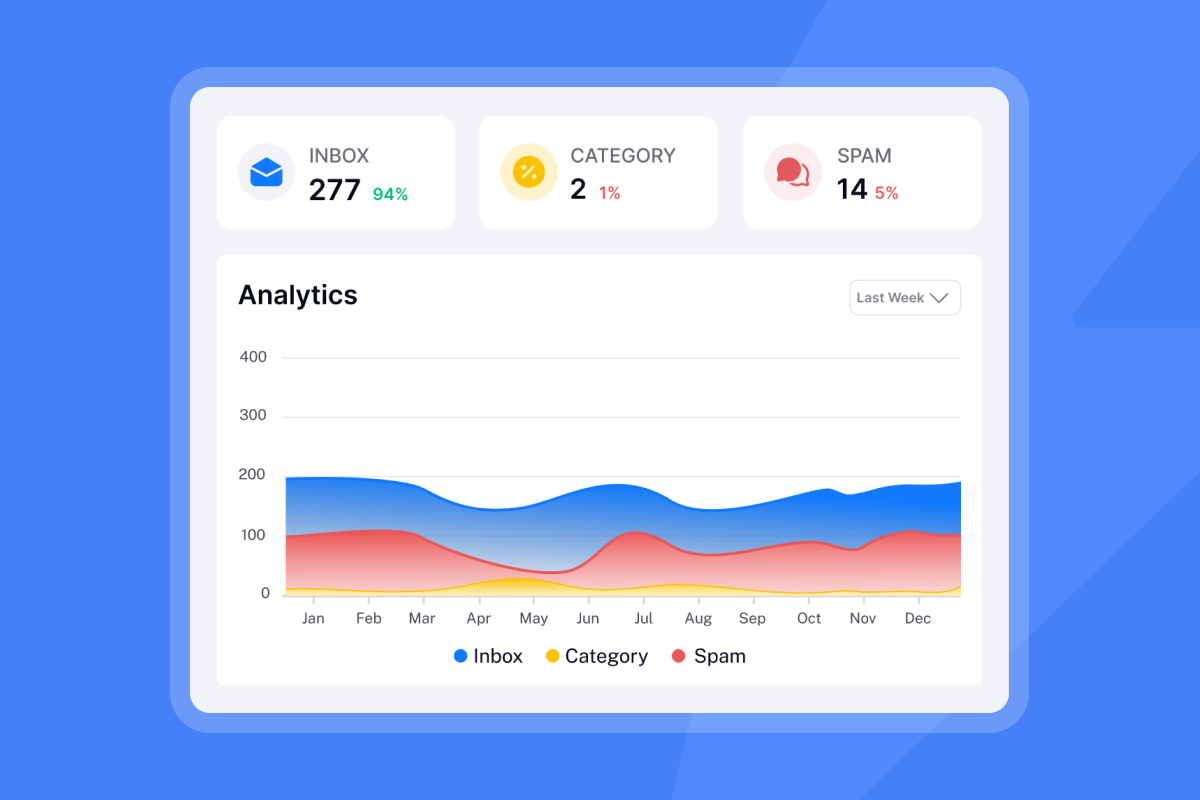
Instantly's Account Analytics dashboard tracks open rates, reply rates, and bounce rates across every connected inbox. The "Combined Score" metric weights open rate and reply rate into a single health indicator. According to the Analytics page, a Combined Score above 30 is a healthy signal once 100+ contacts have been reached in a campaign. Inbox Placement tests are available as a separate Inbox Placement subscription (not bundled into Outreach plans). The Hyper Inbox Placement tier includes automated recurring tests that check whether emails land in the inbox, promotions, or spam folders, monitor IPs and domains against 94 blacklists, and provide spam filter scores and content insights. One-time tests are available on lower Inbox Placement tiers, and a free one-time test is included to start. This gives your ops team verifiable pre-send data, not retrospective damage control.
Managing multi-channel sequences at scale
How each platform handles sequence execution and rep workflow standardization directly affects your team's output consistency and domain health.
Optimizing Artisan for rep productivity
Artisan's sequence builder is integrated into the Ava workflow. The platform is designed for straightforward onboarding, where users chat with Ava on a video call and follow a simplified UI to get a campaign live. There is limited documentation on how reps contribute to or override active sequences without disrupting Ava's execution model. LinkedIn automation, previously a core channel, was restricted in early 2026 over data-scraping concerns and later reinstated after Artisan cooperated with LinkedIn, but the mid-contract disruption is worth factoring into any annual commitment.
Instantly campaign execution workflow
Instantly's campaign engine handles sequence execution through Inbox Rotation, automatically distributing sends across all accounts assigned to a campaign. If you remove an account, another active account takes over immediately with no gap in delivery.
Instantly's Growth plan at $47/mo includes:
- A/Z testing: included on Growth, with the full 26-variant capability available on Hypergrowth ($97/mo) and above
- AI Sequence Writer: generate email sequences with AI assistance
- AI Spam Words Checker: highlights all the words that need to be replaced
- Advanced warmup options: weekday-only sending and read emulation
Standardizing rep workflows for 2026
Workspace-wide controls prevent reps from burning your domain:
- Company send limits: per-domain daily caps to prevent over-sending to a single organization
- Global Blocklist: workspace-wide domain and email blocking, checked at lead import
- AI Blocklist Triggers: automatic blocklisting based on unsubscribe status is available on all plans.
Status-based and reply-content-keyword blocklisting require Hypergrowth and above. Per Instantly's 2026 benchmark data, consistent senders achieve 15-20% higher reply rates than irregular ones. Standardized team workflows deliver that consistency.
How 2026 tools handle reply triage and inbox sync
Reply classification accuracy and inbox sync reliability determine how cleanly leads move from outreach to pipeline. Here is how both platforms compare.
Speed and accuracy of 2026 classifiers
Instantly's Unibox v2, released in March 2026, adds AI Sentiment Analysis, bulk actions, team-visible notes, persistent records after campaign deletion, and an "Attach Lead" function to reconnect stray replies. Unibox NLP auto-classifies incoming replies into custom labels across 50+ languages. Custom label selection is available on Hypergrowth and Light Speed. The Out-of-Office Resume (AI Smart Pause) extracts return dates from OOO replies, pauses the lead automatically, and resumes outreach on the stated date. It is included on all plans at no extra cost.
Artisan supports both Autopilot and Copilot modes for reply handling. In fully autonomous mode, replies are handled automatically unless you have manually configured human review steps. For brand-sensitive verticals, that gap matters.
Ensuring lead handoff accuracy
Unibox v2 lets reps add team-visible notes, view persistent records even after a campaign ends, and triage leads without losing context between handoffs. This maps directly to clean AE handoffs and reliable CRM sync, which is what your pipeline reporting depends on.
Standardizing lead data and CRM workflows
Clean data handoffs between your outreach tool and CRM are what turn reply rates into pipeline. Here is how each platform connects.
Real-time CRM connectivity options
Instantly's Automations is a visual, node-based workflow tool that supports bidirectional sync with HubSpot and Pipedrive. You can trigger Instantly actions from HubSpot contact and deal changes, or create HubSpot tasks and notes automatically when a lead replies or a campaign completes. Copilot can build Automations from natural language, converting requests like "when a lead replies, create a contact in HubSpot" into working workflows you review and activate.
Native connections also include Slack, Clay (requires Explorer Tier or higher), Make, Zapier, and Pabbly. Artisan offers native HubSpot sync, with activity flowing into the contact timeline automatically, though how autonomous agent activity maps to actual email-send records in ops reviews is not clearly documented.
The practical approach: create a trigger that fires when Unibox NLP classifies a reply as "Interested," then creates a HubSpot contact and deal automatically. Your AEs get a single source of truth without manual data entry, and your ops team can audit every action in the execution history log inside Automations.
Value analysis of 2026 pricing and seat tiers
Pricing structure determines how costs scale with team size and channel changes. Here is what each platform's billing model means for your budget.
Predictable billing for Artisan users
Artisan does not publish list pricing for most tiers. Based on third-party contract data, costs vary considerably depending on lead volume and seat count. Annual contracts are standard with limited cancellation options.
That pricing structure means:
- Rep turnover leaves you paying for unused seats until renewal
- Channel disruptions reduce value without reducing cost
- Budget validation requires multi-quarter commitment before you can prove ROI
Flat fee vs. usage billing options
Instantly's Outreach plans include unlimited email accounts and warmup on every tier. There is no per-seat tax as you add reps or inboxes.
Plan | Monthly price | Annual price | Key limits |
|---|---|---|---|
Growth | $47/mo | $37.60/mo | 5,000 emails/mo, 1,000 contacts. Unibox requires Hypergrowth |
Hypergrowth | $97/mo | $77.60/mo | 125,000 emails/mo, 25,000 contacts |
Light Speed | $358/mo | $286.30/mo | 500,000 emails/mo, 100,000 contacts. SISR included |
Enterprise | Custom | Custom | Custom |
Instantly Credits (powering Instantly's AI agents) run on a separate subscription starting at $9/mo for 150 credits. The AI Reply Agent and AI Sales Agent each cost 5 credits per action, which keeps AI spend visible and auditable. The Deliverability AI Agent is included in Outreach plans at Hypergrowth and above at no credits cost.
Calculating true cost per opportunity
Instantly's three core plans can be purchased independently and used together:
- Outreach Growth: $47/mo
- Credits Growth: $47/mo
- CRM Growth: $47/mo
- Combining to roughly $141/mo with no annual lock-in required
At Instantly's platform average reply rate of 3.43%, 5,000 emails per month produces roughly 172 replies. Convert 20% of replies to meetings and you reach approximately 34 meetings per month at a cost-per-meeting well under $10 on the starter stack. At Artisan's median contract value and a comparable meeting count, the math favors Instantly by a clear margin for teams already running a validated cold outreach motion.
Key decisions for your 2026 sales stack
Three questions come up most when sales leaders evaluate these platforms. Here is how each one maps to Artisan and Instantly.
Inbox placement reliability 2026 review
If your emails land in spam, AI capabilities do not matter. Artisan's autonomous model introduces domain risk because sending volume, timing, and content are all controlled by the agent. Instantly's infrastructure model puts domain health tools directly in your hands: warmup, inbox placement tests and the Deliverability AI Agent running every 24 hours. For sales leaders whose quarterly targets depend on consistent primary-inbox placement, that control difference is material.
Can I migrate active sequences?
Instantly stores all lead data in the workspace and supports CSV export at any time. If you cancel, you can export your contact lists, campaign history, and reply records before your account is deleted. Artisan's data portability depends on CRM sync depth and may require support team involvement to extract autonomous agent activity logs cleanly. Factor migration time into any annual contract evaluation.
Standardizing rep output: Artisan vs Instantly
Artisan standardizes through Ava's autonomous execution, which means consistency is only as good as the AI's judgment at a given moment. Instantly standardizes your team's output through shared templates, workspace rules, sequence governance settings, and rep-level send limits you define. Sales leaders who have been burned by reps going off-script will prefer a system where the guardrails are explicit and auditable, not embedded inside an AI agent.
Are annual contracts required for 2026?
Instantly offers flexible monthly plans with a 14-day free trial requiring no credit card. You can cancel each subscription type (Outreach, Credits, CRM, Website Visitors) independently at any time. Annual plans carry a discount on Outreach, CRM, and Credits tiers. Artisan's standard terms are annual commitments paid upfront with limited cancellation options. If you want to validate cold email ROI with a 30-day POC before committing budget, Instantly's monthly structure supports that cleanly.
Ask any vendor for their current DPA and sub-processor list before signing an enterprise deal.
What to ask your vendor before signing:
- Can you provide a current DPA and sub-processor list?
- What is your process for notifying customers of a data breach?
- How do you handle GDPR data subject access requests for lead data?
- What are your cancellation terms and data export options?
Start your 14-day free trial with no credit card required to test Outreach and CRM capabilities against your actual pipeline goals. Then read Instantly's 2026 Cold Email Benchmark Report to align your team's reply rate and meeting targets with what top-quartile senders actually achieve.
FAQs
What is the platform average reply rate for Instantly in 2026?
According to Instantly's 2026 benchmark report, the platform average reply rate is 3.43%, with top-quartile senders achieving 5.5% or higher and the top 10% reaching 10.7%+. These are performance ranges from consistent senders, not guaranteed outcomes.
Does Instantly require annual contracts?
No. Instantly offers flexible monthly plans alongside a discount for annual commitments on Outreach and CRM, and each subscription type can be cancelled independently. The 14-day free trial requires no credit card.
How many emails should I send per single inbox per day?
Do not scale past 30 campaign emails and 10 warmup emails per single inbox per day. Scale horizontally with more inboxes rather than pushing higher volume through fewer accounts.
How does Artisan's pricing compare to Instantly for a 10-rep sales team?
Artisan does not publish list pricing for most tiers, and costs vary based on lead volume and seat count, with annual contracts standard. Instantly's Hypergrowth Outreach plan ($77.60/mo annual) plus a Credits tier and CRM keeps costs predictable with no per-seat charges as your headcount changes.
Key terms glossary
SISR (Server and IP Sharding and Rotation): An automated deliverability system on Instantly's Light Speed plan that rotates dedicated servers and private IP pools to isolate sender reputation across high-volume sending workspaces.
Deliverability AI Agent: An always-on monitoring tool on Hypergrowth and Light Speed plans that audits DNS health, blocklists, warmup scores, and bounce rates every 24 hours, with one-click remediation options.
Unibox NLP: An AI-powered reply classifier that automatically tags incoming emails into custom sentiment and interest labels across 50+ languages. Custom label selection requires Hypergrowth or Light Speed.
BounceShield: An automated safety feature that analyzes bounce data in real-time to automatically skip any known high-risk recipients. The separate high bounce auto-pause triggers at 5% bounce rate after 200 sends.
Combined Score: Instantly's Account Analytics metric that weights open rate and reply rate into a single inbox health indicator, with a score above 30 indicating healthy performance once 100+ contacts have been reached.
Read next
- Best outbound sales software for B2B GTM teams: Instantly's 2026 guide: A breakdown of the top outbound sales tools for B2B teams in 2026, covering features, pricing, and what to prioritize at each stage of pipeline growth.
- AI SDR technical breakdown: how it works (2026): A technical look at how AI SDR platforms source leads, generate copy, and manage replies, with a clear-eyed view of where autonomous execution introduces risk.
- Best AI SDR tools for outbound B2B sales in 2026: top platforms compared: A side-by-side comparison of the leading AI SDR tools for outbound B2B sales, evaluated on deliverability, automation controls, CRM sync, and pricing transparency.


