.svg)
%20(1).svg)


Updated August 3, 2026
TL;DR: For teams bottlenecked on deliverability and pricing predictability, Instantly is the most purpose-built option on this list, combining unlimited email accounts, built-in warmup at scale, and flat-fee pricing that does not compound with headcount. Smartlead fits high-volume email-only teams that source contacts externally. Reply.io handles multichannel sales sequences. Lemlist works best for low-volume personalized campaigns. Apollo.io leads on contact database quality. Outreach and Salesloft are enterprise-grade choices for large organizations with dedicated ops budgets. We rate each platform honestly on deliverability systems, pricing predictability, and team-level workflow control.
Artisan and similar autonomous AI SDR tools fail on infrastructure, not intelligence. Generic machine-generated outreach sent at high volume from poorly managed domains drives spam complaints up and sender reputation down. Sales leaders report sending hundreds of emails and receiving zero replies, with domains flagged before they realize the platform treated deliverability as an afterthought. If you are weighing AI BDR options too, see our list of top AI BDR tools in 2026.
This guide evaluates seven artisan alternatives for B2B sales teams as part of a comparison of top AI SDR tools, comparing them on deliverability systems, pricing predictability, and workflow standardization.
Why sales leaders are leaving Artisan
Autonomous AI SDRs promise a simple value proposition: plug in your ICP, let the AI source leads, write emails, and book meetings without hiring. In practice, sales leaders hit a hard wall. Deliverability bottlenecks, unpredictable billing, and rigid playbooks with no room for human intervention are the three friction points driving the most migration. Instantly offers an AI sales agent for B2B outbound built on the deliverability infrastructure this guide evaluates.
Avoiding unpredictable platform fees
Artisan's pricing is opaque. Sales leaders burned by annual lock-ins at Outreach or Salesloft won't sign another contract without clear per-unit economics. The fear is legitimate, and any AI BDR tool for outbound teams should show its unit economics upfront. Some enterprise platforms charge $2,000 to $10,000 in data export fees at cancellation, and others run automatic renewals with minimal notice.
Here is a realistic picture of what top-performer benchmarks look like, based on Instantly's 2026 Cold Email Benchmark Report (data from Jan 1 to Dec 18, 2025, across billions of interactions):
Use these benchmarks to estimate potential meetings from your monthly send volume. Top-quartile results require clean lists, proper warmup, and consistent sending patterns.
Cost-per-meeting ROI benchmarks
Sending volume (monthly) | Reply rate tier | Est. replies | Est. meetings |
|---|---|---|---|
5,000 emails | Avg (3.43%) | 172 | 34 |
5,000 emails | Top quartile (5.5%+) | 275+ | 55+ |
5,000 emails | Top 10% (10.7%+) | 535+ | 107+ |
25,000 emails | Avg (3.43%) | 858 | 172 |
25,000 emails | Top quartile (5.5%+) | 1,375+ | 275+ |
Consistent, stable sending patterns produce 15-20% higher reply rates than irregular sending. Est. meetings uses 20% as an illustrative midpoint. Industry benchmarks for reply-to-meeting conversion range from 15-30% depending on ICP fit, offer, and follow-up quality. These are reference benchmarks, not guaranteed outcomes.
Difficulty scaling outreach playbooks
Artisan's fully autonomous mode removes human control at the points where control matters most. When a lead replies ambiguously, when spam signals appear, or when a key account needs custom intervention, you cannot step in. Rigid AI sequences that auto-send replies without human review create brand risk that is hard to undo once a poorly timed email reaches a CFO.
How we stress tested every Artisan competitor
Evaluating these platforms required looking beyond feature lists, the same principle behind our AI BDR platform scoring framework. The criteria that matter to sales leaders managing 3 to 15 reps are ramp time, CRM integration complexity, and security posture. We tested each platform on those three axes alongside deliverability infrastructure and pricing.
Matching tools to specific workflows
We evaluated additional platforms that come up in the artisan alternatives conversation, building on our broader Artisan vs AI SDR tools comparison. Longer ramp times reflect stricter warmup requirements before full campaign volume is safe.
Sales leader's decision matrix
Platform | Ramp time | CRM integration | Compliance posture |
|---|---|---|---|
Instantly | 2-4 weeks (warmup) | Native HubSpot, Zapier, Make | DPA published, sub-processor list available |
11x.ai | 30+ days (requires ~25% dedicated team oversight) | Native HubSpot and Pipedrive (bi-directional sync). Full API | Standard SaaS terms |
Salesforge | 2-3 weeks | HubSpot, Pipedrive via API | Standard SaaS terms |
Instantly requires a minimum two-week warmup period before campaigns go live, with a health score above 90% before adding new domains to active campaigns.
Benchmarking domain safety features
We evaluated each platform on four deliverability infrastructure criteria: warmup pool size and quality, bounce protection (does it auto-skip risky addresses?), automated pause triggers (does it stop campaigns at defined thresholds?), and IP rotation (dedicated infrastructure or shared?).
Standardizing workflows across teams
Admin controls, global blocklists, shared templates, and team-level reporting separate "a tool one rep uses" from "a process the whole team runs." Platforms without these controls create a governance gap that leads to reps going rogue with unsafe send volumes and domains that aren't properly warmed.

1. Instantly - built for deliverability-first teams
Best for: Deliverability-first teams, scaling agencies, and sales orgs with 3-15 reps who need unlimited inboxes on a flat fee.
Instantly commits to a principle the rest of this list treats as optional: deliverability is infrastructure, not a feature. Every plan includes unlimited email accounts and unlimited warmup, which means you scale volume by adding inboxes, not by raising per-inbox send rates past safe limits. Cap campaign sends at 30 emails per inbox daily and add more inboxes to grow total volume.
Scaling without domain bans and protecting sender reputation
Instantly's Inbox Rotation distributes sends automatically across all accounts assigned to a campaign. Assign 10, 20, or 50 inboxes to a single campaign and the platform rotates sends so no single inbox exceeds safe daily limits. The warmup pool covers 4.2 million active accounts, all simulating authentic engagement to build ESP trust gradually.
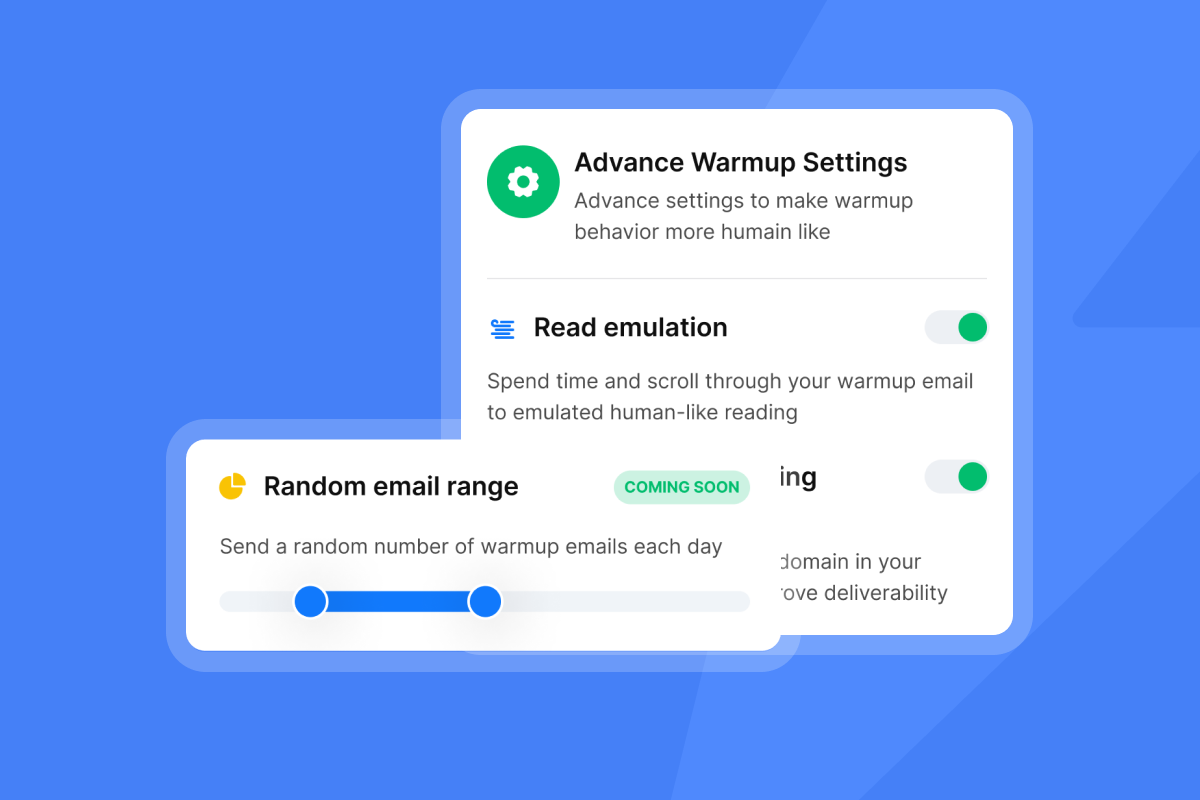
The Deliverability AI Agent runs automatically every 24 hours on Hypergrowth and above plans. It monitors DNS health, blocklist status, warmup scores, bounce rates, and campaign copy, then surfaces specific one-click fixes such as pausing campaigns, replacing risky accounts, or rebalancing sending across providers.
BounceProtect auto-skips known high-risk recipients before they count against your bounce rate. The high-bounce auto-pause triggers on any campaign that exceeds 5% bounces after a minimum of 200 sends.
"SuperSearch makes prospecting simple, and email verification helps maintain data quality. The campaign automation is intuitive and powerful, and the inbox centralizes replies from multiple inboxes, making conversations much easier to manage." - Verified user on G2
Clear pricing for predictable ROI
The Outreach Growth plan costs $47/month and includes unlimited accounts, unlimited warmup, A/Z testing, AI Sequence Writer, and AI Spam Words Checker. Hypergrowth costs $97/month and adds the Deliverability AI Agent and 125,000 emails per month. Light Speed at $358/month adds SISR, which distributes your sending volume across dedicated, private server and IP pools.
A 14-day free trial activates automatically on signup with no credit card required, and includes 250 uploaded contacts and 1,000 emails. Review the full outreach plans comparison to match the right tier to your sending volume.
Centralized team controls and known limitations
The Global Blocklist lets admins block entire domains or addresses workspace-wide, applied at import time via CSV, manual entry, or live Google Sheets sync. Combined with custom send windows and AI Spintax Writer for copy variation, this gives sales ops a consistent governance layer across every rep's campaigns. The AI Smart Pause feature detects out-of-office replies automatically and pauses the sequence until the lead's stated return date.
On limitations: Instantly does not offer native LinkedIn messaging. You can route LinkedIn leads through the Automations builder using third-party connectors like HeyReach, but there is no in-app LinkedIn sequence step. On compliance, Instantly publishes a Data Processing Agreement and detailed data-category restrictions. Enterprise buyers with formal security requirements should request current attestations directly from the vendor.
2. Smartlead - best for cold email at scale
Best for: High-volume email-only teams that prioritize API flexibility over integrated data.
Smartlead's Base plan starts at $39/month and caps contacts at 2,000 with 6,000 email sends per month. Unlimited contacts are available only on the Smart plan at $174/month and above. It includes built-in warmup and IP rotation, making it a credible deliverability-focused tool for developer-led teams.
Managing sender pools for deliverability
Smartlead's sending infrastructure handles warmup and IP rotation well. The master inbox consolidates replies across connected accounts, though it does not include the AI sentiment analysis and bulk actions that Unibox v2 offers. Campaign-level reporting covers opens, replies, and bounces, but team-level rep performance tracking is less detailed than what RevOps leaders need for quota accountability.
Strategic gaps in scaling
Smartlead added SmartProspect in 2026, an in-platform B2B lead database with 300M+ verified profiles. On the Base and Pro plans it is a $59/month add-on. On the Smart and Prime plans it is included free. For teams that prefer to keep data and sending in separate, purpose-built tools, the add-on structure on lower tiers still applies.
3. Reply.io - scalable outreach across every channel
Best for: Multichannel sales teams running coordinated email, LinkedIn, and voice sequences.
Reply.io's Multichannel plan starts at $99 per user per month on monthly billing, or $89 per user per month on annual billing, and covers email, LinkedIn, and call sequences within a single workflow. LinkedIn and calls are paid add-ons on the lower-tier Email Volume plan ($69/month per LinkedIn account, $29/month per calls account). For enterprise accounts where a multi-touch approach makes sense, this is a workable setup, though per-user pricing means team costs compound with headcount.
Managing LinkedIn and call sequences
Reply.io lets you build sequences that coordinate email, LinkedIn connection requests, LinkedIn messages, and phone calls in a defined order. This fits account-based marketing (ABM) campaigns against defined target accounts, not broad-reach outbound where the operational overhead compounds quickly. Multichannel sequences make the most sense when each account justifies the effort of coordinating across multiple touchpoints.
Avoiding hidden fees and lock-ins
Reply.io prices per seat. A 5-rep team at the Scale tier runs well over $1,000/month. Each new hire adds to the software cost directly, in a way that flat-fee platforms do not. For growing teams, that per-seat structure compounds every time you hire, as our AI BDR pricing guide shows.
4. Lemlist - ideal for custom outreach workflows
Best for: Highly personalized, lower-volume campaigns where visual customization improves reply rates.
Lemlist's Email plan starts at $69/month (or $55/month on annual billing) and includes Lemwarm, its native email warmup feature, bundled into every paid plan. Its Multichannel plan costs $109/month per user (or from $87/user/month on annual billing) and includes LinkedIn, SMS, and call automation alongside unlimited emails and messages.
Automating personalized visual outreach
Lemlist's core capability is inserting personalized images, screenshots, and short videos into cold email at scale. You can auto-generate images with a lead's name on a whiteboard or their LinkedIn profile photo in a custom template. This works well for ABM campaigns and ICP lists under 500 contacts per month where each email justifies the personalization overhead. The deliverability infrastructure, however, does not match the private warmup network scale or automated IP rotation that high-volume teams need at 5,000+ sends per month.
Per-seat costs at team scale
Lemlist's multichannel plan for a 3-person team runs $327/month. Each additional mailbox beyond the plan's included allotment costs extra. For teams scaling beyond a handful of inboxes, those add-on costs accumulate in ways that unlimited-account platforms avoid.
5. Apollo.io - best for lead data accuracy
Best for: Data-driven teams that need a large, accurate B2B database integrated with their outbound tool.
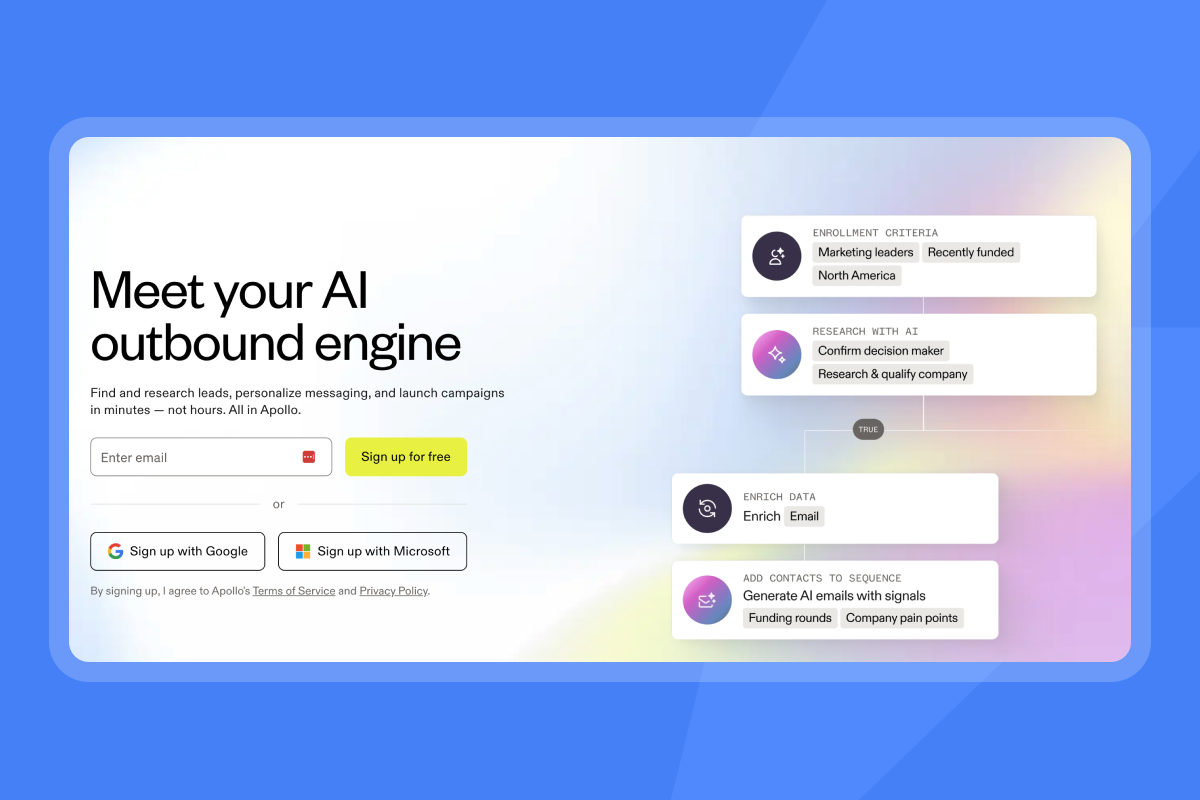
Apollo prices at $65/month (Basic), $99/month (Professional), and $149/month (Organization, minimum 3 seats) on monthly billing, with annual rates of $49, $79, and $119 per month, respectively. It combines a large contact database with built-in outreach, which reduces context switching for teams focused on prospecting accuracy rather than high-volume sending.
Verified data and contact accuracy
Apollo's B2B database covers 240M+ verified contacts and uses a 7-step email verification process with a built-in accuracy rate of 91%. For teams where finding the right verified contact is the primary bottleneck, not deliverability at scale, Apollo's data quality justifies its price. The combination of search, intent signals, and built-in sequence automation keeps the workflow compact.
Technical guardrails for outreach
Apollo's per-seat pricing means a 10-rep team on the Professional plan costs $990/month for the tool. Credits expire each billing cycle, so unused research credits are lost. Apollo includes a Deliverability Suite and Email Warmup feature across its paid plans. Professional and Organization plans offer unlimited Google or Microsoft mailboxes, plus 5 SMTP mailboxes per user on Professional and 15 per user on Organization. Basic is limited to 1 mailbox per user total. While Apollo provides warmup and inbox rotation capability, its infrastructure differs from dedicated warmup networks like Instantly's 4.2 million-account pool, which matters for high-volume teams that need large-scale deliverability support.
6. Outreach - the secure choice for RevOps teams
Best for: Enterprise RevOps and large sales organizations with dedicated operations support and formal security requirements.
Outreach no longer publishes specific per-user pricing. All four tiers (Amplify Essentials, Amplify Core, Amplify Plus, Amplify Pro) require a pricing request, and costs combine seat-based access with consumption-based AI credits usage that scales with team size and activated workflows. Implementation fees vary depending on team size and workflow complexity. This custom-quote structure and enterprise-grade packaging place total first-year costs well above most mid-market budgets.
Ensuring data security and privacy
Outreach holds formal compliance certifications that matter for enterprise security reviews and regulated industries. The platform's sequence governance is built for large, complex sales motions with multiple stakeholders and formal playbook enforcement across 20+ reps. This is a genuine differentiator versus earlier-stage platforms that have strong operational features but fewer formal compliance attestations.
Financial impact of scaling Outreach
Annual-only contracts and long implementation timelines make Outreach cost-prohibitive for lean teams. Per-seat enterprise pricing for a small sales team versus flat-fee platforms like Instantly Hypergrowth ($97/month) represents a major cost gap for comparable core outbound functionality. The complexity pays off only if you need the full enterprise governance layer.
7. Salesloft - standardized workflows for sales ops
Best for: Established sales teams with dedicated sales operations and a need for formalized SDR-to-AE handoffs.
Salesloft no longer publishes specific per-user pricing. Its two tiers, Advanced and Elite, both require a demo and custom quote, positioning it alongside Outreach as an enterprise sales engagement platform with costs above most mid-market budgets. The platform offers strong call intelligence and conversation analytics.
AI-driven call and reply analysis
Salesloft's conversation intelligence analyzes call recordings and email replies to surface coaching insights, objection patterns, and deal risk signals. The platform standardizes the SDR-to-AE handoff more formally than any tool on this list, reducing the "lost in translation" problem when a hard-won reply does not convert to a booked meeting. For sales managers who need structured coaching workflows and call-level analytics, this is a meaningful capability that pure email tools do not offer.
Budgeting for platform scalability
Salesloft's add-ons and implementation costs stack up fast. Total cost of ownership at mid-market scale places it well above the budget threshold for most teams below 50 reps, especially when you account for ongoing admin time and training.
Selecting the right Artisan alternative for your SDRs
The decision comes down to where your bottleneck sits, detailed further in our Instantly vs Artisan comparison. Most teams below 200 employees are bottlenecked on deliverability and pricing, not enterprise governance.
Compare core infrastructure features across all seven platforms. Flat-fee pricing and unlimited accounts prevent compounding software costs as your team scales.
Feature comparison across all 7 alternatives
Platform | Unlimited accounts | Built-in warmup | Integrated database | Multichannel | Flat-fee pricing |
|---|---|---|---|---|---|
Instantly | Yes | Yes (4.2M+ network) | Yes (450M+ contacts) | Email (base), calling/SMS via Hyper CRM | Yes |
Smartlead | Yes | Yes | No | Email only | Yes |
Reply.io | Yes | Yes | No | Yes | No (per seat) |
Lemlist | No | Yes (bundled) | Yes (all paid tiers, 650M+ contacts) | Yes | No (per seat) |
Apollo.io | Yes (Google/Microsoft) | Yes (via third-party engine, select plans) | Yes | Email + calls | No (per seat) |
Outreach | No | No | No | Yes | No (per seat) |
Salesloft | No | No | No | Yes | No (per seat) |
Standardizing outreach for team compliance
Watch for these red flags in any AI SDR platform you evaluate:
- No audit logs: If you cannot see what emails went out and when, you cannot reconcile against CRM or investigate deliverability incidents.
- Annual-only contracts: This removes your ability to exit if deliverability or product quality degrades.
- No CRM reconciliation: If the reply count in the tool does not match what lands in HubSpot, your pipeline reporting is unreliable.
- Browser extension-based LinkedIn automation: These automate actions through the browser, which violates LinkedIn's terms and creates account suspension risk.
- Shared deliverability infrastructure: If the platform cannot tell you whether you're on shared or dedicated IPs, treat it as shared.
High-volume sending for sales teams
For teams sending 5,000 to 125,000 emails per month, the flat-fee model with unlimited accounts avoids a per-unit tax as you grow. Scaling from 5 inboxes to 25 on Instantly adds zero cost, while scaling from 5 reps to 10 on a per-seat platform doubles your software line item and compounds over 12 months.
The AI Sales Agent handles autonomous lead sourcing and sequence execution for teams that want AI-assisted prospecting without fully removing human oversight. It supports human-approval and full Autopilot modes, so you control how much autonomy the AI gets.
Prioritizing CRM integration and data handoffs
Instantly's HubSpot integration connects through the Automations builder, where HubSpot contact and deal changes can trigger Instantly actions and Instantly replies can create HubSpot contacts, tasks, and notes. Basic lead imports are one-directional natively. For full bidirectional sync, build the flow in the Automations builder or use Zapier.
What leaders ask before replacing Artisan
Migration risk is the top objection we hear from sales leaders evaluating a platform switch. The biggest risks are data loss, deliverability gaps during transition, and wasted time on a tool that underperforms. Here is how to de-risk each one.
Preventing data loss when switching
Before you cancel Artisan or any platform, export three assets: your full lead list with historical status data, your bounce history (blocklist these hard bounces in your new platform immediately), and your active email templates. Load the bounce history into your new platform's Global Blocklist on day one.
Migration timeline and deliverability continuity
A realistic migration runs 4 to 12 weeks from signup to first campaign launch, depending on team size, domain count, and CRM workflow complexity. Week one covers DNS setup (SPF, DKIM, DMARC), account connection, and warmup activation. Weeks two through four cover the core warmup period, with campaign-ready status confirmed by a health score above 90%. Teams migrating from enterprise platforms with complex CRM integrations, custom sequence libraries, or multiple sending domains should budget toward the higher end of that range.
Do not cancel your existing warmup when you start the new platform. Run both warmup pools in parallel for at least two weeks. Start sending on new domains at low volume (5-10 emails per inbox per day) and ramp gradually to avoid triggering spam filters during what should be a routine switch. The Instantly cold email strategy guide walks through the full ramp methodology.
Evaluating platforms via paid pilots
Run a 30-day proof of concept with a small subset of domains before migrating the entire team. A 3.43% reply rate sits at the industry average for cold email in 2026, per Instantly's 2026 benchmark report. Top performers in the top 10% reach 10.7%+ on clean, well-targeted lists, per Instantly's 2026 benchmark report. A bounce rate below 2% is a sound threshold to maintain. Instantly's high-bounce auto-pause triggers at 5% after 200 sends, but staying below 2% keeps you well clear of that threshold. Use these as your pilot evaluation benchmarks, not ceilings. Set success thresholds upfront based on industry benchmarks and your current performance baseline. Keep warmup running on your old domains throughout the pilot so you have a fallback if the new platform underperforms.
"Instantly has been everything I needed so far. Only been active for a short time, but it makes cold email outreach so much easier. They basically do everything for you once it is all set up. Def the best cold email platform out there." - Michael Lieberman on Trustpilot
Try Instantly free for 14 days with no credit card required. The trial includes 250 uploaded contacts and 1,000 emails, enough to test your warmup setup, validate domain health, and run your first sequence. Read Instantly's 2026 benchmark report to calibrate your reply rate targets and optimize sequence length before your first campaign goes live.
FAQs
How much does Instantly cost for unlimited accounts?
Instantly's Outreach plans start at $47/month for Growth and $97/month for Hypergrowth, and both include unlimited email accounts and unlimited warmup across all connected inboxes. Annual billing brings Growth down to $37.60/month and Hypergrowth down to $77.60/month.
What is the recommended daily sending limit per email account?
Cap campaign sends at 30 emails per inbox per day to protect sender reputation. Add more inboxes to increase total daily volume rather than raising per-inbox send rates, and run 10 warmup emails per inbox per day alongside campaign sends.
Does Instantly offer a free trial?
Yes. Instantly activates an automatic 14-day free trial upon signup with no credit card required. The trial includes 250 uploaded contacts and 1,000 emails, plus access to warmup, AI tools, and campaign setup.
Can I run Instantly and another platform in parallel during migration?
Yes. Run warmup on both platforms for at least two weeks during your transition, and start campaigns on new domains at low volume (5-10 emails per day) before ramping to full throughput. This protects sender reputation during the switch and gives you a fallback if the new platform needs adjustment.
Key terms glossary
SISR (Server and IP Sharding and Rotation): An advanced deliverability architecture on Instantly's Light Speed plan that automatically distributes sending volume across dedicated, private servers and IP pools. This isolates sender reputation across sending environments to protect domain health at high volume.
Unibox: A centralized inbox in Instantly that aggregates replies from all connected sending accounts into one interface. Unibox v2, released March 12, 2026, adds AI sentiment analysis, bulk actions, team-visible notes, and an "Others Folder" for non-lead replies.
BounceProtect: An automated safety feature in Instantly that skips high-risk email addresses based on real-time and historical bounce data. It operates by default and is configured via Settings rather than requiring manual configuration per campaign.
SuperSearch: Instantly's integrated B2B lead database with over 450 million contacts, waterfall enrichment across multiple provider partners, and buyer-intent signal filters updated with approximately 5.8 million new signals per week.
Inbox Rotation: A sending architecture in Instantly where all email accounts assigned to a campaign automatically share the sending load. If you remove one account, the platform reassigns its volume to the remaining active accounts without manual intervention.
Read next
- How to fix email deliverability issues in your outbound sales platform: Steps for diagnosing and resolving deliverability problems, from DNS configuration gaps to bounce rate management and warmup recovery.
- AI BDR for agencies: evaluating platforms for multi-client outreach: A framework for agency operators choosing between dedicated sending infrastructure options when managing outreach across multiple client domains.
- AI BDR vs human SDR: when automation makes sense and when it doesn't: A practical breakdown of which outreach tasks benefit from AI automation and where human judgment still drives better outcomes.


